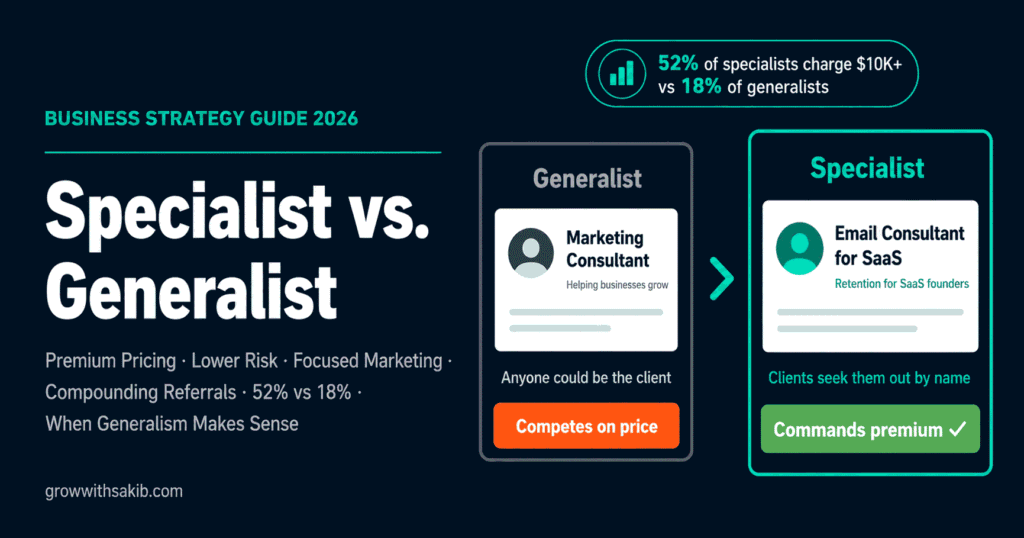
A specialist focuses on one type of client or problem; a generalist serves many. For most service businesses, specialising wins more clients because it signals expertise, lowers the buyer’s perceived risk, and justifies higher fees. Generalists compete on price and availability; specialists compete on trust and outcomes — which is the easier game to win.
“But if I niche down, won’t I lose all the other clients?” It’s the most common fear in service businesses, and it’s backwards. Narrowing your focus usually grows your client list, because being known for one thing makes you the obvious choice for the people who need exactly that. This article expands on why the pillar guide on finding the right niche treats specialisation as an advantage, not a limitation — and where the trade-offs actually lie.
Specialist vs. Generalist: What’s the Difference?
A generalist offers broad services to a wide range of clients — “a web designer,” “a marketing consultant,” “a copywriter.” A specialist focuses on a defined audience or problem — “a web designer for dental clinics,” “an email consultant for SaaS,” “a copywriter for fintech.” Same underlying skill; radically different positioning.
The distinction isn’t about what you can do — it’s about what you’re known for. A specialist can often perform general work; they simply choose to be famous for one thing. That reputation is the asset. As one industry framing puts it, a plain “graphic designer” is a commodity, while a “brand designer for SaaS companies” is a specialist clients seek out by name — and knowing the customer pain points of SaaS companies is what lets the specialist speak their language precisely.
Why Specialists Win More Clients (and Charge More)
It feels paradoxical: narrow your market, win more work. But the mechanism is straightforward once you see it. Four forces stack in the specialist’s favour.
1. Lower perceived risk
Hiring is risk. A client choosing between “a designer” and “a designer who’s built 40 dental websites” feels far safer with the second. Specialists reduce the buyer’s fear of a bad outcome, and lower risk closes deals. Clients pay experts more precisely because the perceived chance of failure is lower.
2. Premium pricing power
Specialisation commands higher fees, and the data backs it. A survey of nearly 1,000 consultants by Consulting Success found that 52% of specialists charge at least $10,000 per project, compared with just 18% of generalists. Specialists charge for the outcome and the expertise; generalists end up charging for hours.
3. Easier, cheaper marketing
When you know exactly who you serve, your message writes itself and lands harder. You can name the client’s specific problem in their own words — which is why a clearly defined target audience makes every piece of content more effective. Generalists shout into a crowd; specialists speak to a person.
4. Compounding referrals and reputation
Specialists become the obvious name in their niche, so referrals concentrate. “You need a Shopify expert? Talk to her.” That word-of-mouth compounds in a way it never can for a generalist, who is no one’s first specific recommendation — the mechanism behind this is niche topical authority, where consistent focus makes you the recognised expert both in search results and in referral conversations. Over time, the specialist stops chasing work and starts receiving it.
Specialist vs. Generalist: A Direct Comparison
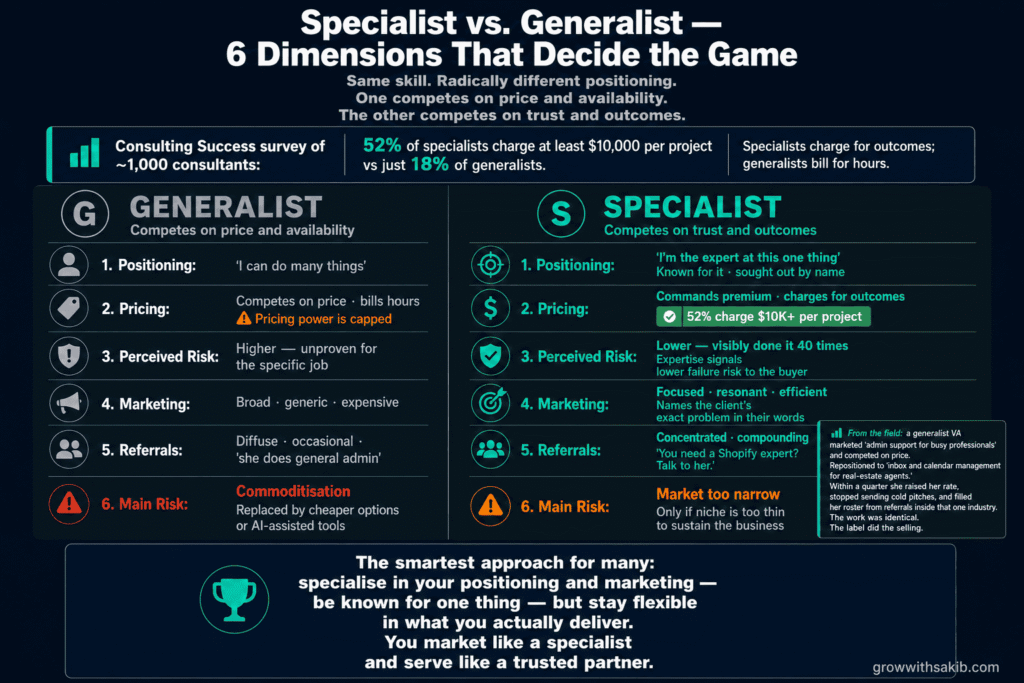
| Dimension | Generalist | Specialist |
|---|---|---|
| Positioning | “I can do many things” | “I’m the expert at this one thing” |
| Pricing | Competes on price; bills hours | Commands premium; charges for outcomes |
| Perceived risk | Higher — unproven for the specific job | Lower — visibly done it before |
| Marketing | Broad, generic, expensive | Focused, resonant, efficient |
| Referrals | Diffuse, occasional | Concentrated, compounding |
| Main risk | Commoditisation | Market shrinks if niche is too narrow |
When Being a Generalist Actually Makes Sense
Specialisation isn’t a universal law, and pretending it is would be dishonest. There are real situations where staying broad is the smarter call.
- You’re brand new and still discovering your niche. Early on, taking varied work helps you learn what you enjoy and what pays — the raw data you’ll later use to specialise. Use Google Trends for niche research to start reading the market signals before you commit.
- You operate in a thin local market. A rural handyman can’t niche to “only kitchen remodels” if the town won’t supply enough of them. Geography already narrows you.
- Your value is being a flexible, trusted partner. Some fractional and agency relationships are valued precisely for breadth across many needs.
The honest nuance: many successful service providers are specialised in positioning but flexible in delivery. They’re known for one thing, win clients through it, then expand the relationship. You market like a specialist and serve like a trusted partner — the best of both.
How to Niche Down Without Losing Opportunities
If specialising still feels scary, these moves lower the risk of narrowing.
- Specialise in positioning first, not in your contract. Lead your marketing with one niche; you can still accept good work outside it.
- Pick a niche with proven buying power. Narrowing only pays if the niche can pay — confirm it has real budget by validating market demand before you commit.
- Use your strongest, most-requested skill as the anchor. Build the specialism on what you already do best and get asked for most.
- Keep a “why me” line tied to a specific outcome. “I help X achieve Y” beats a list of services every time.
Choosing the right niche to specialise in is exactly what the broader process of finding your niche walks through, and confirming it can pay ties back to a niche’s buying power.
Common Mistakes When Choosing Specialist or Generalist
- Staying general out of fear. “Keeping options open” usually means competing on price forever.
- Niching into a market that can’t pay. A tight niche with no budget is worse than a broad one with money.
- Confusing your service with your positioning. You can narrow how you market without narrowing what you’re able to deliver.
- Niching too early with no data. Lock in before you know what you enjoy and what sells, and you may pick wrong — the right sequence is to validate a niche before building around it with live tests that prove people will pay.
- Picking a niche you’ll resent. Profitable but joyless specialisation rarely lasts; energy matters too.
Frequently Asked Questions
Is it better to be a specialist or a generalist?
For most service businesses, specialising wins. A specialist signals expertise, lowers the client’s perceived risk, and commands higher fees, while generalists tend to compete on price. The main exceptions are when you’re new and still finding your niche, operating in a thin local market, or valued specifically for broad, flexible support.
Do specialists really earn more than generalists?
Generally, yes. A survey of nearly 1,000 consultants by Consulting Success found 52% of specialists charge at least $10,000 per project versus just 18% of generalists. Specialists charge for expertise and outcomes; generalists more often bill for hours, which caps their pricing power.
Will niching down mean I lose clients?
Usually the opposite. Narrowing your positioning makes you the obvious choice for the people who need exactly what you do, so enquiries become more frequent and better qualified. You can also specialise in how you market while still accepting strong work outside your niche — narrowing your message, not your capability.
How do I choose a niche to specialise in?
Anchor on your strongest, most-requested skill, then confirm the niche has real buying power and a problem people pay to solve. Match your expertise to a market with budget and urgency. The full process of finding the right niche walks through each step in order.
Can I be a specialist and still take other work?
Yes — this is the smartest approach for many. Specialise in your positioning and marketing so you’re known for one thing, but stay flexible in delivery and accept good work that falls outside it. You market like a specialist and serve like a trusted partner, capturing the benefits of both.
When should a service business stay a generalist?
Stay broad when you’re new and still discovering what you enjoy and what pays, when your local market is too thin to support a narrow focus, or when clients value you specifically as a flexible, all-round partner. In these cases, generalism is a deliberate strategy rather than indecision — just revisit it as you gather data.
Key Takeaways
- A specialist focuses on one client type or problem; a generalist serves many — same skill, different positioning.
- Specialising usually wins more clients by signalling expertise and lowering perceived risk.
- Specialists command higher fees — 52% charge $10K+ per project versus 18% of generalists.
- Niching makes marketing cheaper and referrals compound around your name.
- Specialise in positioning first; you can stay flexible in what you actually deliver.
- Generalism is valid when you’re new, in a thin local market, or valued for breadth.
- Only niche into a market with real buying power — a tight niche with no budget is a trap.