Most digital businesses approach competitor research wrong. They check a competitor’s website, note their pricing, scan their social media followers, and call it done. That kind of surface-level observation tells you very little about why a business is actually growing — or where the real market opportunities are.
Effective competitor research goes far deeper. It helps you understand customer behavior, identify market gaps, uncover pricing psychology, analyse content strategies, and discover the real reasons customers choose one business over another.
According to CB Insights, 42% of startups fail because they build products or services that the market does not actually need — often because they never properly researched what competitors were already solving. A further 19% fail because they enter crowded markets without meaningful differentiation. Both problems are preventable with the right research process.
This guide gives you a complete, structured framework for conducting competitor research that goes beyond surface-level observation — including competitor types, a SWOT framework, the best tools for each research goal, and how to turn findings into strategic decisions.
What Is Competitor Research?
Competitor research is the structured process of analysing other businesses in your market to understand how they attract customers, communicate value, and position themselves — and to identify where opportunities exist that they are not addressing.
It is not about copying successful competitors. Copying creates businesses with no clear identity, weak differentiation, and no compelling reason for customers to choose them. The goal of competitor research is to understand the market so clearly that you can build something more useful, clearer, or more valuable than what already exists.
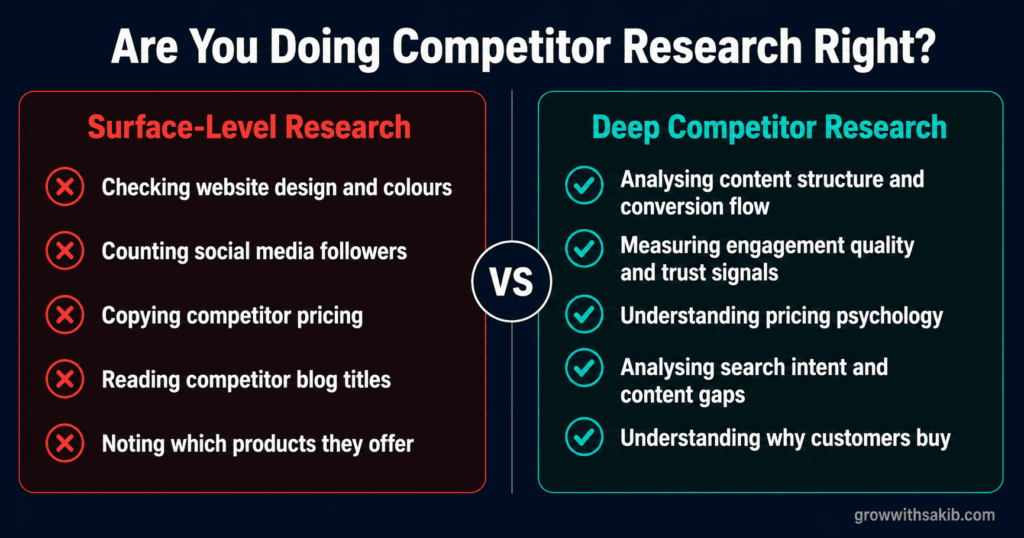
What effective competitor research covers
| Surface-level research (weak) | Deep competitor research (effective) |
|---|---|
| Checking website design and colours | Analysing content structure, UX, and conversion flow |
| Counting social media followers | Measuring engagement quality and audience trust signals |
| Copying pricing | Understanding pricing psychology and perceived value |
| Reading competitor blog titles | Analysing search intent, content gaps, and keyword strategy |
| Noting which products they offer | Understanding why customers buy and what problems they solve |
Why Competitor Research Matters for Digital Businesses
In competitive digital markets, the businesses that make the best decisions are usually the ones with the deepest market understanding — not the largest budgets. Competitor research is how smaller businesses close that gap.
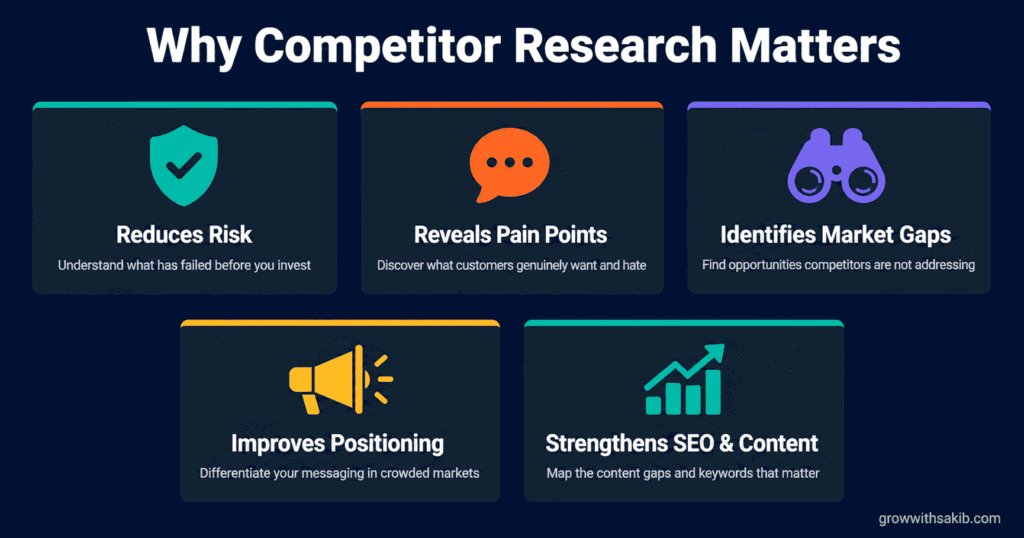
Reduces risk and prevents costly mistakes
Competitor research helps you understand what has already been tried, what has failed, and what customer expectations actually look like in your market — before you invest time and money building in the wrong direction. Around 20% of businesses struggle because competitors move faster or build stronger positioning. Most of that gap is an information problem, not a talent problem.
Reveals customer pain points and buying behavior
Customer reviews, complaints, and community discussions around competitors reveal what people genuinely want, what frustrates them, and why they choose certain brands. This intelligence directly improves your messaging, offers, and positioning in ways that internal brainstorming rarely achieves.
Identifies market gaps and opportunities
Every competitor has blind spots — audiences they ignore, problems they solve poorly, or content areas they have never covered. Structured competitor research makes those gaps visible. Businesses that identify and fill gaps early build a lasting advantage because they are solving problems others are not addressing.
Improves brand positioning and messaging
When you understand how competitors communicate, you can identify where they all sound the same — and position your business differently. In crowded digital markets, differentiation in messaging often matters more than differentiation in the product itself.
Builds stronger content and SEO strategy
Understanding which content performs best for competitors, which keywords they rank for, and where their content is thin gives you a clear map for creating content that ranks, attracts the right audience, and builds topical authority faster.
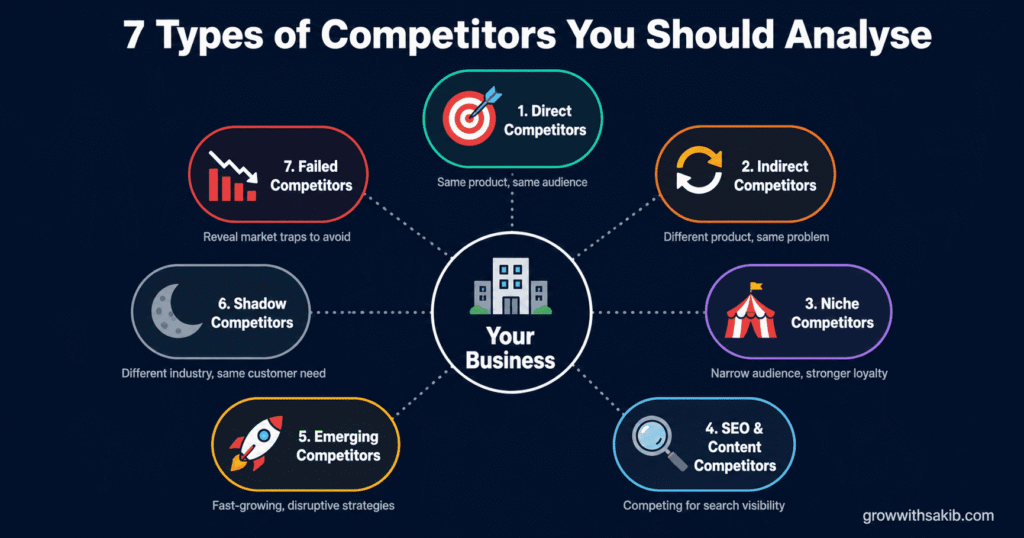
7 Types of Competitors You Should Analyse
Most guides cover only direct and indirect competitors. That gives you an incomplete picture. Here are all seven types worth analysing — each one reveals different market insights.
How to Research Competitors: An 8-Step Framework
Effective competitor research follows a structured process. Work through these steps in order — each one builds on the last and produces more useful insights than random observation.
Step 1 Define your research goal
Without a clear goal, competitor research becomes random data collection that creates confusion instead of insight. Before you start, define exactly what you want to learn.
| Research goal | What to focus on |
|---|---|
| Improve SEO performance | Keywords, content gaps, backlink strategy, topic clusters |
| Sharpen brand positioning | Messaging, value propositions, tone, differentiation |
| Improve pricing strategy | Pricing tiers, perceived value, offer structure |
| Find content opportunities | Underperforming topics, unanswered questions, content formats |
| Understand customer expectations | Reviews, complaints, community discussions, testimonials |
| Identify market gaps | Missing services, underserved segments, weak competitor areas |
Step 2 Identify the right competitors
Analysing the wrong competitors produces misleading insights. A local service business targeting small clients learns very little from studying a global enterprise brand. Be deliberate about who you include.
- Start with 3–5 direct competitors serving your exact audience
- Add 2–3 indirect or niche competitors solving similar problems differently
- Include 1–2 SEO competitors ranking for your target keywords
- Add at least one emerging competitor growing quickly in your space
- Pro tip: Building a list of 10 competitors gives significantly better market signal than just 3. Use Google, Ahrefs, Semrush, and community forums to find competitors you may not know exist.
Step 3 Collect data from multiple sources
Different sources reveal different insights. Single-source research always creates blind spots. Here are the most important data sources for digital competitor research — and the competitor analysis tools guide compares every major paid and free option by job so you can match the right tool to your budget:
Primary research sources
- Their website — structure, messaging, offers, UX, CTAs, and conversion flow
- Customer reviews — Google, Trustpilot, G2, Capterra, and industry-specific platforms
- Social media — engagement quality, content format, audience comments and questions
- Community forums — Reddit, Quora, Facebook Groups, industry Slack communities
- Mystery shopping — sign up for their email list, download their lead magnet, or complete their contact form. Their entire sales sequence is visible data.
SEO and traffic research sources
- Ahrefs — keyword rankings, backlink profile, content gaps, organic traffic estimation
- Semrush — keyword overlap, advertising data, position tracking, traffic analytics
- SimilarWeb — traffic sources breakdown, audience demographics, referral sites
- Google Search Console — for your own performance benchmarked against competitor rankings
Content and advertising research sources
- SpyFu — competitor PPC keywords, ad history, and paid search strategy
- Meta Ad Library — every active Facebook and Instagram ad competitors are running, completely free
- BuzzSumo — most shared competitor content, top-performing formats, engagement patterns
- Google Alerts — free real-time monitoring of competitor brand mentions and news
Step 4 Analyse competitor content and SEO
Content is where most digital competitors are easiest to beat — because most produce a lot of content without a clear strategy. Look for these specific signals:
- Which topics rank on page one — and which topics have weak coverage? The competitor keyword analysis guide shows how to strip branded terms, map keywords to funnel stages, and cluster rivals’ topics to reveal their content strategy.
- What content format dominates — long-form guides, short posts, videos, tools?
- Where is the content thin, outdated, or clearly written without expertise?
- How deep does the content go — does it answer follow-up questions or stop at the basics?
- What questions are audiences asking in comments that the content never answers?
Step 5 Analyse customer reviews and buying behavior
Customer reviews are the most honest data in competitor research. They reveal what customers genuinely value, what frustrates them, and what they wish existed — information competitors would never publish themselves.
What to look for in competitor reviews
- Repeated complaints — these are your positioning opportunities. If customers consistently mention poor support, slow delivery, or confusing pricing — that is your opening.
- What customers praise most — understand what creates loyalty for competitors so you know what baseline expectations look like in your market.
- Language customers use — the exact words and phrases customers use to describe their problems become your content and messaging language. The competitor review mining guide covers which platforms to mine, how to code themes at scale, and how to capture verbatim language that powers your best positioning.
- Buying triggers — why did they finally decide to buy? What pushed them from considering to purchasing?
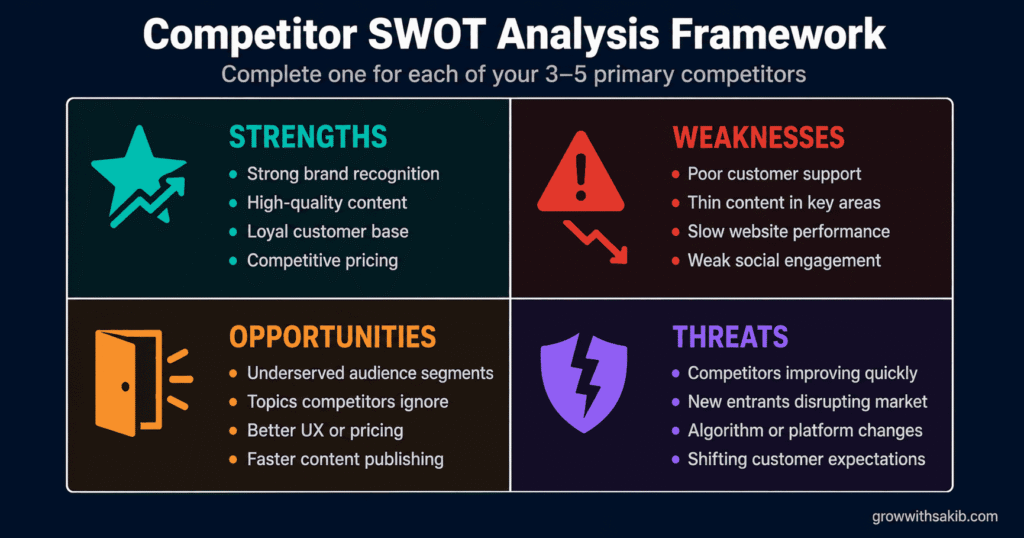
Step 6 Run a SWOT analysis for each key competitor
A SWOT analysis organises your research findings into four categories that directly inform your strategy. Complete one for each of your 3–5 primary competitors — the competitor SWOT analysis guide covers the full template, evidence sources, and how to turn four quadrants into a ranked action list.
After completing individual competitor SWOTs, look for patterns across all of them. If multiple competitors share the same weakness, that weakness represents a market-wide opportunity — not just a single competitor’s problem.
Step 7 Identify market gaps and positioning opportunities
Market gaps are where your competitive advantage lives. They are the problems competitors are ignoring, the audiences they are underserving, or the experiences they are delivering poorly. The market gaps guide expands this step across all five gap types with the four-check validation process that separates a real opportunity from expensive empty space.
Types of market gaps to look for
- Content gaps — topics with real search demand that no competitor covers with depth or accuracy
- Audience gaps — specific customer segments that competitors address too broadly or not at all
- Experience gaps — weak onboarding, poor support, confusing pricing, or bad UX that competitors consistently deliver
- Messaging gaps — value propositions no competitor is claiming, even though customers clearly care about them
- Offer gaps — service tiers, delivery formats, or pricing structures that do not exist yet in the market
Step 8 Monitor competitors continuously
Competitor research is not a one-time task. Digital markets change constantly — new competitors emerge, customer expectations shift, and strategies that worked last year may already be outdated.
- Monthly: Check top competitor content for new posts, pricing changes, and product updates — the competitor monitoring guide covers the full monthly and quarterly cadence, the free alert stack, and the triage rule that prevents overreacting to every competitor move.
- Quarterly: Run a full SEO gap analysis using Ahrefs or Semrush to find new keyword opportunities
- Quarterly: Review new competitor reviews on Google, Trustpilot, and G2 for emerging complaints and praise
- Ongoing: Set Google Alerts for each key competitor’s brand name to get notified of mentions, news, and PR
- Ongoing: Subscribe to competitor email lists and follow their social channels for real-time strategy signals
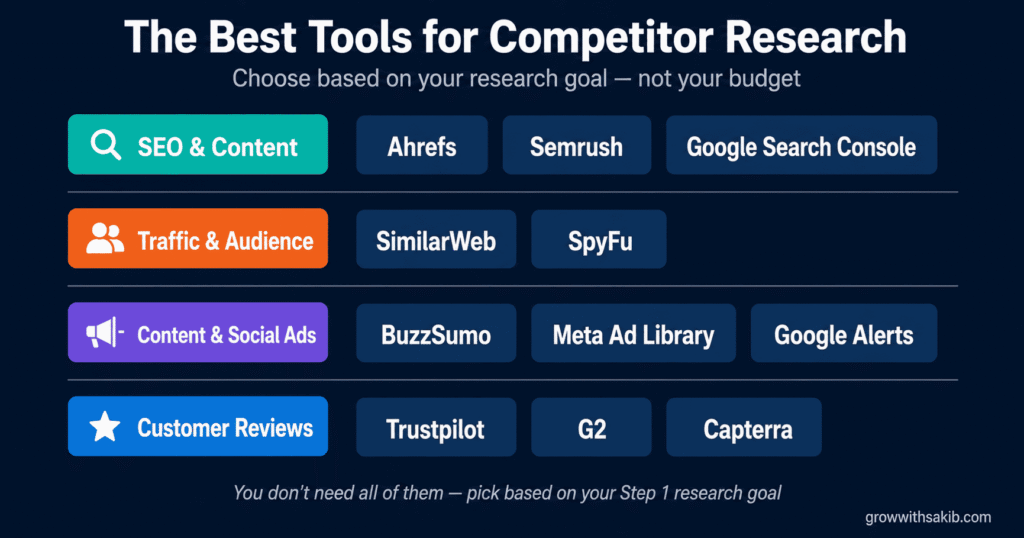
The Best Tools for Competitor Research
Each tool below serves a different research purpose. You do not need all of them — choose based on your research goals from Step 1.
| Tool | Best for | What it does in competitor research |
|---|---|---|
| Ahrefs | SEO and content | Keyword rankings, content gaps, backlink profiles, organic traffic estimates |
| Semrush | SEO, ads, and traffic | Keyword overlap, ad strategy, position tracking, traffic analytics |
| SimilarWeb | Traffic analysis | Traffic source breakdown, audience demographics, referral sites |
| SpyFu | Paid search | Competitor PPC keywords, ad copy history, paid search budgets |
| Meta Ad Library | Social ads | Every active Facebook and Instagram competitor ad — completely free |
| BuzzSumo | Content performance | Most shared competitor content, top formats, engagement by platform |
| Google Alerts | Brand monitoring | Free real-time alerts when competitors are mentioned anywhere online |
| Trustpilot / G2 | Customer reviews | Deep review analysis for competitor strengths, weaknesses, and customer language |
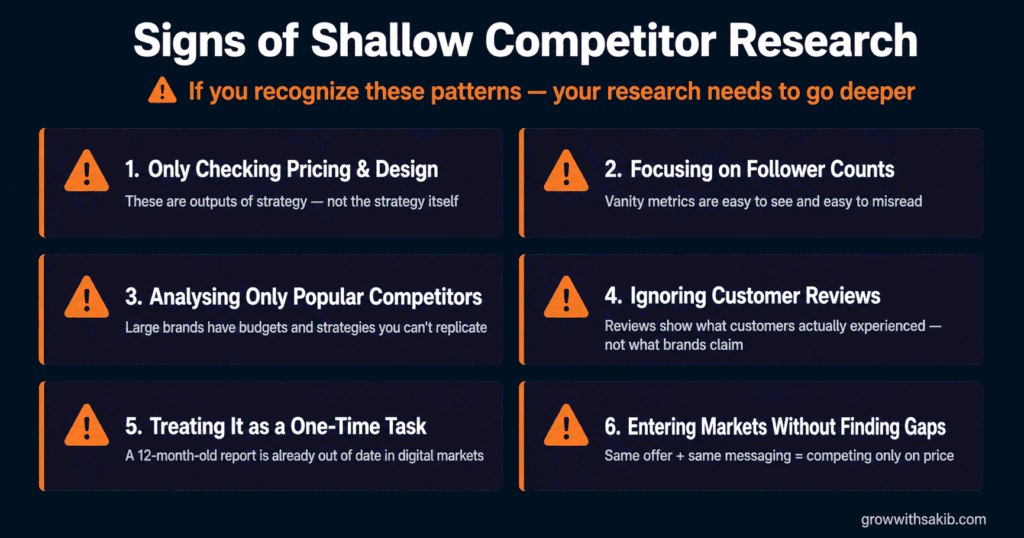
Signs of Shallow Competitor Research
These are the patterns that make competitor research look busy but produce no useful strategic insight. Recognise them early — in your own process and in the businesses you compete with.
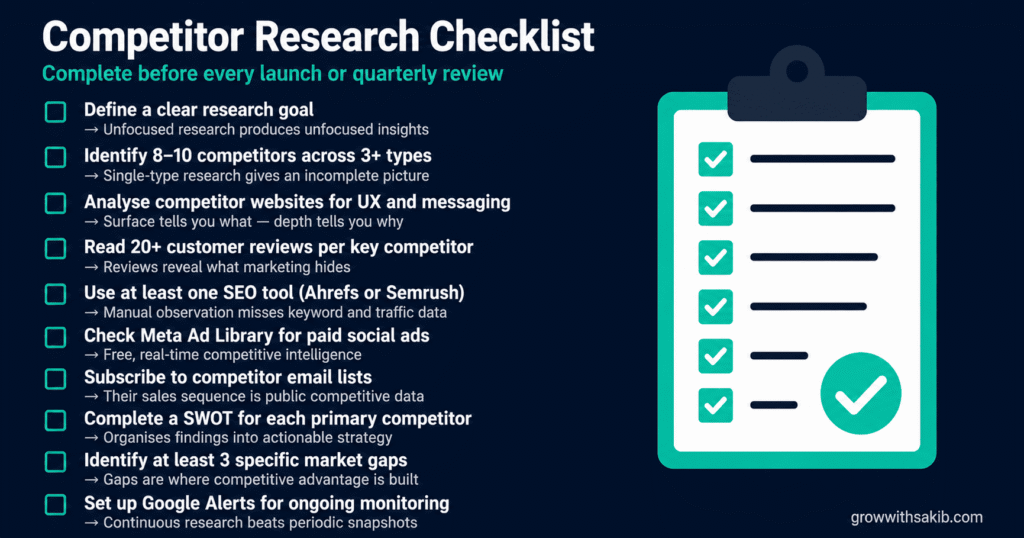
Competitor Research Checklist
Use this checklist before launching a new product, service, or content strategy — or as part of your quarterly review cycle.
| What to check | Why it matters |
|---|---|
| ☐ Defined a clear research goal before collecting data | Unfocused research produces unfocused insights |
| ☐ Identified 8-10 competitors across at least 3 types | Single-type research gives an incomplete market picture |
| ☐ Analysed competitor websites for structure, UX, and messaging | Surface tells you what — depth tells you why |
| ☐ Read 20+ customer reviews per key competitor | Reviews reveal what marketing hides |
| ☐ Used at least one SEO tool (Ahrefs or Semrush) | Manual observation misses keyword and traffic data |
| ☐ Checked Meta Ad Library for competitor paid social ads | Free, real-time competitive intelligence |
| ☐ Subscribed to competitor email lists and lead magnets | Their sales sequence is public competitive data |
| ☐ Completed a SWOT analysis for each primary competitor | Organises findings into actionable strategy |
| ☐ Identified at least 3 specific market gaps | Gaps are where competitive advantage is built |
| ☐ Set up Google Alerts for ongoing competitor monitoring | Continuous research beats periodic snapshots |
Effective competitor research is not about watching competitors — it is about understanding the market clearly enough to build something meaningfully better. The businesses that consistently win in competitive digital markets are the ones that know their market more deeply than anyone else.
The framework in this guide — clear goals, the right competitor types, multiple data sources, SWOT analysis, gap identification, the right tools, and continuous monitoring — gives you a repeatable process that produces real strategic advantage, not just interesting observations.
Start with Step 1. Define your goal. Pick your competitors. Then go deeper than the surface level most businesses stop at. That depth is where the real opportunities are.
Frequently Asked Questions
How long does competitor research take?
A basic competitor research review covering 3–5 competitors takes 4–8 hours. A thorough research process including SWOT analysis, SEO gap analysis, and customer review analysis typically takes 2–3 days. The investment is worth it — bad market entry decisions cost far more than the research to avoid them.
How many competitors should I analyse?
Aim for 8–10 competitors across different types — not just direct competitors. Research consistently shows that analysing 10 competitors gives significantly better market signal than analysing 3. Include at least one niche competitor, one SEO competitor, and one emerging competitor beyond your obvious direct competition.
Which competitor research tool should I start with?
If budget allows, start with Ahrefs or Semrush for SEO and content intelligence — they provide the most actionable data for digital businesses. If you need a free starting point, use Google Alerts for monitoring, Meta Ad Library for paid social ads, and read competitor reviews manually on Google and Trustpilot. These three free sources alone will reveal more than most businesses discover.
How often should I research competitors?
Monthly checks for content and pricing updates, quarterly deep-dives for SEO gaps and review analysis, and continuous monitoring via Google Alerts. Build it into your calendar rather than treating it as an occasional project.
Is competitor research the same as copying competitors?
No — and confusing the two is one of the most common mistakes in digital business. Copying creates a business with no identity and no differentiation. Competitor research helps you understand the market clearly enough to build something more useful, better positioned, or more clearly communicated than what already exists.
What should I do with competitor research findings?
Translate findings directly into decisions: update your positioning and messaging based on gaps in competitor communication, create content around topics competitors cover poorly, adjust pricing based on market patterns and customer review signals, and focus product or service development on problems competitors consistently fail to solve well.