Traditional search is no longer the only path to content discovery. Google AI Overviews now appear in more than 25% of all searches — up from 13% in early 2025. ChatGPT has surpassed 800 million weekly active users. Perplexity processed 780 million queries in a single month in 2025 alone.
These platforms don’t send users to links. They synthesize answers and cite sources directly. If your content isn’t structured for these systems to understand, extract, and trust — it’s invisible in an increasingly large share of all search interactions.
This guide explains what GEO is, what the research actually shows works, and how to apply it to your content right now.
What Is Generative Engine Optimization (GEO)?
Generative Engine Optimization (GEO) is the practice of structuring and writing content so AI-powered search systems can accurately understand, extract, and cite it when generating responses to user queries.
The term was formally defined in a 2023 research paper by Aggarwal et al. from Princeton University, Georgia Tech, IIT Delhi, and the Allen Institute for AI — later presented at the ACM SIGKDD Conference on Knowledge Discovery and Data Mining (KDD 2024), one of the most prestigious data science conferences in the world.
The Princeton study tested nine optimization strategies across 10,000 queries and found that the right GEO techniques can boost AI visibility by up to 40%. Critically, lower-ranked pages (around position 5) benefited most — seeing up to 115% visibility improvement — while position-1 pages saw little change. This means GEO is not just for established sites. It’s an opportunity to outperform stronger domains in a channel where traditional authority matters less.
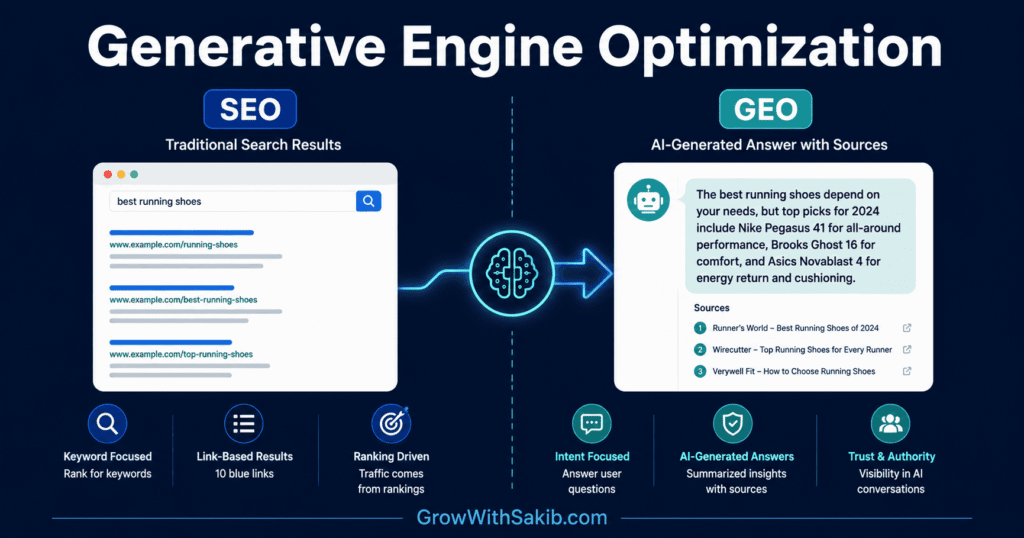
SEO vs. GEO — what actually changes
| Traditional SEO focus | GEO focus |
|---|---|
| Keyword placement and density | Semantic clarity and topical meaning |
| Backlinks and domain authority | Entity recognition and subject consistency |
| SERP ranking position | Citation frequency in AI-generated answers |
| Click-through rate (CTR) | Content extractability and summarisation quality |
| Page-level optimisation | Site-wide topical depth and cluster coherence |
| Meta tags and title tags | Structured, machine-readable formatting + schema |
These aren’t competing priorities — they’re layered ones. Weak technical SEO undermines GEO because generative AI systems rely on crawled and indexed web content as source material. If your pages can’t be crawled, GEO tactics are irrelevant.
What the Research Actually Says
Most GEO guides are built on opinion. This one is built on data. Here are the key findings from the peer-reviewed and industry research that now exists on this topic.
The Princeton GEO-Bench findings (KDD 2024)
The Princeton study tested nine specific optimisation strategies. The results, ranked by impact:
- Adding statistics: +41% AI visibility. The single most effective tactic.
- Adding quotations from credible sources: +28% visibility.
- Citing external sources within content: +115% visibility for lower-ranked pages (position 5). No meaningful gain for position-1 pages.
- Keyword stuffing: −10% vs baseline. It actively harms AI citation likelihood.
2026 industry data
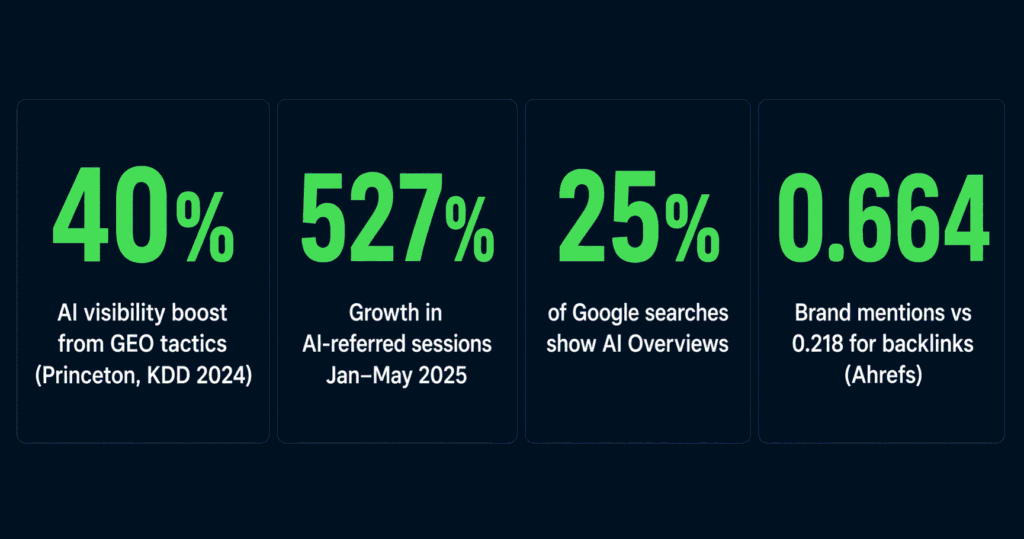
One finding from Ahrefs’ analysis of 76 million AI Overviews deserves special attention: brand mentions across independent sources correlate with AI citation probability at 0.664, compared to 0.218 for backlinks. This doesn’t mean mentions cause citations — the driver is entity recognition. But it confirms that building a presence outside your own site (PR, communities, industry publications) matters far more in GEO than it does in traditional SEO.
Ahrefs also found that only 6.82% of ChatGPT results overlap with Google’s top-10 organic results — and 83% of AI Overview citations come from outside the organic top 10. Traditional rankings predict AI citations poorly. This is a separate game.
How Generative Search Actually Works
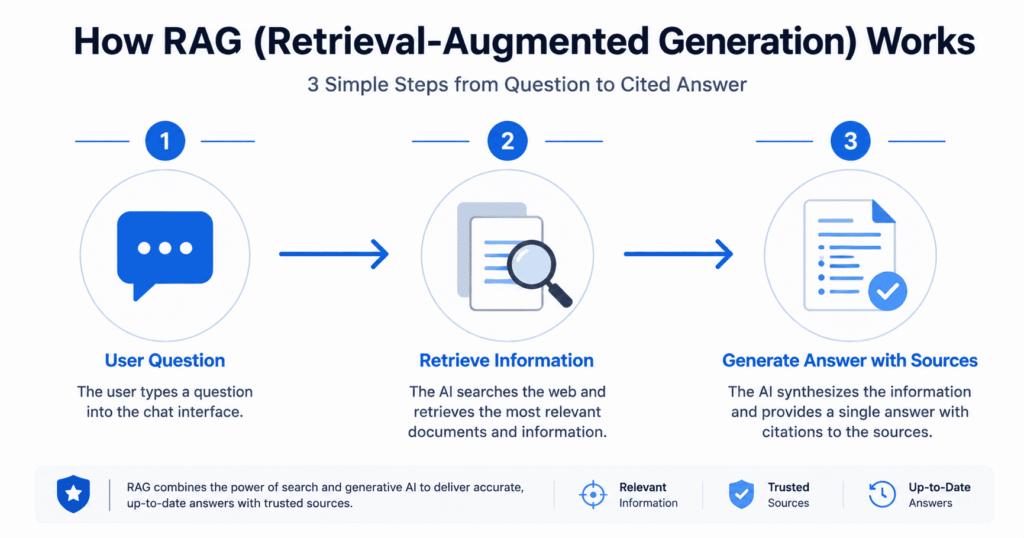
Traditional search engines crawl, index, and rank pages. Users get a list of links. Generative search works differently — systems like Google AI Overviews, ChatGPT, and Perplexity synthesize answers from multiple sources and generate a single response. Your content either gets pulled into that synthesis or it doesn’t.
Most of these systems use Retrieval-Augmented Generation (RAG): the AI retrieves relevant documents from its index in real time, extracts key passages, and uses them to build its response. The critical implication is that AI systems cite at the passage level — not the page level. A single well-structured paragraph can earn a citation even if the surrounding article is mediocre.
What generative systems evaluate
- Factual clarity: Can the system confidently extract a specific, accurate claim from your content?
- Entity recognition: Does the content clearly establish what it’s about — the people, brands, tools, and concepts involved?
- Topical authority: Does your site consistently cover this subject area, or is this an isolated page?
- Source credibility signals: Is there an author, a date, external citations, and E-E-A-T evidence?
- Structural extractability: Are ideas organised so a system can pull a clean answer from a specific section?
A practical consequence: a clear 900-word article from a topically consistent site will often outperform a 4,000-word wall of loosely organised text from a general-purpose blog — even if the longer article ranks higher in Google.
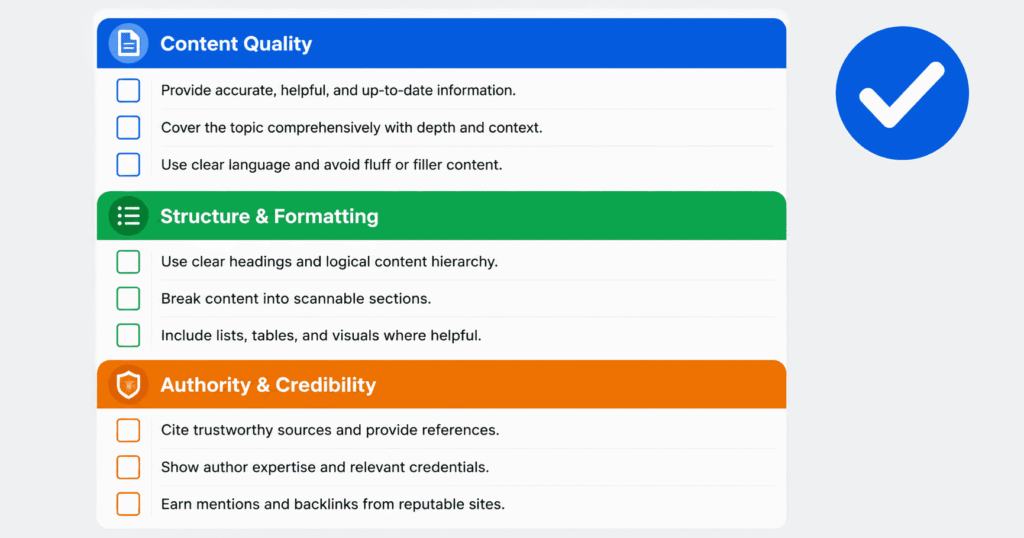
How to Apply GEO to Your Content
1. Build topic clusters, not keyword silos
A single article optimised for one keyword sends a weak topical signal. A cluster of 8–12 connected articles covering a subject from multiple angles sends a strong one. This is how you build entity association across your site — the signal that correlates most strongly with AI citation probability.
A GEO topic cluster for this subject might include:
- What is GEO? (definition and overview)
- GEO vs. SEO — what changes and what stays the same
- How AI search systems select sources (technical)
- Entity optimisation for generative search
- How to structure content for AI summaries
- How to measure GEO performance
- GEO audit checklist
Each article handles one angle clearly. Together they establish topical authority — exactly the signal generative systems look for when deciding whose content to cite.
2. Add statistics and cite your sources
This is the single highest-impact GEO tactic the Princeton study identified. Adding statistics to your content improved AI visibility by 41% — more than any other tested strategy. Including citations to credible external sources improved visibility by up to 115% for mid-ranked pages.
Practical application:
- Include at least 3–5 specific data points per article, with source attribution.
- Cite the original source, not a secondary reference to it. Link to the actual study or report.
- Use specific numbers, not ranges. “41% improvement” is more citable than “significant improvement.”
- Update statistics when better data emerges. Stale stats weaken credibility signals.
3. Write for semantic clarity, not keyword frequency
Generative AI reads for meaning, not keyword count. The goal is to communicate ideas clearly enough that a system can extract and restate them accurately.
- Use consistent terminology. If you introduce a concept as “topical authority,” don’t switch to “subject expertise” mid-article.
- Define terms when you first use them. Don’t assume the reader or the AI knows your shorthand.
- Lead with the answer. Put the core claim in the first sentence of each section, then expand.
- Remove hedge stacking. “Content may sometimes potentially perform better” commits to nothing. Say what you mean.
4. Structure content for passage-level extraction
AI systems cite at the passage level. Each section of your article should be able to stand alone as a complete answer to a specific question. If a section only makes sense in the context of what came before it, it’s harder to extract and cite cleanly.
- Answer the section’s question in the first 1–2 sentences, then expand with evidence.
- Use H2/H3 headings phrased as real user questions. 68.7% of ChatGPT citations come from pages with logical heading hierarchies.
- Keep paragraphs to 3–4 sentences. Dense blocks are harder to extract cleanly.
- Add a summary sentence at the end of complex sections to reinforce the key takeaway.
5. Optimise for entity clarity, not just keywords
Entities are the named things your content is about — people, brands, tools, technologies, organisations. Generative systems use entity recognition to establish subject context and filter for relevance.
An article about GEO that names Google AI Overviews, Perplexity, ChatGPT, schema markup, and Retrieval-Augmented Generation signals subject authority far more clearly than one that simply repeats the keyword “GEO” 40 times.
- Name the specific tools, platforms, and systems you discuss — don’t use vague category terms.
- Connect entities to each other: explain how they relate to your main topic.
- Be consistent with entity names across your whole site. Inconsistency weakens entity association.
- Maintain accurate information about your own entity (business name, location, products) across your site, Google Business Profile, and third-party listings.
6. Build your off-site presence
The Ahrefs finding that brand mentions correlate with AI citation probability at 0.664 — vs 0.218 for backlinks — changes the off-page strategy equation. Traditional link building still matters for crawlability and indexing, but getting mentioned in credible external sources (trade publications, community discussions, industry reviews) is a stronger GEO signal.
- Pitch data-led stories to industry publications in your niche.
- Participate in community discussions where your target audience asks questions.
- Ensure your brand information is consistent and accurate across Wikipedia (if applicable), industry directories, and review platforms.
- Earn mentions, not just links. A mention on a trusted site without a link still builds entity recognition.
7. Format for machine readability
Clean formatting is not cosmetic — it’s structural. AI systems parse heading hierarchy, list structure, and content organisation to understand relationships between ideas.
- Use a logical H1→H2→H3 hierarchy. Never skip levels.
- Keep bullet lists to 5–7 items. Longer lists lose structural signal.
- Use tables for comparisons — they indicate structured, reliable information.
- Add schema markup (Article, FAQ, HowTo) to give systems explicit metadata about your content’s purpose.
- Include a visible publication date and author — recency and authorship are credibility signals.
8. Build topical depth across your site
Individual articles don’t establish topical authority — a connected body of content does. Sites that publish consistently on a subject area, cross-link related articles, and update existing content regularly send stronger subject-authority signals than sites that treat each article as an isolated asset.
- Cover the subject from multiple angles: beginner overview, advanced tactics, comparisons, use cases.
- Cross-link related articles to reinforce subject relationships.
- Add a visible “Last updated” date and refresh cornerstone content at least quarterly. Content freshness within 30 days carries a 3.2× citation multiplier, according to ConvertMate’s analysis of 12,500+ queries.
- Use consistent entity names and terminology across all related posts on your site.
Real-World Examples
Tally — ChatGPT as the #1 referral source
Tally, a bootstrapped form-builder tool, reported that ChatGPT became their single largest referral traffic source after restructuring their content around GEO principles — ahead of Google organic. Their approach focused on clearly positioning the brand across third-party reviews, community discussions, and comparison articles rather than increasing content volume on their own site.
The lesson: brand presence across independent sources, not just on-site content volume, is what drove AI citation frequency.
Lower-ranked pages outperforming position-1 results
The Princeton GEO-Bench study documented a striking pattern: pages at organic position 5 that applied GEO optimisation techniques — adding statistics, sourcing claims, improving structure — saw 115% improvement in AI visibility. Position-1 pages on the same queries saw almost no change.
This is the core GEO opportunity for smaller sites. In traditional SEO, outranking a position-1 result requires significant authority. In generative search, a well-structured, data-rich article from a lower-authority site can routinely outperform it.
The promotional-tone penalty
Semrush’s 2025 GEO analysis found that promotional language carries a −26.19% correlation with AI citation probability. Content written in a sales or marketing tone is actively disadvantaged compared to neutral, informational writing.
The practical implication: if your existing content reads like a landing page or product pitch, it will underperform in generative search regardless of its other qualities. Rewriting your highest-value informational pages in a neutral, evidence-led tone is one of the fastest GEO wins available.
How to Measure GEO Performance
This is the biggest gap in most GEO strategies. Marketers comfortable with Google Analytics dashboards often have no visibility into AI search performance. Here is a practical measurement framework.
Step 1 — Manual citation auditing (free, start here)
Build a list of 15–20 questions your content definitively answers. These should be specific enough to generate a clear AI response — not so broad that hundreds of sources could answer them.
Example for a GEO guide:
- “What is generative engine optimization?”
- “How does GEO differ from SEO?”
- “What content strategies improve AI visibility?”
- “How do I get cited in Google AI Overviews?“
Run each question across ChatGPT (with search enabled), Perplexity, Google (AI Overviews), and Bing Copilot. Document: whether your domain is cited, where in the response it appears, and how your brand/content is described.
Do this monthly for your target queries. Improving citation rate is your primary GEO success metric.
Step 2 — Track AI-referred traffic in GA4
AI platforms that do send traffic appear as referral sources in GA4. Set up a custom channel grouping or segment to isolate traffic from:
- chat.openai.com (ChatGPT)
- perplexity.ai
- bing.com/chat (Copilot)
- claude.ai
AI-referred sessions jumped 527% year-over-year in the first five months of 2025, according to Previsible’s AI Traffic Report. Tracking this now gives you a baseline to measure growth against as AI search adoption continues.
Note: zero-click citations (where the AI answers without sending traffic) are not tracked this way. Manual auditing is still necessary to capture full AI visibility.
Step 3 — Proxy signals to monitor
- Branded search volume: Rising branded searches often indicate AI is mentioning your brand name in responses, prompting users to search for you directly.
- Direct traffic: Some AI-surface brand mentions result in direct navigation rather than referral clicks.
- Content freshness signals: Monitor which of your updated articles earn new citations. This validates your refresh cadence.
Step 4 — Paid tools (when you’re ready to scale)
Once manual tracking becomes time-consuming, several platforms now offer AI citation monitoring:
- Semrush Enterprise AIO — tracks brand visibility across ChatGPT, Google AI Mode, and Perplexity with share-of-voice reporting.
- Profound — tracks citations across AI platforms and provides agent analytics to see which AI bots are crawling your site.
- Peec AI — citation tracking with competitive benchmarking.
- ConvertMate — AI citation analysis with query-level detail.
Common GEO Mistakes
Publishing content with no evidence
Vague, hedge-heavy writing fails what the Princeton study validated as the core citation criterion: extractable, specific claims. If your content makes no falsifiable statement — no data, no named example, no defined process — there’s nothing for an AI to cite. Every major section should contain at least one specific, sourceable claim.
Keyword stuffing (it actively hurts)
The Princeton study tested keyword stuffing as a GEO strategy and found it performed 10% worse than the unoptimised baseline. It’s not neutral — it’s harmful. Generative systems are optimised to detect and deprioritise repetitive, low-information content.
Treating GEO as a one-page fix
A single well-optimised article doesn’t establish topical authority. Topical authority is built across a connected body of content. Sites that publish one GEO guide and then return to scattered keyword-focused publishing don’t accumulate the entity association that drives sustained AI citation.
Writing in a promotional tone
Semrush’s data shows a −26.19% citation probability correlation with promotional language. If your content reads like a marketing pitch, rewrite it in a neutral, informational tone. This is one of the most underappreciated differences between SEO and GEO — promotional copy that earns clicks can actively reduce AI citation frequency.
Assuming GEO replaces SEO
Crawling, indexing, page experience, technical structure, and backlinks remain the infrastructure that makes content discoverable in the first place. Generative AI systems source from indexed web content. Weak technical SEO limits GEO performance. The correct framing: GEO adds a layer on top of a strong SEO foundation.
Ignoring content freshness
ConvertMate’s analysis found that content updated within the past 30 days carries a 3.2× citation multiplier compared to older content on the same topic. Add a quarterly content refresh cycle to your content calendar, update statistics, and keep a visible “Last updated” date on all cornerstone pages.
GEO Audit Checklist
Use this checklist to evaluate any piece of content before publishing or when auditing existing pages.
Content quality
| Check | Why it matters |
|---|---|
| Each section answers its question in the first 1–2 sentences | AI systems cite at passage level — buried answers don’t get extracted |
| Article contains at least 3 specific statistics with source attribution | Princeton study: statistics addition = +41% AI visibility |
| External sources are cited and linked directly | Source attribution = +115% visibility for mid-ranked pages |
| No promotional or sales language in informational sections | Semrush: promotional tone = −26.19% citation probability |
| Terminology is consistent throughout (no synonym-swapping) | Inconsistent terms weaken entity recognition |
Structure and formatting
| Check | Why it matters |
|---|---|
| Logical H1→H2→H3 heading hierarchy (no skipped levels) | 68.7% of ChatGPT citations come from structurally hierarchical pages |
| Headings phrased as questions or clear topic statements | Matches natural language query patterns |
| Paragraphs limited to 3–4 sentences | Shorter paragraphs = cleaner passage extraction |
| Comparison information presented in tables | Tables signal structured, reliable data to AI systems |
| Schema markup implemented (Article, FAQ, or HowTo) | Provides explicit metadata about content purpose and structure |
Authority and credibility
| Check | Why it matters |
|---|---|
| Author byline with credentials or bio link | E-E-A-T signal — author expertise |
| Publication and last-updated date visible | Recency within 30 days = 3.2× citation multiplier |
| Related articles linked internally (topic cluster structure) | Reinforces topical authority across the site |
| Brand/entity information consistent across site and external listings | Entity consistency strengthens AI subject association |
Generative search is not a future trend — it’s already reshaping how information is discovered. AI Overviews appear in 25% of Google searches. ChatGPT has 800 million weekly users. AI-referred web sessions grew 527% in the first five months of 2025.
The research is clear on what actually works: add statistics and cite your sources (+41% visibility), cite external sources (+115% for mid-ranked pages), avoid promotional language (−26% citation penalty), maintain a logical heading structure (present in 68.7% of cited pages), and keep content fresh (3.2× multiplier for content updated within 30 days).
None of these tactics require starting over. They require editing with intention. Start with your highest-traffic informational pages, run the extraction test, and fix what fails. Build topic clusters around your strongest subjects. Add schema markup. Update regularly.
The sites that earn sustained GEO visibility won’t be the ones that found a new exploit. They’ll be the ones that built the most trustworthy, structured, and evidence-backed content on their subject.
Technical GEO Readiness: How to Make Your Website AI-Crawlable
Most businesses focus on what their content says and ignore whether AI systems can actually access, render, and read it in the first place. A perfectly structured, evidence-rich article that AI bots cannot crawl is invisible in generative search — regardless of how well it is written.
This section covers five technical requirements that determine whether AI systems can find, process, and cite your content. Every item is actionable today — most take under an hour to implement.
1. AI Bot Management in Robots.txt — The Decision Most Guides Miss
In 2026, your robots.txt file controls access for two fundamentally different types of AI bots — and most businesses treat them as one. They are not.
- AI training scrapers collect your content to train AI language models. Blocking them prevents your content being used in model training — but it does not affect whether you appear in AI search results.
- AI search retrieval agents crawl your site to retrieve content for real-time search responses. Blocking these removes you from AI-generated answers entirely.
Here are the five bot names every website owner needs to know:
| Bot name | Company | Purpose | Block or allow? |
|---|---|---|---|
| GPTBot | OpenAI | Training data collection | Your choice — blocks training use only |
| OAI-SearchBot | OpenAI | ChatGPT search citations | ✅ Allow — blocking removes you from ChatGPT search |
| PerplexityBot | Perplexity | Search retrieval | ✅ Allow — blocking removes you from Perplexity |
| Google-Extended | Gemini training data | Your choice — separate from GoogleBot | |
| GoogleBot | Search indexing | ✅ Always allow — blocks you from Google entirely |
The strategic configuration most businesses should use:
| User-agent: GPTBotDisallow: / ← Blocks OpenAI training scraping (optional) User-agent: OAI-SearchBotAllow: / ← Allows ChatGPT search citations User-agent: PerplexityBotAllow: / ← Allows Perplexity search citations User-agent: GoogleBotAllow: / ← Always allow — never block this |
This configuration lets you protect content from being used to train AI models while remaining fully visible in AI-generated search results — the outcome most businesses actually want.
How to check and update: Visit yourdomain.com/robots.txt in your browser and read your current rules. For WordPress, the Rank Math and Yoast SEO plugins both provide robots.txt editing directly in the dashboard under SEO → General → Robots.txt.
2. llms.txt — The Emerging Standard for AI Site Readability
llms.txt is a plain-text file placed at yourdomain.com/llms.txt that tells AI language models how to navigate and understand your website — similar in concept to how robots.txt guides search crawlers, but designed specifically for LLMs.
It is not yet a universal standard, but adoption is growing among technically forward sites and AI systems are beginning to reference it when crawling for structured information. Creating one costs five minutes and signals to AI systems that your site is intentionally structured for machine readability.
A basic llms.txt for a content site:
| # GrowWithSakib > Digital marketing, SEO, and GEO guidance for small businesses> and digital brands. ## Core content – [SEO for Small Business Guide](https://growwithsakib.com/seo-for-small-business/)- [GEO Complete Guide](https://growwithsakib.com/the-complete-guide-to-generative-engine-optimization-geo/)- [Technical SEO Strategies](https://growwithsakib.com/strong-technical-seo-strategies/)- [Link Building Guide](https://growwithsakib.com/link-building-guide-for-beginners/) ## About GrowWithSakib provides SEO strategy, content marketing, and GEOoptimisation guidance. Written by Md. Sakib Hossain. |
Create this file in a text editor, save it as llms.txt, and upload it to your root directory via your hosting file manager or FTP. Verify it is publicly accessible at yourdomain.com/llms.txt before moving on.
3. Server-Side Rendering — Why JavaScript-Only Content Gets Missed
AI crawlers vary significantly in their ability to execute JavaScript. Some process it fully. Others — particularly newer AI retrieval agents — read only the server-rendered HTML that arrives before any JavaScript executes.
If your most important content is loaded by JavaScript after the initial page request (common in React, Vue, Next.js, and some WordPress themes with heavy page builders), some AI systems will see a blank or partial page rather than your full content.
How to check whether this affects your site
- Go to any important page on your site
- In Chrome, right-click anywhere on the page and select ‘View Page Source’ — not Inspect, specifically View Page Source
- Press Ctrl+F and search for the first sentence of your main body content
- If it appears in the source: you are fine — the content is server-rendered and AI crawlers can read it
- If it does not appear: your content is JavaScript-rendered and may be invisible to some AI systems
The fix: Ensure critical content — your H1, first two paragraphs, and key section headings — is present in the initial HTML response. For standard WordPress sites with classic themes, this is handled automatically. For JavaScript-heavy page builders or headless setups, enable server-side rendering (SSR) for content pages.
4. Schema Markup for AI Citation — The Three Types That Matter Most
Schema markup tells AI systems not just that content exists, but what type it is, who wrote it, when it was published, and what specific questions it answers. Three schema types have a direct, measurable impact on AI citation probability.
Article and BlogPosting schema — establishes authorship and credibility
AI systems use Article schema to evaluate recency and source credibility before deciding whether to cite a page. A page with Article schema naming a real author, a publication date, and a publisher is treated as a more trustworthy source than an anonymous, undated page — even when the content is identical.
| { “@context”: “https://schema.org”, “@type”: “Article”, “headline”: “Your Article Title Here”, “author”: { “@type”: “Person”, “name”: “Md. Sakib Hossain”, “url”: “https://growwithsakib.com/about/” }, “datePublished”: “2026-05-17”, “dateModified”: “2026-05-19”, “publisher”: { “@type”: “Organization”, “name”: “GrowWithSakib”, “logo”: { “@type”: “ImageObject”, “url”: “https://growwithsakib.com/logo.png” } }} |
In Rank Math: Article schema is enabled automatically when you set the post type to ‘Article’ in the Schema tab of each post. Verify the author field is pulling your correct author profile.
FAQ schema — the most direct path to AI Overview inclusion
FAQ schema is the single most direct technical pathway into Google AI Overviews. When your FAQ section is marked with FAQ schema, Google’s AI systems can pull individual question-and-answer pairs directly into generated responses — without the user visiting your page.
Every article with a FAQ section should have FAQ schema implemented. In Rank Math: when you add an FAQ block using the Rank Math FAQ block type in Gutenberg, FAQ schema is generated automatically. No manual coding required.
HowTo schema — makes individual steps extractable
For step-by-step process content, HowTo schema makes each numbered step a discrete, extractable unit. AI systems can cite a specific step from your guide rather than the entire page — which significantly increases citation frequency for procedural content.
5. BLUF Formatting — Answering Before You Explain
BLUF stands for Bottom Line Up Front. It is the single most impactful formatting change you can make for AI citation — and it costs nothing except a shift in how you structure your writing.
AI systems extract content at the passage level, not the page level. When generating a response, an AI pulls the specific paragraph that most directly answers the query. If your answer is buried at paragraph four after three paragraphs of context, the AI either cites a competitor who answered it immediately or generates its own answer without citing anyone.
The rule is simple: every H2 and H3 heading poses a question or introduces a topic. The first sentence of that section answers it completely. Everything after expands with evidence, context, and detail.
Apply this principle retroactively to your existing content. Identify sections where the core answer appears at paragraph 3 or 4, and rewrite the opening sentence to lead with it. This single change, applied across your highest-traffic pages, consistently improves AI citation rates faster than any other optimisation.
Technical GEO Readiness Checklist
Use this checklist to verify your site’s technical AI readiness. Each item can be checked and resolved in under one hour.
| What to do | Why it matters |
|---|---|
| ☐ Robots.txt allows OAI-SearchBot and PerplexityBot — verified at yourdomain.com/robots.txt | Blocking these removes you from ChatGPT and Perplexity search results entirely |
| ☐ llms.txt created and accessible at yourdomain.com/llms.txt | Signals to AI systems that your site is structured for machine readability |
| ☐ Critical page content is visible in raw HTML — tested via View Page Source in Chrome | JavaScript-only content is invisible to some AI crawlers |
| ☐ Article / BlogPosting schema on all content pages — validated in Rich Results Test | Establishes authorship and credibility signals that AI systems use to evaluate citation worthiness |
| ☐ FAQ schema on all pages with a FAQ section — enabled in Rank Math FAQ block | The most direct technical pathway to Google AI Overview inclusion |
| ☐ Every section opens with the answer in the first sentence (BLUF formatting) | AI systems extract at passage level — buried answers are not cited |
Frequently Asked Questions
How is GEO different from traditional SEO?
SEO optimises for ranking position in search engine results pages. GEO optimises for citation frequency in AI-generated responses. A page can rank #1 in Google and still be ignored by AI Overviews — and vice versa. Research shows only 6.82% of ChatGPT results overlap with Google’s top-10 organic results. The signals are genuinely different.
Does GEO only apply to large sites?
No — and this is one of the most important findings from the Princeton research. Lower-ranked pages (around position 5) saw 115% AI visibility improvement from GEO optimisation, while position-1 pages saw almost no change. GEO levels the playing field in ways traditional SEO does not.
Which platforms does GEO apply to?
Google AI Overviews, ChatGPT (with search enabled), Perplexity, Bing Copilot, and Claude. As AI interfaces expand into voice assistants and AI agents, the number of surfaces where GEO matters will grow. Google AI Overviews alone now appear in 25% of searches, with higher rates in healthcare (48.75%) and lower in real estate (4.48%). Check your niche’s AI Overview prevalence before prioritising GEO vs. traditional SEO.
How do I know if GEO is working?
Start with manual prompt auditing: search your target questions across ChatGPT, Perplexity, and Google with AI Overviews enabled, and check whether your domain is cited. Track AI-referred traffic in GA4 as a secondary signal. Paid tools (Semrush, Profound, Peec AI) offer more granular tracking once manual auditing becomes too time-intensive.
Does GEO require schema markup?
Schema markup is not required, but ConvertMate’s analysis found that 61% of heavily-cited pages use structured data markup. It makes it significantly easier for generative systems to understand your content’s purpose and structure. Treat it as high-priority, not optional.
How long does GEO take to produce results?
Individual well-optimised articles can appear in AI Overviews quickly — sometimes within weeks of indexing — if they directly answer a query no other source handles clearly. Sustained topical authority, which drives consistent citation across many queries, typically takes 3–6 months of connected content publishing to establish.