
Finding the right niche for your service is not just about picking something popular. It is about choosing a space where real demand exists, your skills are genuinely strong, and people are willing to pay for solutions.
Most service businesses fail not from lack of effort — but from entering the wrong market. According to CB Insights, 42% of startups fail because there is no real market need for what they are offering. The solution is not to work harder. It is to choose the right direction first.
This guide gives you a step-by-step framework — backed by real data — to identify, validate, and commit to a niche that can support a sustainable, growing service business.
What Is the ‘Right Niche’ for a Service?
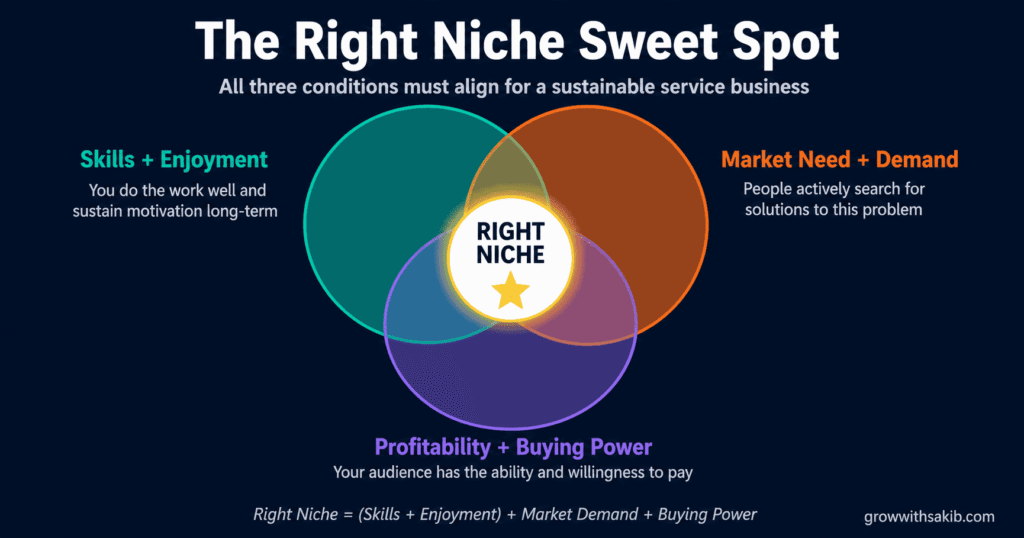
The right niche is not simply the one you are most skilled at. It is the intersection of three things working together at the same time.
| Condition | What it means in practice |
|---|---|
| Skills + Enjoyment | You can do the work well and sustain motivation long-term. Skill without interest leads to burnout. Interest without skill leads to poor results. |
| Market Need + Real Demand | A meaningful problem exists that people are actively searching for solutions to. Without demand, even excellent services go unfound. |
| Profitability + Buying Power | Your target audience has the financial ability and willingness to pay. Demand without purchasing power means the business cannot grow. |
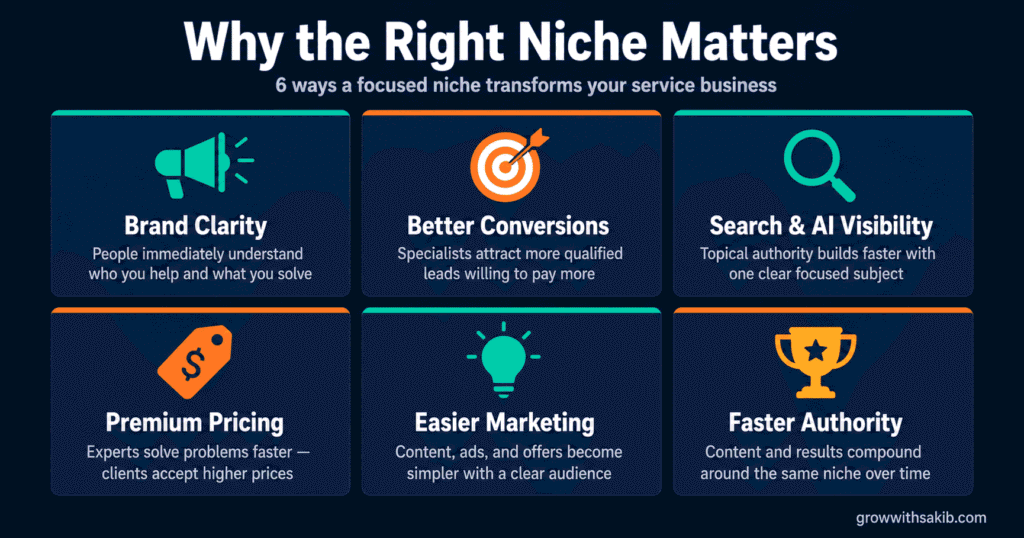
Why Choosing the Right Niche Matters
A focused niche changes how every part of your business works — from content and marketing to pricing and client trust. Below are the six most direct benefits.
1. Brand clarity
When your niche is specific, people immediately understand who you help, what you do, and what problem you solve. That clarity is what makes a brand memorable.
Weak: “We provide digital marketing services.” → Strong: “We provide SEO services for WordPress business websites.”
2. Better conversions
Specific services attract more qualified leads. People trust specialists over generalists — and they are more willing to pay premium prices for someone who understands their specific situation.
3. Stronger search and AI visibility
A website focused on one clear subject builds topical authority faster. Search engines and AI systems like Google AI Overviews and ChatGPT consistently favor sources with deep, consistent coverage of a specific subject area over broad, generalist sites.
4. Premium pricing
Specialists solve problems faster and more effectively. That efficiency increases perceived value — and clients who see you as an expert accept higher prices without heavy resistance.
5. Easier content and marketing strategy
When you know exactly who you serve and what their problems are, creating content, ads, and offers becomes significantly simpler. Every piece of content you produce has a clear audience.
6. Faster authority building
All your content, case studies, and client results compound around the same subject. Over time, both users and search systems associate your brand with that specific niche — creating a compounding advantage that generalists cannot replicate.
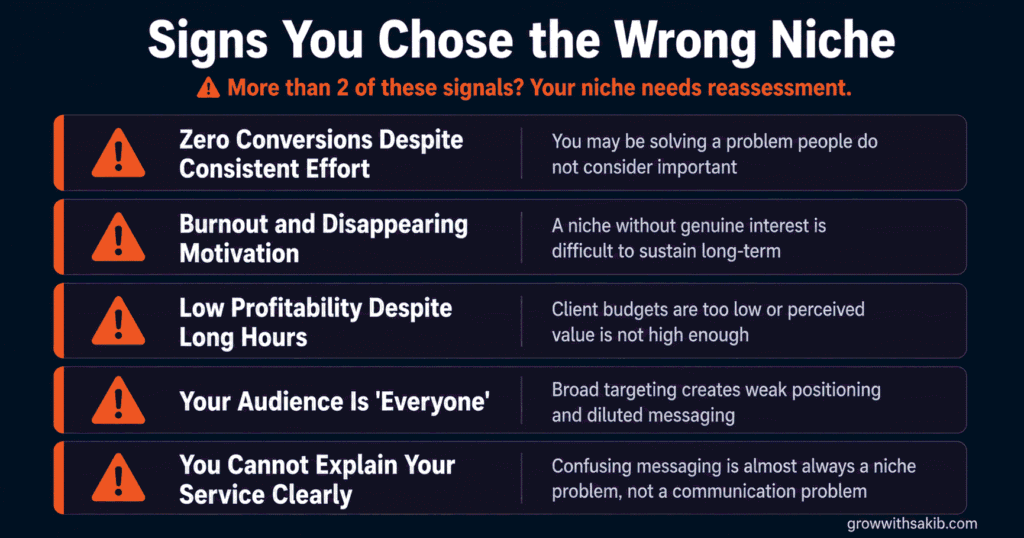
Signs You Chose the Wrong Niche
Recognising these warning signs early can save years of wasted effort. If you are experiencing more than two of the following, your niche selection may need reassessment.
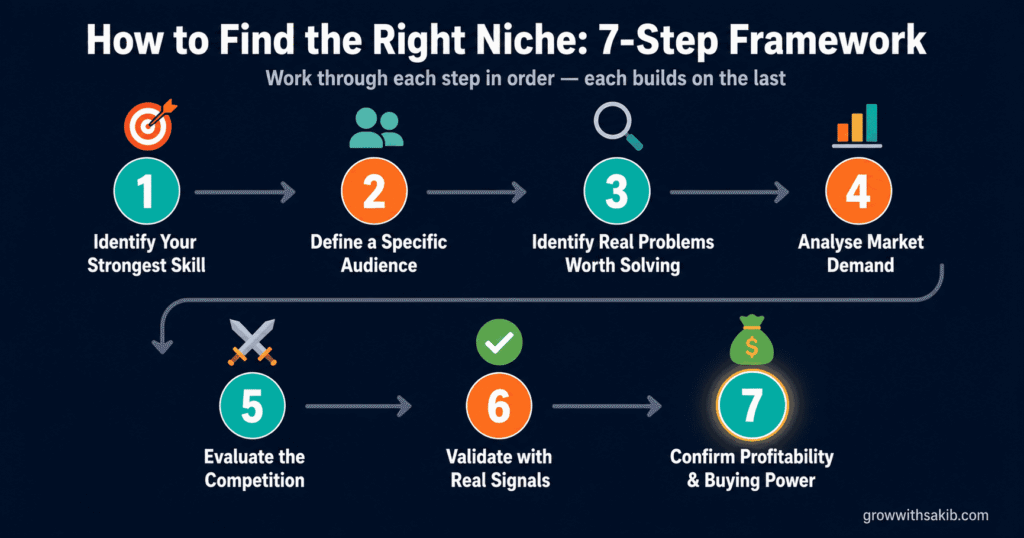
How to Find the Right Niche: A 7-Step Framework
Work through these steps in order. Each one builds on the last. Skipping steps — especially the validation step — is the most common cause of niche selection failure.
Step 1 Identify your strongest skill
Start with what you can do with genuine confidence. Ask yourself:
- What work can I do confidently and deliver strong results?
- What have I already achieved that I can point to?
- Which service feels natural, not forced?
Your niche should align with both expertise and long-term interest. Skill without interest leads to burnout. Interest without skill leads to poor client results — and poor results destroy the reputation a service business depends on. The skill identification guide walks you through a 5-step audit to find your strongest, most-transferable skill before committing to any niche.
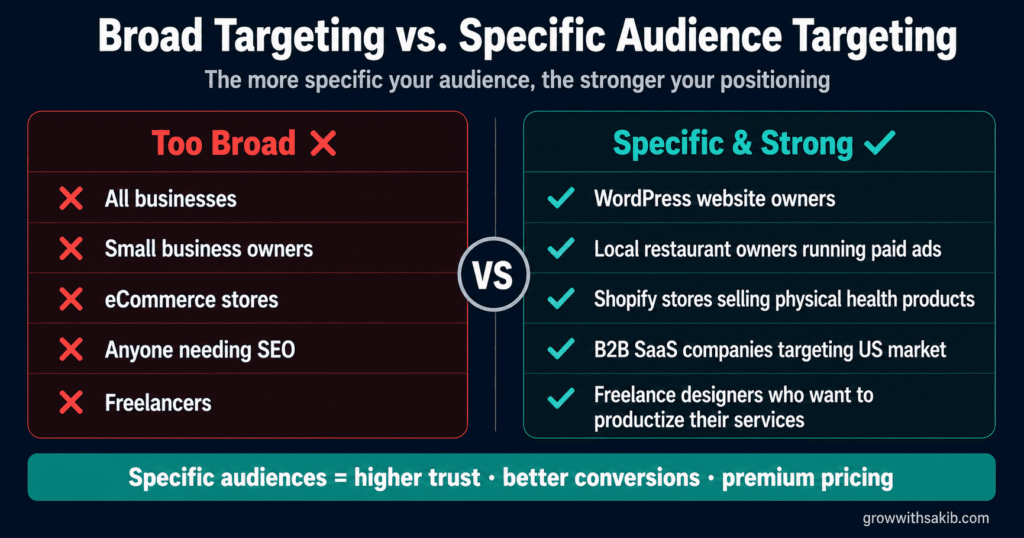
Step 2 Define a specific audience
Strong niches always serve a specific group of people — not everyone. The more clearly you define your audience, the stronger your positioning, content, and marketing become.
| Too broad (weak) | Specific (strong) |
|---|---|
| All businesses | WordPress website owners |
| Small business owners | Local restaurant owners running paid ads |
| eCommerce stores | Shopify stores selling physical health products |
| Anyone needing SEO | B2B SaaS companies targeting US market |
| Freelancers | Freelance designers who want to productize their services |
Businesses that target clearly defined, segmented audiences consistently outperform those targeting broadly — not just in marketing efficiency, but in conversion rates, referrals, and client retention. The target audience definition guide gives you the 3-layer framework for defining exactly who you serve, what problem they have, and whether they have the budget to pay.
Step 3 Identify real problems worth solving
People pay for solutions to real, painful, urgent problems — not for services that sound nice. Before committing to a niche, confirm that the problem you are solving meets these criteria:
- People are actively searching for solutions online
- Businesses are already spending money to address this problem
- The problem is ongoing, not a one-time event
- The pain of not solving it is significant — financially, operationally, or emotionally
The bigger and more urgent the problem, the stronger the business opportunity. A service that removes a serious frustration, saves meaningful time, or directly increases revenue will always be easier to sell than one that solves a minor inconvenience.
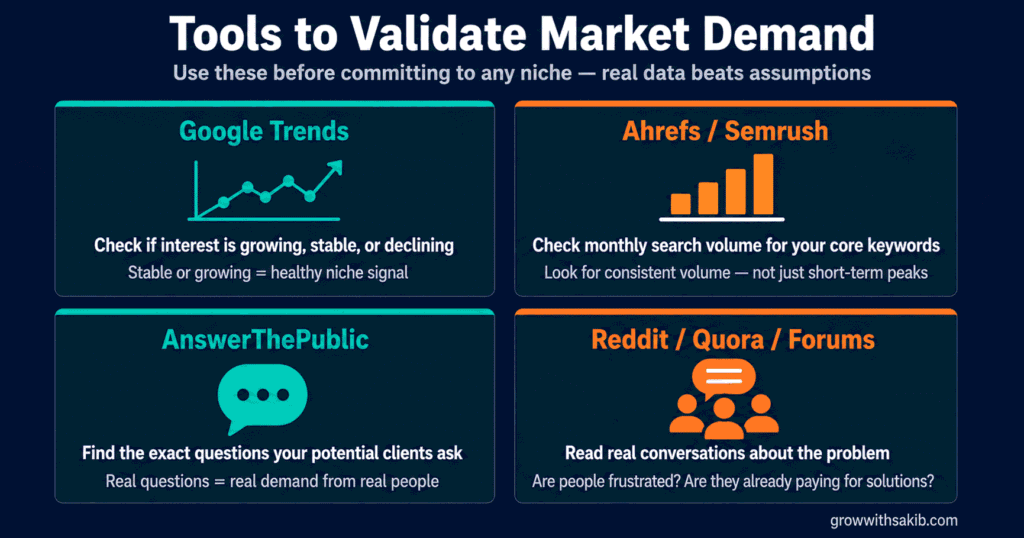
Step 4 Analyse market demand
Passion and skill are not enough. Your niche must have real, sustained demand — people actively searching and businesses willing to spend money to solve the problem.
Tools to validate demand
- Google Trends — check whether interest in your topic is growing, stable, or declining. Stable or growing = healthy signal.
- Ahrefs / Semrush — check monthly search volume for your core service keywords. Look for consistent volume, not just peaks.
- AnswerThePublic — find the exact questions your potential clients are asking right now.
- Reddit / Quora / industry forums — read real conversations. Are people frustrated? Are they paying for solutions already?
Step 5 Evaluate the competition
Healthy competition confirms that real demand exists. The goal is not to avoid competitive niches — it is to find the gaps that others are not covering well.
What to look for in competitor analysis
- Weak or outdated content — topics nobody is covering deeply
- Poor SEO — strong demand with weak competition is your entry point
- Negative reviews — what do clients consistently complain about in your niche?
- Missing audience segments — a sub-group that competitors ignore
- Poor user experience — slow sites, unclear messaging, confusing offers
Step 6 Validate with real market signals
This is the step most guides skip — and the one most responsible for niche selection failures. Before fully committing to a niche, test it with real people and real signals.
How to validate before committing
- Talk to 5–10 potential clients in your target niche. Ask what they struggle with, what they have already tried, and what they would pay to solve the problem. Their exact words are your best research.
- Create a simple offer — a landing page, a social post, or a direct message to potential clients — and measure the response. Real interest shows up as replies, clicks, or questions. Silence is also data.
- Run a small paid ad targeting your ideal audience with a specific problem statement. Even a small budget (£30–50) will tell you whether the message resonates.
- Search for your service on freelance platforms (Upwork, Fiverr, PeoplePerHour). If clients are already posting jobs for exactly what you do, demand is confirmed.
Step 7 Confirm profitability and buying power
A niche is only sustainable if your audience has both the ability and the willingness to pay for your service. This is one of the most overlooked factors in niche selection.
Signs of strong buying power in a niche
- Clients in this niche already invest in similar services — the budget category exists
- Higher pricing is accepted without heavy resistance or constant negotiation
- The problem you solve has a direct and measurable business impact (revenue, cost, time)
- Businesses in this niche have recurring needs — not just one-off projects
Even if your niche has strong demand and low competition, it is not viable unless the audience has genuine purchasing power. A niche full of people who want your service but cannot afford it is not a business — it is a hobby. The niche buying power guide shows you the 5 signals of real buying power and how to test them before committing.
7 Common Niche Selection Mistakes
Most niche selection failures come from the same repeating patterns. Here they are — condensed — so you can recognise and avoid them.
| What to check | Why it matters |
|---|---|
| ☐ Choosing a trend without real skills or experience in it | Skills and confidence are what create client results — and results build reputation |
| ☐ Copying competitors blindly without understanding their strategy | Replication without context creates weak positioning and no identity |
| ☐ Skipping market demand validation before committing | Even a well-designed service fails without an active audience searching for it |
| ☐ Choosing passion without checking if anyone will pay for it | Passion sustains motivation; market need determines whether it becomes a business |
| ☐ Ignoring audience buying power | Demand without budget means attention without revenue |
| ☐ Trying to serve everyone to maximise reach | Broad targeting dilutes your message and weakens your positioning |
| ☐ Choosing a niche with no future scalability | Short-term income without long-term growth creates a ceiling you cannot break through |
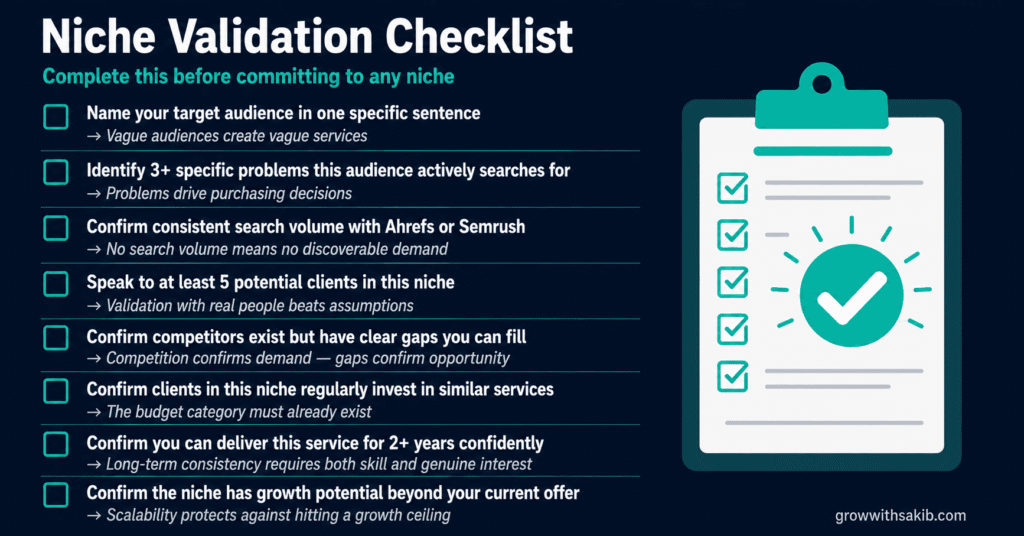
Niche Validation Checklist
Use this before committing to any niche. Each row represents a question you should be able to answer with confidence.
| What to check | Why it matters |
|---|---|
| ☐ I can name my target audience in one specific sentence | Vague audiences create vague services |
| ☐ I have identified 3+ specific problems this audience faces and actively searches for | Problems drive purchasing decisions |
| ☐ Search volume confirms consistent demand (checked with Ahrefs or Semrush) | No search volume = no discoverable demand |
| ☐ I have spoken to at least 5 potential clients in this niche | Validation with real people beats assumptions |
| ☐ Competitors exist but have clear gaps I can fill better | Competition confirms demand; gaps confirm opportunity |
| ☐ Clients in this niche regularly invest in services like mine | Budget category must already exist |
| ☐ I can deliver this service confidently and sustain it for 2+ years | Long-term consistency requires both skill and genuine interest |
| ☐ The niche has growth potential beyond my current service offering | Scalability protects against hitting a growth ceiling |
Choosing the right niche is the single most important strategic decision a service business makes. It determines who finds you, who trusts you, what you can charge, and how sustainable your growth will be.
The framework in this guide reduces the risk of that decision by replacing guesswork with a structured process: identify your strongest skill, define a specific audience, validate real problems, confirm market demand, analyse the competition, test with real signals, and confirm buying power.
Most businesses skip steps — especially the validation step. The ones that do not are consistently the ones that grow faster, charge more, and build authority that compounds over time.
Choose the right direction first. Everything else becomes easier from there.
Frequently Asked Questions
What is the most important factor in choosing the right niche?
The balance between your skills, market demand, and audience buying power. A niche missing any one of these three will create a long-term problem — even if early traction looks promising.
Can I choose a niche based only on passion?
Passion alone is not enough. It sustains your motivation and consistency, which matters — but a niche must also have real market demand and clients who can afford your service. The best results come when all three align.
How do I know if a niche has real market demand?
Use Google Trends, Ahrefs, or Semrush to check search volume and trend direction. Then validate with real people: talk to potential clients, post on relevant forums, or run a small test offer. If people are already spending money on this problem, demand is confirmed.
How do I test a niche before fully committing?
Talk to 5–10 potential clients before building anything. Create a simple landing page or direct offer and measure genuine interest — not just social likes. If you can find a paying client before formally launching, you have confirmed both demand and buying power simultaneously.
Why do most people fail in niche selection?
They choose based on trends, income potential, or what appears to be working for others — without honestly assessing their own skills, validating real demand, or confirming that the audience can actually pay. All three inputs matter equally.
Can I change my niche later if it is not working?
Yes, but frequent niche changes slow authority building and client trust significantly. It is far better to validate properly at the start. If a niche clearly lacks demand or profitability after genuine effort, a strategic pivot is the right decision — but treat it as a deliberate move, not a reaction to short-term discomfort. The niche pivot guide covers exactly when the evidence justifies changing direction and how to do it without losing your progress.