Ask most business owners who their competitors are, and they’ll name the two or three brands they bump into at trade shows. Then they run an SEO campaign against those brands and wonder why nothing moves.
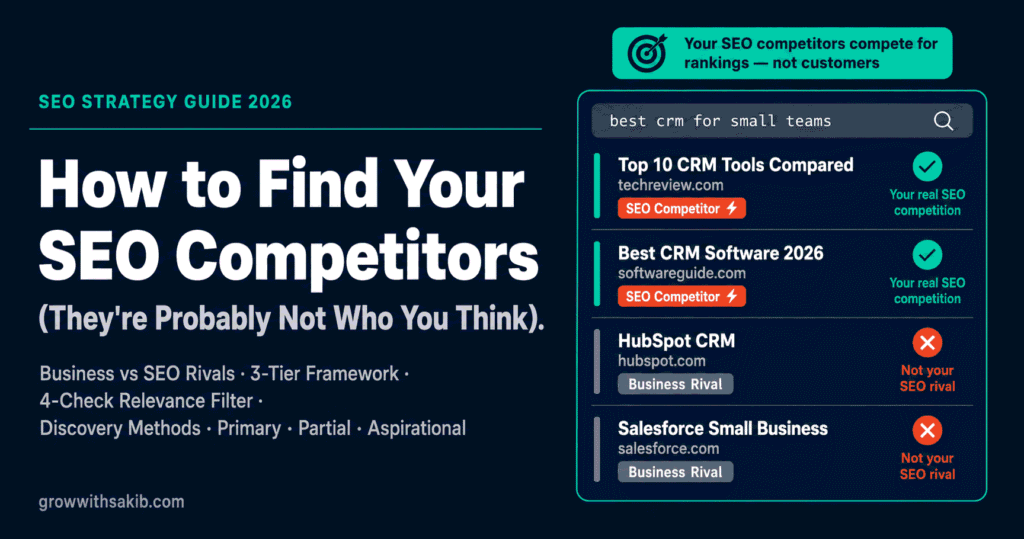
Here’s the problem: your SEO competitors are often completely different from your business competitors. The site stealing your search traffic might be a blog, a marketplace, or a media outlet you’ve never thought of as a rival.
This expands the SEO-competitor type in our complete guide to competitor research. Getting this right matters, because every other analysis you run depends on having the correct competitors in front of you.
Business Competitors vs SEO Competitors: What’s the Difference?
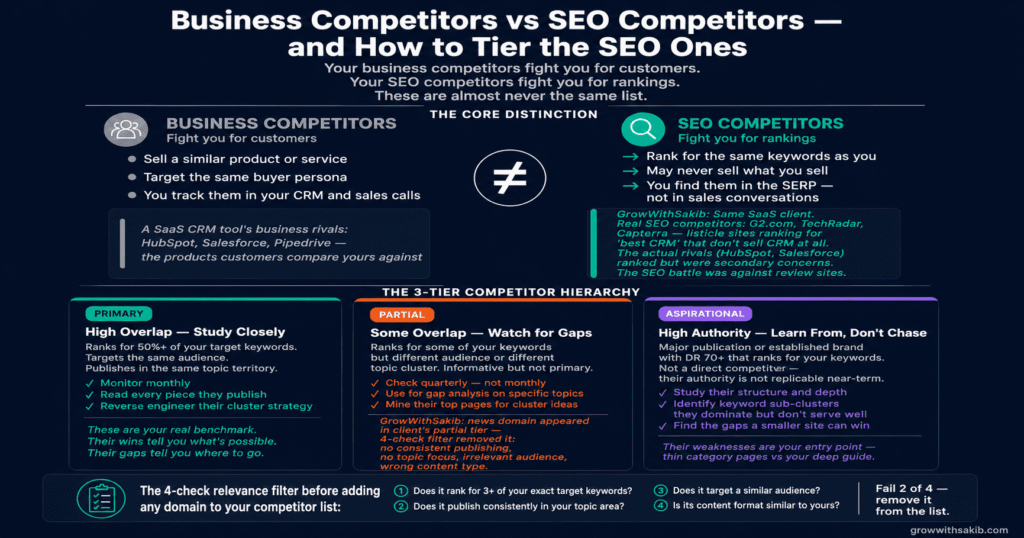
A business competitor sells what you sell to the customers you want. An SEO competitor ranks for the keywords you want — whether or not they sell anything at all.
The two overlap, but never completely. A local accounting firm competes for clients with other local firms, but in search it competes with national finance blogs, government tax pages, and sites like Investopedia. Those blogs will never steal a client — but they’ll absolutely steal the ranking — this is why direct vs indirect competitors in business never maps cleanly onto your SEO competitor set.
| Business competitor | SEO competitor | |
|---|---|---|
| Competes for | Customers | Search rankings |
| Examples | Direct rivals in your niche | Blogs, publishers, marketplaces, aggregators |
| Why it matters | Pricing, positioning | Who you must outrank for traffic |
Your SEO Competitors Change With Every Keyword
This trips people up: you don’t have one fixed set of SEO competitors. You have different competitors for different keywords, because intent shifts who Google ranks.
For a broad informational keyword, you might compete with Wikipedia and big publishers. For a commercial “best [product]” keyword, you compete with review sites. For a bottom-funnel “buy [product]” keyword, you compete with actual stores. Same business, three different competitor sets.
That’s why the content gap analysis you run is only as good as the competitors you feed it — match them to the keywords and intent you’re targeting, not to a single generic list.
How to Find Your SEO Competitors: 4 Methods
Method 1: Read the SERP (free, fast)
Search your most important keywords in Google, in an incognito window to avoid personalised results. The domains that appear on page one for those keywords are, by definition, your SEO competitors for them. Note who shows up repeatedly across several of your target keywords — those are your core search rivals.
Method 2: Use the Organic Competitors report (tool-based)
An SEO tool does this at scale. Ahrefs’ Organic Competitors report and Semrush’s equivalent list sites ranking for the same keywords as you, sorted by overlap. We cover the exact workflow in our walkthrough on using Ahrefs for competitor analysis. This surfaces rivals you’d never have guessed.
Method 3: Mine Google Search Console (free, your data)
Open the Performance report in Google Search Console, which shows the queries you already appear for. Take your page-two queries, search them, and see who’s beating you on page one. Those are the competitors you’re closest to overtaking — the most actionable set of all.
Method 4: Check ‘people also search for’ and related results
Google’s own related searches and “people also search for” suggestions reveal adjacent terms — and the sites ranking for them are often competitors for topics you haven’t targeted yet. It’s a quick way to find competitors at the edges of your niche.
Filter the Noise: Are They Really a Competitor?
A tool will hand you a long list. Not all of them matter. Run each candidate through a quick relevance test — if it fails two or more, it’s noise:
- Topical overlap: do they rank for the themes you want to grow, not just one stray keyword? A shadow competitor fails this check entirely — they rank for your keywords but serve a different job entirely.
- Intent overlap: do they serve the same search intent, or are they a publisher with a different angle?
- Format overlap: are they winning with pages your site could plausibly create?
- Audience overlap: would the same searcher find both of you useful?
Tier Your SEO Competitors
Once you’ve filtered, don’t treat the survivors equally. Sort them into three tiers so you spend effort where it pays.
| Tier | Who they are | How to treat them |
|---|---|---|
| Primary | Rank for many of your core keywords, similar site | Study closely; benchmark against them using Ahrefs for competitor analysis to measure their keyword footprint vs yours |
| Partial | Overlap on some keywords or one topic cluster | Watch; mine for specific gaps with competitor keyword analysis |
| Aspirational | Big sites you can’t outrank yet | Learn from, don’t chase head-on |
Feed your primary tier into a competitor SWOT analysis and your wider competitor analysis framework. Aspirational sites are for inspiration — don’t burn your budget trying to outrank a domain with ten years and a million backlinks on you.
Common Mistakes to Avoid
- Trusting the founder’s list. The brands you name aren’t always who ranks against you.
- Assuming one fixed competitor set. Competitors change by keyword and intent.
- Including every domain a tool returns. Filter with the four-check relevance test.
- Chasing aspirational giants. Outranking a massive authority site head-on rarely works early.
- Ignoring your own Search Console. Page-two queries reveal your most winnable rivals.
An Honest Note
No method gives a perfect, permanent list. Search results shift, Google tests new layouts, and your competitor set moves as you climb. Treat this as a living list you refresh, not a one-time exercise.
It also varies by business type. Local businesses compete mostly within a geographic SERP and the map pack, so their SEO competitors look very different from a global SaaS brand’s — the local SEO for small business guide covers exactly how that local SERP works. And with AI Overviews changing some result pages, “who ranks” is getting murkier — read the whole SERP, not just the blue links, when you size up who you’re really up against.
Frequently Asked Questions
How do I find my SEO competitors?
Search your target keywords in an incognito Google window and note which domains rank repeatedly — those are your SEO competitors. To do it at scale, use the Organic Competitors report in Ahrefs or Semrush, which lists sites ranking for the same keywords. Then mine Google Search Console for page-two queries to find the rivals you’re closest to overtaking.
Are SEO competitors the same as business competitors?
No. A business competitor sells what you sell to the same customers; an SEO competitor ranks for the keywords you want, whether they sell anything or not. They overlap but never fully. Blogs, publishers, marketplaces, and aggregators are often your biggest SEO competitors despite never competing for a single customer.
Who are my SEO competitors if I’m a small business?
For local businesses, your SEO competitors are usually other local providers in the same geographic results and map pack, plus national directories and informational sites ranking for your keywords. They differ sharply from a global brand’s competitors. Search your core local keywords to see exactly who appears — that’s your real competitive set.
How many SEO competitors should I track?
Tier rather than count. Focus closely on three to five primary competitors who rank for many of your core keywords, keep a lighter watch on partial-overlap sites, and learn from — but don’t chase — aspirational giants. Tracking everything a tool returns wastes effort on domains you’ll never realistically outrank.
Why do my SEO competitors change for different keywords?
Because search intent changes who Google ranks. A broad informational keyword may pit you against Wikipedia and publishers, a “best product” keyword against review sites, and a “buy” keyword against stores. Same business, different competitor sets — which is why you match competitors to the specific keywords and intent you’re targeting.
Can I find SEO competitors for free?
Yes. Searching your keywords in Google reveals who ranks, and Google Search Console shows queries you already appear for — take your page-two queries and see who beats you. Google’s related searches and “people also search for” suggestions surface adjacent competitors too. These free methods cover most of what a paid tool would show a small site.
What’s a SERP competitor?
A SERP competitor is any site that appears on the search engine results page for a keyword you target. It’s the most literal definition of an SEO competitor — whoever you’d have to outrank to win that result. SERP competitors often include sites that aren’t your business rivals at all, like blogs, forums, and large publishers.
Key Takeaways
- Your SEO competitors are whoever ranks for your keywords — often not your business rivals.
- Don’t trust the founder’s list; read the actual SERPs to see who really ranks.
- Competitor sets change by keyword and intent — there’s no single fixed list.
- Use SERPs and Search Console free, or Organic Competitors reports at scale.
- Filter candidates with four checks: topical, intent, format, and audience overlap.
- Tier survivors into primary, partial, and aspirational — don’t chase the giants.
- Page-two queries in Search Console reveal your most winnable competitors.
- Refresh the list regularly; it shifts as you climb and as SERPs change.