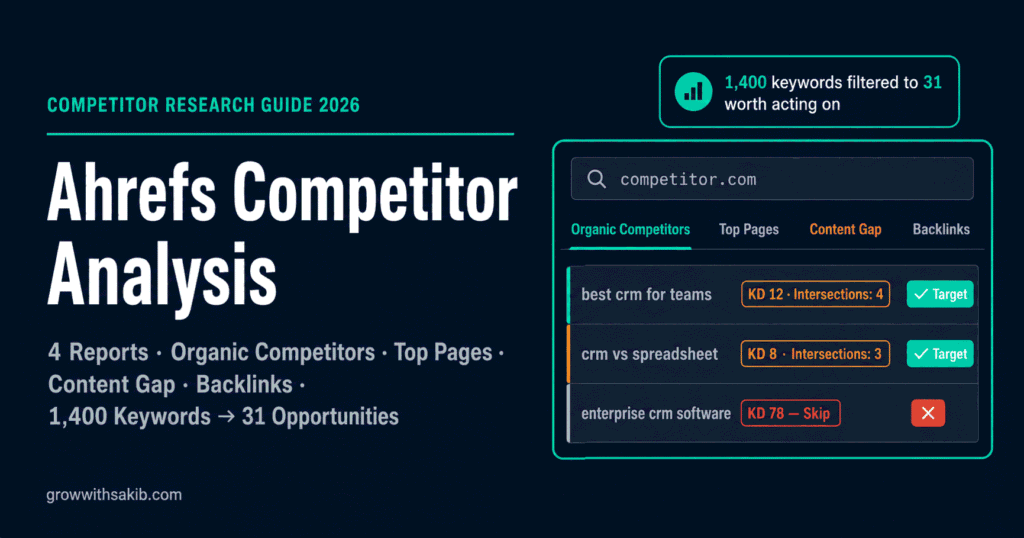
Most people open Ahrefs, get hit with a wall of tabs and numbers, and close it again. The tool is powerful, but power without a workflow is just noise.
This is a practical Ahrefs competitor analysis walkthrough — one ordered path through the reports that actually matter, in the sequence that turns raw data into an opportunity list. No feature tour, no clicking around hoping something useful appears.
This expands the Ahrefs row in our complete guide to competitor research. If you want the broader research process around it, the pillar covers that; here we stay inside the tool.
What Can Ahrefs Actually Tell You About Competitors?
Ahrefs is an SEO platform built around a large index of pages and links. For competitor work, it answers three questions: what topics a rival ranks for, which of their pages perform best, and where their links come from. Ahrefs’ own team describes the Content Gap tool as showing keywords your competitors rank for but you don’t — which is the heart of competitor analysis.
You don’t need every feature. Four reports do most of the work, and we’ll go through them in the order that makes sense.
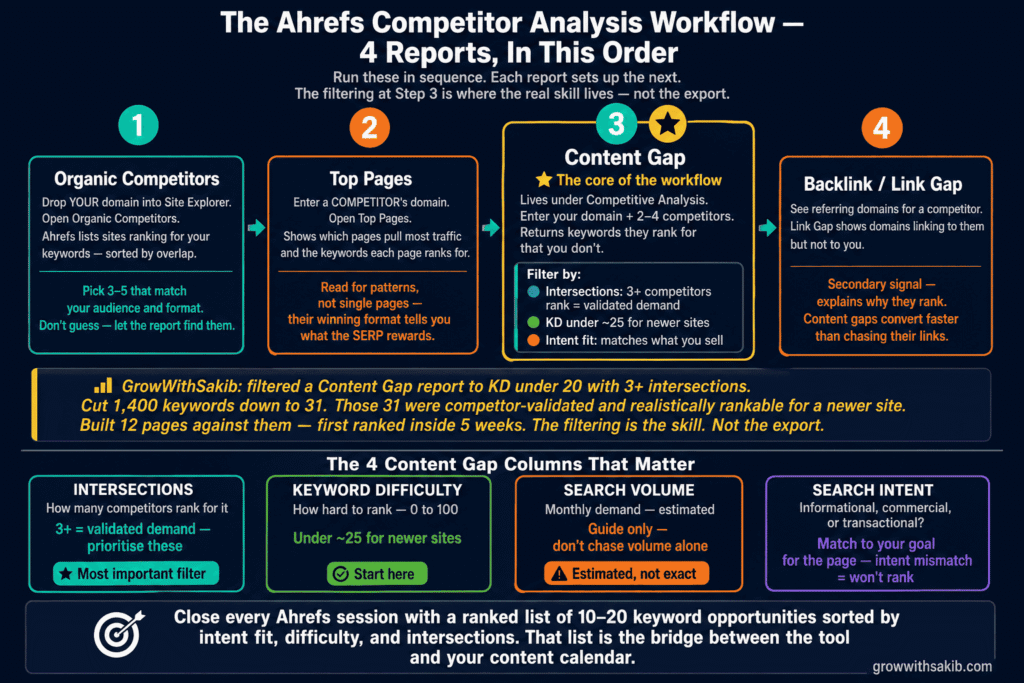
The Ahrefs Competitor Analysis Workflow (4 Reports, In Order)
Run these in sequence. Each one sets up the next.
| Order | Report | What it answers |
|---|---|---|
| 1 | Organic Competitors | Who actually competes with you in search? |
| 2 | Top Pages | What content drives their traffic? |
| 3 | Content Gap | Which keywords do they rank for that you don’t? |
| 4 | Backlink / Link Gap | Where do their links come from? |
Step 1: Find your real competitors (Organic Competitors)
Drop your own domain into Site Explorer, then open the Organic Competitors report. Ahrefs lists sites that rank for the same keywords you do, ranked by overlap. This is how you find your real SEO and content competitors instead of guessing — and it often surprises people.
Pick three to five from this list that genuinely match your audience and format. Ignore the ones that overlap on a few keywords but serve a totally different intent.
Step 2: See what works for them (Top Pages)
Enter a competitor’s domain in Site Explorer and open Top Pages. This shows which of their pages pull the most organic traffic and which keywords each page ranks for. Reviewers note this is one of Ahrefs’ strongest views because it connects traffic directly to specific URLs.
Read it for patterns, not single pages. If a competitor’s top 10 pages are all comparison posts or all how-to guides, that’s their winning format — and a signal about what the SERP rewards in your niche.
Step 3: Find the keywords you’re missing (Content Gap)
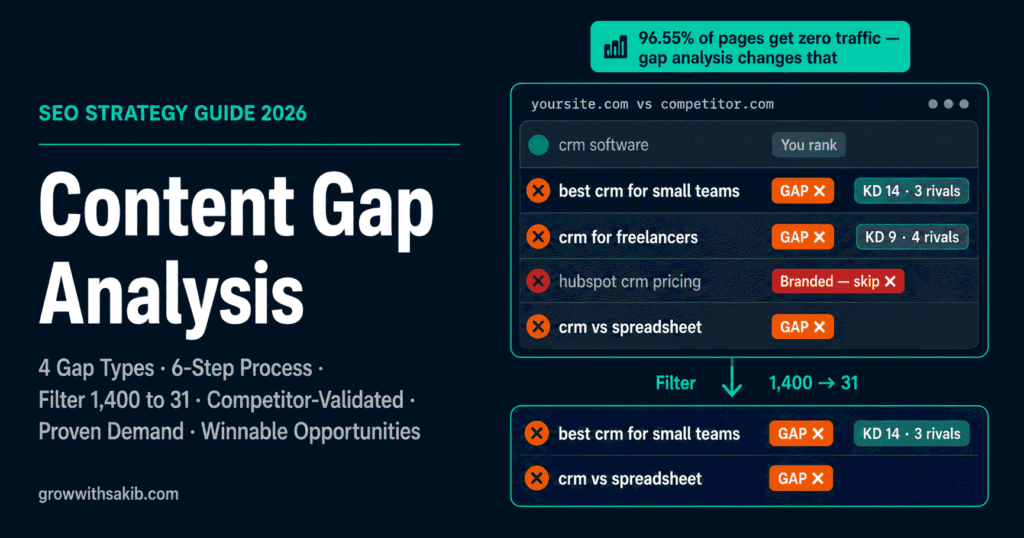
This is the core of the whole exercise. The Content Gap tool now lives under Competitive Analysis in Ahrefs. Enter your domain as the target, add two to four competitors, and run the comparison. It returns keywords at least one competitor ranks for where you don’t.
Don’t just export the whole list. Read these columns to prioritise:
- Intersections: how many of your competitors rank for the keyword. More intersections = a stronger, more proven opportunity.
- Keyword Difficulty (KD): how hard it is to rank, 0–100. Newer sites should start with KD under ~25.
- Search Volume: rough monthly demand — but don’t chase volume alone.
- Search Intent: informational, commercial, or transactional — match it to your goal for the page.
The sweet spot is a keyword with high intersections, low KD, and intent that fits your business — the keyword research for small business guide explains how to apply this same scoring logic to your own keyword discovery, not just competitor gap analysis. For the full strategic version of this step, see our dedicated guide on how to find and fill content gaps.
Step 4: Understand their links (Backlink / Link Gap)
Open a competitor’s backlink profile in Site Explorer to see their referring domains. The Link Gap view (also under Competitive Analysis) shows domains linking to competitors but not to you. Ahrefs maintains one of the largest backlink indexes in the industry, so this data is deep — sometimes overwhelmingly so.
Treat links as a secondary signal. They explain why a competitor ranks, but for most digital businesses, the Content Gap opportunities are faster to act on than chasing the same backlinks.
Turning the Data Into an Action List
A pile of reports isn’t a strategy. Close every Ahrefs session by writing a short, ranked list: the 10–20 keyword opportunities worth pursuing, sorted by a simple score of intent fit, difficulty, and intersections — then feed the most relevant ones into a competitor SWOT analysis to place keyword insights in the context of broader competitive positioning.
That list is the bridge between the tool and your content calendar. It also slots straight into the broader competitor analysis framework as the data step — Ahrefs fills the evidence, the framework decides what to do with it.
Common Mistakes to Avoid
- Guessing your competitors. Use Organic Competitors first; your search rivals may not be your business rivals.
- Exporting everything. A 1,400-keyword export is procrastination. Filter by KD, intent, and intersections.
- Chasing volume over intent. A high-volume keyword that doesn’t fit your business wastes a page.
- Obsessing over backlinks. For most sites, content gaps convert to results faster than link-chasing.
- Treating one export as permanent. Rankings shift; re-run the workflow each cycle — build a competitor monitoring system to alert you when significant shifts happen between full Ahrefs sessions.
Where Ahrefs Has Limits (an Honest Note)
Ahrefs data is estimated, not exact. Search volume and traffic figures come from its own model, and they can differ from other tools and from Google’s own data. Use the numbers for relative comparison, not as gospel.
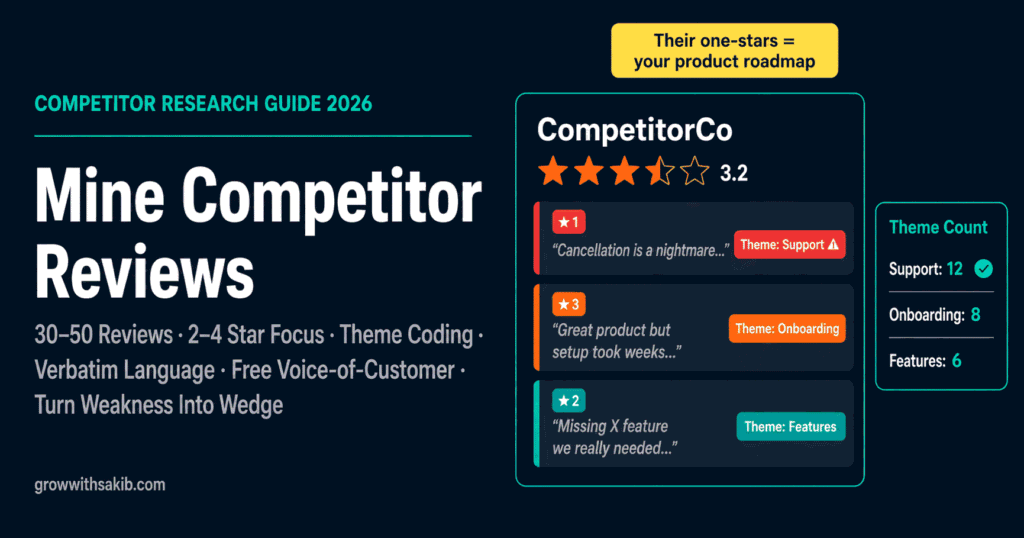
It’s also a paid tool, and serious use pushes you toward higher plans. For very small businesses or one-off research, the free Webmaster Tools or a cheaper alternative may be enough — we compare options in our guide to the best competitor analysis tools. And Ahrefs only sees search; it won’t tell you about a competitor’s paid social, email, or product experience. Pair it with review mining and ad-library research for the full picture — together they cover what the complete competitor research guide calls the three evidence pillars: search, sentiment, and paid creative.
Frequently Asked Questions
How do you use Ahrefs for competitor analysis?
Enter your domain in Site Explorer and open Organic Competitors to find real search rivals. Then check each competitor’s Top Pages to see what drives their traffic, run the Content Gap tool to find keywords they rank for and you don’t, and review their backlinks. Finish by turning the findings into a prioritised opportunity list.
Where is the content gap tool in Ahrefs?
The Content Gap tool now lives under the Competitive Analysis section in Ahrefs. You enter your own domain as the target, add a few competitor domains, and run the comparison. It returns keywords that at least one competitor ranks for in the top results while your site doesn’t — the core of competitor SEO analysis.
How do I find my competitors in Ahrefs?
Use the Organic Competitors report. Drop your domain into Site Explorer and Ahrefs lists sites ranking for the same keywords, sorted by overlap. This finds your true search competitors, which often differ from the business rivals you’d name from memory. Pick three to five that genuinely match your audience and content format.
Is Ahrefs good for competitor research?
Yes — it’s one of the strongest tools for search-based competitor research, with deep data on rankings, top pages, content gaps, and backlinks. Its main limits are that data is estimated rather than exact, it’s a paid tool, and it only covers search. Pair it with review and ad research for a complete view.
What’s the difference between Content Gap and Keyword Gap?
They’re essentially the same idea under different names — Ahrefs calls it Content Gap, while Semrush calls it Keyword Gap. Both compare your keyword coverage against competitors to reveal terms they rank for and you don’t. Ahrefs places its version inside the Competitive Analysis section of the platform.
How many competitors should I compare in Ahrefs?
Two to four works best in the Content Gap tool. Fewer than two and you miss validated patterns; more than four and the report fills with noise and edge cases. Use the Intersections column to see how many of them rank for each keyword — higher intersections signal a stronger, more reliable opportunity.
Can I do competitor analysis on Ahrefs for free?
Ahrefs offers free Webmaster Tools for sites you own, but full competitor analysis — including the Content Gap and Organic Competitors reports — requires a paid plan. For one-off or budget research, free alternatives exist, though they’re shallower. For ongoing serious competitor work, a paid plan pays for itself in saved guesswork.
Key Takeaways
- Run Ahrefs reports in order: Organic Competitors, Top Pages, Content Gap, then backlinks.
- Let Ahrefs find your real search competitors — don’t guess them from memory.
- Top Pages reveals a competitor’s winning content format, not just individual posts.
- The Content Gap tool lives under Competitive Analysis; it’s the core of the workflow.
- Prioritise gaps by intersections, keyword difficulty, and intent fit — not volume alone.
- Filtering the data is the real skill; a giant export is not a strategy.
- Ahrefs data is estimated and search-only — pair it with reviews and ad research.
- End every session with a ranked opportunity list for your content calendar.