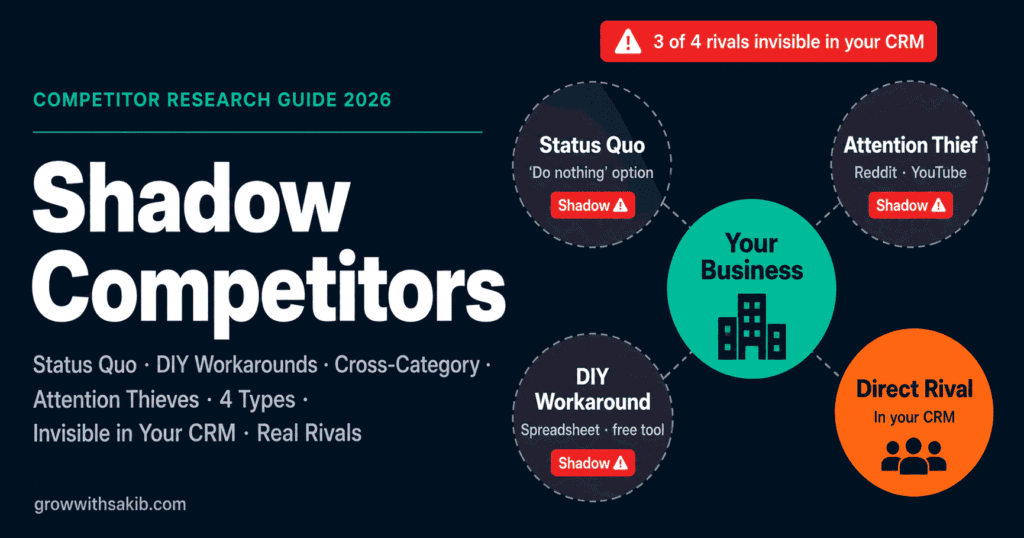
You lost the sale, but not to a competitor on your list. The customer didn’t pick a rival — they picked a spreadsheet, a free workaround, or simply decided to do nothing at all. You never saw it coming, because that rival was never on your radar.
Those are shadow competitors: the rivals that quietly take your customers without ever showing up in your competitive analysis. They’re the hardest to see and, often, the most expensive to ignore.
This goes a layer deeper than the competitor-types covered in our complete guide to competitor research, and builds on the distinction between direct and indirect competitors — shadow competitors are the ones hiding even beyond “indirect.”
Shadow Competitors vs Indirect Competitors: What’s the Difference?
They overlap, but they’re not the same. An indirect competitor still solves the same need with a recognisable product — a gym versus a fitness app. You can name it; it’s in your industry’s orbit.
A shadow competitor is harder to see because it often sits outside your category entirely, or isn’t a “product” at all. It competes for the same finite resource — the customer’s budget, time, or attention — from somewhere you’d never think to look. Every shadow competitor is indirect, but not every indirect competitor is hidden enough to be a shadow.
The Biggest Shadow Competitor: Doing Nothing
Here’s the rival almost no competitive analysis includes, and it beats everyone: the customer choosing to do nothing. The status quo. Sticking with the current mess because changing feels like effort.
For most digital businesses, “no decision” wins more often than any named competitor. The prospect agrees they have a problem, nods at your solution — and then just… doesn’t act. If you’re only positioning against other vendors, you’re ignoring the option that actually takes most of your lost deals.
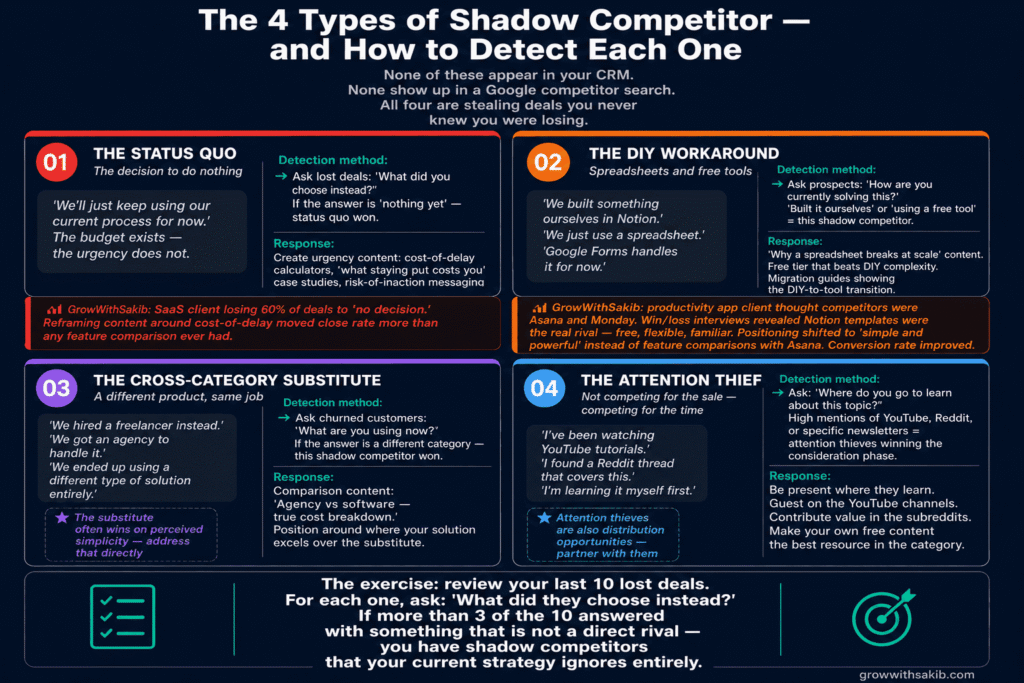
The 4 Types of Shadow Competitor
| Type | What it is | Example |
|---|---|---|
| The status quo | Customer does nothing / keeps current habit | Sticking with manual spreadsheets |
| The DIY workaround | Customer builds their own free fix | Using a free template instead of a tool |
| Cross-category substitute | A different category fills the same job | A podcast app ‘competing’ with a book |
| The attention thief | Anything competing for the same time | Social feeds vs your content |
Notice none of these would appear if you listed “companies like mine.” They compete on the customer’s terms — their budget, their hours, their focus — not on your category’s terms. A competitor SWOT analysis is the right place to capture and categorise them once identified.
How to Uncover Your Shadow Competitors
You can’t track what you can’t see, so detection is the whole game. Four methods surface shadow competitors reliably.
1. Ask lost prospects what they did instead
The most direct method. When a deal dies or a trial doesn’t convert, ask one question: “What are you doing instead?” The answers — “we just kept using email,” “we built a spreadsheet” — name your shadow competitors in the customer’s own words.
2. Read reviews for what customers switched from
Customers often describe what they used before in reviews — “I was managing this in my notes app until…” Those “before” stories reveal the shadow options your category replaces. This is one more reason mining competitor reviews pays off; the switched-from mentions are pure shadow-competitor data.
3. Look at what ranks for your problem keywords
Search the problem your product solves, not your product category — and check whether AI Overviews are answering it directly, since AI-generated answers are themselves a shadow competitor taking clicks before any organic result appears. The results often include free templates, DIY guides, and tools from other categories — all shadow competitors for that need — and a content gap analysis can reveal which of those results you are not yet ranking against. This overlaps with competitor keyword analysis, which routinely surfaces rivals from outside your industry through problem-keyword searches.
4. Map the customer’s whole job, not your product
Step back and ask what job the customer is really hiring you to do. Then list every other way they could get that job done — including ways that look nothing like your product. That full list is your true competitive set, shadows included — and the starting point for a proper competitor analysis framework.
How to Respond (Without Chasing Ghosts)
You can’t out-feature “doing nothing,” and you shouldn’t try to beat every cross-category option. The response to shadow competitors is mostly about messaging: make the cost of the status quo vivid, and show why your way beats the free workaround for the job that matters. Understanding competitor pricing analysis helps you position your price against the perceived cost of free alternatives. Feed the strongest shadow competitors into your competitor analysis framework so they’re tracked deliberately, not forgotten.
But keep perspective. Not every shadow is worth fighting. If a shadow competitor only takes a tiny slice of would-be customers, naming it is enough — don’t redesign your strategy around a ghost. Spend your energy on the shadow rivals that actually win deals, usually the status quo and the credible DIY fix.
Common Mistakes to Avoid
- Ignoring ‘do nothing’. The status quo wins more deals than any named rival — position against it.
- Only listing companies. Shadow competitors are often habits, workarounds, or free tools, not businesses.
- Never asking lost prospects. The simplest detection method — “what did you do instead?” — is the most ignored.
- Chasing every shadow. Some take too few customers to matter — don’t redesign around ghosts.
- Searching your category, not the problem. Shadows hide in problem-keyword results, not category ones — the same reason SEO for small business prioritises problem-intent keywords over category keywords for content strategy.
An Honest Note on Shadow Competitors
Shadow competitors are real, but the concept can be overused. Almost anything can be framed as competing for a customer’s attention or money, and if you take that too far, your competitor list becomes infinite and useless. The discipline is to track only the shadows that actually cost you customers, confirmed by lost-deal and review evidence — not every theoretical alternative.
The mix also shifts by business type. In a new or category-creating market, the status quo and DIY workarounds are your main rivals, because customers don’t yet know they need your category. In a mature market, named competitors matter more. Weight your attention to where your deals are actually going, and revisit it as the market evolves — use competitor monitoring to track when the balance shifts.
Frequently Asked Questions
What are shadow competitors?
Shadow competitors are non-obvious rivals that compete for your customer’s money, time, or attention without sharing your product category. They include cross-category substitutes, free or DIY workarounds, and the customer’s option to do nothing. Because they never appear in a standard competitor list, they cause lost deals that businesses often can’t explain.
What’s the difference between shadow and indirect competitors?
Indirect competitors solve the same need with a recognisable product in your industry’s orbit, like a gym versus a fitness app. Shadow competitors are harder to see — they often sit outside your category entirely or aren’t products at all, like a spreadsheet or the choice to do nothing. Every shadow competitor is indirect, but not every indirect competitor is truly hidden.
Is ‘doing nothing’ really a competitor?
Yes — and often the biggest one. For most digital businesses, the customer choosing the status quo wins more lost deals than any named rival. Prospects agree they have a problem, then simply don’t act because change feels like effort. If you only position against other vendors, you ignore the option that actually takes most of your losses.
How do I find my shadow competitors?
Ask lost prospects what they did instead, read reviews for what customers switched from, search the problem your product solves (not your category) to see what ranks, and map the full job your customer is hiring you to do. Each method surfaces rivals — habits, workarounds, free tools — that never appear in a standard competitor list.
Why do shadow competitors matter?
Because they cause losses you can’t otherwise explain. When deals die not to a known rival but to inertia, a free workaround, or a cross-category option, your strategy misses the real fight. Identifying shadow competitors lets you position against what customers actually choose instead of you — usually the status quo — rather than only against obvious vendors.
Can a free tool be a shadow competitor?
Absolutely. A free template, a built-in app feature, or a DIY workaround is one of the most common shadow competitors. Customers frequently choose “simple and free” over “feature-rich and paid,” especially early on. If people solve their problem with a free hack instead of buying, that hack is a shadow competitor worth understanding and positioning against.
Should I track every shadow competitor?
No. Almost anything can be framed as competing for attention or money, so an unlimited shadow list becomes useless. Track only the shadows that actually cost you customers — confirmed by lost-deal feedback and review evidence — usually the status quo and a credible DIY fix. Name minor shadows, but don’t redesign your strategy around ghosts.
Key Takeaways
- Shadow competitors compete for your customer’s money, time, or attention from outside your category.
- The biggest shadow competitor is usually ‘doing nothing’ — the status quo.
- They include the status quo, DIY workarounds, cross-category substitutes, and attention thieves.
- Ask lost prospects “what did you do instead?” — the simplest, most ignored detection method.
- Reviews and problem-keyword searches reveal what customers switched from or use instead.
- Respond mostly through messaging — make the cost of the status quo vivid.
- Don’t chase every shadow; track only the ones that actually cost you deals.
- The mix shifts by market — status quo dominates new categories, named rivals dominate mature ones.