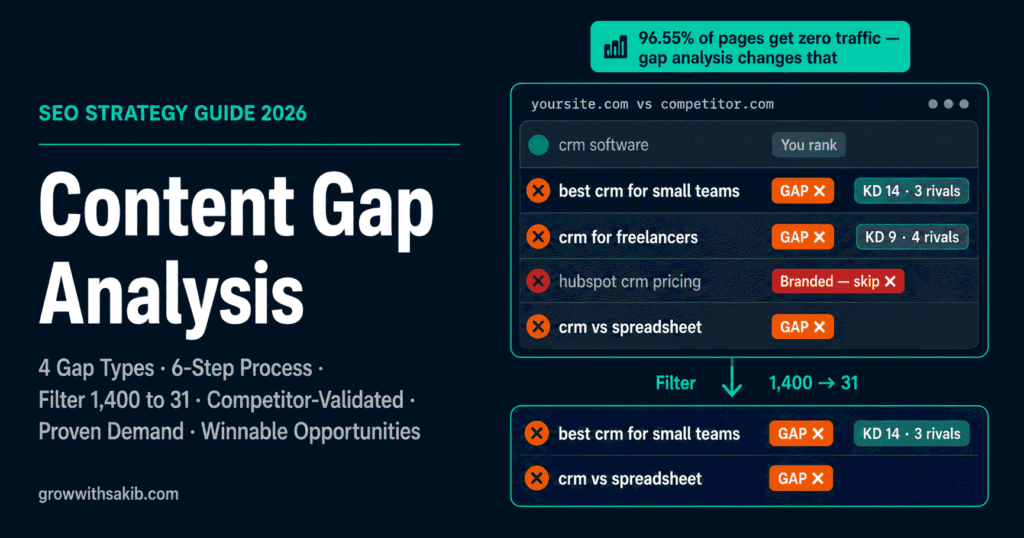
Here’s a number that should change how you plan content: Ahrefs studied 14 billion pages and found 96.55% of them get zero traffic from Google. Most content fails not because it’s badly written, but because it targets the wrong thing.
A content gap analysis fixes that at the planning stage. Instead of guessing what to write, you find the exact topics your competitors already rank for — proven demand — that your site is missing.
This expands Step 4 of our complete guide to competitor research. Here we go deep on the method — and on the part most guides skip: what to do with the giant list a tool hands you.
What Is a Content Gap Analysis?
A content gap analysis compares what your site covers against what competitors cover, then surfaces the difference. That difference — the gap — is where the opportunity sits.
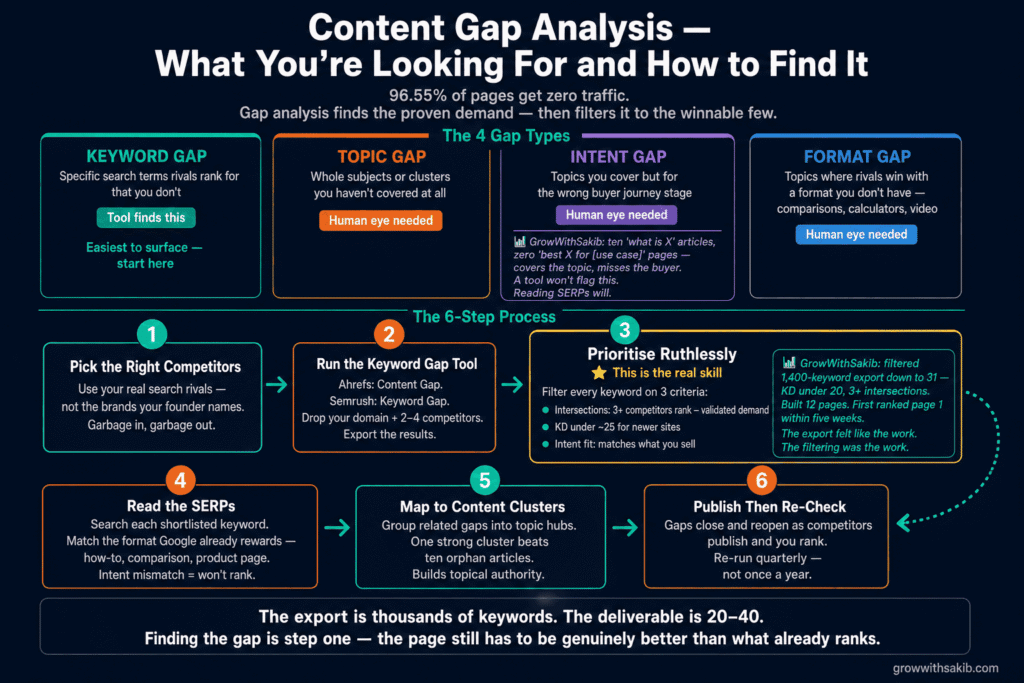
Most people think it’s purely about keywords. It’s broader than that. There are four kinds of gap worth hunting:
- Keyword gaps: specific search terms competitors rank for and you don’t.
- Topic gaps: whole subjects or clusters you haven’t covered at all.
- Intent gaps: topics you cover, but for the wrong stage of the buyer journey — the search intent guide covers how to diagnose and fix intent mismatches for pages that already exist.
- Format gaps: topics where competitors win with a format you don’t have — comparisons, calculators, video.
Keyword gaps are the easiest to find with a tool. The other three need a human eye — which is exactly why this skill still matters.
How to Do a Content Gap Analysis: 6 Steps
Step 1: Pick the right competitors
Garbage in, garbage out. If you feed the analysis the wrong competitors, you’ll get a tidy report full of keywords you should never chase. Use your real search rivals, not the brands your founder names — our guide on how to find your SEO competitors shows how to identify them properly.
Step 2: Run the keyword gap (with a tool)
Drop your domain plus two to four competitors into a gap tool — Ahrefs calls it Content Gap, Semrush calls it Keyword Gap. Both return keywords at least one competitor ranks for where you don’t. For the exact Ahrefs workflow, see our walkthrough on using Ahrefs for competitor analysis.
Step 3: Prioritise ruthlessly (the real skill)
A gap tool will hand you thousands of keywords. The export is not the deliverable — the filtered shortlist is. Score each opportunity on three things:
- Intersections: how many competitors rank for it. More = more validated demand.
- Keyword difficulty: can you realistically rank? Newer sites should start under ~25 — specifically targeting long-tail keywords where lower competition and stronger intent make early rankings achievable.
- Intent fit: does this keyword match what your business actually sells or serves?
Cut hard. A list of 1,400 keywords becomes 30 worth acting on. Those 30 are competitor-validated, winnable, and relevant — the other 1,370 are noise.
Step 4: Read the SERPs for intent and format
Before writing, search each shortlisted keyword and look at what already ranks. Are the top results how-tos, comparisons, or product pages? That tells you the intent and format Google rewards. Match it, or your perfectly-chosen keyword still won’t rank.
Step 5: Map gaps to a content plan
Group your shortlist into clusters — related keywords that belong in one piece or one hub. This is how a gap analysis builds topical authority instead of a pile of disconnected posts. One strong cluster beats ten orphan articles.
Step 6: Publish, then re-check
Gaps close and reopen as competitors publish and you rank. Re-run the analysis each quarter as part of your competitor analysis framework so your content plan stays ahead rather than reacting late — and track SEO results monthly to confirm which gap pages are gaining ranking traction.
No Paid Tool? A Free Manual Method
You can do a lighter content gap analysis without a subscription. It’s slower, but it works.
Pick your top competitor and browse their blog or resources section. List the topics they cover that you don’t. Then search your core keywords in Google and note which competitor pages rank that you have no equivalent for. Finally, check Google Search Console for queries where you appear on page two — those are near-miss gaps you can close by improving existing content.
It’s manual, but for a small site it surfaces the same big opportunities a tool would.
Why Found Gaps Still Don’t Rank (Common Mistakes)
- Chasing volume over intent. A high-volume keyword that doesn’t fit your business wastes a page.
- Publishing the keyword, ignoring the SERP. If the SERP wants a comparison and you write a definition, you lose.
- Treating the export as the plan. Filtering to the winnable few is the actual skill.
- Feeding in the wrong competitors. Bad inputs produce a confident, useless report — which is why finding real SEO competitors is Step 1, not an afterthought.
- Writing orphans. Cluster related gaps into hubs to build topical authority.
An Honest Note on Content Gap Analysis
A content gap analysis tells you what’s missing — it doesn’t guarantee a ranking. With nearly 60% of Google searches now ending without a click thanks to AI Overviews and featured snippets, ranking for a keyword no longer always means traffic. Choose gaps where a click still has value, not just where a ranking is winnable.
It also won’t fix weak content. Finding the gap is step one; the page still has to be genuinely better than what ranks. And tool data is estimated, so treat difficulty and volume as guides, not guarantees. For very new sites, even “low difficulty” keywords can take months — patience is part of the method, and the complete competitor research guide explains how gap analysis fits within the wider research system.
Frequently Asked Questions
What is a content gap analysis?
A content gap analysis is the process of finding topics and keywords your competitors rank for that your site doesn’t. You compare your content coverage against rivals, surface the missing terms, prioritise them by difficulty and intent, and turn the winnable ones into a content plan — so you target demand that competitors have already validated.
How do you do a content gap analysis?
Pick your real search competitors, run a keyword gap report in a tool like Ahrefs or Semrush, then prioritise the results by intersections, difficulty, and intent fit. Read the SERPs to match the right format, group the winners into topic clusters, and publish. Re-run it quarterly, since gaps close and reopen over time.
What’s the difference between a content gap and a keyword gap?
A keyword gap is a specific search term competitors rank for and you don’t — it’s one type of content gap. A full content gap analysis is broader, covering missing topics, intent mismatches, and format gaps too. Ahrefs labels its tool “Content Gap” and Semrush calls its version “Keyword Gap,” but both find missing keywords.
Can you do a content gap analysis for free?
Yes, manually. Browse a competitor’s blog and list topics you don’t cover, search your core keywords to see which competitor pages rank without an equivalent on your site, and check Google Search Console for queries where you sit on page two. It’s slower than a paid tool but surfaces the same major opportunities for a small site.
How many keywords should a content gap analysis produce?
Far fewer than the tool shows. A gap report may return thousands of keywords, but the deliverable is a filtered shortlist — often 20 to 40 — that are competitor-validated, winnable for your site’s authority, and relevant to your business. The filtering down is the real skill, not the size of the export.
Why doesn’t my content rank even after finding the gap?
Usually an intent or quality mismatch. If the SERP rewards comparison pages and you publish a definition, you won’t rank despite targeting the right keyword. Finding the gap is only step one — the page must match search intent and be genuinely better than what currently ranks. Tool data is also estimated, so difficulty is a guide, not a promise.
How often should you run a content gap analysis?
Quarterly works for most digital businesses. Gaps close as you publish and rank, and new ones open as competitors add content, so a one-time analysis ages quickly. Running it on a regular cadence — ideally as part of a broader competitor analysis framework — keeps your content plan proactive rather than reactive.
Key Takeaways
- Almost all content gets no Google traffic — gap analysis targets proven demand instead of guesses.
- There are four gap types: keyword, topic, intent, and format — tools only catch the first easily.
- Feed the analysis your real search competitors, or the report is confidently useless.
- The export isn’t the deliverable — filter to the winnable few by intersections, difficulty, and intent.
- Read the SERP before writing; match the format and intent Google already rewards.
- Cluster related gaps into hubs to build topical authority, not orphan posts.
- You can run a lighter version free using competitor browsing and Google Search Console.
- Re-run quarterly — gaps close and reopen as you and competitors publish.