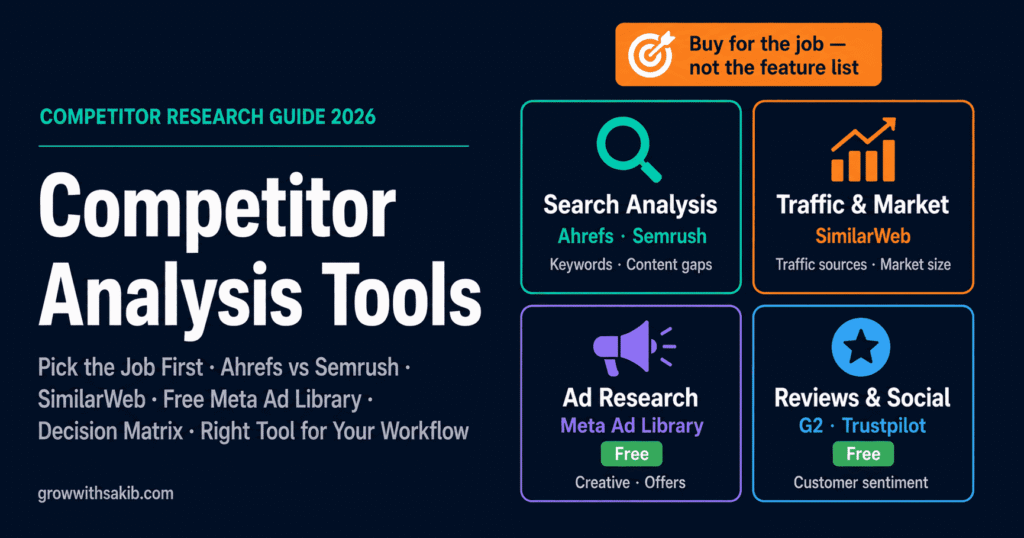
There are dozens of competitor analysis tools, and almost every “best tools” list reads the same: 20 logos, a feature dump, and an affiliate link. None of it helps you actually choose.
This comparison is organised differently — by the job you’re hiring a tool to do. Because the best competitor analysis tool for spying on ads is not the one for finding keyword gaps, and the right pick depends on your budget and business type, not on which brand shouts loudest.
This expands the tools section of our complete guide to competitor research. The pillar covers the research process; this article helps you build the toolkit to run it.
First, Pick the Job — Not the Tool
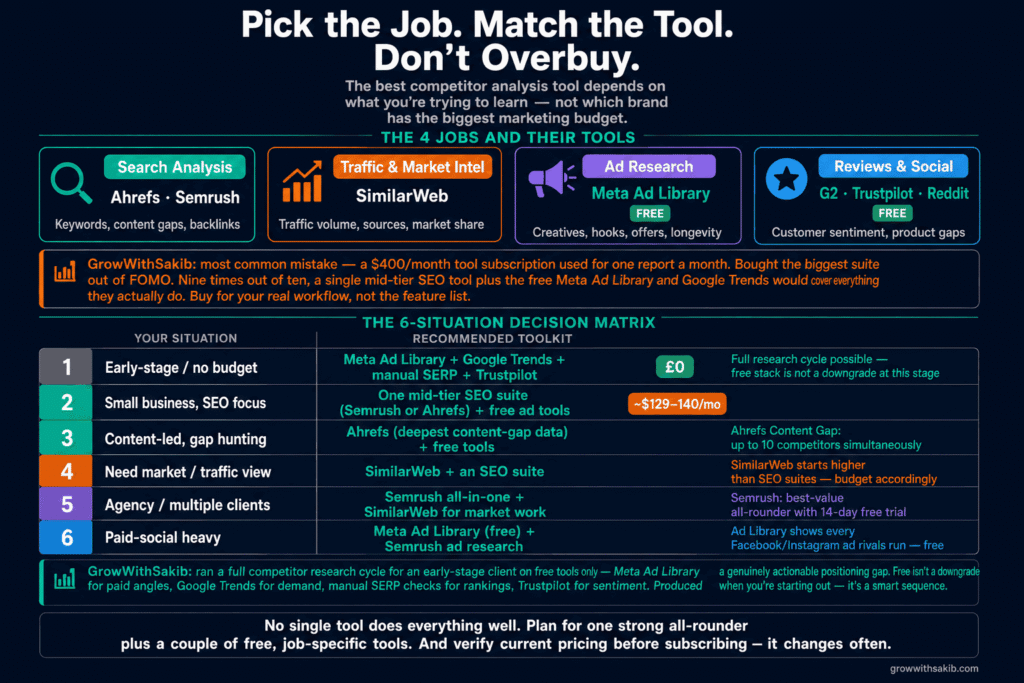
Competitor analysis isn’t one task. It’s four, and different tools win at each. Start by deciding which job you actually need done.
| The job | What you’re trying to learn | Tool category |
|---|---|---|
| Search analysis | What keywords and content rivals win on | SEO suites (Ahrefs, Semrush); see competitor keyword analysis for the full workflow |
| Traffic & market intel | How much traffic rivals get, from where | Market intelligence (SimilarWeb) |
| Ad research | What paid campaigns rivals run | Ad libraries (Meta Ad Library) |
| Reviews & social | What customers say about rivals | Review sites, social listening |
Most businesses overspend by buying a tool that does all four averagely, when they really only needed to nail one. Match the tool to the job and the budget question gets a lot smaller.
The Paid Heavyweights (Search & Market Intelligence)
Ahrefs — best for search and content-gap depth
Ahrefs is built around one of the largest backlink and keyword indexes in the industry, and it shines for finding the gaps between you and rivals. Reviewers note its Content Gap tool lets you compare against up to ten competitors at once, more than most rivals allow. Plans start around $129/month, with no free trial.
If search is your main battleground, this is the deep-dive tool — we walk through the exact workflow in our guide to using Ahrefs for competitor analysis.
Semrush — best all-in-one suite
Semrush does keyword research, site audits, PPC research, and increasingly AI-search visibility tracking. Independent comparisons in 2026 lean toward Semrush as the better-value all-rounder, starting around $139.95/month with a 14-day free trial. It also covers paid-ad research that Ahrefs doesn’t.
If you want one tool to cover the most ground, Semrush is usually the pick. If you want the deepest pure backlink and content-gap data, Ahrefs edges it.
SimilarWeb — best for traffic and market intelligence
SimilarWeb answers a different question: how much traffic a competitor gets and where it comes from — search, social, referral, direct. It’s the go-to for market-level benchmarking rather than keyword tactics, though it’s pricier, with entry pricing higher than the SEO suites. Best for analysts and businesses needing a whole-market view.
The Free Tools That Actually Work
You don’t need a paid subscription to start. These free tools cover real ground:
- Meta Ad Library: every Facebook/Instagram ad a competitor runs, free. See our guide on using the Meta Ad Library for competitor research.
- Google Trends: compare brand and topic interest over time and by region — great for spotting rising demand.
- Google Search (manual): searching your money keywords shows exactly who ranks. Old-fashioned, still useful — and the how to find SEO competitors guide turns this manual check into a full, tiered competitor identification process.
- Ahrefs Webmaster Tools: free for sites you own — limited, but enough for basic self-vs-rival checks.
- Review platforms (G2, Trustpilot): free customer intelligence on competitors; the basis of mining competitor reviews.
Which Tool Should You Choose? (Decision Matrix)
Match your situation to the recommendation below.
| Your situation | Recommended toolkit |
|---|---|
| Early-stage / no budget | Meta Ad Library + Google Trends + manual SERP + Trustpilot |
| Small business, SEO focus | One mid-tier SEO suite (Semrush or Ahrefs) + free ad tools |
| Content-led, gap hunting | Ahrefs (deepest content-gap data) + free tools |
| Need market/traffic view | SimilarWeb + an SEO suite |
| Agency / multiple clients | Semrush all-in-one + SimilarWeb for market work |
| Paid-social heavy | Meta Ad Library (free) + Semrush ad research |
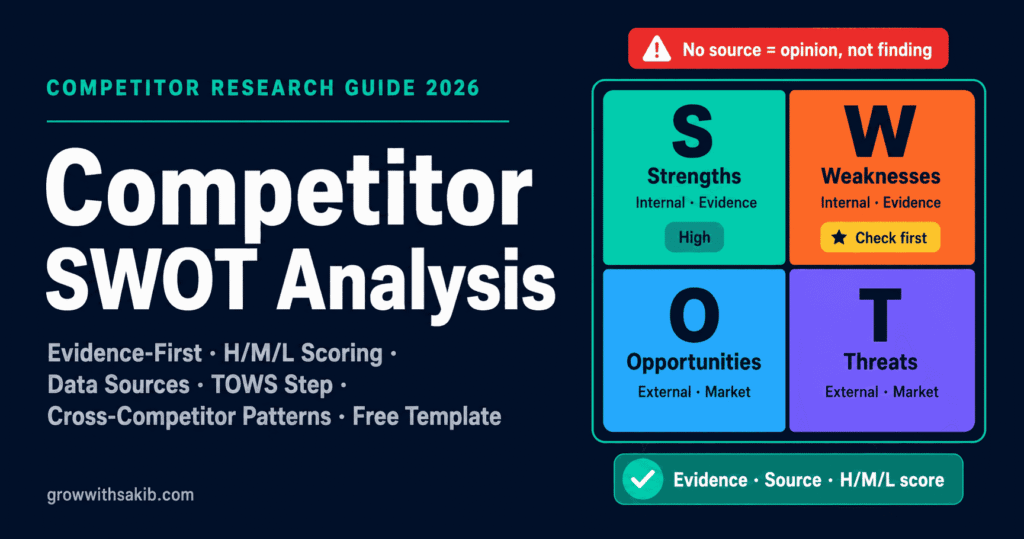
Whichever you pick, the tool only fills the data step. Deciding what to do with that data is the job of a competitor analysis framework — the tool is the input, the framework is the process — including the competitor SWOT analysis where you turn raw tool output into strategic decisions.
Common Mistakes to Avoid
- Buying the biggest suite out of FOMO. Match the tool to your real workflow, not the feature list.
- Trusting traffic numbers as exact. All tools estimate; use figures for relative comparison, not gospel.
- Ignoring free tools. The Meta Ad Library and Google Trends cover real ground for free.
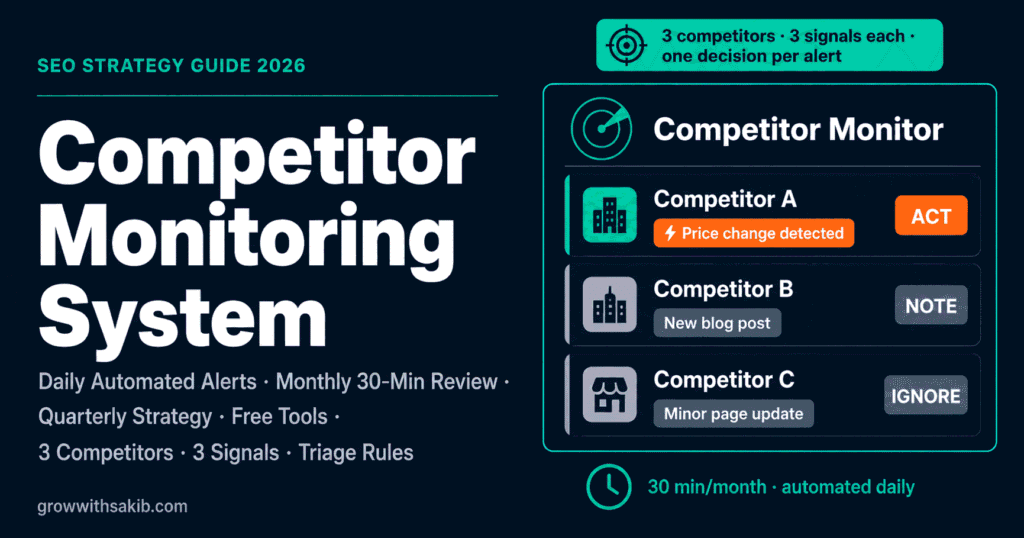
- Paying for one report a month. If usage is light, a cheaper tool or free stack is smarter — set up competitor monitoring alerts to get continuous value from free tools between paid research cycles.
- Expecting one tool to do everything. No single tool covers search, traffic, ads, and reviews well.
An Honest Note on Tool Data
Every tool here — paid or free — uses estimated data from its own crawlers and models. Search volume and traffic figures differ noticeably between platforms, so a keyword’s “2,400 searches” in one tool may read differently in another. Use the numbers to compare options against each other, not as absolute truth.
Pricing also changes often, and the figures here are starting points that shift with plans and promotions — always check the current page before buying. And the best tool genuinely depends on your size and goals: a solo founder and a 20-person agency should not buy the same stack. There’s no universal winner, only the right fit for your job — and whichever tool you choose, its value depends on the complete competitor research process you apply it to.
Frequently Asked Questions
What are the best competitor analysis tools?
It depends on the job. Ahrefs and Semrush lead for search and keyword-gap analysis, SimilarWeb for traffic and market intelligence, and the free Meta Ad Library for ad research. Most businesses need one paid all-rounder plus a few free tools rather than a whole stack of overlapping subscriptions.
What’s the best free competitor analysis tool?
The Meta Ad Library is the strongest free tool — it shows every Facebook and Instagram ad a competitor runs. Pair it with Google Trends for demand signals, manual Google searches for rankings, and review sites like G2 and Trustpilot for customer sentiment. Together these cover real ground at no cost.
Should I choose Ahrefs or Semrush?
Choose Semrush if you want one all-in-one suite covering SEO, PPC, and AI-search visibility — it’s often rated the better-value all-rounder. Choose Ahrefs if your priority is the deepest backlink and content-gap data, with a cleaner interface for link analysis. Both cost roughly the same; the difference is breadth versus depth.
Do I really need a paid competitor analysis tool?
Not always. Early-stage businesses can run a full research cycle with free tools — Meta Ad Library, Google Trends, manual SERP checks, and review sites. A paid tool pays off when you do competitor research regularly and need speed, depth, and keyword-gap data. Match the spend to how often you’ll actually use it.
Why do competitor tools show different traffic numbers?
Because every tool estimates traffic and search volume using its own crawlers and models rather than Google’s actual data. Figures can differ noticeably between Ahrefs, Semrush, and SimilarWeb for the same keyword or site. Use the numbers to compare competitors relative to each other, not as exact, absolute measurements — the same relative-measurement discipline that makes tracking SEO results useful even when absolute traffic numbers shift from platform to platform.
How much do competitor analysis tools cost?
Paid SEO suites typically start around $129–$140 per month, with SimilarWeb’s market-intelligence plans running higher. Prices change often with plans and promotions, so check current pricing before buying. Free tools like the Meta Ad Library and Google Trends cost nothing and are enough to begin serious research.
Can one tool cover all competitor research?
No single tool does search, traffic, ads, and customer reviews equally well. Suites like Semrush come closest by bundling several jobs, but you’ll still want the free Meta Ad Library for paid social and review sites for sentiment. Plan for one strong all-rounder plus a couple of free, job-specific tools.
Key Takeaways
- Choose tools by the job — search, traffic, ads, or reviews — not by brand hype.
- Semrush is the best-value all-rounder; Ahrefs wins on backlink and content-gap depth.
- SimilarWeb is the pick for traffic and whole-market intelligence.
- The free Meta Ad Library and Google Trends cover real ground at no cost.
- Early-stage businesses can run a full cycle on free tools alone.
- All tools estimate data — compare relatively, don’t treat numbers as exact.
- Pricing changes often; verify current plans before subscribing.
- No single tool does everything — plan for one all-rounder plus free job-specific tools.