Pulling a competitor’s keyword list takes about ten seconds in any SEO tool. Understanding what that list tells you about their strategy takes actual skill — and that’s where the value lives.
Most competitor keyword analysis stops at the export: a spreadsheet of a thousand keywords nobody reads. Done properly, it’s reverse-engineering — you read a rival’s entire keyword footprint to see what they’re betting on, where they make money, and where they’re soft.
This expands Step 4 of our complete guide to competitor research, from a different angle than gap analysis. Here the goal isn’t finding gaps — it’s reading the whole strategy behind a competitor’s keywords.
Keyword Analysis vs Content Gap Analysis: What’s the Difference?
These two get confused constantly, so let’s draw the line clearly.
| Competitor keyword analysis | Content gap analysis |
|---|---|
| Question: What is this rival’s whole keyword strategy? | Which keywords do they have that I don’t? |
| Output: A map of their footprint and priorities | A shortlist of missing opportunities |
| Use it to: Understand and reverse-engineer strategy | Plan specific content to fill gaps |
They’re complementary. You analyse a competitor’s keywords to understand them, then run a content gap analysis to find what to do about it. This article covers the first job; that one covers the second.
How to Find the Keywords a Competitor Ranks For
Drop a competitor’s domain into an SEO tool’s organic keywords report — Ahrefs and Semrush both have one — and you’ll get every keyword they rank for, with position, volume, and estimated traffic. For the exact clicks, our walkthrough on using Ahrefs for competitor analysis shows the workflow.
No paid tool? Google Search Console shows your own ranking keywords for free, and manual SERP checks reveal what competitors rank for on specific terms. It’s slower, but it works for a focused list.
Getting the list is the easy part. Now comes the analysis that actually matters.
Step 1: Strip Out Branded Keywords First
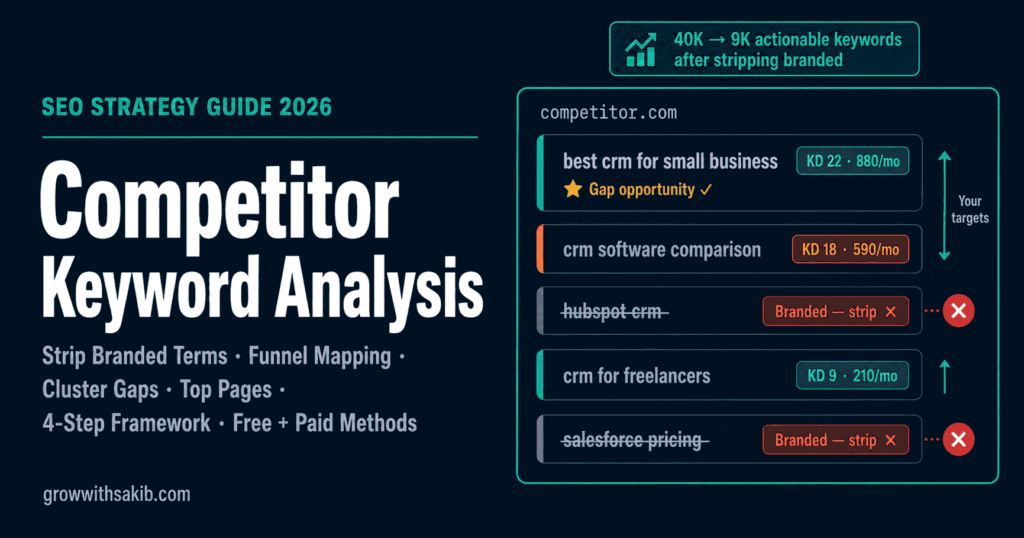
Before you read anything, separate branded from non-branded keywords. Branded terms — the competitor’s own name and product names — inflate their numbers but tell you nothing you can use. Nobody searching “Nike Air Max” is up for grabs.
Filter those out and you’re left with the keywords that represent real, contestable demand. This single step changes the whole picture, because for established brands, branded search can be a huge share of their traffic.
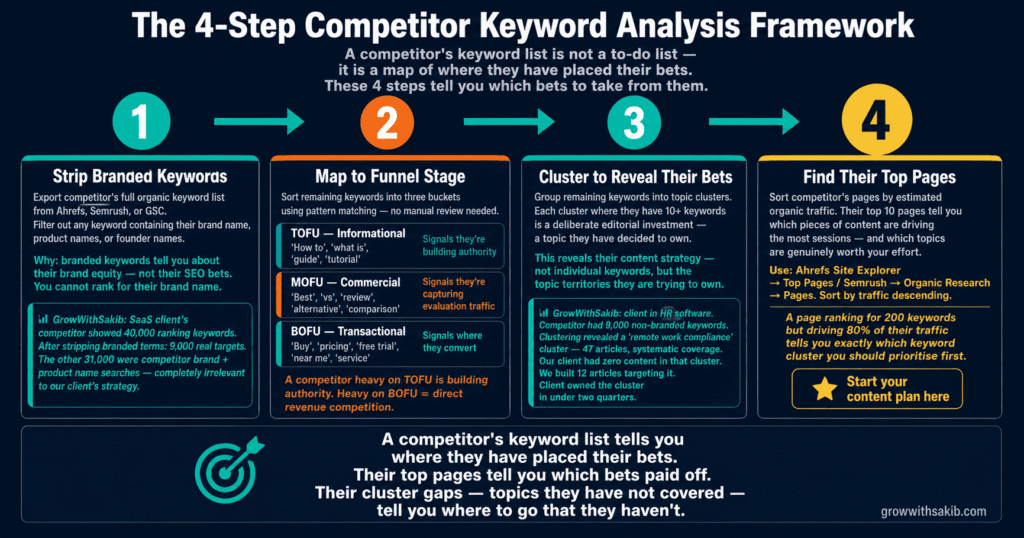
Step 2: Map Keywords to the Funnel
Not all keywords are equal. A competitor ranking for 500 informational terms but zero commercial ones has a very different strategy from one who owns the “best” and “buy” keywords. Sort their non-branded keywords into funnel stages.
| Funnel stage | Keyword pattern | What it signals |
|---|---|---|
| Awareness (TOFU) | what is, how to, guide, tips | They invest in education and reach; see the search intent guide for how intent determines content format at each funnel stage |
| Consideration (MOFU) | best, vs, review, alternative | They target buyers comparing options |
| Decision (BOFU) | buy, pricing, near me, discount | They chase ready-to-purchase intent |
This map is gold. If a competitor is strong at the top but thin at the bottom, their lower-funnel keywords are exposed — and those usually convert best, applying the same long-tail keyword logic where low-volume, high-intent queries produce more revenue per click than high-volume informational ones. Reading intent this way connects directly to the wider competitor analysis framework, where these findings become decisions.
Step 3: Cluster Keywords to Reveal Their Bets
Individual keywords are noise. Clusters are strategy. Group a competitor’s keywords by topic and you’ll see where they’ve concentrated effort — the themes they’re trying to own.
When you spot a dense cluster, that’s a deliberate bet: they’ve built a hub of content around it. A sparse, scattered footprint signals a competitor without a clear plan — which is itself an opportunity. The clusters they own tell you where not to fight head-on; the gaps between clusters tell you where to move — and those are exactly what a shadow competitor scan can also reveal when the gaps are being filled by non-traditional rivals.
Step 4: Check Their Top Pages and Traffic Concentration
Finish by looking at which pages earn a competitor’s keyword traffic. Often a handful of pages drive most of it. That concentration tells you their real winners — and if those winners cluster around one topic, you’ve found the core of their SEO business.
Pair this with their keyword map and you can reverse-engineer the whole strategy: what they target, where they convert, and which few pages hold it all up. Then feed those findings into a competitor SWOT analysis to turn the reverse-engineered strategy into a set of actionable competitive decisions.
Common Mistakes to Avoid
- Reading the raw export. A thousand unfiltered keywords is data, not insight.
- Forgetting to strip branded terms. They inflate the numbers and mislead you — the same reason finding real SEO competitors must come before any keyword analysis, since analysing the wrong competitor’s keywords produces equally misleading results.
- Treating all keywords as equal. Map them to funnel stages — intent matters more than volume.
- Looking at keywords in isolation. Cluster them to see the actual strategy.
- Confusing this with gap analysis. Analysis is understanding; gap analysis is acting.
An Honest Note on Competitor Keyword Data
Every tool estimates keyword data from its own model, so a competitor’s “traffic” and “keyword count” are approximations that differ noticeably between platforms. Use them to understand shape and strategy, not as exact scorecards.
Analysis also doesn’t tell you a competitor’s conversion or revenue — ranking for commercial keywords isn’t the same as making money from them. And the value of this work scales with your market: in a tiny niche with few competitors, customer interviews may teach you more than a keyword footprint. Treat keyword analysis as one strong lens, not the whole view — the complete competitor research guide shows how to combine it with pricing, review, and ad research for the full picture.
Frequently Asked Questions
What is competitor keyword analysis?
Competitor keyword analysis is the process of finding and interpreting the keywords a rival ranks for to understand their SEO strategy. You pull their ranking keywords with a tool, strip out branded terms, map the rest to funnel stages, and cluster them — revealing not just what they rank for, but the strategy and priorities behind it.
How do you find what keywords a competitor ranks for?
Enter the competitor’s domain into an SEO tool’s organic keywords report, such as Ahrefs or Semrush, and you’ll see every keyword they rank for with position, volume, and estimated traffic. Without a paid tool, Google Search Console shows your own keywords free, and manual SERP checks reveal what competitors rank for on specific terms.
What’s the difference between competitor keyword analysis and content gap analysis?
Keyword analysis asks “what is this rival’s whole keyword strategy?” and maps their footprint. Content gap analysis asks “which keywords do they have that I don’t?” and produces a shortlist to act on. You analyse keywords to understand a competitor, then run a gap analysis to decide what content to build.
Why should I remove branded keywords first?
Branded keywords — a competitor’s own name and products — inflate their totals but represent demand you can’t realistically capture. Nobody searching a brand name by name is contestable. Stripping branded terms leaves the non-branded footprint, which is the real, winnable demand and a far more honest basis for comparing your strategy against theirs.
How do I know a competitor’s keyword strategy?
Map their non-branded keywords to funnel stages and cluster them by topic. Funnel mapping shows whether they target awareness, comparison, or purchase intent; clustering reveals which themes they’ve deliberately built hubs around. Dense clusters are their bets; sparse areas are gaps. Together they expose the strategy behind the raw keyword list.
Can I do competitor keyword analysis for free?
Partly. Google Search Console reveals your own ranking keywords at no cost, and manual Google searches show who ranks for specific terms. Seeing a competitor’s full keyword footprint, though, generally needs a paid tool like Ahrefs or Semrush. For a small, focused list, the free methods are enough to start reading strategy.
Does ranking for many keywords mean a competitor is winning?
Not necessarily. A large keyword count is often inflated by branded terms and low-value pages, and ranking isn’t the same as converting or earning revenue. A competitor with fewer, well-clustered commercial keywords may outperform one with thousands of scattered informational terms. Read the footprint’s shape and intent, not just the headline number.
Key Takeaways
- Competitor keyword analysis is reverse-engineering strategy, not pulling a keyword list.
- It answers a different question than content gap analysis — understanding vs acting.
- Always strip branded keywords first, or the numbers will mislead you.
- Map non-branded keywords to funnel stages to read a competitor’s intent strategy.
- Cluster keywords by topic — dense clusters are their bets, gaps are your openings.
- A few pages usually drive most of a competitor’s keyword traffic — find them.
- Tool data is estimated; read the footprint’s shape, not exact numbers.
- Ranking for many keywords doesn’t mean winning — intent and conversion matter more.