Most Meta ads fail silently. The targeting is fine. The creative is decent. The offer is real. But nobody reads past the first line. The copy either says nothing that stops a scrolling thumb, or says something that could have been written by any advertiser in any category about any product.
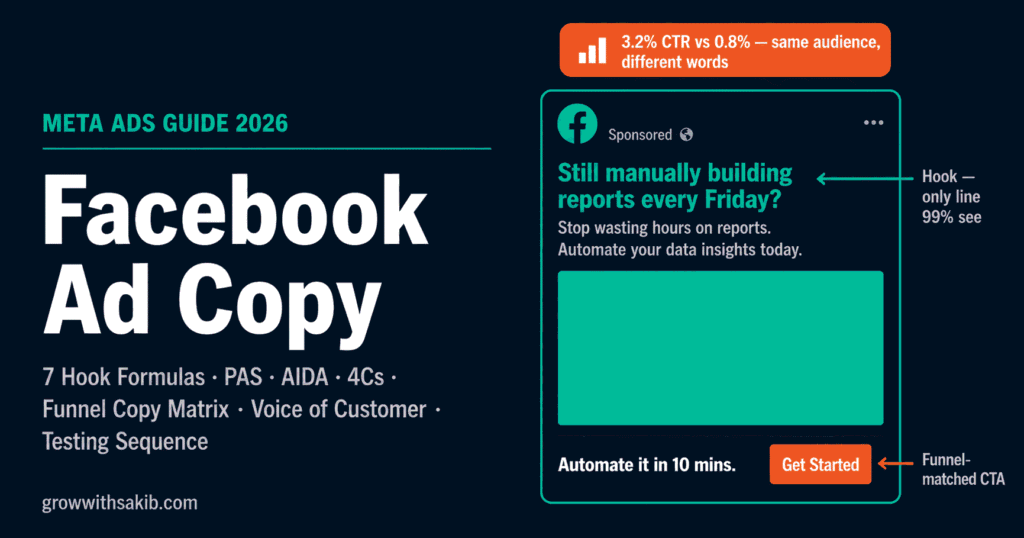
The difference between a Facebook ad that generates a 0.8% CTR and one that generates a 3.2% CTR is almost always the copy. Same audience. Same creative. Different words. And yet most advertisers spend 90% of their ad-building time on targeting and creative, and 10% — if that — on what they actually say.
This guide gives you the complete 2026 framework for writing Facebook ad copy that works: the character limits you need to know, the hook formulas that stop the scroll, the copywriting frameworks matched to funnel stage, and the testing sequence that turns good instincts into proven performers — all within the complete Meta Ads framework.
The Anatomy of a Facebook Ad: What Each Copy Field Does
Before writing a word, understand what each text field in a Meta ad actually does and where it appears. Most advertisers write all fields with equal attention. They should not.
1. Primary Text
- Visible Characters: ~125 chars before ‘See More’ (up to 2,200 total)
- Where It Appears: Above the creative in Feed; varies by placement
- Performance Impact: 15–20% of ad performance
- Priority: High — this is your hook and first impression
2. Headline
- Visible Characters: 40 chars recommended; 255 max
- Where It Appears: Below the creative, next to the CTA button
- Performance Impact: 10–15% of ad performance
- Priority: High — read before body copy in Z-pattern scan
3. Description
- Visible Characters: 30 chars recommended; 255 max
- Where It Appears: Below headline in some placements; often hidden
- Performance Impact: 2–5% of ad performance
- Priority: Low — write it but do not rely on it being seen
4. CTA Button
- Visible Characters: Fixed options (Shop Now, Learn More, etc.)
- Where It Appears: Fixed position next to headline
- Performance Impact: 5–8% of ad performance
- Priority: Medium — choose the verb that matches intent
As Vaizle’s 2026 Facebook ad anatomy analysis documents, users typically scan Meta ads in a Z-pattern: visual first, then headline, then CTA, then primary text. This means your headline is often read before your primary text body. Write your headline as a standalone hook, not as a continuation of your primary text.
The character limit reality
The complete Meta ad copy specs, as documented by Ads Uploader’s 2026 guide, show that 125 characters is not a hard limit — it is the truncation point. You can write 2,200 characters in primary text, but only the first ~125 appear before ‘See More’ in Feed placements. For Reels overlay, the recommended primary text drops to 40–72 characters with no ‘See More’ option.
1. Facebook Feed
- Primary Text Visible: ~125 chars before ‘See More’
- Headline Limit: 40 chars recommended
- Key Implication: Lead with your best line — the rest is bonus copy
2. Instagram Feed
- Primary Text Visible: ~125 chars
- Headline Limit: 40 chars
- Key Implication: Same rule applies; mobile truncates earlier
3. Facebook Reels
- Primary Text Visible: 40–72 chars (no ‘See More’)
- Headline Limit: 10-char overlay headline
- Key Implication: Treat Reels as a different format entirely — think billboard, not body copy
4. Instagram Reels
- Primary Text Visible: 40–72 chars
- Headline Limit: 10-char overlay headline
- Key Implication: Same as Facebook Reels — visual must carry the message; for platform-specific performance differences, see the Facebook vs Instagram ads comparison guide.
5. Stories
- Primary Text Visible: ~125 chars
- Headline Limit: 40 chars
- Key Implication: Copy competes with the visual; keep it minimal
6. Right Column
- Primary Text Visible: ~90 chars
- Headline Limit: 25 chars
- Key Implication: Desktop only; write very concise copy
Benefits vs Features: The Most Misunderstood Rule in Ad Copywriting
Every copywriting guide tells you to lead with benefits, not features. Almost none explain why this rule works at a neurological level — and understanding why makes you far better at applying it.
Features describe what a product does. Benefits describe what a product does for the person reading the ad. The distinction matters because people’s brains are fundamentally self-interested. When someone scrolls past your ad, they are not wondering ‘what does this product do?’ They are asking, consciously or not, ‘what does this mean for me?’
The ‘so what?’ framework
Turn any feature into a benefit by asking ‘so what?’ after every claim. Keep asking until you reach an emotion or outcome the reader genuinely cares about.
As CreativeOS’s 2026 Facebook ad design guide puts it: your audience does not care about what your product does — they care about what it does for them. Every sentence of your ad copy should be answerable with ‘yes, I want that’ from your target reader. If the answer is ‘interesting, I suppose,’ you are writing about features.
The Hook: Your One Guaranteed Line of Copy
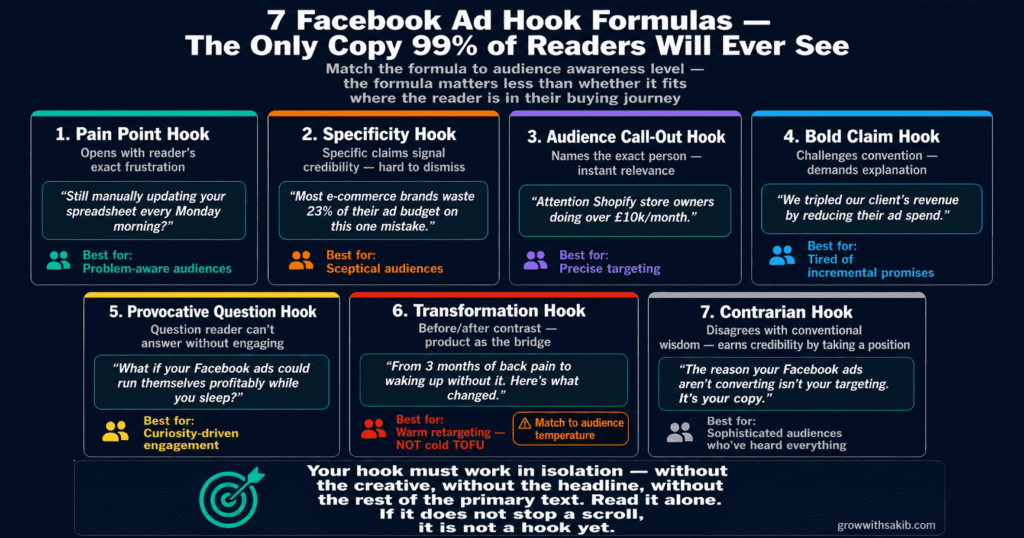
Only about 1% of users tap ‘See More’ to expand primary text past the truncation point. That means your first line — roughly 125 characters — is the only copy the other 99% will ever see. The hook is not the most important part of your Facebook ad copy. It is the only part of your Facebook ad copy for most readers.
7 proven hook formulas with real examples
Each formula triggers a different psychological response. Match the formula to what you know about your audience’s awareness level and emotional state.
1. The Pain Point Hook — for audiences who know they have a problem
Opens with the reader’s exact frustration. Requires knowing specifically how your audience describes their problem in their own words.
2. The Specificity Hook — for audiences who have seen generic claims
Specificity signals credibility. A specific claim (‘4 hours’ vs ‘saves time’) is harder to dismiss than a vague one.
3. The Audience Call-Out Hook — for precise targeting
Names the specific person you’re speaking to. Creates instant relevance — readers who match feel identified; those who don’t self-select out.
4. The Bold Claim Hook — for audiences tired of incremental promises
Makes a statement that challenges conventional wisdom or overpromises in a way that demands an explanation.
5. The Provocative Question Hook — for curiosity-driven engagement
Asks a question the reader cannot answer without engaging. Works best when the question implies they are missing something.
6. The Transformation Hook — for aspirational audiences
Shows the before/after contrast without explicitly stating it. Positions the product as the bridge between current state and desired state.
7. The Contrarian Hook — for sophisticated audiences who’ve heard everything
Disagrees with conventional advice in the category. Earns credibility by taking a position rather than making a claim.
The Three Copywriting Frameworks — Matched to Funnel Stage
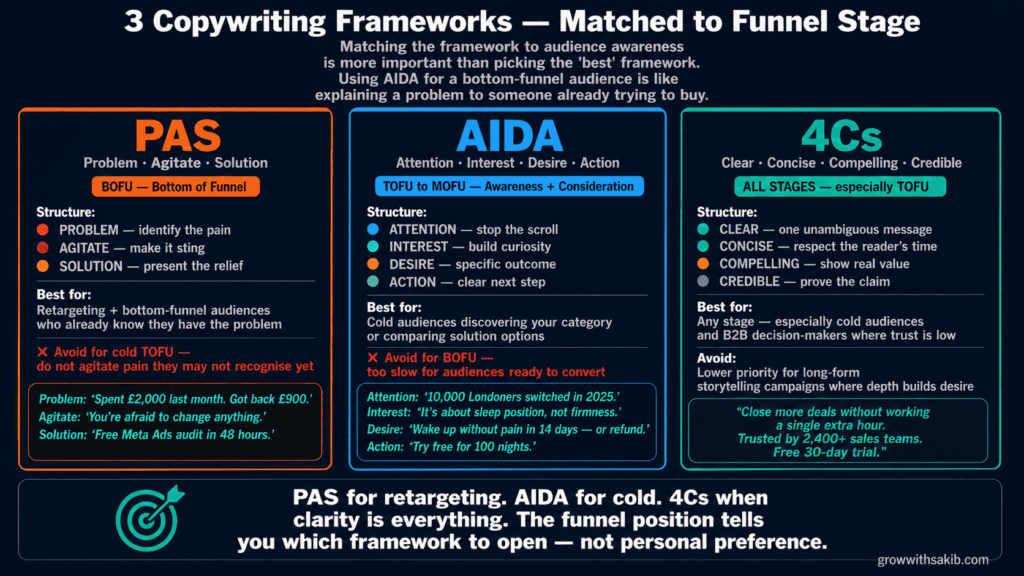
PAS, AIDA, and the 4Cs are the three frameworks that underpin most high-performing Meta ad copy. Most guides define all three and tell you to pick the one you like. That is the wrong approach. As LeadEnforce’s 2026 framework guide documents, each framework suits a specific audience awareness level and funnel position. Using AIDA for a bottom-funnel audience is like explaining what a problem is to someone who is already trying to buy a solution.
1. PAS (Problem-Agitate-Solution)
- Best Funnel Stage: BOFU — retargeting and bottom-funnel
- Audience Awareness: Problem aware — knows they have the issue, not sure of your solution
- Structure: Identify the problem / Make it sting / Present your solution
- When to Avoid: Cold TOFU audiences — do not agitate pain they may not recognise yet
2. AIDA (Attention-Interest-Desire-Action)
- Best Funnel Stage: TOFU to MOFU — awareness and consideration
- Audience Awareness: Unaware to solution aware — discovering the category or comparing options
- Structure: Grab attention / Build interest / Create desire / Drive action
- When to Avoid: Bottom-funnel retargeting — too slow for audiences ready to convert
3. 4Cs (Clear-Concise-Compelling-Credible)
- Best Funnel Stage: All stages — especially TOFU
- Audience Awareness: Any — especially cold audiences and B2B decision-makers
- Structure: Be clear / Be brief / Show value / Prove credibility
- When to Avoid: Long-form storytelling campaigns where depth builds desire
PAS in practice — the retargeting framework
PAS works because it mirrors how people make decisions. First they feel the problem, then they feel it more acutely, then they gratefully accept the relief. For retargeting audiences who already know your category, this sequence moves fast — build those audiences using the Meta Ads retargeting strategy guide.
AIDA in practice — the awareness campaign framework
AIDA works for cold audiences encountering your brand for the first time. The ‘desire’ step is where specificity matters most — vague desire claims (‘you will love it’) do not convert. Specific outcomes (‘sleep 90 minutes longer on average’) do.
The Funnel Copy Matrix: Cold, Warm, and Hot Audiences Need Different Copy
The single most common Facebook ad copy mistake is writing one ad and running it everywhere. Cold prospecting audiences — often reached through Meta Lookalike Audiences — warm retargeting audiences, and hot bottom-funnel audiences are in completely different mindsets. As AdStellar’s 2026 copywriting best practices guide documents, mismatching copy length and tone to funnel stage creates friction that kills conversion rates.
1. Cold (TOFU) — never heard of you
- Copy Length: Short: 2–4 lines primary text
- Opening Approach: Hook that identifies them or interrupts pattern
- Body Copy Focus: One clear benefit or intrigue — tease, don’t explain everything
- CTA Type: Learn More / Discover / See How
2. Warm (MOFU) — visited site, watched video
- Copy Length: Medium: 4–8 lines primary text
- Opening Approach: Reference to their previous interest (implied, not explicit)
- Body Copy Focus: Benefits + social proof + address one objection
- CTA Type: Shop Now / Get Started / See Pricing
3. Hot (BOFU) — cart abandoner, checkout start
- Copy Length: Short and direct: 2–4 lines
- Opening Approach: Direct acknowledgement of the action they did not complete
- Body Copy Focus: Remove the final objection (risk, price, shipping, time)
- CTA Type: Complete My Order / Claim My Offer / Get It Now
Voice of Customer Research: Finding the Words Before You Write Them
The best Facebook ad copy does not sound like advertising — it sounds like the person reading it. That happens when you mine what your actual customers say about their problems, and use their exact language rather than the polished marketing language that lives inside your company’s walls.
This is the section most copywriting guides skip because it requires work that happens before you open a text editor.
Four sources for voice of customer language
- Meta Ad Library: Search your competitors’ active ads — particularly ones that have run for months. Long-running ads convert profitably. The copy angles they use tell you what is already resonating with your shared audience. Pay attention to the specific language, not just the structure.
- Customer reviews (yours and competitors’): Sort by lowest rating to find the specific frustrations your category creates — the same frustrations your SEO for small business content should be addressing to capture organic traffic from people searching for solutions. The language people use in negative reviews — ‘I was so tired of…’, ‘I couldn’t believe how much time I wasted…’ — is emotionally charged and highly specific. These are your hooks.
- Support tickets and chat logs: The questions your sales team and support team field daily are objections your ad copy should pre-empt. If 40% of support tickets ask about shipping time, your ad copy should address shipping time before the question arises.
- Reddit, Facebook Groups, forums in your category: Search for threads where people describe their problem in the category you solve. People speak more honestly in communities than in reviews. The exact phrases they use — unpolished and emotionally specific — are the raw material for hooks that feel personal.
Writing Headlines That Work With Your Creative, Not Against It
The headline in a Meta ad sits directly below the creative, next to the CTA button. As GetKoro’s 2026 headline analysis documents, it is often read before the primary text body in the Z-pattern scan. This makes the headline a second hook — but it functions differently from the primary text hook.
What the headline should do
The primary text hook gets the reader’s attention. The headline’s job is to bridge the creative to the action. By the time a user reaches the headline, they have seen the creative and scanned the hook. The headline should answer: ‘so what do I do now?’
- Short and active: 40 characters is the recommended maximum. This is roughly 5–7 words. Every word must earn its place. ‘Get 50% off your first order’ beats ‘Special discount available for new customers’.
- Benefit or offer focused: the headline is the last persuasion point before the CTA. It should either restate the central benefit in a new way or make the offer explicit: ‘Free 30-day trial. No credit card.”
- Standalone legible: some placements show only the headline and CTA. Your headline must make sense without the primary text above it.
Headline vs primary text: the division of labour
1. Primary text (first line/hook)
- Job: Stop the scroll — create curiosity or emotional resonance
- Tone: Conversational, direct, provocative
- Length: Max 125 chars before cut-off
- Example: Still manually building reports every Friday?
2. Creative (image/video)
- Job: Deliver the visual proof or emotional hit
- Tone: Brand-specific; should amplify the copy claim
- Length: N/A
- Example: Video showing the ‘after’ transformation
3. Headline
- Job: Bridge to the action — restate benefit or clarify offer
- Tone: Clear, active, specific
- Length: 25–40 chars recommended
- Example: Automate it in 10 minutes. Free trial.
4. CTA Button
- Job: Complete the action — reduce friction at the final step
- Tone: Verb-first; action-specific
- Length: Fixed options — choose the most specific fit
- Example: Get Started (not Learn More for BOFU)
How Advantage+ Creative Changes the Way You Write Copy
Advantage+ Creative is Meta’s AI system that automatically adapts your ad elements across placements — and its performance depends on how well your Meta ads learning phase has accumulated sufficient signal. According to the Advantage+ Creative documentation, this includes remixing primary text, headlines, and descriptions in different combinations to find what performs best for each user.
This has a direct implication for how you write copy: each element must be strong as a standalone, not just in its original sequence.
- Write each text field as an independent unit: Meta may show your headline without your primary text in some placements, or show your description prominently while reducing primary text visibility. Each field should communicate value independently.
- Use Dynamic Creative (DCO) intentionally: you can upload multiple primary text variations, headlines, and descriptions, and Meta tests combinations automatically. As Meta’s Dynamic Creative documentation explains, this surfaces winning combinations faster than manual A/B testing.
- Avoid depending on copy-creative sequencing: if your primary text says ‘As you can see in the video…’ and the video is swapped for an image in another placement, the copy makes no sense. Write primary text that works regardless of which creative format is served.
- Headline truncation is platform-specific: a 40-character headline truncated to 25 on Right Column must still communicate something complete. Test headlines at their most restricted length first, then expand from there.
Social Proof and Trust Signals: The Copy Elements That Remove the Final Objection
Cold audiences do not trust you. They have no reason to. Your job in the copy is not to ask them to trust you — it is to show them evidence that reduces the risk of being wrong.
Social proof formats that work in ad copy
- Specific numbers: ‘Trusted by 20,000+ brands’ beats ‘trusted by thousands of brands’. Specificity signals that the number is real. Round numbers feel invented; oddly specific numbers feel measured.
- Named outcome testimonials: ‘Sarah from Manchester saved 5 hours per week in her first month’ is dramatically more persuasive than ‘Customers love this product’. Named, specific, outcome-driven testimonials in primary text consistently outperform vague social proof.
- Star ratings in copy: ‘4.9 stars from 2,300+ reviews’ as a headline or primary text element reduces perceived risk immediately. It tells the reader: other people tried this and were happy enough to rate it highly.
- Duration signals: ‘We’ve helped UK businesses since 2019’ communicates stability without requiring a trust claim. Longevity implies legitimacy.
CTAs that reduce friction
The CTA button text is fixed in Meta’s dropdown options, but your copy before the CTA can dramatically reduce or increase the perceived risk of clicking it. The best copy immediately before the CTA removes the reader’s final objection.
The Copy Testing Sequence: A Framework for Finding Winners
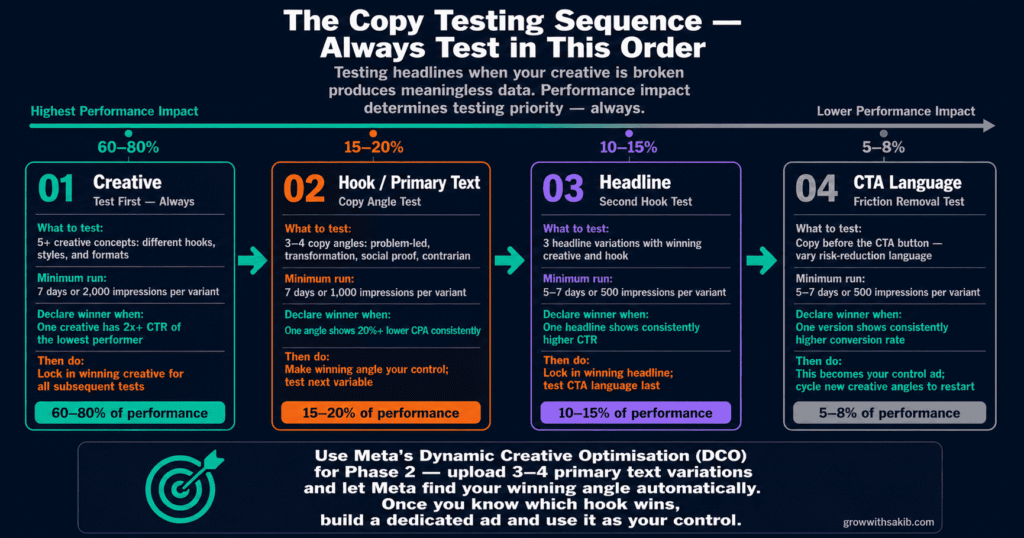
Most advertisers A/B test randomly — two versions of the same ad with slightly different copy — and draw inconclusive results. A structured testing sequence eliminates randomness and identifies which variable is actually driving performance differences.
The correct testing order
As Vaizle’s Facebook ad anatomy analysis documents, creative accounts for 60–80% of performance, primary text for 15–20%, and headlines for 10–15%. Test in descending order of impact: creative first, then hook/primary text angle, then headline, then CTA — the full campaign testing structure is covered in the Meta Ads Guide. Testing headlines while your creative is broken produces meaningless data.
1. Phase 1 — Creative
- Test Phase: Phase 1 — Creative
- What to Test: 5+ creative concepts: different hooks, styles, formats
- Minimum Run: 7 days or 2,000 impressions per variant
- Declare a Winner When: One creative has 2x+ CTR of the lowest performer
- Then Do: Lock in the winning creative for all subsequent tests
2. Phase 2 — Hook/Primary Text
- Test Phase: Phase 2 — Hook/Primary Text
- What to Test: 3–4 different copy angles: problem-led, transformation, social proof, contrarian
- Minimum Run: 7 days or 1,000 impressions per variant
- Declare a Winner When: One angle shows 20%+ lower CPA consistently
- Then Do: Make winning angle your control; test next variable
3. Phase 3 — Headline
- Test Phase: Phase 3 — Headline
- What to Test: 3 headline variations with winning creative and hook
- Minimum Run: 5–7 days or 500 impressions per variant
- Declare a Winner When: One headline shows consistently higher CTR
- Then Do: Lock in winning headline; test CTA language last
4. Phase 4 — CTA Language
- Test Phase: Phase 4 — CTA Language
- What to Test: Copy before the CTA button: vary risk-reduction language
- Minimum Run: 5–7 days or 500 impressions per variant
- Declare a Winner When: One version shows higher conversion rate
- Then Do: This becomes your control ad; cycle new creative angles
5 Facebook Ad Copy Mistakes That Kill Performance
Mistake 1: Writing the same copy for every placement
Running Advantage+ Placements with copy written for Facebook Feed means your headline might appear as a 10-character Reels overlay. The Meta ad copy specs are clear: Reels needs 40–72 characters of primary text and a 10-character overlay headline. If you only have Feed copy, Meta either crops it unpredictably or displays nothing useful in Reels.
Fix: write copy for your most restrictive placement first (Reels), then add additional context in later lines for Feed.
Mistake 2: Burying the offer past the truncation point
If your primary text’s first 125 characters are scene-setting (‘At our company, we believe that every business deserves the kind of support that…’), you have lost 99% of readers before the offer appears.
Fix: every ad’s central benefit, offer, or hook must appear in the first 125 characters. Test your first line by reading it in isolation — does it stand on its own?
Mistake 3: Using fake urgency or scarcity
‘Only 3 left’ when you have 3,000 units. ‘Offer ends midnight tonight’ that has run for three weeks. As AdStellar’s copywriting strategies guide, warns: Fake urgency builds short-term clicks and long-term distrust — and inflates your Meta Ads cost per result as click quality drops over time. Audiences who have seen your ‘limited offer’ ad six times in a row know it is not limited.
Fix: only use urgency when it is real. Real deadlines, real stock limits, real cohort sizes. If you cannot be specific, use action urgency instead (‘Start before Monday and have results by next weekend’) rather than false scarcity.
Mistake 4: Copy that mismatches the creative
An image showing a team in an office paired with copy about individual productivity. A lifestyle photo paired with product specification copy. The cognitive friction of a visual-copy mismatch forces the reader’s brain to work harder to reconcile the disconnect — and confused people do not click.
Fix: creative and copy should tell the same story from different angles. The visual delivers the emotional hit; the copy explains what it means for the reader.
Mistake 5: Using generic CTAs across all funnel stages
‘Learn More’ makes sense for a cold audience encountering your brand for the first time. It makes no sense for a cart abandoner — who is already in your Meta Ads retargeting funnel and needs a specific conversion push, not more information. A bottom-funnel user who abandoned checkout does not need to learn more — they need a push to complete the action they already started.
Fix: match your copy’s pre-CTA language to the specific action you want the reader to take, and choose the most specific available CTA button option. ‘Get Offer’, ‘Shop Now’, and ‘Complete My Order’ all communicate more intent than ‘Learn More’ for conversion-focused ads.
Frequently Asked Questions
How long should Facebook ad copy be?
It depends on funnel stage and placement. For cold audiences and Reels placements: 2–4 lines maximum (40–125 characters). For warm retargeting audiences in Feed placements: 4–8 lines is appropriate because these audiences have context and are in evaluation mode. As documented in the Meta ad copy specs guide, only ~125 characters of primary text appear before truncation in Feed — write your best content there regardless of total copy length.
What should I write in my Facebook ad primary text?
Lead with a hook that identifies your audience, states a specific pain point, makes a bold claim, or asks a provocative question. Your first line is the only copy 99% of readers will see before deciding whether to stop or scroll. The primary text should then build on that hook — providing enough context, social proof, or benefit detail to motivate a click. The Meta Business Help Center creative guidance recommends focusing on one clear message per ad.
What is the Facebook ad headline character limit?
The recommended headline length is 40 characters, though Meta accepts up to 255. In practice, as confirmed by Meta’s character limit documentation, shorter headlines perform better — they are fully visible on mobile without truncation. Right Column placements show only 25 characters. Reels overlay headlines are limited to approximately 10 characters. Write your headline for the most restrictive placement first.
Which copywriting framework works best for Facebook ads?
It depends on funnel stage. PAS (Problem-Agitate-Solution) works best for bottom-funnel retargeting where the audience is problem-aware. AIDA (Attention-Interest-Desire-Action) suits top-funnel awareness campaigns for audiences discovering your category. The 4Cs (Clear-Concise-Compelling-Credible) works across all stages, especially for B2B or cold audiences. As LeadEnforce’s framework guide explains, matching the framework to audience awareness level is more important than picking the ‘best’ framework.
How do I write a hook for a Facebook ad?
Choose a formula that matches your audience’s awareness level: pain point hooks for audiences who know they have a problem, specificity hooks for sceptical audiences, audience call-outs for precise targeting, bold claims for audiences tired of incremental promises. The single most important rule: your hook must work in isolation, without the creative, without the headline, without the rest of the primary text. Read it alone — if it does not stop a scroll, it is not a hook yet.
How do I test Facebook ad copy?
Test in order of performance impact: creative first (60–80% of performance), then primary text hook/angle (15–20%), then headline (10–15%), then CTA language. Do not test headlines when your creative is the problem. Use Meta’s Dynamic Creative Optimisation to test multiple primary text variations simultaneously rather than building separate ad sets for each. Run each phase for a minimum of 7 days or 1,000 impressions per variant before declaring a winner.
Does Facebook penalise long ad copy?
Meta does not penalise long copy directly. The practical penalty is reader drop-off — only 1% of users tap ‘See More’ to read beyond 125 characters. If your central benefit or offer is buried past the truncation point, you are writing for the 1% and hoping the 99% click anyway. Write as much copy as the funnel stage justifies, but always lead with your strongest material within the first 125 characters.
Key Takeaways
- Your first 125 characters of primary text are the only copy 99% of readers will see. Make the hook your single most important writing task — it determines whether anyone reads the rest.
- Lead with benefits, not features. Apply the ‘so what?’ framework to every claim until you reach an emotion or outcome the reader genuinely wants.
- Match hook formula and framework to funnel stage. PAS for retargeting, AIDA for cold awareness, 4Cs when clarity and brevity matter most.
- Voice of customer research produces better copy than creative writing does. Mine reviews, support tickets, and the Meta Ad Library for the exact language your audience uses to describe their problems.
- Write each copy field as a standalone unit. Meta’s Advantage+ Creative may show your headline without your primary text. Each element must communicate value independently.
- Test in order of performance impact: creative first, then hook, then headline, then CTA. Testing headlines when your creative is broken produces meaningless data.
- Match copy length to audience temperature. Cold audiences need short, intriguing copy. Warm retargeting audiences can handle longer, objection-handling copy.
- Fake urgency is a short-term tactic and a long-term trust cost. Only use scarcity and urgency when they are genuinely true and specifically stated.