In every content audit I have ever run, the pattern is consistent. The pages that struggle — the ones that hover at positions 12–20 despite decent keyword targeting and adequate backlinks — almost always have the same underlying problem. They are written for search engines, not for people. They answer the keyword without demonstrating any genuine understanding of the topic. They exist because someone decided a keyword was worth targeting, not because someone had something real to say.
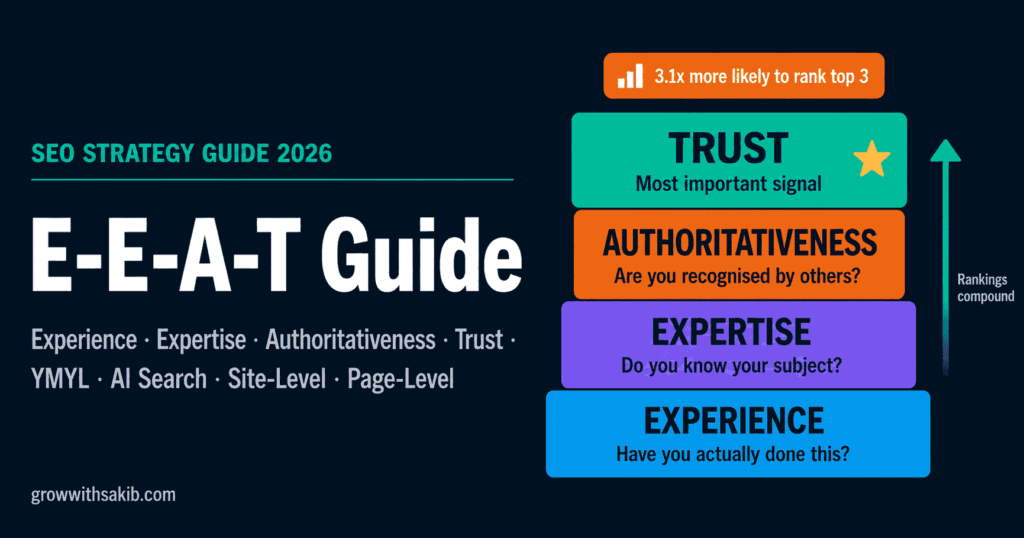
Google’s antidote to that approach is E-E-A-T. Experience, Expertise, Authoritativeness, and Trustworthiness are the four signals that Google’s Search Quality Rater Guidelines — all 170+ pages of them — return to repeatedly when describing what makes content genuinely valuable. They are not a ranking algorithm you can game. They are a framework for evaluating whether content was created by someone who actually knows their subject, has real experience with it, is recognised by others as a credible source on it, and presents information in a way that earns trust.
What changed in 2022 — when Google added the second ‘E’ for Experience to create E-E-A-T — was significant. Expertise alone was no longer sufficient. Google now explicitly values the difference between someone who has studied a topic and someone who has lived it. A certified financial adviser writing about investment strategy has expertise. A certified financial adviser writing about their own experience navigating a recession with specific clients has experience and expertise. The second is significantly harder to replicate, and Google rewards it accordingly.
This guide covers every pillar in specific, actionable terms — not just what they mean theoretically, but what they look like on a real page, what the before and after of improvement looks like, and how each signal connects to the AI search visibility that is increasingly central to content strategy in 2026.
What Is E-E-A-T and How Does Google Use It?
E-E-A-T stands for Experience, Expertise, Authoritativeness, and Trustworthiness. It is the quality evaluation framework that Google uses to assess whether content is genuinely valuable to users — and is one of the most important signals in any SEO for small business strategy.
First: Google’s Search Quality Raters — a global team of contractors who manually evaluate search results using the Quality Rater Guidelines and provide feedback that shapes algorithm training. They do not directly change rankings, but their collective feedback trains the algorithms that do.
Second: Google’s algorithms, which have been trained using quality rater data to identify the on-page and off-page signals that correlate with high E-E-A-T content — author credentials, external citations, structured data, content depth, engagement patterns, and hundreds of other signals.
The history: from E-A-T to E-E-A-T
Google’s original framework was E-A-T — Expertise, Authoritativeness, Trustworthiness — introduced in the Quality Rater Guidelines in 2014 and brought to wider SEO attention after the Medic Update in 2018. In December 2022, Google added a second E for Experience, creating E-E-A-T.
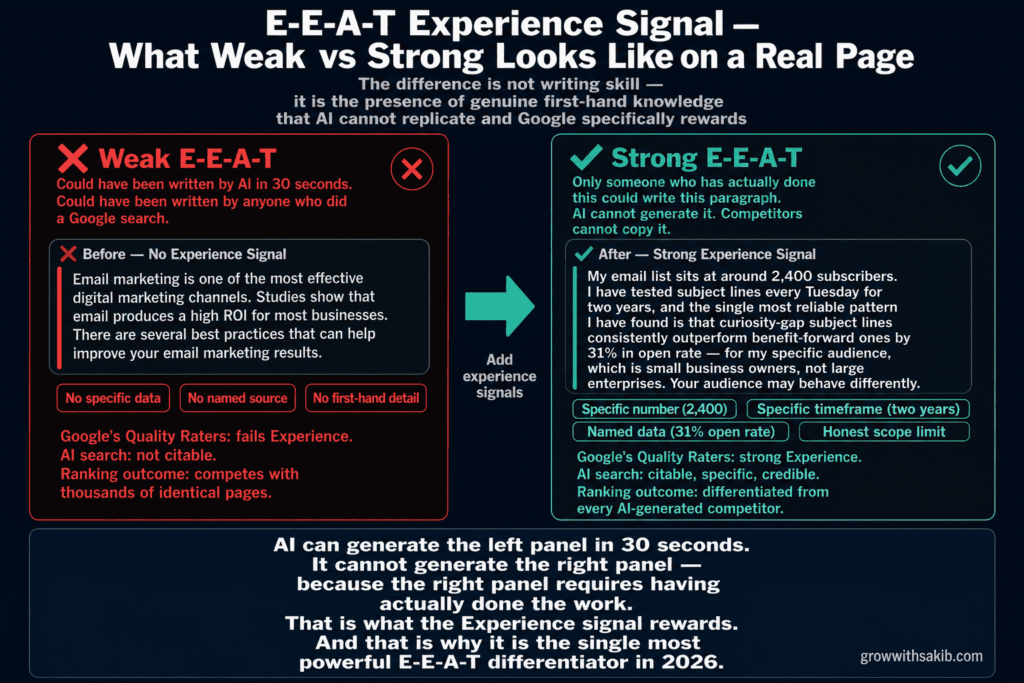
The addition of Experience was a direct response to the explosion of AI-generated content. AI systems can demonstrate expertise by synthesising existing knowledge — but they cannot demonstrate genuine first-hand experience. A language model can write an accurate article about managing diabetes. It cannot write from the perspective of someone who has managed their own diabetes for 15 years and understands the emotional reality of it — not just the clinical facts. The Experience signal rewards the latter and cannot be replicated by the former.
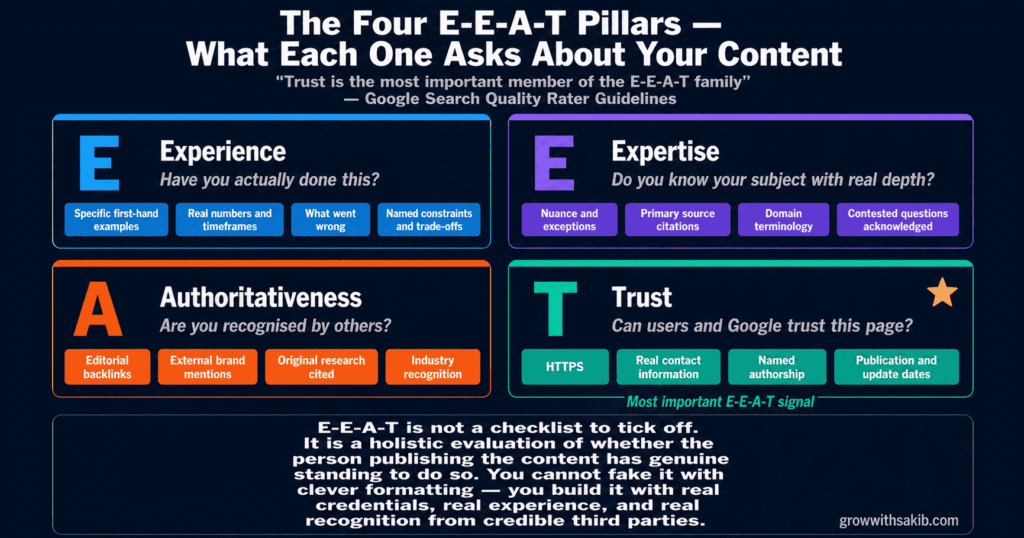
The Four E-E-A-T Pillars — What Each One Means in Practice
Pillar 1 — Experience: Have you actually done this?
Experience is the newest and most distinctively human of the four E-E-A-T signals. It asks: does the content creator have genuine, first-hand experience with the topic they are writing about? Not studied knowledge — lived knowledge.
Google’s Quality Rater Guidelines give a specific example: for a review of a hiking boot, an experienced hiker who has worn the boots on multiple trails provides an experience signal that a product description copied from the manufacturer cannot. The hiker knows how the boots perform when wet, whether the ankle support holds after 8 hours, whether the sizing runs narrow. That knowledge can only come from wearing the boots.
| Content type | Weak experience signal | Strong experience signal |
| Product review | Summarises manufacturer specs and other reviews | Documents personal use: specific conditions, duration, what failed, what surprised |
| How-to guide | Generic steps assembled from research | Steps with specific observations: ‘I learned the hard way that step 3 fails if…’ |
| Case study | Generic client testimonial without detail | Specific client situation, specific challenge, specific solution chosen and why |
| Financial advice | General principles from official sources | Named personal or client experience navigating the specific situation |
| Medical content | Summary of clinical guidance | Patient perspective combined with clinical expertise — or YMYL disclaimer with expert credentials |
How to build experience signals into your content
- Name the specific situation: ‘In my experience auditing 300+ small business websites…’ or ‘When I ran this campaign for a hospitality client last year…’ Specific numbers, specific contexts, specific time frames — the same specificity principle that makes keyword research for small business effective when targeting realistic difficulty levels.
- Include what went wrong: Genuine experience includes failure. Content that only describes success reads as promotional. Content that honestly documents what did not work, and why, reads as experiential.
- Use sensory and contextual detail: ‘The onboarding process felt chaotic in the first week, but by week three we had a pattern that worked’ demonstrates lived experience. ‘The onboarding process can be challenging’ demonstrates none.
- Name real constraints and trade-offs: Experienced practitioners acknowledge trade-offs. Inexperienced ones describe ideal scenarios. ‘This works well if you have a dedicated content manager — if you are doing this alone, the timeline needs to be doubled’ signals real experience.
Pillar 2 — Expertise: Do you know your subject with real depth?
Expertise is demonstrated knowledge — the ability to address a topic accurately, comprehensively, and with the nuance that only genuine understanding produces. Google’s Quality Raters are trained to distinguish between surface-level coverage that could have been assembled from three Google searches and deep coverage that reflects real subject-matter mastery.
Formal credentials contribute to expertise signals — a qualified accountant writing about tax strategy, a certified physician writing about medication interactions. But credentials are not the only expertise signal, and for many topics they are not required. Demonstrated knowledge depth — addressing the nuance, the edge cases, the exceptions, the commonly misunderstood aspects of a topic — signals expertise for readers and for Google’s evaluators.
How to demonstrate expertise in content
- Cover the nuance and exceptions: Generic content covers what is true most of the time. Expert content covers when the general rule does not apply and why. This precision is one of the clearest expertise signals available.
- Use correct technical terminology: Experts in any field use the precise vocabulary of their domain. Consistent, accurate use of domain terminology signals that the author is genuinely embedded in the field, not writing at arm’s length from it.
- Cite primary sources, not secondary summaries: Experts read research papers, not just blog posts about research papers. Where research underlies a claim, cite the primary source — the study, the official guidance, the original data.
- Address what experts debate: In every mature field, there are genuinely contested questions where experts disagree. Content that acknowledges these debates and presents the range of positions demonstrates engagement with the field at an expert level.
- Keep content current: Expertise requires maintaining knowledge over time. Content with outdated statistics, superseded guidance, or references to deprecated tools signals that the author’s expertise may have expired.
Pillar 3 — Authoritativeness: Are you recognised by others?
Authoritativeness is the E-E-A-T signal that is least within your direct control — because it is primarily an external signal. You cannot declare yourself authoritative. Authority is conferred by others. It is built through citation, mention, linking, and recognition by credible third parties who operate in your field.
Google’s Quality Rater Guidelines explicitly distinguish between a site’s self-assessed authority and its externally validated authority. A page that claims to be ‘the leading resource on X’ without any external recognition is not authoritative. A page that has been cited in academic papers, linked from government resources, mentioned by recognised experts in the field, and featured in respected industry publications is authoritative — regardless of whether it makes any claims about itself.
How to build authoritativeness
- Earn editorial backlinks from relevant authoritative sources: A backlink from a respected industry publication, a university website, or a government body is an authority endorsement. Not a directory listing — an editorial citation where a human editor chose to reference your content as a credible resource — the full process for earning these is covered in the link building guide for beginners.
- Get mentioned (even without a link): Ahrefs research shows that brand mentions from authoritative external sources correlate with AI citation probability at 0.664 — higher than backlinks alone. Being named in credible publications establishes authority even when no link is present.
- Have genuine experts cite or quote you: If recognised practitioners in your field reference your content, data, or frameworks in their own work, that is one of the strongest authority signals available.
- Publish original research and data: Original studies, surveys, and data that others cite are the most efficient authority builder available. Even small-scale original research — ‘we surveyed 200 small business owners about their SEO challenges’ — creates citable content that builds authority through citation.
- Speak, appear, and be quoted: Podcast appearances, conference speaking, press quotes, and expert commentary in media all create authority signals that search engines can identify through the digital trail they leave.
Pillar 4 — Trustworthiness: Can users and Google trust this page?
Trust is Google’s primary E-E-A-T signal — the Quality Rater Guidelines explicitly state that ‘Trust is the most important member of the E-E-A-T family.’ A page can have experience, expertise, and authority — but if it lacks trust signals, Google will not rank it confidently. Trust is built through transparency, accuracy, security, and the basic digital signals that tell both users and Google that this site is run by legitimate people who stand behind what they publish.
Trust signals at the site level
- HTTPS — non-negotiable: An HTTP site in 2026 is a trust failure signal that no other optimisation can overcome. HTTPS is the baseline that everything else builds on.
- Clear, accessible contact information: A real address, a real phone number, a real email address — not a generic contact form as the only option. Google’s Quality Raters are specifically instructed to evaluate whether a site has genuine contact information.
- Privacy policy, terms of service, and returns policy: Legal documentation signals legitimate operation. Their absence is a trust deficit.
- Transparent ownership: Who runs this website? Who is responsible for its content? An About page with real people, real photos, and real background — not stock photos and vague corporate language — is a significant trust signal.
Trust signals at the content level
- Accurate, up-to-date information: Content that contains factual errors — even minor ones — damages trust. Content that references outdated statistics or superseded guidance signals that accuracy is not a priority — which is why tracking SEO results regularly helps identify pages that need refreshing.
- Clear publication and update dates: When was this written? When was it last reviewed? Both are trust signals — particularly for topics where currency matters.
- Honest disclosure of limitations: Content that acknowledges what it does not cover, who its advice is and is not suitable for, and where professional consultation is needed is significantly more trustworthy than content that claims universal applicability.
- No misleading claims or clickbait: Headlines and meta descriptions that promise more than the content delivers destroy trust instantly — and Google’s bounce rate monitoring captures the consequence.
YMYL — When E-E-A-T Standards Are at Their Highest
YMYL stands for Your Money or Your Life — Google’s designation for content on topics where poor information could significantly harm a user’s financial situation, health, safety, legal standing, or major life decisions. YMYL content is held to the highest E-E-A-T standards because the stakes of bad information are highest in these categories.
1. Health and medical
- YMYL category: Health and medical
- Examples: Symptoms, diagnoses, medications, treatments, mental health
- E-E-A-T requirement: Named medical credentials, professional review, clear disclaimers, cited clinical sources
2. Financial
- YMYL category: Financial
- Examples: Investment advice, tax guidance, insurance, loans, bankruptcy
- E-E-A-T requirement: Named financial qualifications, regulatory disclosure, cited official sources
3. Legal
- YMYL category: Legal
- Examples: Contracts, rights, legal processes, regulatory compliance
- E-E-A-T requirement: Named legal credentials by jurisdiction, professional review, jurisdiction disclaimer
4. Safety
- YMYL category: Safety
- Examples: Emergency procedures, dangerous activities, security
- E-E-A-T requirement: Named expert credentials, current official guidance cited, safety disclaimers
5. News and current events
- YMYL category: News and current events
- Examples: Breaking news, political content, social issues
- E-E-A-T requirement: Editorial standards disclosed, named journalists, cited primary sources
6. Government and civic
- YMYL category: Government and civic
- Examples: Voting, benefits, immigration, public services
- E-E-A-T requirement: Official sources cited, currency date visible, accuracy disclaimer
For non-YMYL topics — lifestyle content, hobby guides, entertainment, most marketing and business content — E-E-A-T standards are meaningful but proportionately lower. A gardening blog does not need the same credential transparency as a medication interaction guide. Understanding where your content sits on the YMYL spectrum determines how intensively you need to build formal E-E-A-T signals.
E-E-A-T and AI Search — Why It Matters More Than Ever
The connection between E-E-A-T signals and AI search citation is one of the most significant developments in content strategy since Google introduced the concept. AI systems use E-E-A-T signals as credibility filters when deciding which sources to cite in generated answers. A page with weak E-E-A-T — anonymous authorship, no external recognition, thin content without original insight — is less likely to be cited by ChatGPT, Perplexity, or Google AI Overviews than an equivalent page with strong E-E-A-T signals, even when the content quality is similar.
Which E-E-A-T signals most directly influence AI citation?
- Named authorship with credentials (Experience + Expertise): AI systems evaluate author credibility when selecting sources. Person schema with a named author, linked author bio with verifiable credentials, and consistent authorship across a content cluster all improve AI citation probability.
- Organization schema with sameAs entity links (Authoritativeness): Brand entity strength — built through Organization schema, Wikidata entries, and consistent external mentions — is one of the strongest predictors of AI citation. The 0.664 correlation between external brand mentions and AI citation probability reflects the authority signal those mentions create — a core principle covered in the complete guide to GEO.
- External citations and original research (Authoritativeness): Content that is itself cited by other credible sources — meaning your research appears as a reference in others’ content — creates a chain of authority signals that AI systems recognise.
- Transparent trust signals (Trustworthiness): AI systems favour content from identifiable, transparent publishers over anonymous content — particularly for factual claims where reliability matters.
Site-Level vs Page-Level E-E-A-T — Building Both Layers
E-E-A-T operates at two levels simultaneously — and building only one layer while neglecting the other consistently underperforms building both. Site-level E-E-A-T establishes the credibility of the domain as a whole. Page-level E-E-A-T establishes the credibility of the specific content on each page.
Site-level E-E-A-T foundations
- About page with real people: Named team members with photos, backgrounds, and credentials. Not stock photos, not vague role descriptions. Real people who can be found independently.
- Author bio pages for all content contributors: Each person who publishes content on your site should have a dedicated bio page with credentials, professional history, and links to verifiable external profiles.
- Editorial standards page: A page explaining how content is researched, reviewed, fact-checked, and updated. Particularly important for YMYL topics but valuable for any content-heavy site.
- Contact information that is real and functional: Physical address, direct phone number, named contact — not a generic contact form as the only option.
- Organization schema on homepage: Complete with name, logo, URL, and sameAs links to all verified external profiles.
Page-level E-E-A-T implementation
- Named author byline on every piece of content: Linked to the author’s bio page. ‘By Md. Sakib Hossain’ with a link beats ‘By the Editorial Team’ on every E-E-A-T dimension.
- Author credentials visible near the byline: ’15 years in digital marketing and SEO’ or relevant qualification — specific enough to be verifiable, concise enough not to distract from the content.
- Publication and update dates: Both are important — published date establishes origin, updated date signals active maintenance. For evergreen content, an annual review and date update is minimum.
- Sources cited with links to primary sources: Every statistic, study reference, and factual claim should cite its primary source — not a blog post that summarised the original research — and use on-page SEO best practices to structure these citations within your content correctly.
- First-hand experience woven into the narrative: Specific examples from real work, real clients, or real situations — not hypothetical scenarios. These are the Experience signals that distinguish your content from AI-generated alternatives.
E-E-A-T Mistakes That Suppress Rankings and AI Visibility
# 01
- The mistake: Anonymous content — no named author
- What it costs: Google treats authorship as a trust signal — anonymous content scores low on E and T
- The fix: Add named bylines to all content; create author bio pages with credentials and photos
# 02
- The mistake: Credentials claimed but not verifiable
- What it costs: Quality Raters check external verification — unverifiable claims damage trust more than no claims
- The fix: Link every credential to a verifiable external source: licensing body, university, association
# 03
- The mistake: Outdated content with no review date
- What it costs: Stale information signals expertise neglect — particularly damaging for YMYL topics, and a common cause of the gradual ranking decline documented in the SEO timeline guide.
- The fix: Add ‘Last updated’ dates; review high-stakes content annually minimum; update when field changes
# 04
- The mistake: Experience claims without specific evidence
- What it costs: ‘I have 15 years of experience’ without any specific example is noise — not a signal
- The fix: Replace generic experience statements with specific observations: numbers, situations, outcomes
# 05
- The mistake: Citing blog posts instead of primary sources
- What it costs: Secondhand citations are weaker E-E-A-T signals than primary source citations
- The fix: Find and link the original study, official guidance, or primary data — not someone’s summary of it
# 06
- The mistake: Generic about page with no real people
- What it costs: Stock photos and vague team descriptions fail the ‘who is responsible for this?’ trust test
- The fix: Real names, real photos, real backgrounds — with LinkedIn and professional profile links
# 07
- The mistake: No external recognition or citation
- What it costs: Self-declared authority without third-party corroboration carries minimal weight
- The fix: Earn editorial mentions, citations, and links from credible external sources in your field
# 08
- The mistake: YMYL content without appropriate credentials
- What it costs: Anonymous health or financial advice fails YMYL E-E-A-T standards entirely
- The fix: YMYL content requires visible credentials, professional review disclosure, and appropriate disclaimers
E-E-A-T Implementation Checklist
Experience signals
| What to implement | Why it matters |
|---|---|
| ☐ Content includes specific first-hand examples — named situations, real numbers, specific observations | Specific experience is the primary signal distinguishing human expertise from AI synthesis |
| ☐ Content honestly acknowledges what went wrong or what does not work — not only successes | Genuine experience includes failure — content that only describes success reads as promotional |
| ☐ Where applicable, personal experience timeframes and contexts are stated explicitly | ‘In 14 months of running this process across 40 clients’ is more credible than ‘in our experience’ |
Expertise signals
| What to implement | Why it matters |
|---|---|
| ☐ Content covers nuance and exceptions — not just the general rule | Surface-level content avoids nuance; expert content addresses it directly |
| ☐ Domain-appropriate technical terminology used correctly throughout | Correct technical vocabulary signals genuine field immersion |
| ☐ All factual claims cite primary sources — original studies, official guidance, primary data | Secondhand citations are weaker than primary source citations on every E-E-A-T dimension |
| ☐ Content reflects the current state of knowledge — no outdated statistics or superseded guidance | Expertise requires maintaining current knowledge — stale content signals lapsed expertise |
Authoritativeness signals
| What to implement | Why it matters |
|---|---|
| ☐ Named author has an author bio page with verifiable credentials and external profile links | Author entities with verifiable credentials are the primary authoritativeness signal on the page |
| ☐ Organization schema on homepage with complete sameAs links to all verified profiles | Brand entity signals build domain-level authority that supports all pages on the site |
| ☐ External editorial mentions, backlinks, or citations from credible sources in the field | Third-party recognition is the primary authoritativeness signal — it cannot be self-declared |
| ☐ Any relevant awards, certifications, or professional recognitions are visible and verifiable | Third-party endorsements of standing are authority signals — they must be visible to count |
Trust signals
| What to implement | Why it matters |
|---|---|
| ☐ Site uses HTTPS — verified in browser address bar | HTTP is a baseline trust failure that no other signal can compensate for |
| ☐ Real contact information visible: address, phone, named email — not only a contact form | Quality Raters specifically check for genuine, accessible contact information |
| ☐ About page features real people with real photos and verifiable backgrounds | Anonymous site ownership is a trust signal failure — real people build trust |
| ☐ Privacy policy, terms of service, and relevant legal documentation present | Legal documentation signals legitimate operation — their absence is a trust gap |
| ☐ Publication date and last-updated date visible on all content | Currency transparency is a trust signal — particularly for factual and YMYL content |
Frequently Asked Questions
Is E-E-A-T a direct Google ranking factor?
E-E-A-T is not a specific algorithmic ranking factor with a numerical score. Google has been explicit about this. It is a framework used by Search Quality Raters to evaluate content quality, and that evaluation data is used to train the algorithms that do determine rankings. The practical effect is the same as if it were a direct ranking factor — pages with strong E-E-A-T signals consistently rank above pages with weak ones, all else being equal. The distinction matters because there is no E-E-A-T score to optimise — only genuine credibility signals to build.
Does E-E-A-T apply differently to different types of websites?
Yes — significantly. YMYL topics (health, finance, legal, safety) are held to the highest E-E-A-T standards because the consequences of bad information are most severe. A personal finance article written by an unnamed author with no credentials fails YMYL E-E-A-T standards regardless of its accuracy. For non-YMYL topics — lifestyle, hobbies, marketing, business — E-E-A-T standards are meaningful but proportionally lower. A gardening blog can rank well with less formal credential display than a medical information site. Understanding where your content sits on the YMYL spectrum determines how intensively you need to build formal E-E-A-T signals.
Can a small business with no famous name build strong E-E-A-T?
Absolutely — and this is one of the most important misconceptions to correct. E-E-A-T does not require celebrity status or decades of published research. It requires demonstrated real experience with your topic, accurate and specific knowledge, transparency about who you are and what qualifies you, and gradual external recognition built through earning citations and mentions over time. A solo consultant who writes specifically about their real client work, names themselves clearly, links their credentials, and earns mentions in a few relevant industry publications has stronger E-E-A-T than a large anonymous brand publishing generic content.
How long does it take to improve E-E-A-T?
Some E-E-A-T improvements produce results quickly — adding named authorship and author bio pages to existing content, implementing schema markup, and publishing and update dates are changes that Google can process within weeks of recrawling. Authority building — earning external citations and editorial mentions — takes months to years of consistent effort. The on-page E-E-A-T improvements deliver faster results; the off-page authority signals compound over time. A realistic expectation: meaningful ranking improvements from E-E-A-T enhancements within 2–4 months of implementation; significant authority-driven improvements over 12–24 months of consistent work.
How does E-E-A-T relate to AI-generated content?
E-E-A-T is the primary framework through which Google distinguishes human-authored expert content from AI-generated or AI-assisted content. The Experience signal specifically — first-hand knowledge that can only come from doing something rather than knowing about it — is the dimension AI cannot authentically replicate. AI can generate accurate, well-structured, expertise-signalling content. It cannot generate genuine experience signals without fabricating them. Content that demonstrates real first-hand experience, produced by a named, credentialed author, with external recognition — is the content most differentiated from AI production. That differentiation is increasingly what E-E-A-T rewards.
The Bottom Line: E-E-A-T Is Not What You Say About Yourself — It Is What Others Can Verify
The most common E-E-A-T mistake is treating it as a content formatting exercise — adding author bios and update dates and calling it done. Those elements matter. But the deeper work of E-E-A-T is building the foundation of genuine standing: real experience documented honestly, real knowledge demonstrated specifically, real recognition earned from real sources, and real transparency about who is responsible for the content.
None of that can be gamed, because none of it is a checkbox. Google’s Quality Raters — and increasingly, AI systems — are evaluating whether the signal is genuine, not whether it is present — and you can monitor the impact of your E-E-A-T improvements using Google Search Console to track position and CTR changes. A fabricated author bio with stock photography fails the trust test. An accurate author bio with a real LinkedIn profile passes it. The difference is the genuineness of what is behind the signal, not the presence of the signal itself.
At GrowWithSakib, every content strategy we build starts with E-E-A-T foundations — because content that lacks credible signals fails to compound. Each new piece of genuinely authoritative content builds on the credibility of what came before. Each external mention reinforces the authority of the brand entity. Each specific experience documented builds the record of genuine engagement with the topic. E-E-A-T builds the platform that makes every other piece of content more effective than the last.
This article is part of the GrowWithSakib Content Strategy for Small Business Guide.