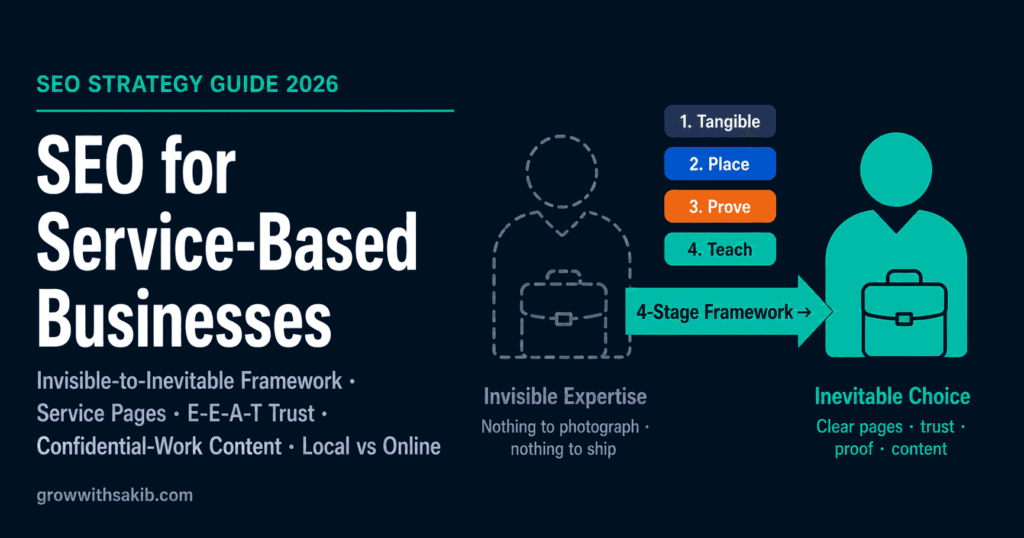
Selling a service is harder to market than selling a product. You can’t photograph tax advice, ship legal counsel overnight, or let someone add “business strategy” to a cart. Yet your future clients are searching for exactly what you do right now – and SEO for service-based businesses is how you make sure they find you instead of a competitor.
This guide skips the generic advice and tackles the hard parts: ranking invisible services, building the right page structure, earning trust when you can’t show your work, and creating content when client engagements are confidential. It’s the service-business deep-dive for the broader small business SEO guide on GrowWithSakib, capturing the high-intent searches the pillar can’t rank for alone.
Why Is SEO Different for Service Businesses?
Service businesses face SEO challenges product businesses never meet. An e-commerce store has product pages, images, prices, and reviews baked in. A service business has intangible expertise and often confidential work – so the usual playbook doesn’t fit.
| Challenge | Product Business | Service Business |
| What you rank | Product pages with images and specs | Intangible services you must describe in words |
| Proof | Product reviews, photos, demos | Testimonials, case studies – often confidential |
| Geography | Often sells nationwide | Usually tied to a service area or niche |
| Content | Specs, comparisons, how-to-use | Process, outcomes, expertise, trust |
That changes your whole approach. Instead of optimising products, you optimise clarity, trust, and expertise — the dedicated E-E-A-T guide breaks down exactly how to demonstrate each of the four dimensions on your pages. This is where Google’s E-E-A-T framework in the Search Quality Rater Guidelines – Experience, Expertise, Authoritativeness, Trustworthiness – becomes your biggest lever, not a buzzword.
The Invisible-to-Inevitable Framework
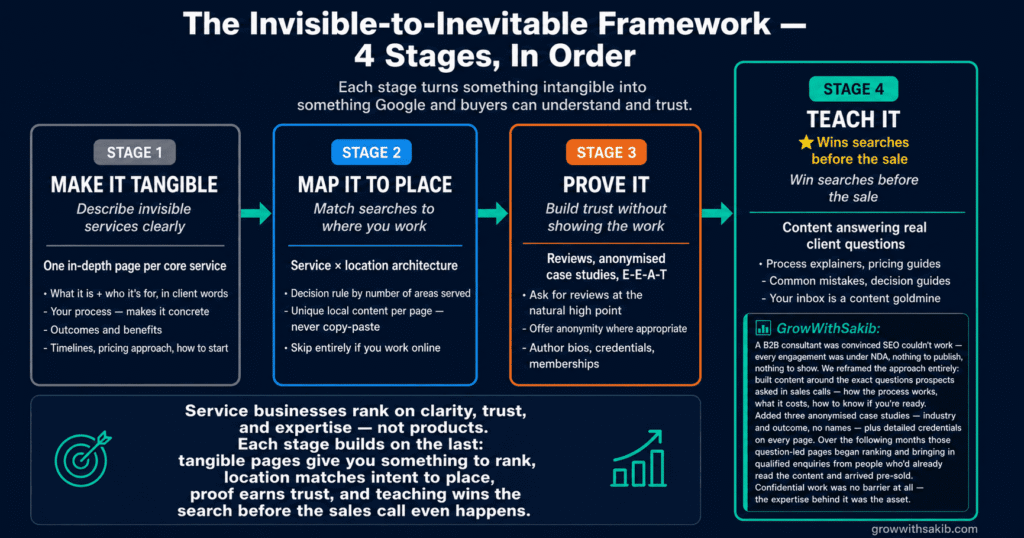
Ranking an invisible service comes down to four moves, in order. Each turns something intangible into something Google and buyers can understand and trust.
| Stage | Goal | Core Move |
| 1. Make it Tangible | Describe invisible services clearly | One in-depth page per core service |
| 2. Map it to Place | Match searches to where you work | Service x location architecture |
| 3. Prove it | Build trust without showing the work | Reviews, anonymised case studies, E-E-A-T |
| 4. Teach it | Win searches before the sale | Content answering real client questions |
Stage 1: Make Invisible Services Tangible – Service Pages
Your service pages are the product pages of a service business. The biggest mistake service owners make is cramming every service onto one thin page, or worse, listing them on the homepage with no detail. Google can’t tell what you specialise in, and neither can buyers.
The rule: one dedicated page per core service.
Each service page should explain, in depth:
- What the service is and who it’s for – in the words your clients use, not industry jargon
- Your process – the steps a client goes through, which makes invisible work feel concrete
- Outcomes and benefits – what changes for the client after the work
- What to expect – timelines, pricing approach, and how to start
If you offer genuinely different services that people search for differently – say a law firm doing both family law and corporate law – each needs its own page. A thin homepage and a contact page won’t rank in 2026; Google needs clear service pages to understand your expertise. Pair each with the on-page SEO checklist on GrowWithSakib to optimise it properly.
Stage 2: Map Services to Place – Location Page Architecture
If you serve specific areas, location pages help you rank in each one. But this is where service businesses get penalised: creating identical pages with only the city name swapped is thin, duplicate content that Google can flag — the same checklist used in the technical SEO audit guide for diagnosing duplicate and thin content issues site-wide.
The service x location matrix:
Think of your pages as a grid of services down one side and locations across the top. The decision rule on whether to build a page for each cell:
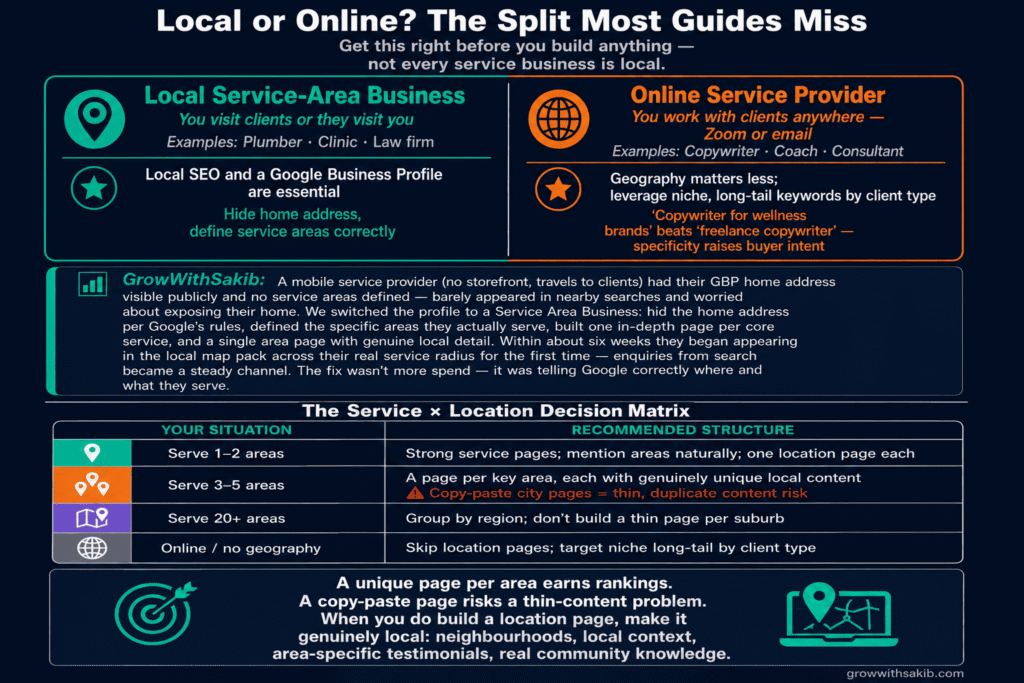
| Your Situation | Recommended Structure |
| Serve 1-2 areas | Strong service pages; mention areas naturally; one location page each |
| Serve 3-5 areas | A page per key area, each with genuinely unique local content |
| Serve 20+ areas | Group by region; don’t build a thin page per suburb |
| Online / no geography | Skip location pages; target niche long-tail by client type |
When you do build a location page, make it genuinely local: reference neighbourhoods, local context, area-specific testimonials, and real knowledge of that community. A unique page per area earns rankings; a copy-paste page risks a thin-content problem. This is long-tail intent in action – the long-tail keywords guide on GrowWithSakib shows how to find these area-and-service combinations.
Are You Even a Local Business? Service Area vs Online
A crucial split most guides miss: not every service business is local. Get this right before you build anything.
- Local service-area business – you visit clients or they visit you (plumber, clinic, law firm). Local SEO and a Google Business Profile are essential.
- Online service provider – you work with clients anywhere via Zoom or email (copywriter, coach, consultant). Geography matters less; your leverage is niche, long-tail keywords by client type.
For the online provider, “copywriter for wellness brands” beats “freelance copywriter” every time – the specificity that lowers search volume is exactly what raises buyer intent. For the local provider, the local SEO guide on GrowWithSakib and Google Business Profile guide carry most of the weight.
Stage 3: Prove It – Trust Signals Without Showing the Work
Product businesses prove quality with reviews and photos. Service businesses must build trust around work that’s often confidential. This is where E-E-A-T does the heavy lifting – and where service providers actually have an advantage, because real expertise is hard to fake.
Reviews – even when clients are private.
Reviews are a strong local ranking and trust signal, but service clients are sometimes reluctant to go public. Work within that:
- Ask at the natural high point – right after a successful outcome, with a direct link to your Google profile
- Offer anonymity where appropriate – a first name and industry (“Sarah K., healthcare”) still carries weight
- Never incentivise or buy reviews – it violates Google’s policies and risks your profile
Case studies and testimonials – anonymised.
You don’t need to name a client to prove results. An anonymised case study – “a mid-sized accounting firm,” the challenge, your process, the measurable outcome – demonstrates expertise without breaching confidentiality. This is genuine Experience, the first E in E-E-A-T, and it’s powerful precisely because most competitors skip it.
Other trust signals that matter:
- Author bios and credentials – real names, qualifications, and experience on your pages
- Professional memberships and certifications – displayed and, where possible, linked
- Local sponsorships and partnerships – a natural, high-value source of local links for service providers
Stage 4: Teach It – Content From Confidential Expertise
Content marketing feels impossible when your work is private. The breakthrough: you don’t write about client work – you write about the questions clients ask before they hire you. Your inbox is a content goldmine.
Content that ranks for service businesses, with zero confidentiality risk:
- Process explainers – “How a tax audit defence actually works” – demystify what you do
- Pricing and timeline guides – the questions everyone asks but few competitors answer publicly
- Common mistakes – “5 mistakes businesses make before hiring a consultant”
- Decision guides – “When to hire an accountant vs do it yourself”
- Local resource guides – area-specific knowledge that earns local links
This content satisfies real search intent, demonstrates expertise, and feeds your service pages with internal links. It also positions you for AI search and featured snippets via clear, direct answers. Build it on a deliberate structure using the internal linking strategy guide on GrowWithSakib.
How Long Does SEO Take for a Service Business?
Faster than the old “six months” narrative suggests – especially if you actively prompt Google to re-crawl. After publishing or updating a page, use the URL Inspection tool in Google Search Console and request indexing so Google takes a fresh look. Meaningful movement in two to four weeks is realistic for pages that are genuinely well-optimised.
What matters more than time is whether your pages actually match intent and whether you’re telling Google to re-evaluate them. Track progress with the guide to tracking SEO results on GrowWithSakib.
Honest Limits: What SEO Can’t Do for Service Businesses
SEO is one of the highest-ROI channels for service businesses, but set realistic expectations:
- It won’t fix a thin website – a homepage and a contact page can’t compete; you need real service pages first.
- It won’t rescue poor service – SEO brings enquiries; reputation and word of mouth keep them coming. Bad reviews undo good rankings.
- Online providers can’t fake local – if you work remotely, don’t invent a service area; target niche keywords instead.
- Competitor backlink gaps take time – established firms have link authority you build over months, not days.
- It’s ongoing, not one-and-done – consistent content, reviews, and updates compound; a single push fades.
If you don’t have five to ten hours a month for this, hiring help is reasonable – just know what you’re paying for. To weigh SEO against other channels, see the guide to SEO versus paid ads on GrowWithSakib.
Common Service Business SEO Mistakes
| Mistake | Why It Hurts | Do This Instead |
| All services on one thin page | Google can’t tell what you specialise in | One in-depth page per core service |
| Copy-paste location pages | Thin, duplicate content risks rankings | Unique local content per area you serve |
| Assuming you’re a local business | Wasted effort if you work online | Match strategy to local vs online provider |
| Skipping reviews as too awkward | Loses a key trust and ranking signal | Ask at the high point; allow anonymity |
| No content because work is private | Misses search demand entirely | Write about client questions, not client work, structured using a topic cluster strategy |
| Hiding credentials and author info | Weakens E-E-A-T for your niche | Show real names, qualifications, experience |
| Home address public for a mobile business | Confuses Google and exposes your home | Set up as a Service Area Business correctly |
Frequently Asked Questions
1. What is SEO for service-based businesses?
SEO for service-based businesses is the practice of ranking a business that sells expertise rather than physical products. Because there’s nothing to photograph or ship, it focuses on clear service pages, location pages where relevant, strong E-E-A-T trust signals like reviews and case studies, and content answering client questions. For local providers, a Google Business Profile and service-area setup do much of the work.
2. How do I do SEO when my services are invisible?
Make the invisible tangible. Build one in-depth page per service that explains your process, outcomes, and what clients can expect – in their words. Describe the steps a client goes through, since that makes intangible work concrete. Add anonymised case studies and reviews for proof, and create content answering the questions clients ask before hiring. Google ranks clarity and trust, not physical products.
3. Do service businesses need location pages?
Only if you serve specific geographic areas. If you serve 3 to 5 areas, build a unique page for each with genuine local content. If you serve 20 or more, group by region rather than making thin pages per suburb. If you work online with clients anywhere, skip location pages entirely and target niche, long-tail keywords by client type instead.
4. How do I create content if my client work is confidential?
Write about the questions clients ask, not the client work itself. Process explainers, pricing and timeline guides, common mistakes, and decision guides all rank well and breach no confidentiality. For proof, use anonymised case studies – industry and outcome, no names. Your sales-call questions and inbox are a content goldmine that demonstrates expertise without revealing a single client.
5. How do I get reviews for a service business when clients are private?
Ask at the natural high point, right after a successful outcome, with a direct link to your Google profile. Offer anonymity where appropriate – a first name and industry still carries weight. Reviews are a strong local ranking and trust signal. Never buy or incentivise reviews, which violates Google’s policies and can get your profile suspended.
6. Is E-E-A-T important for service businesses?
Very. Google’s E-E-A-T framework – Experience, Expertise, Authoritativeness, Trustworthiness – is a major signal, and it’s a structural advantage for service providers because genuine expertise is hard to fake. Show real author credentials, anonymised case studies, professional memberships, and client reviews to signal all four dimensions clearly on your pages.
7. How long does SEO take to work for a service business?
Often faster than six months. After publishing or updating a page, use the URL Inspection tool in Google Search Console to request indexing so Google re-evaluates it quickly. Meaningful movement in two to four weeks is realistic for well-optimised pages. What matters more than time is genuine intent match and actively prompting Google to take a fresh look.
8. What is a Service Area Business on Google?
A Service Area Business (SAB) is one that serves customers at their locations rather than from a storefront – like a plumber or mobile provider. In your Google Business Profile, you can hide your physical address and define the specific areas you serve, following Google’s rules. Set service areas based on where you can realistically work, since overreaching raises suspension risk.
Key Takeaways
- Service businesses rank on clarity, trust, and expertise – not products – so service pages, E-E-A-T, and content do the heavy lifting.
- Run the Invisible-to-Inevitable Framework: make services tangible, map them to place, prove them, then teach to win searches.
- Build one in-depth page per core service; a thin homepage plus contact page won’t rank in 2026.
- Match your strategy to your type: local service-area business needs local SEO and GBP; online providers target niche long-tail by client type.
- Create unique location pages only where you can add genuine local content – copy-paste city pages risk a thin-content problem.
- Write content about the questions clients ask, not confidential client work – process, pricing, and decision guides rank and prove expertise.
- Use anonymised case studies and credentials to build E-E-A-T without breaching confidentiality – a structural advantage for service providers.
- Set up correctly as a Service Area Business if you have no storefront, and request re-indexing in Search Console after updates for faster movement.