“Is GEO replacing SEO?” is the wrong question. The useful question is: what actually changes, what stays the same, and what should I do first? This guide answers all three with real data instead of hype – and ends with a framework for where to start.
This expands the comparison in the complete guide to generative engine optimization on GrowWithSakib. If GEO is brand new to you, start with the plain-English explainer on what generative engine optimization is, then come back here for the side-by-side.
GEO vs SEO: The Core Difference in One Line
Here’s the cleanest way to hold the distinction:
- SEO gets your page into the ranked list of links, so a human can click through to your site.
- GEO gets your content into the AI’s synthesised answer, so you’re cited even when no one clicks.
SEO optimises for rankings and clicks. GEO optimises for citations and mentions. One is a destination; the other is a recommendation. Everything else flows from that single difference.
What Stays the Same? The Shared Foundation
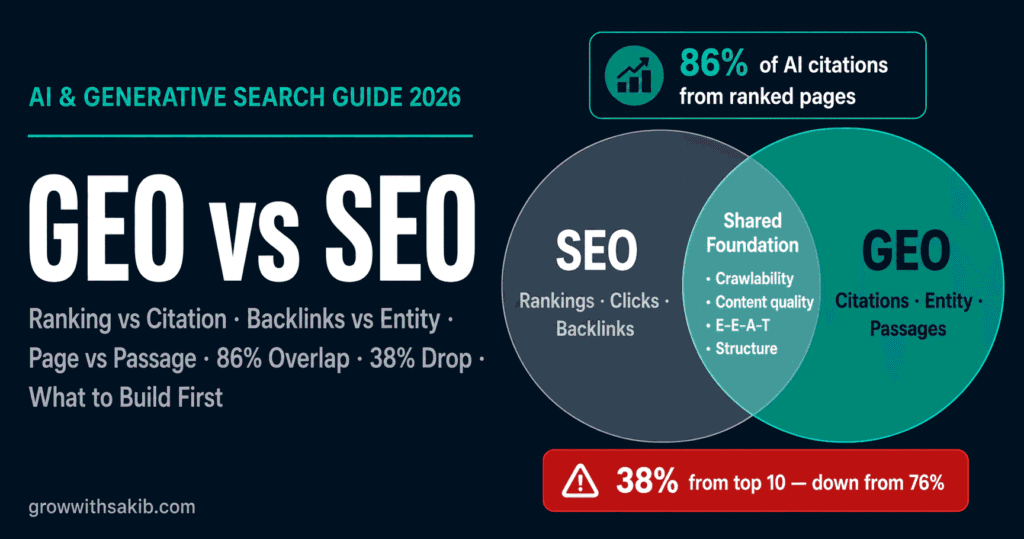
Before the differences, the reassuring truth: GEO and SEO share most of their foundation. AI engines don’t pull answers from thin air – they pull from web content they can find, read, and trust. The same things that make content good for Google make it usable for an AI.
The data backs this up. Ahrefs studied 1.9 million citations from a million AI Overviews and found that 86% of AI Overview citations come from pages ranking somewhere in Google’s top 100, with a median ranking of 3. In other words, ranking well still gets you into the pool AI draws from. Good SEO is the price of admission to GEO.
These signals carry over almost unchanged:
- Crawlability and indexing – if Google can’t crawl your page, an AI can’t retrieve it. Technical SEO still matters.
- Content quality and depth – genuinely helpful, accurate content wins in both worlds.
- Clear structure – headings, short paragraphs, and lists help both Google and AI pull out what matters.
- E-E-A-T and trust – experience, expertise, authoritativeness, and trustworthiness signal credibility to both.
- Topical authority – deep coverage of a subject helps you rank and helps AI trust you as a source.
If you’ve built solid SEO foundations through something like the small business SEO guide on GrowWithSakib, you are not starting GEO from zero. You’re roughly 70% of the way there already.
What Actually Diverges? Three Real Differences
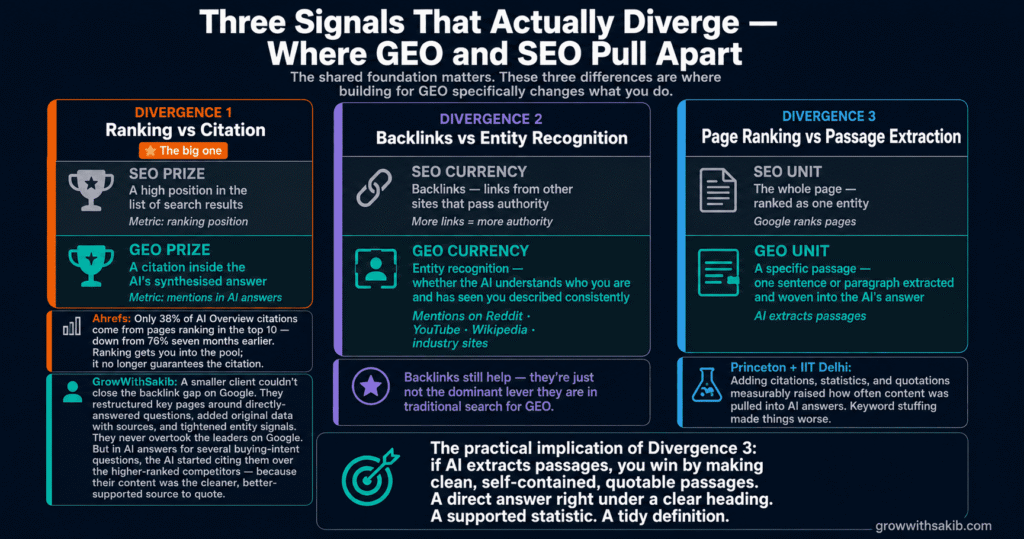
Now the part that matters. Underneath the shared foundation, three signals genuinely diverge – and they change what you build and measure.
1. Ranking vs Citation
This is the big one. In SEO, the prize is a high ranking. In GEO, the prize is a citation inside the answer – and the two have pulled apart faster than most expected. Ahrefs found that only 38% of pages cited in Google’s AI Overviews also rank in the top 10 for that query – down sharply from 76% just seven months earlier.
Read that again: a page can rank number one and still be left out of the AI answer your buyer actually reads. Ranking gets you into the retrieval pool; it no longer guarantees the citation.
2. Backlink Authority vs Entity Recognition
SEO leans heavily on backlinks – links from other sites that pass authority. GEO leans more on entity recognition: whether the AI understands who you are, what you do, and that you’re a recognised, consistent presence across the web – your site, plus mentions on places like Reddit, YouTube, Wikipedia, and industry sites.
Backlinks still help, but they’re not the dominant lever they are in search. What moves GEO is being a clearly defined entity the model has seen described consistently in many trusted places. For how that authority builds in the traditional sense, see the guide to domain authority on GrowWithSakib.
3. Page Ranking vs Passage Extraction
Google traditionally ranks a whole page. A generative engine does something different: it pulls a specific passage – a sentence or paragraph – out of your page to weave into its answer. It’s not ranking your page; it’s extracting a chunk.
That single mechanical fact explains most of GEO’s practical advice. If AI extracts passages, you win by making clean, self-contained, quotable passages: a direct answer right under a clear heading, a supported statistic, a tidy definition. The founding Princeton and IIT Delhi GEO research confirmed this – adding citations, quotations, and statistics measurably raised how often content was pulled into answers, while keyword stuffing made things worse.
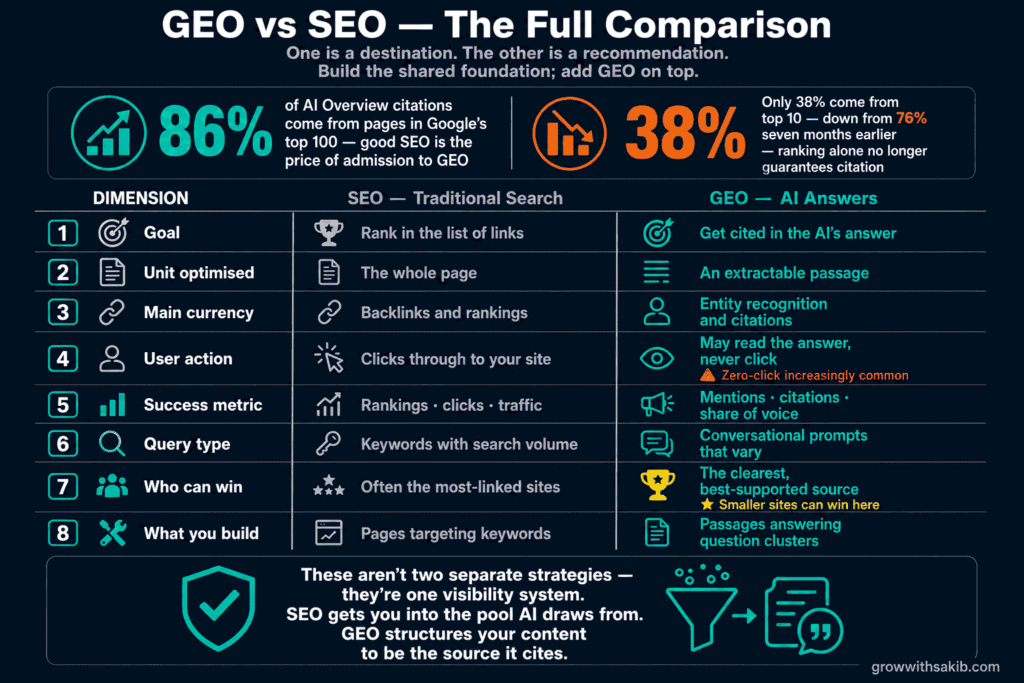
GEO vs SEO: The Full Comparison Table
| Dimension | SEO (Traditional Search) | GEO (AI Answers) |
| Goal | Rank in the list of links | Get cited in the AI’s answer |
| Unit optimised | The whole page | An extractable passage |
| Main currency | Backlinks and rankings | Entity recognition and citations |
| User action | Clicks through to your site | May read the answer, never click |
| Success metric | Rankings, clicks, traffic | Mentions, citations, share of voice |
| Query type | Keywords with search volume | Conversational prompts that vary |
| Who can win | Often the most-linked sites | The clearest, best-supported source |
| What you build | Pages targeting keywords | Passages answering question clusters |
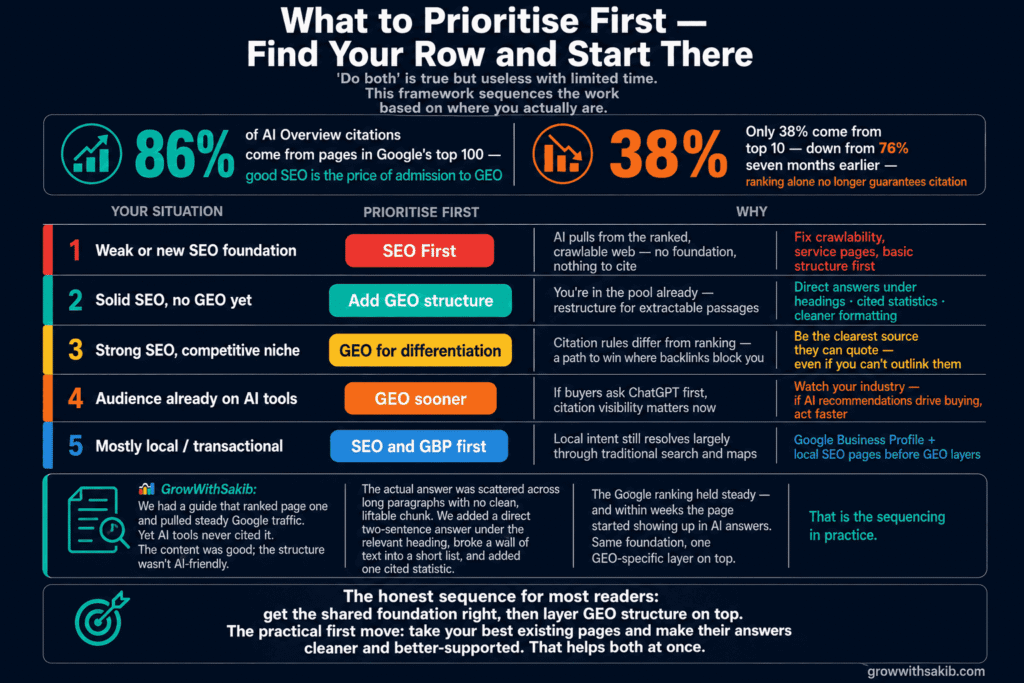
What Should You Prioritise First? A Decision Framework
“Do both” is true but useless if you have limited time. Here’s how to sequence the work based on where you actually are. Find your row and start there.
| Your Situation | Prioritise First | Why |
| Weak or new SEO foundation | SEO first | AI pulls from the ranked, crawlable web – no foundation, nothing to cite |
| Solid SEO, no GEO yet | Add GEO structure | You’re in the pool already; restructure for extractable passages |
| Strong SEO, competitive niche | GEO for differentiation | Citation rules differ from ranking – a path to win where backlinks block you |
| Audience already on AI tools | GEO sooner | If buyers ask ChatGPT first, citation visibility matters now |
| Mostly local / transactional | SEO and GBP first | Local intent still resolves largely through traditional search and maps |
For most readers the honest sequence is simple: get the shared foundation right, then layer GEO structure on top. The two aren’t a choice – they’re one visibility system. The practical first move for almost everyone is to take your best existing pages and make their answers cleaner and better-supported, which helps both at once.
An Honest Word on the Data
Treat every GEO statistic – including the ones here – with healthy caution. This field is months old and moving fast. Ahrefs itself notes that part of the citation-overlap drop reflects improved detection in their tools, not purely a change in Google’s behaviour. Different studies using different methods report different numbers.
What’s not in doubt is the direction: ranking and citation have decoupled meaningfully, AI answers are pulling from a wider pool than page one, and content built for clean extraction does better in AI answers. Build around the durable direction, not any single percentage. Measure your own AI visibility rather than trusting a benchmark, using the approach in the guide to tracking SEO results on GrowWithSakib.
Common GEO vs SEO Mistakes
| Mistake | Why It Hurts | Do This Instead |
| Treating it as either/or | You lose visibility in one whole layer | Build the shared foundation, then add GEO on top |
| Abandoning SEO for GEO | Kills the foundation AI cites from | Keep SEO; AI pulls mostly from ranked pages |
| Chasing one keyword ranking | AI answers question clusters, not single terms | Build topical depth around related questions |
| Burying the answer | AI can’t extract a clean passage | Put a direct answer right under each heading |
| Ignoring entity signals | AI can’t recognise who you are | Keep consistent naming and earn trusted mentions |
| Trusting one GEO stat as gospel | The data is noisy and shifting | Track your own AI visibility over time |
Frequently Asked Questions
1. What is the difference between GEO and SEO?
SEO optimises your content to rank in a search engine’s list of links and earn clicks. GEO optimises your content to be cited inside AI-generated answers from tools like ChatGPT and Google’s AI Overviews. SEO’s currency is rankings and backlinks; GEO’s is citations and entity recognition. They share a foundation of crawlable, clear, authoritative content but optimise for different end goals.
2. Is GEO replacing SEO?
No. GEO builds on SEO rather than replacing it. Ahrefs found that 86% of AI Overview citations come from pages ranking in Google’s top 100, so AI mostly pulls from the ranked web. The realistic model for 2026 is GEO and SEO as one visibility system – SEO gets you into the pool AI draws from, and GEO structures your content to be the source it cites.
3. Do I need both GEO and SEO?
For most businesses, yes – because customers now search across both traditional search and AI tools. The good news is most of the work overlaps: crawlable, clear, authoritative content serves both. You’re not running two separate strategies, but one foundation with a GEO-specific layer – extractable passages, strong entity signals, and cited facts – added on top.
4. What should I prioritise first, GEO or SEO?
If your SEO foundation is weak or new, fix that first – AI pulls from the crawlable, ranked web, so there’s nothing to cite without it. If your SEO is already solid, add GEO structure: restructure key pages around directly-answered questions with supporting data. If your audience already starts on AI tools, move on GEO sooner. Build the shared foundation, then layer GEO on top.
5. Does ranking number one on Google guarantee an AI citation?
No, not anymore. Ahrefs found that only 38% of AI Overview citations come from pages ranking in the top 10, down from 76% seven months earlier. A high ranking gets you into the retrieval pool but no longer guarantees the citation. AI engines increasingly pull from a wider range of pages based on clarity and how extractable the answer is.
6. Do backlinks matter for GEO?
Yes, but less than for SEO. Backlinks help establish the authority that gets you ranked and into the pool AI draws from. But GEO leans more on entity recognition – whether the AI understands who you are from consistent mentions across trusted sites like Reddit, YouTube, Wikipedia, and industry platforms. Backlinks help; they’re just not the dominant lever they are in traditional search.
7. What does GEO optimise that SEO doesn’t?
GEO optimises for passage extraction rather than whole-page ranking. A generative engine pulls a specific sentence or paragraph from your page into its answer, so GEO focuses on clean, self-contained, quotable passages: direct answers under clear headings, supported statistics, and tidy definitions. It also emphasises entity signals and citations more than SEO’s backlink-and-keyword focus.
8. Can a small site win at GEO even if it can’t outrank big competitors?
Yes. Because citation rules differ from ranking, a smaller site with clearer, better-supported content can be cited over higher-ranked rivals. The founding Princeton GEO research found content changes could lift a lower-ranked source’s visibility substantially. If you can’t win the backlink race, GEO offers a different path: be the cleanest, most quotable source on the question.
Key Takeaways
- SEO optimises for rankings and clicks; GEO optimises for citations inside AI answers – one is a destination, the other a recommendation.
- GEO and SEO share most of their foundation: crawlability, content quality, clear structure, E-E-A-T, and topical authority carry over.
- Ahrefs found 86% of AI Overview citations come from pages in Google’s top 100 – so good SEO is the price of admission to GEO.
- But ranking and citation have decoupled: only 38% of AI Overview citations rank in the top 10, down from 76% seven months earlier.
- Three signals genuinely diverge: ranking vs citation, backlink authority vs entity recognition, and whole-page ranking vs passage extraction.
- GEO rewards clean, extractable passages – direct answers under clear headings, with supporting statistics and citations.
- Prioritise by stage: weak SEO means fix the foundation first; solid SEO means add GEO structure; AI-first audiences mean move on GEO sooner.
- Treat every GEO statistic with caution – the field is months old and shifting – but build around the clear direction, not any single number.