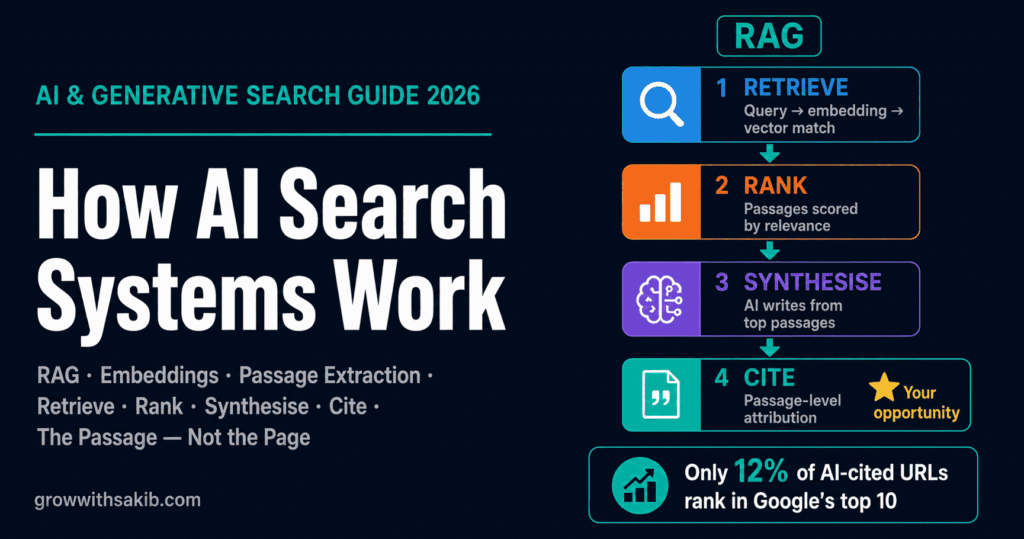
If you understand how AI search systems work under the hood, every piece of GEO advice suddenly makes sense – because it all flows from one mechanism. This article explains that mechanism in plain English, then shows the single insight that changes how you write: the passage, not the page, is what gets cited.
This expands the technical foundation in the complete guide to generative engine optimization on GrowWithSakib. If the terms GEO or AI search are new, start with the plain-English explainer on what generative engine optimization is.
What Is Retrieval-Augmented Generation (RAG)?
Retrieval-augmented generation is the technique behind almost every AI search tool. In plain terms, RAG means the AI doesn’t answer from memory alone – it first retrieves relevant documents from an outside source, then generates an answer grounded in what it found.
Per Amazon Web Services’ explanation of retrieval-augmented generation, RAG optimises an AI model’s output by making it reference an authoritative knowledge base outside its training data before answering. Elastic’s RAG guide frames it as a multi-step process that starts with retrieval and then leads to generation.
Why does this matter? Without RAG, an AI can only answer from training data that may be outdated, and it’s prone to making things up. RAG grounds the answer in real, current documents – which is exactly why these systems can cite sources. Those citations are the entire opportunity for GEO.
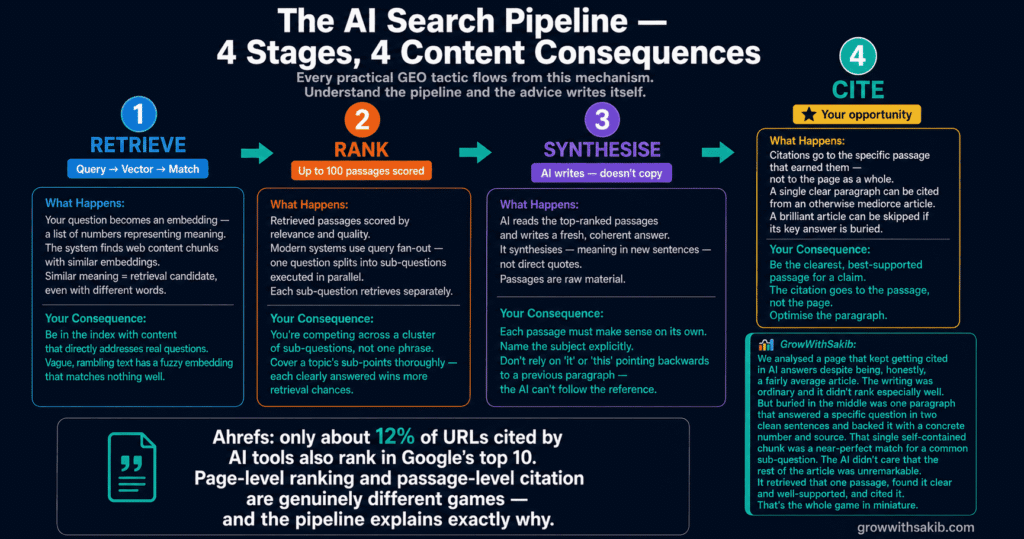
The AI Search Pipeline: Retrieve, Rank, Synthesise, Cite
Here’s what actually happens between your question and the AI’s answer. Four stages – and each one has a direct consequence for how you should write.
| Stage | What Happens | Your Content Consequence |
| 1. Retrieve | Query becomes a vector; system finds similar passages | Be in the index; write passages that match real questions |
| 2. Rank | Retrieved passages scored by relevance and quality | Make each passage clearly relevant and well-supported |
| 3. Synthesise | AI writes an answer from the top passages | Write self-contained chunks the AI can lift cleanly |
| 4. Cite | AI attributes claims to specific sources | Be the clearest source for a claim to earn the citation |
Stage 1: Retrieve – Your Question Becomes Numbers
When you ask an AI a question, it doesn’t scan the web word by word. It converts your question into an embedding – a long list of numbers (a “vector”) that represents the meaning of your words, not the words themselves.
Your content has already been through the same process. AI systems break pages into chunks, turn each chunk into an embedding, and store them in a vector database. When your question’s vector is close to a chunk’s vector, that chunk is a candidate. Elastic describes this as converting information into vectors stored in a vector database, then ranking by relevance to the query.
Consequence: if a chunk of your content clearly and directly addresses a real question, its embedding will sit close to that question’s embedding – and it gets retrieved. Vague, rambling text has a fuzzy embedding that matches nothing well.
Stage 2: Rank – The Best Passages Win
Retrieval pulls many candidate passages; ranking decides which actually get used. The system scores each retrieved passage on relevance and quality, keeping only the top handful. Amazon’s documentation notes that RAG systems retrieve semantically relevant passages ordered by relevance – in its Bedrock service, up to 100 passages of around 200 tokens each, ranked before the best are passed on.
This is also where modern systems use query fan-out: they split your one question into several sub-questions and retrieve for each. Microsoft’s Azure AI Search documentation describes breaking complex queries into focused subqueries executed in parallel. So a single prompt can pull passages from many pages at once.
Consequence: you’re not competing for one query – you’re competing across a cluster of sub-questions. Covering a topic thoroughly, with each sub-point clearly answered, wins more retrieval chances than one page targeting one phrase.
Stage 3: Synthesise – The AI Writes the Answer
Now the AI takes the top-ranked passages and writes a coherent answer. Crucially, it doesn’t copy them – it synthesises: reading the passages and rewriting the combined meaning in fresh sentences. The passages are its raw material, like quotes feeding a journalist’s article.
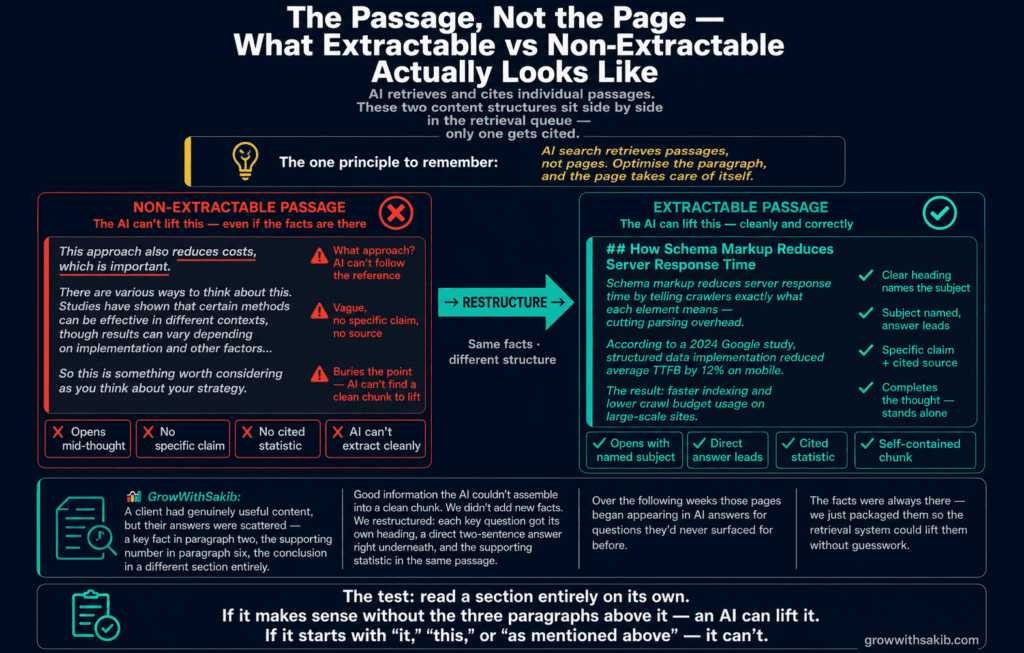
This is why a passage has to make sense on its own. If your chunk starts mid-thought – “This approach also reduces costs” with no clue what “this approach” is – the AI can’t use it cleanly. A self-contained passage that names its subject (“Schema markup reduces costs by…”) gives the AI something it can lift without confusion.
Consequence: write each section so it stands alone. A reader – or an AI – should understand it without the three paragraphs above it. Name the subject in the sentence; don’t rely on “it” or “this” pointing backwards.
Stage 4: Cite – Why the Passage Beats the Page
Finally, the system attributes claims to the sources it used and shows citations. And here’s the insight the whole article builds to: the unit of citation is the passage, not the page.
Because RAG retrieves, ranks, and synthesises at the chunk level, a citation goes to the specific passage that earned it – regardless of how good the rest of the page is. This is why a single excellent paragraph can be cited from an otherwise mediocre article, and why a brilliant article can be ignored if its key answer is buried under waffle the system can’t extract cleanly.
The data supports this decoupling. Ahrefs analysed 15,000 queries and found only about 12% of URLs cited by AI tools also rank in Google’s top 10. Page-level ranking and passage-level citation are genuinely different games. The founding Princeton and IIT Delhi GEO research pointed the same way: adding clear statistics and citations to a passage measurably raised how often it was pulled into answers.
Do All AI Search Systems Work the Same Way?
The core RAG pattern is shared, but the implementations differ – and the exact details are proprietary and changing. Treat these as general tendencies, not fixed rules:
- ChatGPT Search leans on a live web index plus its training data, synthesising answers and citing inline.
- Perplexity is citations-first, relying heavily on real-time web retrieval and showing visible source links in every answer.
- Google AI Overviews integrate with Google’s own index and use query fan-out across related sub-questions.
The practical upshot is the same across all of them: clear, self-contained, well-supported passages get retrieved and cited more reliably. You don’t need to optimise separately for each engine – you need to be genuinely extractable. For where this fits the bigger picture, see how GEO and SEO compare on GrowWithSakib.
An Honest Note on What We Can and Can’t Know
Be cautious with anyone who claims to know exactly how ChatGPT or Google AI ranks passages. The general RAG mechanism is well-documented by AWS, Microsoft, Elastic, and the research literature – that part is solid. But the specific scoring each commercial engine uses is proprietary and changes often.
So build on the durable mechanism, not on any single claimed ranking factor. The mechanism says: be retrievable (in the index, clearly chunked), be relevant (directly answer real questions), and be liftable (self-contained, well-supported passages). Those hold no matter how the internal scoring shifts. Measure your own results rather than trusting a benchmark, using the approach in the guide to tracking SEO results on GrowWithSakib.
Common Mistakes About How AI Search Works
| Mistake | Why It’s Wrong | The Reality |
| Thinking AI reads whole pages | RAG retrieves chunks, not full pages | Optimise individual passages to be self-contained |
| Assuming ranking = citation | Only ~12% of AI citations rank in Google’s top 10 | Citation is a separate, passage-level game |
| Burying the answer mid-section | The chunk starts mid-thought and can’t be lifted | Lead each section with a direct, named answer |
| Keyword stuffing for AI | Embeddings match meaning, not repeated words | Write clearly; meaning is what gets matched |
| Targeting one phrase per page | Query fan-out pulls many sub-questions | Cover a topic’s sub-questions thoroughly |
| Treating all engines as identical | Retrieval details differ by platform | Be extractable; that works everywhere |
Frequently Asked Questions
1. How do AI search systems actually work?
AI search systems use retrieval-augmented generation (RAG). When you ask a question, the system converts it into a numerical embedding, searches a vector database for the most semantically similar passages of text, ranks them by relevance, feeds the best ones to an AI model, and the model writes an answer citing those sources. The key point: it retrieves and cites individual passages, not whole pages.
2. What is retrieval-augmented generation (RAG)?
RAG is a technique where an AI retrieves relevant documents from an external knowledge base before generating an answer, rather than relying on training data alone. Per AWS, it makes the model reference an authoritative source before answering. This grounds responses in real, current information, reduces made-up answers, and lets the system cite its sources – which is what makes GEO possible.
3. What is passage extraction in AI search?
Passage extraction is how AI search pulls a specific chunk of text – usually a paragraph – from a page to use in its answer, rather than the whole page. Pages are broken into chunks, each turned into an embedding and stored. When a chunk closely matches a question, that passage is retrieved and may be cited, independent of the rest of the page’s quality.
4. Why does AI cite one paragraph instead of my whole article?
Because RAG operates at the passage level, not the page level. The system retrieves, ranks, and synthesises individual chunks, so a citation goes to the specific passage that best answered the query. This is why one clear, self-contained, well-supported paragraph can be cited even from an average article – and why a strong article can be skipped if its key answer is buried and hard to extract.
5. What is an embedding in simple terms?
An embedding is a list of numbers that represents the meaning of a piece of text. Think of it as coordinates in “meaning space”: sentences with similar meaning get similar numbers and sit close together, even if they use different words. AI search converts both your question and web content into embeddings, then matches them by closeness – which is how it finds relevant passages without exact keyword matching.
6. Does ranking well on Google mean AI will cite me?
Not necessarily. Ranking helps you get into the pool AI retrieves from, but citation is a separate, passage-level decision. Ahrefs found only about 12% of URLs cited by AI tools also rank in Google’s top 10. A page can rank well yet never be cited if its answers aren’t structured as clean, extractable passages the retrieval system can lift.
7. How do I structure content so AI can extract it?
Make every section self-contained. Lead each one with a direct answer to its implied question, name the subject explicitly instead of relying on “it” or “this,” support claims with specific statistics, and use clear headings, short paragraphs, and lists. The test: if a section makes sense read entirely on its own, an AI can lift it cleanly. Buried or mid-thought passages get skipped.
8. Do ChatGPT, Perplexity, and Google AI work the same way?
They share the core RAG pattern – retrieve, rank, synthesise, cite – but differ in details. ChatGPT uses a live index plus training data, Perplexity is citations-first with heavy real-time retrieval, and Google AI Overviews integrate with Google’s index using query fan-out. The exact scoring is proprietary and evolving, but writing clear, self-contained, well-supported passages works across all of them.
Key Takeaways
- AI search systems work through retrieval-augmented generation (RAG): retrieve relevant passages, rank them, synthesise an answer, and cite sources.
- Your question becomes an embedding – numbers representing meaning – and AI matches it to content chunks with similar embeddings, not matching keywords.
- The pipeline has four stages: Retrieve, Rank, Synthesise, Cite – and each one has a direct consequence for how you should structure content.
- The single most important insight: AI retrieves and cites passages, not pages – so one clear paragraph can be cited even from a mediocre article.
- Query fan-out splits your question into sub-questions, so covering a topic’s sub-points thoroughly wins more retrieval chances than targeting one phrase.
- Self-contained passages win: name the subject, lead with a direct answer, and support it – so the AI can lift the chunk without confusion.
- Ranking and citation are different games – Ahrefs found only about 12% of AI-cited URLs rank in Google’s top 10.
- The general RAG mechanism is well-documented, but each engine’s exact scoring is proprietary and shifting – build on the durable mechanism, not one claimed factor.