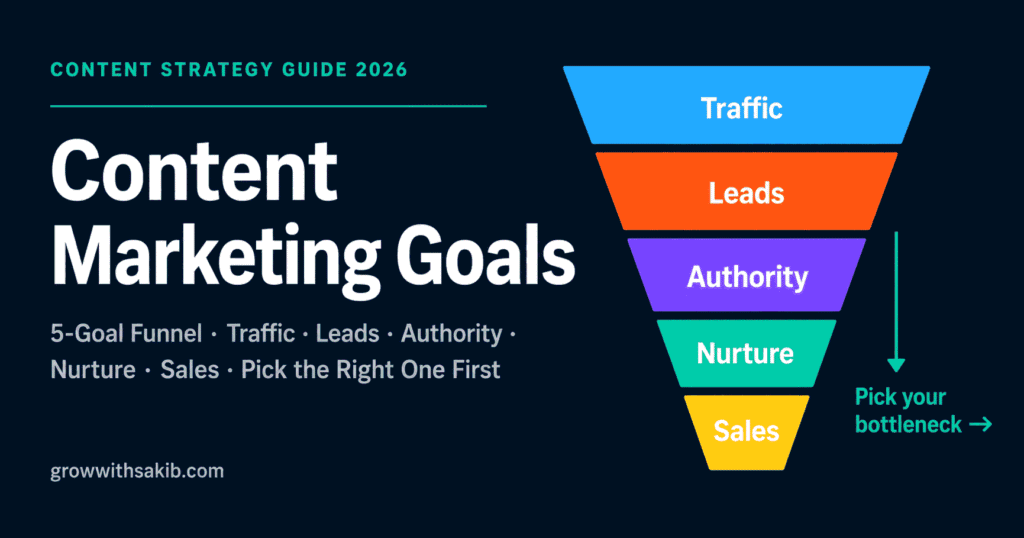
Most small business content fails for one boring reason: it has no goal. Owners create posts “to have a presence,” then wonder why nothing happens. Research from the Content Marketing Institute consistently finds only a minority of marketers rate their content strategy as highly effective – and the biggest difference between those who do and those who don’t is clear, measurable goals.
This guide gives you a simple 5-goal framework and, crucially, helps you choose which goal to focus on first. It expands the goals section of the content strategy for small business guide on GrowWithSakib. Let’s get you pointed in one clear direction.
The 5 Content Marketing Goals (and How They Connect)
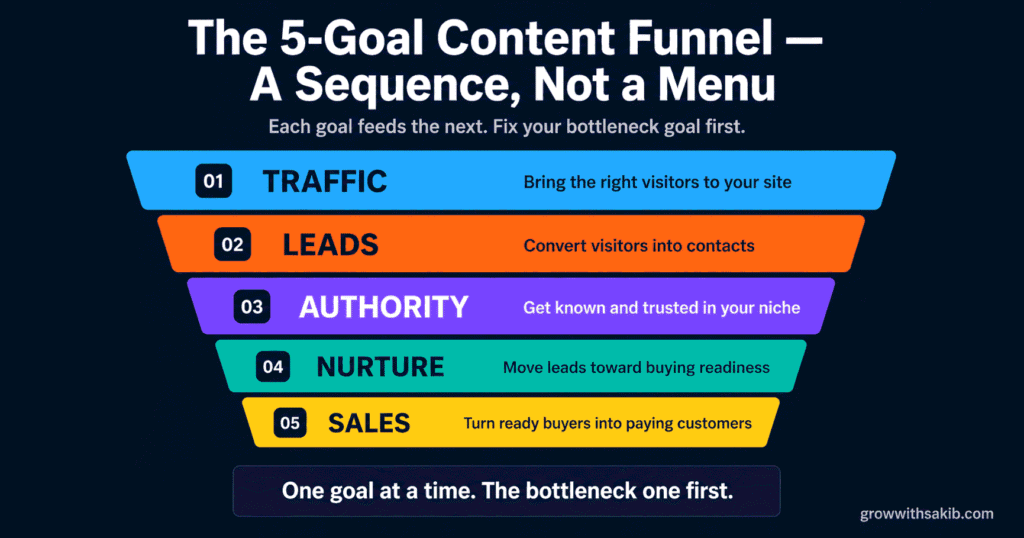
The five goals aren’t a random menu – they’re a funnel. Each one moves a stranger a step closer to becoming a customer. Understanding the sequence is what tells you where to focus.
| Goal | What It Does | Funnel Stage |
|---|---|---|
| 1. Traffic | Gets strangers to find you | Top (awareness) |
| 2. Leads | Turns visitors into contacts | Upper-middle (capture) |
| 3. Authority | Makes people trust you | Middle (consideration) |
| 4. Nurture | Keeps contacts warm over time | Lower-middle (relationship) |
| 5. Sales | Turns trust into purchases | Bottom (conversion) |
Here’s the mistake nearly everyone makes: they try to chase all five at once. A small business doesn’t have the time or team for that. The winning move is to find your single biggest bottleneck and pick the one goal that fixes it. Do that well, then move to the next.
The Goal-Selection Exercise: Which Goal Comes First?
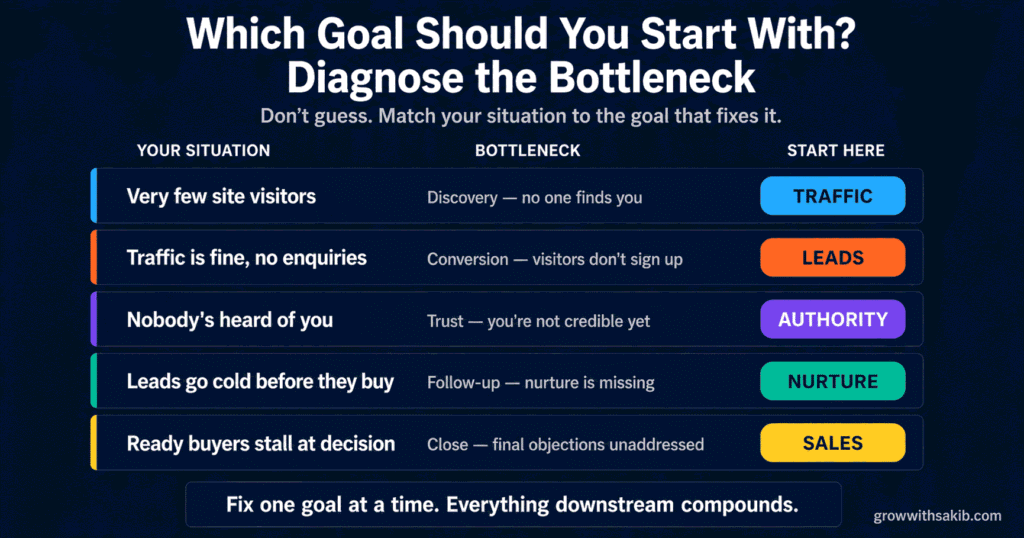
Don’t guess. Diagnose. Your primary goal should be whichever stage of the funnel is leaking most right now. Answer one honest question: where does your growth actually break down?
| If your situation is… | Your bottleneck is… | Start with this goal |
|---|---|---|
| Barely anyone finds you online | Awareness | Traffic (or Authority) |
| You get visitors but no contacts | Capture | Leads |
| People visit but don’t trust you yet | Credibility | Authority |
| You collect leads but they go cold | Relationship | Nurture |
| You have warm leads but few buy | Conversion | Sales |
Whatever line describes you best, that’s your primary goal for the next 90 days. Write it down. Everything you publish should serve it. You’re not ignoring the others forever – you’re fixing the leak that’s costing you most right now, then moving down the funnel.
Goal 1: Traffic – Get Found by New People
What it’s for: Bringing strangers who’ve never heard of you to your website. This is the top of the funnel – without it, nothing else can happen.
Best content type: Search-optimised blog posts and guides answering the questions your customers type into Google and AI tools. Helpful, question-based articles are the workhorse here. Build them with a small business SEO approach on GrowWithSakib.
How to measure it: Organic sessions and impressions in Google Search Console and Google Analytics 4 – both free. Watch the trend, not one week.
90-day success: A visible upward trend in organic impressions and a handful of pages starting to rank and bring in visitors. You’re looking for momentum, not a traffic explosion – SEO compounds over months.
Goal 2: Leads – Turn Visitors Into Contacts
What it’s for: Capturing visitor details (usually an email) so a stranger becomes someone you can reach again. Traffic you can’t capture is traffic you lose.
Best content type: A lead magnet – a free, genuinely useful resource (checklist, template, guide, mini-course) offered in exchange for an email, plus clear signup forms on your best pages.
How to measure it: New email subscribers and conversion rate (signups divided by visitors), tracked in your email tool and Analytics. A simple email platform like Mailchimp shows subscriber growth directly.
90-day success: A steadily growing email list and a measurable signup conversion rate on your key pages – even 1-3% of visitors converting is a real, working system you can improve.
Goal 3: Authority – Make People Trust You
What it’s for: Proving you genuinely know your field, so visitors and AI tools alike see you as a credible source. Trust is what makes people choose you over a cheaper unknown.
Best content type: Deep, expert content – thorough guides, original insights, case studies, and data – that covers your niche completely. This is where topical depth pays off; see the guide to topical authority on GrowWithSakib.
How to measure it: Softer but real signals: branded searches (people Googling your name), returning visitors, backlinks earned, and mentions or citations in AI answers. Track these in Search Console and Analytics.
90-day success: A few pieces of genuinely authoritative content published, early backlinks or mentions, and the first uptick in people searching for you by name. Authority is the slowest goal – judge direction, not volume.
Goal 4: Nurture – Keep Contacts Warm
What it’s for: Staying useful to the contacts you’ve captured so they remember and trust you when they’re ready to buy. Most leads aren’t ready today; nurture keeps you top of mind until they are.
Best content type: A regular email newsletter and a welcome email sequence – helpful, consistent, and personal, not constant selling. Email is the highest-control channel you own, with no algorithm in the way.
How to measure it: Email open rate, click rate, and replies. Rising engagement over time means your nurture is working; falling engagement means you’re selling too hard or adding too little value.
90-day success: A consistent send schedule established, healthy open and click rates for your industry, and real replies from subscribers – signs of a warm, engaged list rather than a dormant one.
Goal 5: Sales – Turn Trust Into Revenue
What it’s for: Directly helping warm, trusting prospects make the decision to buy. This is the bottom of the funnel, and it only works once the earlier stages are in place.
Best content type: Bottom-of-funnel content – comparison pages, case studies, detailed service or product pages, FAQs, and testimonials that answer buying questions and remove objections.
How to measure it: Conversions, enquiries, bookings, or sales attributed to content – tracked with goals in Analytics, UTM links, and a simple “how did you hear about us?” question. Tie content to revenue, not just clicks.
90-day success: A measurable number of enquiries, bookings, or sales you can trace back to specific content. Even a handful of clearly content-driven sales proves the system converts and is worth scaling.
The 5-Goal Framework at a Glance
Here’s the whole framework in one table – bookmark it, pick your row, and go.
| Goal | Best Content | Measure With | 90-Day Success |
|---|---|---|---|
| Traffic | SEO blog posts / guides | Organic sessions, impressions | Upward traffic trend |
| Leads | Lead magnet + signup forms | New subscribers, conversion % | Growing email list |
| Authority | Deep expert guides, data | Branded search, backlinks, mentions | First mentions and name searches |
| Nurture | Newsletter + welcome series | Open rate, click rate, replies | Engaged, consistent list |
| Sales | Comparisons, case studies, FAQs | Conversions, enquiries, sales | Content-driven sales you can trace |
Turn Your Goal Into a SMART Target
Once you’ve picked your primary goal, make it SMART – Specific, Measurable, Achievable, Relevant, and Time-bound – so you can actually tell if it’s working. A vague goal like “get more traffic” gives you nothing to aim at.
Honest Expectations: Content Is a Long Game
Before you set your goal, calibrate your patience:
- 90 days shows signals, not final results – especially for traffic and authority, three months reveals whether you’re trending the right way, not the full payoff. Content compounds over 6-12 months
- One goal at a time – focus is the whole point. Splitting effort across all five is why most small business content stalls. Nail one, then add the next.
- Faster vs slower goals – leads and nurture can show results within weeks; authority and traffic take longer. Match your expectations to the goal you chose.
- Consistency beats intensity – a realistic schedule you can sustain for a year beats a burst that dies by March. Pick a goal and a pace you can actually keep.
The reassuring part: once you’ve picked one clear goal, content marketing gets simpler, not harder. Every decision – what to write, where to post, what to measure – has an obvious answer, because it either serves the goal or it doesn’t. Track your progress with the method in the guide to tracking results on GrowWithSakib.
Common Content Goal-Setting Mistakes
| Mistake | Why It Hurts | Do This Instead |
|---|---|---|
| Creating content with no goal | Effort with no direction or payoff | Pick one primary goal first |
| Chasing all five goals at once | Splits effort; nothing progresses | Focus on your biggest bottleneck |
| Vague goals like ‘more traffic’ | Nothing to measure or aim at | Write a SMART, time-bound target |
| Choosing traffic when you need sales | Fills a leaky bucket | Diagnose the bottleneck, then choose |
| Measuring vanity metrics | Looks nice, proves nothing | Track the metric tied to your goal |
| Expecting fast results | Quitting before content compounds | Judge 90-day signals, commit longer |
| Switching goals every month | Nothing gets time to work | Hold one goal for a full quarter |
Frequently Asked Questions
1. What are the main content marketing goals for a small business?
There are five core content marketing goals: traffic (get found by new people), leads (turn visitors into contacts), authority (build trust and credibility), nurture (keep contacts warm over time), and sales (turn trust into revenue). They form a funnel. For a small business, the key is to focus on one primary goal at a time rather than chasing all five at once.
2. Which content marketing goal should I focus on first?
Focus on whichever funnel stage is leaking most. If barely anyone finds you, start with traffic or authority. If you get visitors but no contacts, choose leads. If leads go cold, choose nurture. If warm leads rarely buy, choose sales. Diagnose your biggest bottleneck, make that your primary goal for 90 days, and align all your content to it before moving on.
3. How do I measure content marketing goals?
Match one clear metric to each goal: traffic uses organic sessions and impressions (Google Search Console, Analytics); leads use new subscribers and conversion rate; authority uses branded searches, backlinks, and mentions; nurture uses email open and click rates; sales use conversions and enquiries attributed to content. Track the metric tied to your chosen goal rather than vanity numbers, and watch the trend over time.
4. How do I write a SMART content marketing goal?
Make it Specific, Measurable, Achievable, Relevant, and Time-bound. Instead of “get more subscribers,” write “grow my email list from 50 to 250 in 90 days by adding a lead magnet and signup form to my top three posts.” The SMART version tells you exactly what to build, the number to hit, and when to check progress – turning a vague wish into a goal you can actually manage and measure.
5. How long does content marketing take to show results?
It depends on the goal. Leads and nurture can show results within weeks. Traffic and authority take longer – typically three to twelve months – because SEO and trust compound slowly. Treat 90 days as a checkpoint for early signals (is the trend going the right way?) rather than final results. Content marketing is a long game that rewards consistency, so match your patience to the goal you chose.
6. Can I pursue more than one content goal at once?
You can, but as a small business you usually shouldn’t. Splitting limited time and energy across all five goals is exactly why most small business content stalls – nothing gets enough focus to work. Pick the one goal that fixes your biggest bottleneck, commit to it for a full quarter, then add the next once it’s working. Focus beats breadth, especially with a small team.
7. What content type works best for each goal?
Traffic: SEO blog posts and guides. Leads: a lead magnet plus signup forms. Authority: deep expert guides, original data, and case studies. Nurture: a regular email newsletter and welcome sequence. Sales: comparison pages, case studies, detailed product or service pages, and FAQs. Each goal has a natural content type – matching them is what makes your content actually move the metric you care about.
8. Why is setting content goals important?
Because content without a goal is just noise – effort with no direction or way to measure success. The Content Marketing Institute consistently finds that marketers with clear, documented goals rate their strategy far more effective than those without. A goal turns “posting to have a presence” into a system: it tells you what to create, where to publish, what to measure, and whether it’s working.
Key Takeaways
- Content without a clear goal is the top reason small business content fails – a defined goal turns random posting into a working system.
- There are five content marketing goals forming a funnel: traffic, leads, authority, nurture, and sales.
- Don’t chase all five – use the selection exercise to diagnose your biggest bottleneck and pick one primary goal for 90 days.
- Match the content to the goal: SEO posts for traffic, lead magnets for leads, deep guides for authority, newsletters for nurture, and comparison/case-study content for sales.
- Measure each goal with one clear metric and a free tool – not vanity numbers – and watch the trend over time.
- Make your chosen goal SMART: specific, measurable, achievable, relevant, and time-bound, with a real number and deadline.
- Judge 90 days on early signals, not final results – traffic and authority compound over 6-12 months, while leads and nurture move faster.
- Hold one goal for a full quarter before switching; focus and consistency beat doing everything at once.