Isolated blog posts rarely rank anymore. A single article on a competitive topic gets buried, no matter how good it is. A content cluster – a pillar page surrounded by 8-12 connected articles – changes that, because it shows Google and AI engines that you cover a subject completely, not just in one post.
This is the full, practical build process, and instead of a made-up example, it walks through a real cluster: the Generative Engine Optimization cluster on GrowWithSakib. It’s the implementation guide for the content strategy for small business guide on GrowWithSakib, which names pillar pages and clusters as the strongest topical authority signal. For why clusters earn AI citations specifically, see the companion topic clusters for AI search guide on GrowWithSakib; this article is about how to build one.
What Is a Pillar Page and Content Cluster?
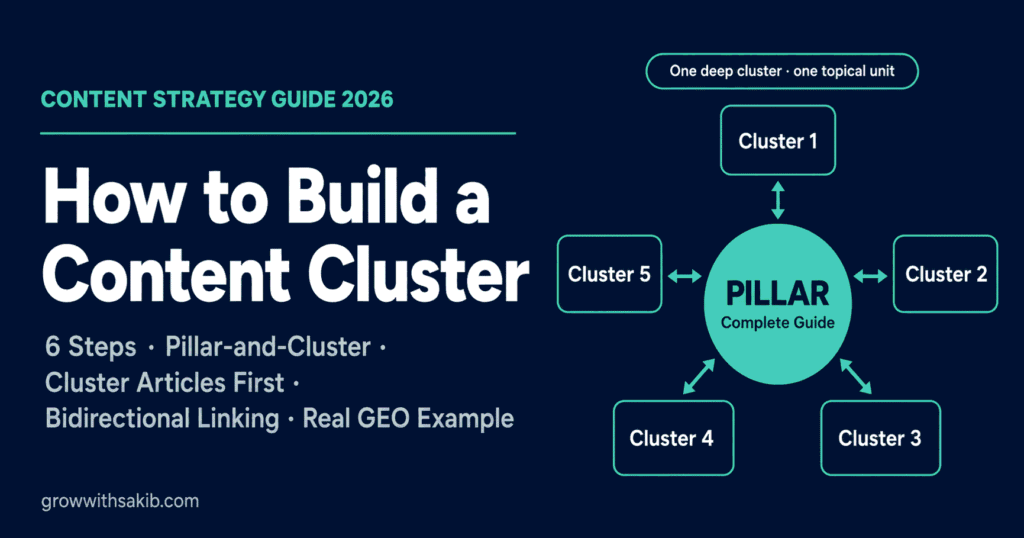
A content cluster has three parts:
- The pillar page – a comprehensive, high-level hub covering a broad topic and linking out to every cluster article. It’s the “city-centre map” of the subject.
- The cluster pages – individual in-depth articles, each covering one specific subtopic in detail and targeting a long-tail keyword.
- The internal links – the connective tissue: every cluster page links up to the pillar, the pillar links down to every cluster page, and related cluster pages link to each other.
The model was popularised by HubSpot, and it works because it matches how Google now evaluates topical authority on GrowWithSakib – not by single keywords, but by whether your site demonstrates genuine, connected expertise across a whole subject.
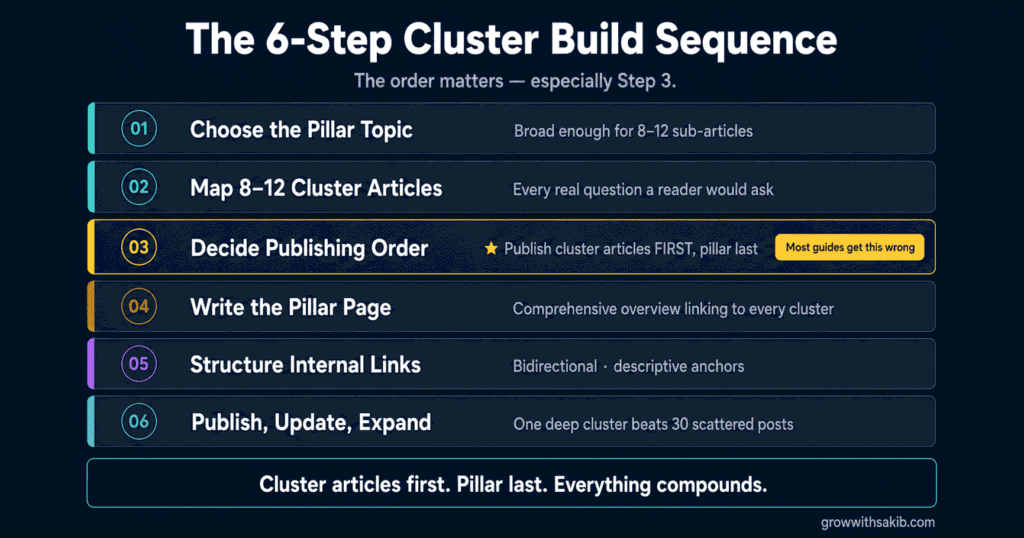
Step 1: Choose Your Pillar Topic
Your pillar topic must be broad enough to support 8-12 distinct articles, but specific enough that you can genuinely own it. “Marketing” is too broad; “the best pen for left-handers” is too narrow. And it should map to a real business goal – a topic your customers care about and that leads toward what you offer.
A quick test: can you brainstorm at least eight real questions or subtopics under it without straining? If yes, it’s a viable pillar. Pick a topic where you have genuine expertise, since depth is what earns authority.
Real example: GrowWithSakib chose Generative Engine Optimization – broad enough for a dozen-plus articles, specific enough to own as a niche, directly tied to the agency’s services, and a subject of real expertise. It passed the test easily.
Step 2: Map 8-12 Cluster Articles
Now break the pillar into its subtopics – each becomes one cluster article. Draw these from the real questions and angles people search: the definition, comparisons, how-tos, the mechanics, measurement, mistakes, and use cases. Mine People Also Ask, autocomplete, ChatGPT, and your audience the way the content audience profile guide on GrowWithSakib describes.
Aim for 8-12 articles as a solid starting cluster – enough to cover the topic convincingly. You can grow to 20+ over time, but quality beats count: a few deep, distinct articles outperform a pile of thin, overlapping ones. Make sure each targets a distinct angle so they don’t cannibalise each other.
Real example: here’s how the GEO pillar was mapped into cluster articles, each with its own angle:
| Cluster Article (Angle) | Sub-Intent It Covers |
|---|---|
| What is GEO? | Definition (entry point) |
| GEO vs SEO | Comparison |
| How AI search systems work | The mechanics |
| How to structure content for AI summaries | Technique |
| Statistics-rich content for AI | Technique |
| How to get cited by ChatGPT | Platform how-to |
| Answer engine optimisation (AEO) | Adjacent concept |
| How to measure GEO performance | Measurement |
| GEO for small business | Audience-specific |
| Topic clusters for AI search | Advanced tactic |
Step 3: Decide Your Publishing Order
Here’s the question most guides skip: what do you publish first – the pillar or the cluster pages? The intuitive answer is “pillar first.” The better answer, for most people, is the opposite.
Many experienced content teams build several cluster pages first, then create the pillar. The reason is practical: if you write the pillar first, you tend to either say too much (stealing depth your cluster pages need) or too little (a thin hub). When the cluster pages already exist, the pillar can genuinely summarise and link to real content – which is exactly its job.
Real example: the GEO cluster was mapped in full first, then the supporting articles were written and published in sequence – definition and comparison pieces early, deeper technique and measurement pieces after – with the pillar guide serving as the hub that links them all together and gets updated as new articles go live.
Step 4: Write the Pillar Page
The pillar page covers the whole topic at a high level and links to every cluster page. It should be comprehensive and genuinely useful on its own – a thin pillar undermines the whole cluster – but it shouldn’t go so deep on any one subtopic that it competes with the cluster page devoted to it. Introduce each subtopic, then link to the full article.
There are three common pillar formats – pick the one that fits your topic:
- The “Guide” pillar – “The Complete Guide to [Topic].” Best for broad subjects; introduces every subtopic. (This is what the GEO pillar uses.)
- The “What is” pillar – answers “What is [Topic]?” at length, with subtopics as sections. Good for concept-led topics.
- The “How-to” pillar – walks through a process, with cluster pages expanding each step. Good for task-led topics.
Whichever format, phrase your pillar’s H2s as real questions, lead with clear answers, and write it with the same care as any cluster page – the process in the guide to writing a blog post that ranks on GrowWithSakib applies to the pillar too.
Step 5: Structure the Internal Links
Internal links are what turn a pile of related articles into a cluster. Get the structure right:
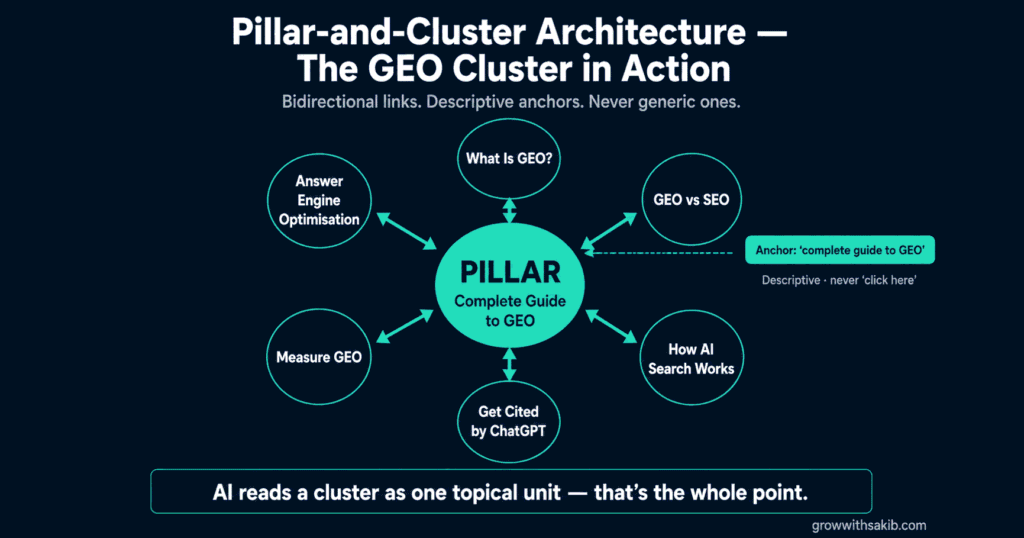
- Every cluster page links up to the pillar – using descriptive anchor text that includes the pillar’s topic, not “click here.”
- The pillar links down to every cluster page – so it works as the hub that ties the group together.
- Related cluster pages link to each other – where it genuinely helps the reader, so siblings reinforce one another.
Real example: in the GEO cluster, every supporting article links up to the pillar guide with a descriptive anchor, the pillar links out to all of them, and closely related pieces – like “how AI search works” and “how to get cited by ChatGPT” – cross-link to each other. That web is what search engines read as one connected body of expertise.
Step 6: Publish, Interlink, and Expand
Publish your initial batch, add the internal links in every direction, and then keep going. A cluster is a living asset, not a one-time project. Add new cluster pages as you find new subtopics, update the pillar’s links each time, and refresh existing pages on a schedule so the whole cluster stays current.
Track how the cluster performs as a whole – rankings, traffic, and citations across the topic – using the guide to tracking results on GrowWithSakib. Watch whether readers travel from the pillar into the cluster pages; that flow is a sign the structure is working.
Your Content Cluster Planning Template
Copy this simple table to plan your own cluster before you write a word.
| Planning Field | Your Answer |
|---|---|
| Pillar topic | … |
| Business goal it serves | … |
| Pillar format (guide / what-is / how-to) | … |
| Cluster articles (8-12, one angle each) | 1… 2… 3… (up to 12) |
| Publishing order (which first) | … |
| Internal-link plan | All cluster pages up to pillar; pillar to all; siblings cross-link |
| How you’ll measure it | … |
Honest Expectations
- It compounds over months – a cluster builds authority gradually as pages accumulate, link, and get recrawled. Expect a slow climb, not an overnight jump.
- Quality gates everything – a big cluster of thin, overlapping pages won’t work. Each article must genuinely earn its place with real depth.
- Start smaller if needed – if 8-12 feels daunting, begin with 4-6 strong pages and a pillar, then expand. A small, tight cluster beats an abandoned big one.
- It needs maintenance – clusters aren’t “set and forget.” Budget time to refresh pages and add articles, or the authority slowly goes stale.
The payoff is worth the patience: a well-built cluster earns rankings and AI citations from one connected investment, and it keeps working across every related question your audience asks.
Common Content Cluster Mistakes
| Mistake | Why It Hurts | Do This Instead |
|---|---|---|
| Writing the pillar first, in full | Bloated pillar, thin cluster pages | Map all, build key cluster pages first |
| Overlapping cluster angles | Pages cannibalise each other | Give each a distinct sub-intent |
| A thin pillar page | Undermines the whole cluster | Make the pillar genuinely comprehensive |
| Vague anchor text | Wastes the internal-link signal | Use descriptive, specific anchors |
| One-directional linking | No connected structure | Link pillar and clusters both ways |
| Chasing article count | Thin volume underperforms | Prioritise depth over raw number |
| Publishing then abandoning | Authority goes stale | Expand and refresh over time |
Frequently Asked Questions
1. How do I build a content cluster?
Follow six steps: choose one pillar topic broad enough for 8-12 articles but specific enough to own; map those articles from real subtopics and questions; decide the publishing order (often cluster pages before the pillar); write the pillar page as a high-level hub; connect everything with bidirectional internal links using descriptive anchor text; then publish and expand over time. The connected structure signals topical authority, lifting every page in the cluster.
2. What is the difference between a pillar page and a cluster page?
A pillar page is a comprehensive, high-level hub covering a broad topic and linking out to every cluster page. A cluster page is an individual, in-depth article covering one specific subtopic in detail and targeting a long-tail keyword, which links back up to the pillar. The pillar gives the overview; the cluster pages provide the depth. Together, connected by internal links, they form a content cluster that signals authority on the whole subject.
3. Should I publish the pillar page or cluster pages first?
For most people, build several cluster pages first, then the pillar. If you write the pillar first, you tend to either overstuff it (stealing depth your cluster pages need) or leave it thin. When the cluster pages already exist, the pillar can genuinely summarise and link to real content, which is its job. The practical sequence: map the whole cluster, draft a pillar outline, write your key cluster pages, then build the pillar as the hub.
4. How many articles should a content cluster have?
Aim for 8-12 cluster articles plus a pillar page as a solid starting cluster – enough to cover a topic convincingly. You can grow to 20 or more over time for competitive subjects. But quality beats count: a few deep, distinct articles outperform many thin, overlapping ones. If 8-12 feels daunting, start with 4-6 strong pages and a pillar, then expand. Make sure each article targets a distinct angle so they don’t compete.
5. How do I choose a pillar topic?
Pick a topic broad enough to support 8-12 articles but specific enough that you can genuinely own it – not “marketing,” not “the best pen for left-handers.” It should map to a real business goal and a subject where you have genuine expertise. A quick test: can you brainstorm at least eight real questions or subtopics under it without straining? If yes, it’s a viable pillar topic worth building a cluster around.
6. How should I link pillar and cluster pages together?
Use bidirectional internal links: every cluster page links up to the pillar, the pillar links down to every cluster page, and related cluster pages link to each other where it helps the reader. Always use descriptive anchor text that names the destination topic – “how to measure GEO performance,” not “click here.” This connected structure is what search engines read as one body of expertise, so vague or one-directional linking wastes the authority signal.
7. How long does it take a content cluster to rank?
Expect months, not weeks. A cluster builds authority gradually as pages accumulate, interlink, and get recrawled – typically a slow climb over three to twelve months rather than an overnight jump. Competitive pillar topics take longer. The encouraging part is that the whole group tends to rise together over time, and the structure keeps compounding as you add and refresh pages, so early patience pays off across the entire cluster.
8. Can I turn my existing blog posts into a content cluster?
Yes – and it’s often the fastest way to start. Audit your existing posts, group related ones under a natural pillar topic, identify gaps to fill with new articles, build a pillar page that summarises and links to them, and add bidirectional internal links across the group. Organising isolated posts into a connected cluster can lift the whole group’s rankings without much new writing, because it finally signals the topical authority the scattered posts never showed.
Key Takeaways
- A content cluster is a pillar page plus 8-12 connected cluster articles, tied together by internal links – it signals topical authority that lifts every page.
- Choose a pillar topic broad enough for 8-12 articles but specific enough to own, mapped to a real business goal and genuine expertise.
- Map cluster articles from real subtopics and questions, giving each a distinct angle so they don’t cannibalise each other.
- Publishing order matters: build several cluster pages first, then the pillar, so the pillar summarises real content instead of being bloated or thin.
- Write the pillar as a high-level hub (guide, what-is, or how-to format) that introduces each subtopic and links to the full cluster article.
- Connect everything with bidirectional internal links and descriptive, specific anchor text – vague or one-directional links waste the signal.
- Use the real example throughout: our GEO pillar plus its cluster articles shows exactly how the process works in practice.
- Clusters compound over months and need maintenance – start with 4-6 strong pages if needed, prioritise quality over count, and expand over time.