If you searched for how to add FAQ page schema markup for SEO, you probably expected a guide to winning those expandable Q&A snippets in Google. Here’s the honest update most articles haven’t caught up to: those snippets are gone. But don’t close the tab – FAQ pages are more valuable than ever, just for a different reason. This guide gives you the accurate 2026 picture and the practical steps that actually work.
This expands the FAQ section of the content strategy for small business guide on GrowWithSakib, which rightly calls the FAQ format one of the highest-performing formats for AI citations. The important nuance – and the thing that protects your site’s credibility – is understanding why that’s true, and where schema markup does and doesn’t fit.
What Changed: Google Retired FAQ Rich Results
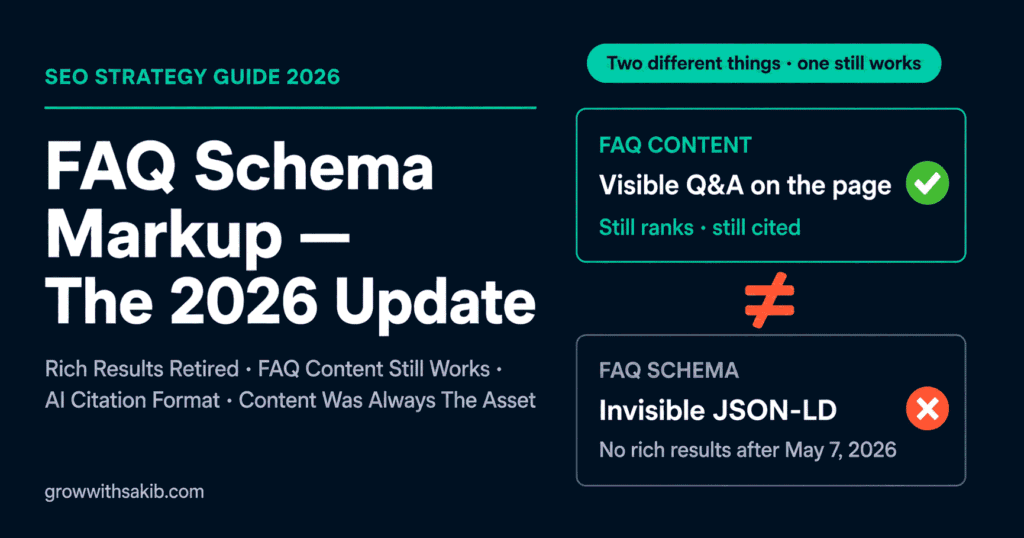
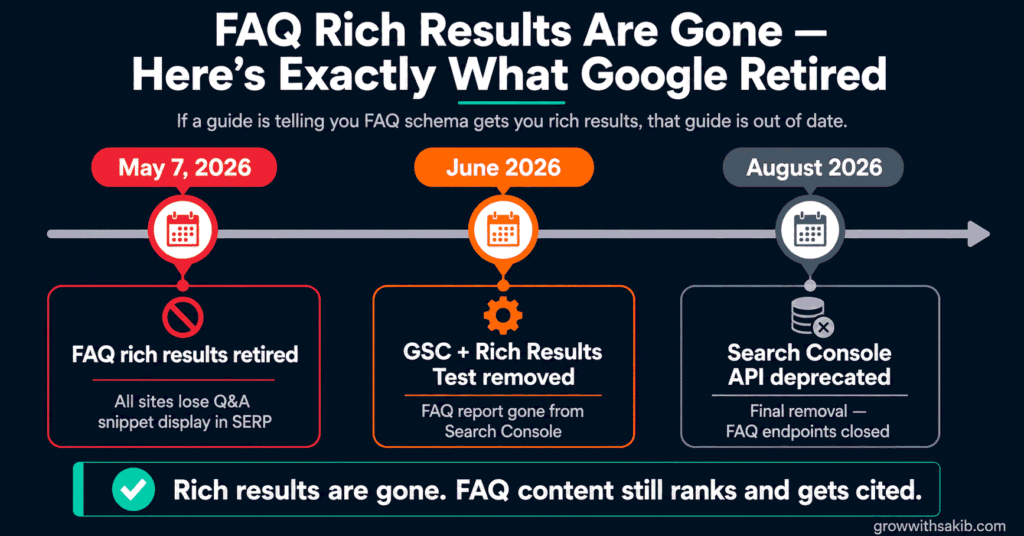
On May 7, 2026, Google added a deprecation notice to its FAQ structured data documentation: FAQ rich results no longer appear in Google Search. According to Google Search Central, the supporting tools are being retired in stages too.
| Date | What Happens |
|---|---|
| May 7, 2026 | FAQ rich results stop appearing in Google Search |
| June 2026 | FAQ report and Rich Results Test support removed |
| August 2026 | Search Console API support for FAQ removed |
This wasn’t sudden. Back in August 2023, Google had already restricted FAQ rich results to well-known government and health sites, so most commercial sites lost them years ago. The 2026 change simply makes the retirement final and official, following the same pattern as the HowTo rich result removal before it. As Search Engine Journal reported, FAQPage remains a valid Schema.org type – Google just no longer shows it as a rich result.
FAQ Content vs FAQ Schema: The Distinction That Matters
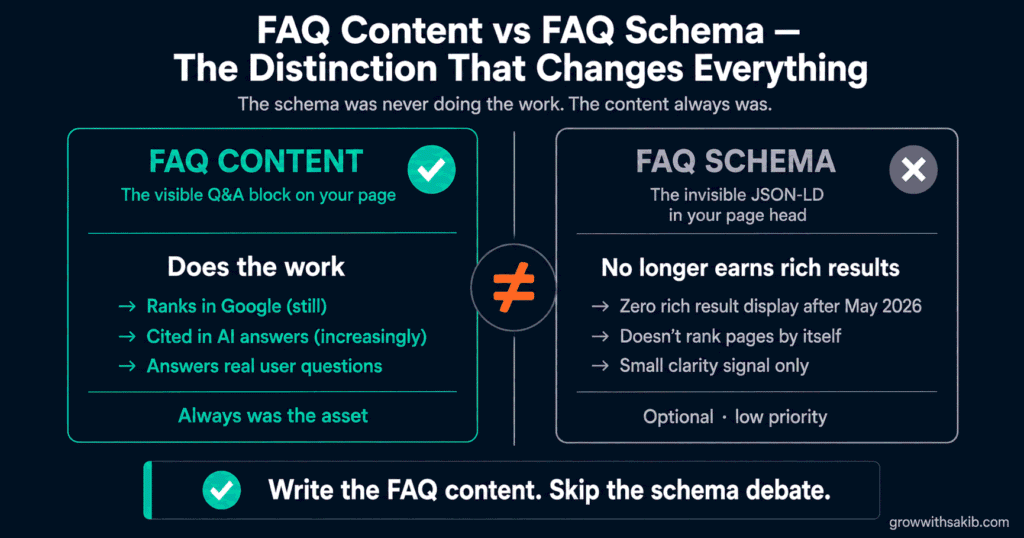
Here’s the confusion at the heart of every outdated FAQ guide. Two different things have been blurred together for years:
- FAQ content – the actual visible questions and answers on your page. This is the format: clear Q&A that readers (and machines) can understand.
- FAQ schema markup – the invisible FAQPage code (JSON-LD) that labels that content as questions and answers for search engines.
For years, people added the schema to win rich results and assumed the markup was doing the work. The deprecation made the truth obvious: the schema was never doing the work – the content always was. Now that the rich result is gone, what remains is what always mattered: genuinely useful question-and-answer content.
Why FAQ Content Is Still a Top Format for AI Citations
So if the snippets are gone, why does the FAQ format still matter so much? Because question-and-answer content mirrors exactly how AI answer engines work. Here’s the mechanism:
- It matches how AI retrieves – ChatGPT, Perplexity, Gemini, and AI Overviews answer questions, so content already structured as question-then-direct-answer is the easiest pattern for them to extract and cite.
- It’s answer-first by design – a good FAQ leads with the answer, which is precisely the structure AI engines reward, as covered in the guide to structuring content for AI summaries on GrowWithSakib.
- It covers the long tail – each question is its own micro-topic, so a strong FAQ section covers many related queries a single article body would miss.
- It builds answer-engine visibility – this is the heart of answer engine optimisation on GrowWithSakib, where being the clear, direct source is what earns the citation.
In other words, the pillar is right that FAQs are one of the highest-performing formats for AI citations – it’s the format and content doing that work, not the markup. That distinction is what keeps your advice (and your site) accurate in 2026.
How to Find the Right Questions to Answer
A citation-worthy FAQ answers the questions people actually ask – not questions you invented to look thorough. Find the real ones for free:
- Google’s People Also Ask and autocomplete – type your topic and harvest the questions Google surfaces.
- Ask ChatGPT and Perplexity – type your topic and note the follow-up questions they suggest; those are the sub-queries AI is already mapping.
- Reddit, Quora, and your own inbox – real customers phrase problems in their own words; mine them the way the content audience profile guide on GrowWithSakib describes.
- Your sales and support questions – the things you get asked repeatedly are perfect FAQ entries, because you know real people want the answer.
Then answer each in a direct sentence or two – lead with the answer, keep it concise and self-contained, and make sure it genuinely resolves the question. Back any claims with specific, sourced facts using the statistics-rich content guide on GrowWithSakib.
Should You Still Add FAQ Schema? Yes – Here’s the Honest Reason
Given all this, is FAQPage schema still worth adding? For most sites, yes – but for honest reasons, not the old ones. It won’t win you rich results or guarantee AI citations. But it’s still worth having because:
- It reinforces meaning for machines – valid schema that matches your visible content helps search engines and AI systems parse your page cleanly. It’s a small clarity boost, not a magic switch.
- It does no harm – Google has confirmed unused structured data doesn’t cause problems, and it won’t hurt your rankings.
- Some non-Google surfaces still use it – other engines and assistants may read it, so it’s reasonable future-proofing.
How to Add FAQ Schema in Rank Math
Sakib’s own stack uses Rank Math, and it makes this simple. Rank Math’s own documentation confirms the deprecation and notes you can still add FAQ schema to help AI platforms understand your content. Here’s how:
- Add the “FAQ by Rank Math” block – search “FAQ” in the block menu and insert it.
- Type your questions and answers directly into the block. This creates both the visible FAQ and the FAQPage schema at once, so they always match.
- Use one FAQ block per page – Rank Math combines multiple into a single valid block in the code, but one is best practice.
- Publish or update the page. The schema is now in your page’s code.
Migrating from Yoast? Rank Math imports and converts Yoast FAQ blocks automatically during setup, or manually via Rank Math SEO -> Status & Tools -> Database Tools (in Advanced Mode).
How to Add FAQ Schema in Yoast
Yoast works the same way, through its own block:
- Open your post or page in the Block Editor.
- Add the “Yoast FAQ” block – search “FAQ” in the block menu and select the Yoast FAQ block.
- Enter your questions and answers in the block fields. Yoast generates the FAQPage schema automatically and keeps it matched to the visible content.
- Confirm FAQ output is enabled under Yoast SEO -> Settings -> Content Types if needed.
- Update the page.
How to Test Your FAQ Schema in 2026
Here’s an important update: Google’s Rich Results Test no longer checks FAQ schema (that support is being removed with the deprecation). So the old “run it through the Rich Results Test” advice is outdated. Instead:
- Use the Schema Markup Validator at validator.schema.org – paste your URL and confirm the FAQPage type is detected with your questions and answers. This is now the right tool for FAQ validation.
- View your page source – search for “FAQPage” to confirm the JSON-LD is present and your questions appear.
- Check the answers are visible – make sure every marked-up question and answer actually shows on the page, since hidden content invalidates the markup.
But the real test of an FAQ in 2026 isn’t a schema validator – it’s whether your answers get cited. Track that by checking whether ChatGPT, Perplexity, and AI Overviews reference your content for your questions, using the guide to measuring GEO performance on GrowWithSakib.
Bonus: Don’t Forget Google Business Profile Q&A
If you’re a local or service business, there’s a separate FAQ-style surface the deprecation didn’t touch: the Q&A section on your Google Business Profile. It’s often overlooked and frequently filled with inaccurate user-submitted answers. Seed it with the real questions customers ask, provide owner-verified answers, and audit existing ones for accuracy. It’s genuine low-hanging fruit for local visibility – and it’s completely unaffected by the website FAQ change.
Honest Limits and Expectations
- Schema is optional, not magic – adding FAQPage markup won’t by itself win citations or rankings. It’s a minor clarity signal on top of good content.
- Content quality gates everything – thin, promotional, or fake FAQs won’t get cited no matter how they’re marked up. Answer real questions genuinely.
- Don’t panic-delete existing schema – if you already have valid FAQ schema on real content, leave it; it doesn’t hurt. Just stop expecting rich results from it.
- Update your reporting – if any dashboard tracked FAQ rich results, retire that metric so disappearing data doesn’t look like a bug.
Common FAQ Schema Mistakes in 2026
| Mistake | Why It Hurts | Do This Instead |
|---|---|---|
| Expecting rich snippets | They were retired in May 2026 | Optimise for AI citations instead |
| Thinking schema drives AI citations | Content does, not markup | Write excellent Q&A content first |
| Marking up hidden FAQs | Violates guidelines; causes errors | Only mark up visible content |
| Faking an FAQ for the code | Thin FAQs never get cited | Answer real questions genuinely |
| Running two schema plugins | Duplicate markup errors | Use one schema source only |
| Testing FAQ in Rich Results Test | It no longer checks FAQ | Use the Schema Markup Validator |
| Panic-deleting all FAQ schema | Valid schema does no harm | Keep it if it matches real content |
Frequently Asked Questions
1. Does FAQ schema markup still work for SEO in 2026?
Not the way it used to. On May 7, 2026, Google retired FAQ rich results, so FAQ schema no longer produces the expandable Q&A snippets it once did – and most commercial sites lost those back in 2023 anyway. FAQPage is still a valid Schema.org type and won’t hurt your rankings, but it’s no longer a SERP-appearance lever. The real value now is the FAQ content itself, which remains excellent for AI citations.
2. Does FAQ schema help with AI Overviews and AI citations?
Not directly through the markup. Google’s AI features guidance says no special schema is required for AI Overviews or AI Mode, and AI systems pull from clean question-and-answer content whether the FAQPage markup is there or not. So it’s the visible FAQ content – clear, direct answers to real questions – that earns citations, not the schema code. Write great Q&A content; treat the schema as an optional technical extra.
3. Should I remove my existing FAQ schema?
No, not if it marks up real, visible FAQ content. Google has confirmed that unused or extra structured data doesn’t cause problems for Search, and valid FAQPage schema won’t hurt your rankings. There’s no urgency to strip it out. Just stop expecting rich results from it, and update any reporting that tracked FAQ rich results. Only remove schema if it’s stale, hidden, or creating maintenance work with no benefit.
4. How do I add FAQ schema in Rank Math?
Open your post in the WordPress Block Editor, search for the “FAQ by Rank Math” block, and add it. Type your questions and answers into the block – this creates both the visible FAQ and the matching FAQPage schema at once. Use one FAQ block per page as best practice, then publish. Rank Math also imports and converts Yoast FAQ blocks automatically if you’re switching plugins.
5. How do I test if my FAQ schema is working?
Use the Schema Markup Validator at validator.schema.org, because Google’s Rich Results Test no longer checks FAQ schema after the 2026 deprecation. Paste your URL and confirm the FAQPage type is detected with your questions and answers. You can also view your page source and search for “FAQPage.” The more meaningful test, though, is whether your answers actually get cited in AI results for their questions.
6. Why did Google remove FAQ rich results?
Google didn’t publish a detailed reason, but the move fits a clear pattern of simplifying the search results page. It retired HowTo rich results in 2023 and seven other structured data types in 2025. FAQ rich results had also been widely overused – added to pages that weren’t really FAQs just to grab SERP space. Reclaiming that space, much of which now goes to AI Overviews, is the consistent direction Google has taken.
7. Are FAQ pages still worth creating?
Absolutely – arguably more than ever, just for different reasons. A good FAQ section answers real customer questions, covers the long tail of a topic, and matches exactly how AI answer engines retrieve information, making it one of the strongest formats for earning AI citations. The value was never really the rich snippet; it was always the clear, direct question-and-answer content that both readers and AI systems find easy to use.
8. What should FAQ answers look like to get cited by AI?
Lead with the answer in the first sentence, keep each answer concise and self-contained, and make sure it genuinely resolves the real question a user asked. Use the person’s actual phrasing for the question, avoid promotional fluff, and back any claims with specific, sourced facts. Answers that can be lifted out and understood on their own are exactly what AI engines extract and cite – which is the whole point of the FAQ format.
Key Takeaways
- Google retired FAQ rich results on May 7, 2026 – the expandable Q&A snippets FAQ schema used to win are gone (most commercial sites lost them back in 2023).
- Separate two things: FAQ content (the visible Q&A) and FAQ schema (the invisible markup). The content does the work; the schema never did.
- Google confirms no special schema is required for AI Overviews – AI systems cite clean Q&A content whether or not the FAQPage markup is present.
- The FAQ content format is still one of the highest-performing formats for AI citations because Q&A mirrors how AI answer engines retrieve and answer.
- Still worth adding FAQ schema for minor clarity and future-proofing – but only on real, visible FAQ content, and it won’t win snippets or guarantee citations.
- In Rank Math or Yoast, add FAQ content via their FAQ block, which generates matching schema; use one schema source only to avoid duplicate-markup errors.
- Test with the Schema Markup Validator (validator.schema.org), not the Rich Results Test, which no longer checks FAQ – and judge success by actual AI citations.
- For local businesses, seed and verify your Google Business Profile Q&A – a separate FAQ surface the deprecation didn’t affect.