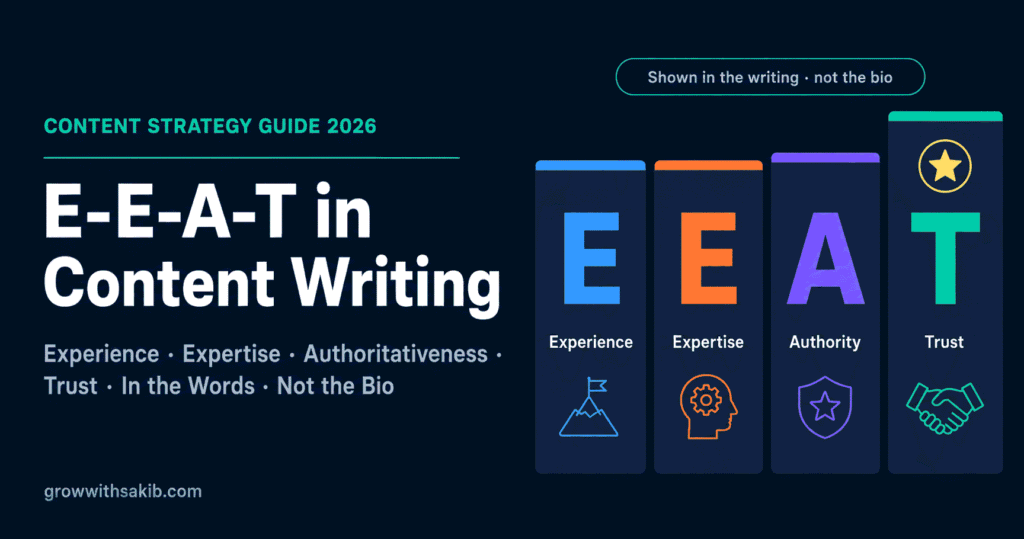
You’ve been told to “add E-E-A-T” to your content. But most advice then talks about author bios, schema markup, and backlinks – the site plumbing. That matters, but it’s not writing. The question this guide answers is different: how do you make the actual words on the page demonstrate experience, expertise, authority, and trust?
This is a guide to building E-E-A-T into your content writing – the craft, sentence by sentence. It expands the content strategy for small business guide on GrowWithSakib. For the site-level side – author bios, schema, contact pages, and trust signals across your website – see the companion E-E-A-T explained guide on GrowWithSakib; this article is purely about the writing.
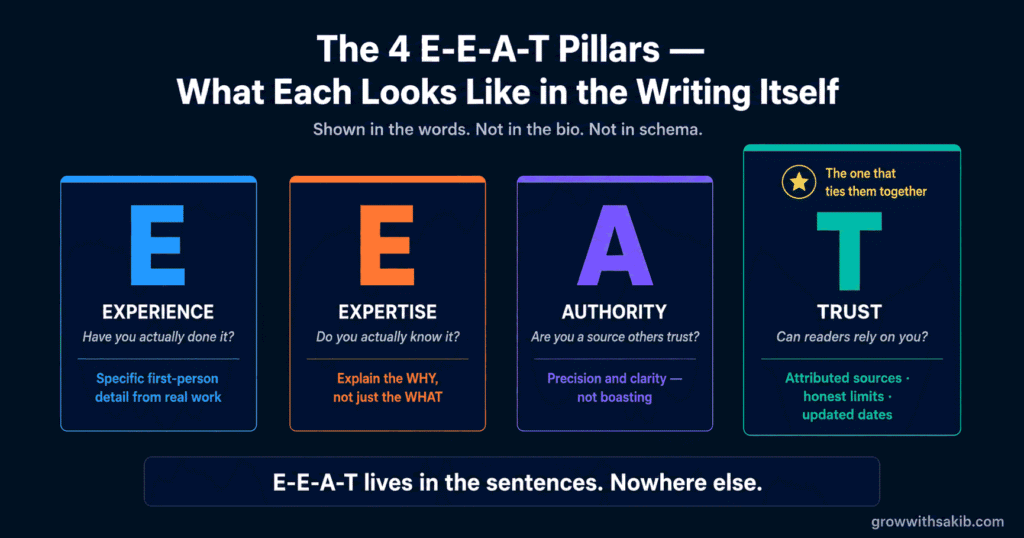
What E-E-A-T Means (Briefly)
E-E-A-T stands for Experience, Expertise, Authoritativeness, and Trustworthiness. It comes from Google’s Search Quality Rater Guidelines and shapes how Google’s systems identify helpful content. Two facts matter most for writers:
- Trust is the most important pillar. Google’s guidelines state that untrustworthy pages have low E-E-A-T no matter how experienced, expert, or authoritative they seem. The other three feed into trust.
- It’s not a direct ranking factor, per Google Search Central – but Google’s systems use a mix of signals to identify content with strong E-E-A-T, and it carries extra weight for topics affecting health, finances, or safety.
There’s a second payoff now, too: strong E-E-A-T has become an AI citation signal. Semrush’s research on AI Overviews found E-E-A-T-aligned content correlates with more AI citations, and AI engines lean on the same expert, well-sourced signals. So the craft below helps you rank and get cited – the goal of generative engine optimization on GrowWithSakib.
Experience: Write It in First Person, Specifically
Experience is the newest E, and it asks a simple question: has the person writing this actually done the thing? You show it not by claiming it, but by writing the specific, lived details only someone who’s been there would know.
- Use first-person, grounded in doing – “when I tested this on a client’s site” beats “it is known that.” Real markers of involvement, not just “I think.”
- Be specific, not general – concrete numbers, names, situations, and outcomes signal real experience. “A 40-product catalogue” reads as lived; “many products” reads as guessed.
- Share what diverged from the standard advice – “the guides say X, but I found Y happens when Z” is the single strongest experience signal, because only real practice produces it.
The trap: don’t sprinkle “in my experience” everywhere while saying nothing specific. Empty first-person is worse than none. One concrete, real detail outweighs ten vague “I believe”s.
Expertise: Show Depth, Not Credentials
Here’s the insight most writers miss: you don’t demonstrate expertise by announcing it (“as a leading expert…”). You demonstrate it through the depth of what you write. Expertise is the difference between a surface overview anyone could write after an afternoon of research and content that reveals earned, nuanced understanding.
- Cover the nuance and edge cases – the “it depends, and here’s exactly when” that only someone who’s done it repeatedly knows. Surface content skips this; expert content lives in it.
- Explain the why, not just the what – anyone can list steps; explaining the mechanism behind them signals real understanding.
- Anticipate the reader’s next question – answering the objection or follow-up before they ask it proves you know the terrain.
This is genuinely empowering: you don’t need a PhD to write with expertise. You need real depth on the specific thing you’re covering. A solo founder who has run 50 ad campaigns can out-expert a credentialed generalist who hasn’t – if the writing shows that depth. Depth is also how you build topical authority on GrowWithSakib over time.
Authoritativeness: Write With Clarity, Not Boasting
In the writing itself, authority comes across as confident clarity – the ability to make a direct claim and own it. It’s the opposite of two failure modes: timid hedging and hollow boasting.
| Instead of… | Write… | Why |
|---|---|---|
| “You might possibly want to maybe consider…” | “Do this – here’s why.” | Hedging reads as uncertain, not humble |
| “As the #1 leading world expert, I…” | “In practice, this is what works:” | Boasting repels; clarity earns respect |
| “There are many possible approaches…” | “Two approaches work; here’s when to use each.” | Taking a position signals authority |
Authority means taking a clear stance and guiding the reader decisively – while still being honest about trade-offs. You don’t need adjectives about yourself; you need clarity about the subject. Notably, an overly promotional, self-praising tone actively hurts AI citations too, as covered in the guide to removing promotional tone on GrowWithSakib.
Trustworthiness: Attribute Sources and Be Honest
Trust is the most important pillar, and in the writing it comes down to two habits: show your sources and tell the truth, including the inconvenient parts.
- Replace vague attribution with specifics – “studies show” and “experts agree” signal nothing. Name the actual source and link it: “Google’s guidelines state…” or “a 2026 Semrush study found…” Cite the original, not a roundup.
- Use specific numbers, not hand-waving – “this cut load time noticeably” is weak; “this cut load time from 4s to 1.2s” is trustworthy. Specifics that can be checked build trust.
- Be honest about limitations – the most underused trust move. “This works well for X, but not for Y” and “here’s what I’d still test” make you more credible, not less. Balanced recommendations beat one-sided hype.
- Get the facts right – easily-verified errors destroy trust instantly. Accuracy is non-negotiable, and it’s exactly where generic content fails.
Sourcing your claims well overlaps with writing statistics-rich content on GrowWithSakib – specific, attributed facts are both a trust signal and a citation magnet.
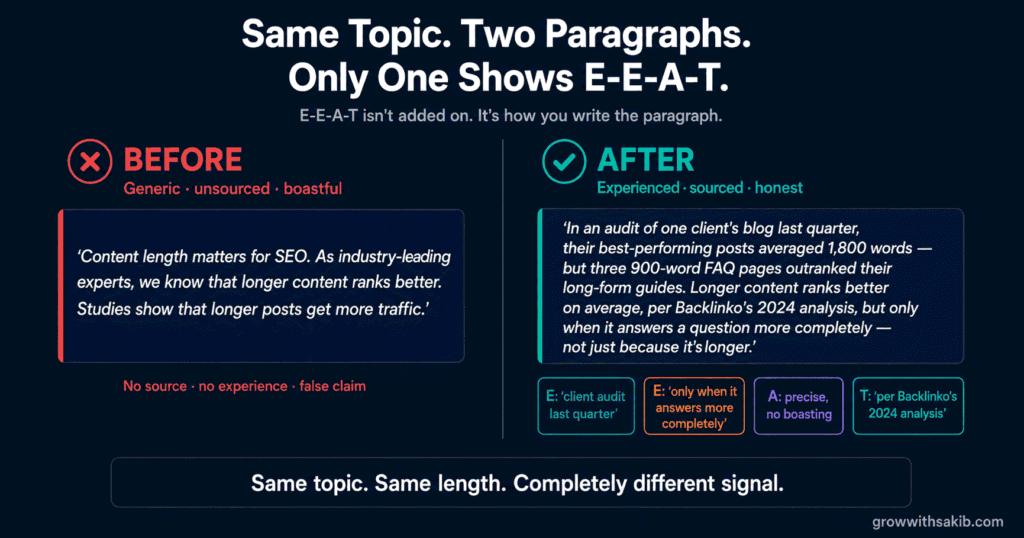
Before and After: E-E-A-T in a Single Paragraph
Here’s the whole craft in one example. Below is the same short paragraph – answering “does content length matter for ranking?” – written first without E-E-A-T craft, then with it.
Before: No E-E-A-T in the Writing
The problems: it claims expertise (“leading expert”) instead of showing it, attributes vaguely (“studies show,” “widely known,” “everyone agrees”), cites nothing, shows no real experience, boasts, and is actually false – Google states it has no preferred word count.
After: All Four Signals in the Writing
Same topic, transformed. Here’s what each part is doing:
| Signal | How the ‘After’ Shows It |
|---|---|
| Experience | “When I audited a client’s blog… 800 words… 3,000-word post” – specific, first-person, lived |
| Expertise | “length only helps when the extra words add real depth” – the nuance a practitioner knows |
| Authoritativeness | “I aim to cover a topic completely, then stop” – a clear, owned stance |
| Trustworthiness | “I checked Google’s own guidance: no preferred word count” – real source, and honest it surprised them |
Your E-E-A-T Writing Self-Check
Before you publish, ask one question per signal:
| Signal | Ask Yourself | If No… |
|---|---|---|
| Experience | Have I included specific, first-hand detail? | Add a real example only you could give |
| Expertise | Have I gone deeper than an afternoon of research? | Add nuance, edge cases, or the ‘why’ |
| Authority | Have I made clear claims without boasting? | Cut hedging and self-praise; take a stance |
| Trust | Have I sourced claims and named limitations? | Link real sources; add an honest caveat |
The Honest Truth About E-E-A-T Writing
- You can’t fake it – experience, depth, and honesty either exist in the writing or they don’t. That’s the point; it’s Google’s (and readers’) defence against generic content.
- Trust is the foundation – one easily-checked error or one oversold claim can undo all the experience and expertise you demonstrated. Guard accuracy above all.
- It’s how you beat generic AI content – AI can produce fluent, structured prose instantly, but it can’t supply your lived experience or honest judgement. That human layer is your durable edge.
- It compounds with the site-level work – great E-E-A-T writing plus the author bios, schema, and reputation signals from the site-level side together make the whole page credible.
Write about what you genuinely know, include the specific and the honest, source what you claim, and say it clearly. Do that, and E-E-A-T stops being a checklist and becomes just what good writing already is. Apply it inside the full blog-post writing framework on GrowWithSakib.
Common E-E-A-T Writing Mistakes
| Mistake | Why It Hurts | Do This Instead |
|---|---|---|
| Claiming expertise (‘leading expert’) | Telling isn’t showing; it reads as boasting | Demonstrate depth in the writing itself |
| Empty first-person (‘in my experience…’) | Vague markers with no real detail | Add specific, lived detail |
| ‘Studies show’ with no source | Signals nothing; erodes trust | Name and link the actual source |
| Hedging every sentence | Reads as uncertain, not authoritative | Make clear claims and own them |
| Hiding limitations | Oversell breaks trust when found out | Name what doesn’t work, honestly |
| Surface-level ‘afternoon research’ | No expertise signal | Go deep: nuance, edge cases, the why |
| Publishing generic AI text as-is | No experience or honesty in it | Layer in your real, human specifics |
Frequently Asked Questions
1. How do I write E-E-A-T content?
Express each signal in the actual words: write experience as specific, first-person detail (“when I tested this…”); show expertise through depth and nuance rather than claiming credentials; convey authority through clear, decisive writing instead of boasting or hedging; and build trust by attributing real sources and being honest about limitations. E-E-A-T isn’t just author bios and schema – it’s demonstrated in the writing itself, which is the part you can’t fake.
2. How do I show experience in my writing?
Write in the first person, grounded in things you’ve actually done – “when I audited a client’s site” rather than “it is known that” – and be specific with real numbers, situations, and outcomes. The strongest experience signal is sharing what diverged from standard advice: “the guides say X, but I found Y happens when Z.” Only real practice produces that. Avoid empty “in my experience” markers with no concrete detail behind them.
3. How do I demonstrate expertise without credentials?
Show depth instead of announcing titles. Expertise is the difference between a surface overview anyone could write after an afternoon of research and content that reveals earned, nuanced understanding. Cover the edge cases and the “it depends, and here’s exactly when,” explain the why behind the steps, and anticipate the reader’s next question. You don’t need a PhD – you need real depth on the specific thing you’re writing about, and writing that shows it.
4. How do I write with authority without sounding boastful?
Authority in writing is confident clarity, not self-praise. Make direct claims and own them – “Do this, here’s why” instead of “you might possibly consider maybe.” Take a clear position and guide the reader decisively, while still being honest about trade-offs. Avoid both failure modes: timid hedging reads as uncertain, and boasting (“as the #1 expert”) repels readers. You need clarity about the subject, not adjectives about yourself.
5. What is the most important part of E-E-A-T?
Trustworthiness. Google’s Quality Rater Guidelines state that untrustworthy pages have low E-E-A-T no matter how experienced, expert, or authoritative they seem – the other three pillars feed into trust. In your writing, you build trust by attributing real sources instead of saying “studies show,” using specific verifiable numbers, being honest about limitations, and getting your facts right. A single easily-checked error can undo everything else, so accuracy comes first.
6. Is E-E-A-T a Google ranking factor?
Not directly. Google’s Search Central documentation states E-E-A-T itself isn’t a specific ranking factor, but Google’s systems use a mix of signals to identify content with strong E-E-A-T, and it carries extra weight for topics affecting health, finances, or safety (YMYL). So while there’s no single “E-E-A-T score,” writing that genuinely demonstrates experience, expertise, authority, and trust aligns with the signals Google’s helpful-content systems reward.
7. Does E-E-A-T help with AI citations?
Yes. Strong E-E-A-T has become an AI citation signal as well as an SEO one. Semrush’s research on AI Overviews found E-E-A-T-aligned content correlates with more AI citations, and AI engines like ChatGPT and Perplexity lean on the same expert, well-sourced, trustworthy signals when choosing what to cite. So writing that demonstrates real experience, depth, clear authority, and honest sourcing helps you both rank on Google and get cited by AI.
8. Can AI-generated content have good E-E-A-T?
Only with real human input. Google rewards great content regardless of how it’s produced, but fully AI-generated text tends to lack the first-hand experience, genuine depth, and honest judgement E-E-A-T rewards – it reads like a summary of other summaries. The fix is to use AI as a drafting tool, then layer in what only you can add: real results, specific numbers, mistakes you learned from, and honest limitations. That human layer is what AI can’t manufacture.
Key Takeaways
- E-E-A-T is expressed in the words you write, not just author bios and schema – the site setup is table stakes; the writing is where it’s won or lost.
- Experience: write specific, first-person, lived detail – especially what diverged from standard advice – not empty ‘in my experience’ markers.
- Expertise: demonstrate depth and nuance, not credentials – a surface overview anyone could write after an afternoon of research shows no expertise.
- Authoritativeness: write with confident clarity and take a stance, avoiding both timid hedging and hollow boasting.
- Trustworthiness is the most important pillar: attribute real sources (not ‘studies show’), use specific verifiable numbers, and name limitations honestly.
- Get the facts right – a single easily-verified error destroys trust no matter how strong the other signals are.
- The same paragraph transforms when you add lived detail, real depth, a clear stance, and honest sourcing – see the before/after example.
- You can’t fake E-E-A-T writing, which is exactly why it beats generic AI content – your lived experience and honest judgement are the durable edge.