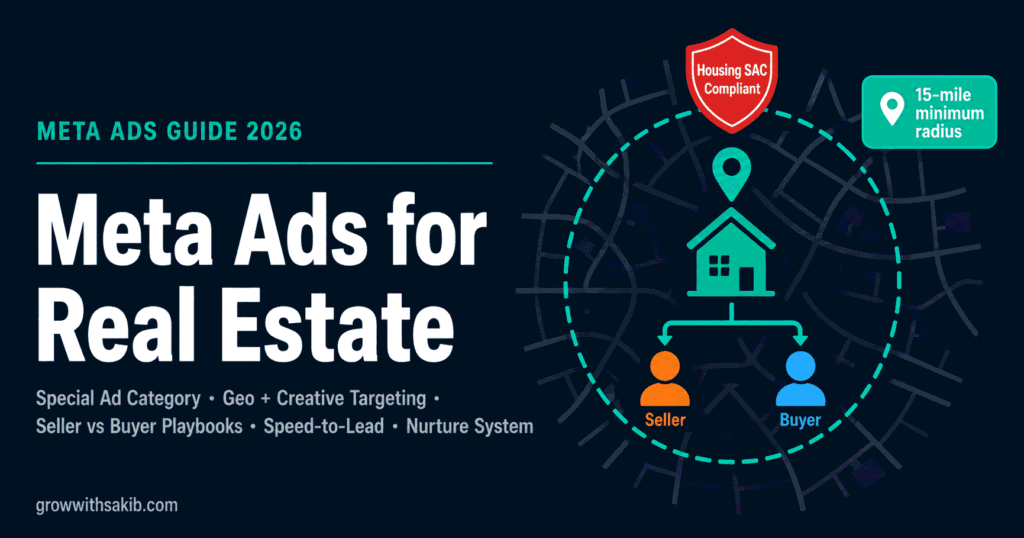
Real estate agents have a love-hate relationship with Facebook and Instagram ads. They generate leads — sometimes floods of them — but the leads are often tire-kickers, the targeting rules changed dramatically, and half the agents running ads are not sure they are even compliant with fair housing law.
Here is the truth that reframes everything: the restrictions that frustrate agents are actually pushing them toward what works best anyway. Since Meta banned demographic targeting for housing, you can no longer micro-target by age, income, or ZIP. That sounds limiting. In practice, it forces you to let your creative do the targeting — which is exactly what the Andromeda-era algorithm rewards.
This guide covers the whole picture: the Special Ad Category rules you must follow, how to target compliantly, the creative that qualifies buyers and sellers without demographic filters, the lead-quality and speed-to-lead systems that separate closers from collectors of junk leads, and separate playbooks for buyer and seller campaigns — all within the complete Meta Ads framework.
The Special Ad Category for Housing: The Rule That Changes Everything
Before you build a single real estate campaign, you must understand the Special Ad Category for Housing. It is not optional, it is not a suggestion, and ignoring it risks your ad account. It also fundamentally shapes how real estate advertising works on Meta in 2026.
What the Special Ad Category is
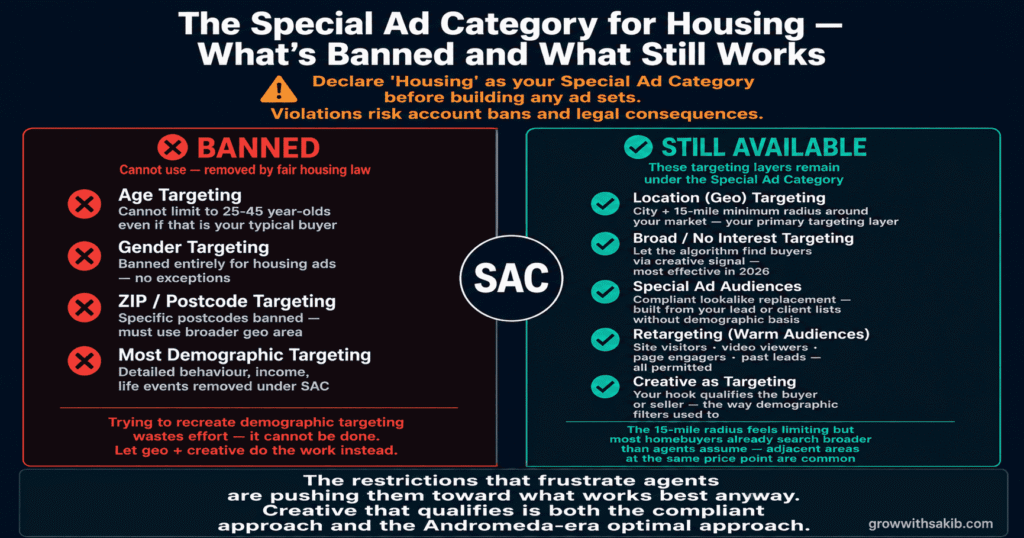
The Special Ad Category for Housing is Meta’s framework, created to comply with fair housing laws, that restricts how housing-related ads can be targeted. As AdAmigo’s compliance guide explains, it covers everything from individual property listings and open-house promotions to mortgage services and agent branding campaigns. Any ad related to housing sales, rentals, or financing must declare ‘Housing’ as its special category before the ad sets are built.
What it bans
As Ryze AI documents, real estate ads must use the Housing Special Category designation, cannot target based on age, gender, or ZIP code, and require neutral language that does not suggest tenant or buyer preferences. The restrictions exist to prevent discrimination by removing the ability to include or exclude protected groups.
- No age targeting. You cannot limit to 25-45 year-olds, even though that may be your typical buyer.
- No gender targeting. Banned entirely for housing.
- No ZIP-code targeting. You target a broader geographic area with a 15-mile minimum radius, not a specific postcode.
- Limited interest and behaviour targeting. Most detailed-targeting options are removed; some broad interests may remain where permitted.
How to Target Compliantly: Geo Plus Creative
With demographic targeting gone, real estate targeting in 2026 rests on two legs: broad geographic targeting and creative that qualifies. The agents who struggle are the ones who relied on demographic precision; the ones who thrive let the creative and the algorithm do the work.
Geographic targeting under the 15-mile rule
As the Maven X real estate guide explains, you can still target by location with the 15-mile minimum radius, and the agents who thrive are the ones who let their creative do the targeting — when your ad speaks directly to luxury homeowners in a specific area, the right people self-select by engaging, even though your targeting parameters are broader than you would prefer.
As Media Strobe’s housing-ads analysis notes, in smaller markets the 15-mile minimum can feel frustrating, but most homebuyers already search a broader area than agents assume — a buyer looking in one suburb is often open to adjacent communities at the same price point. The radius limit is less of a constraint than it first appears.
Creative as the new targeting
Since you cannot filter by demographics, the creative must filter for you. As Propphy’s real estate ad guide describes the practical approach: let Meta’s algorithm do the heavy lifting and use the ad creative to call out the right people — for example, an opening line like ‘If you’re looking for homes under £400k in [area]…’ The creative qualifies the audience the way targeting settings used to.
This is the same creative-as-targeting principle that now governs B2B Meta advertising and the broader Andromeda era — but for real estate it is not just best practice, it is the compliant necessity. Your hook does the demographic work the platform no longer lets you do in settings.
Targeting layers that remain
| Layer | Status Under SAC | How to Use |
| Location (geo) targeting | Allowed, 15-mile min radius | Your primary targeting; city + radius around your market |
| Age / gender / ZIP | Banned | Cannot use; creative must qualify instead |
| Broad / no interest | Allowed | Let the algorithm find buyers via creative signal |
| Special Ad Audiences | Allowed (lookalike replacement) | Built from your lead/customer lists without demographic basis |
| Retargeting (warm) | Allowed | Site visitors, video viewers, page engagers, past leads |
Note the Special Ad Audience — Meta’s compliant replacement for standard lookalikes in restricted categories. It finds people similar to your seed list using behavioural signals while excluding the demographic factors fair housing law protects. Build it from your past leads or closed clients, the same way you would a standard lookalike, and it becomes your most efficient compliant prospecting audience.
The Real Problem Isn’t Leads — It’s Lead Quality and Speed
Here is what most real estate ad guides get wrong. They celebrate low cost per lead as the goal. For real estate specifically, cheap leads are usually the problem, not the achievement. The two things that actually determine whether Meta ads make you money are lead quality and speed-to-lead.
Why cheap real estate leads are usually worthless
As the Maven X guide explains, native Lead Ads generate 30-50% lower cost per lead than landing-page campaigns because the form is pre-filled and frictionless — but that low barrier means more tire-kickers, accidental submissions, and impulse fills with no real intent. A £4 lead that never answers the phone is more expensive than a £40 lead that lists their house with you.
Speed-to-lead: the factor that beats everything
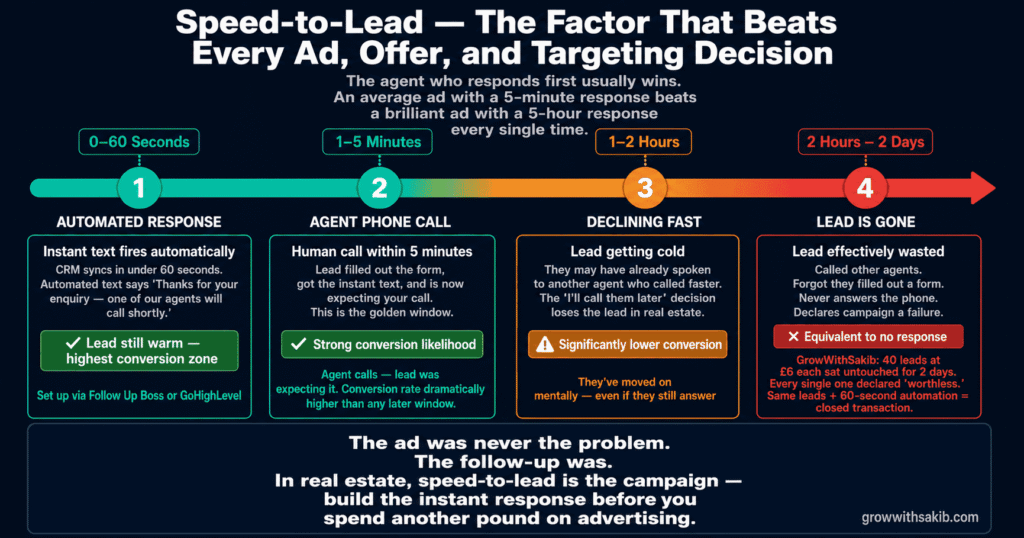
In real estate, the agent who responds first usually wins, and the drop-off is brutal. A lead contacted within 5 minutes is dramatically more likely to convert than one contacted an hour later — and most agents take hours or days. This is the single highest-leverage factor in real estate lead generation, and it has nothing to do with your ad.
As AdLibrary’s playbook stresses, you should sync leads to your CRM in under 60 seconds and trigger automated follow-up immediately. The entire loop — lead submits form, lands in your CRM, gets an instant text or call — must fire in real time. An agent with a mediocre ad and a 5-minute response beats an agent with a brilliant ad and a 5-hour response every single time.
Building lead quality into the campaign
- Use qualifying questions on the form — as covered in our Meta Lead Ads guide, adding timeline, pre-approval, and price-range fields filters out accidental submissions and attracts only serious buyers and sellers.
- Use Higher Intent forms. The confirmation step reduces accidental submissions and raises quality at the cost of some volume.
- Match the offer to intent. A home-valuation tool attracts sellers; a curated listing list attracts buyers. A generic ‘get info’ offer attracts nobody useful.
Two Different Campaigns: Seller Leads vs Buyer Leads
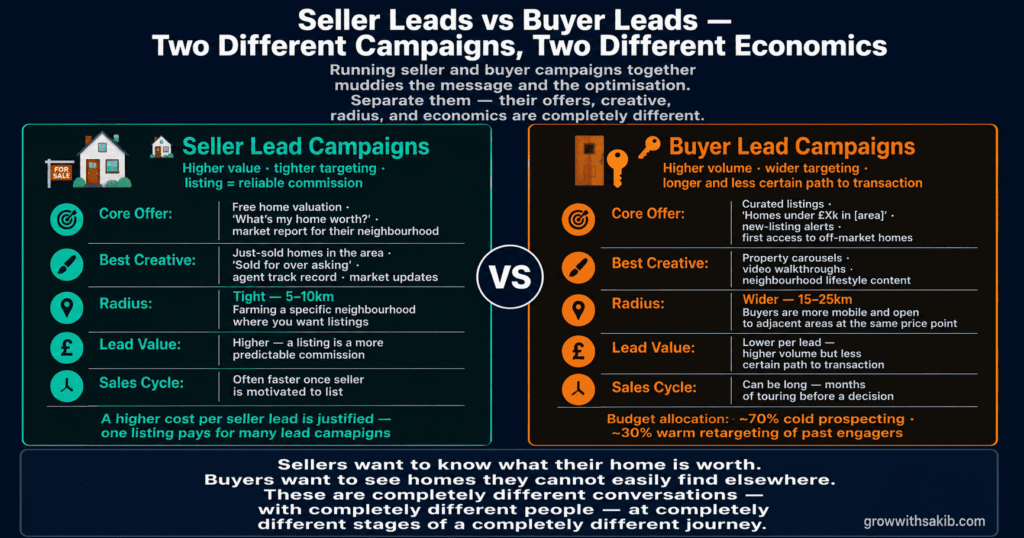
Seller leads and buyer leads are completely different products with different economics, offers, creative, and targeting. Running them as one campaign is a common and costly mistake. Sellers are usually the more valuable target — a listing is a more reliable commission than a buyer who may tour twenty homes and buy none.
Seller lead campaigns
Sellers respond to the question ‘what is my home worth?’ The classic, durable seller offer is a home valuation. The creative speaks to the homeowner’s curiosity and the favourable market for sellers in their area.
- Offer: free home valuation, ‘what’s my home worth?’ tool, market report for their neighbourhood.
- Creative: recently sold homes in the area (‘Just sold in [area] for over asking’), market updates, agent track record.
- Targeting: tighter radius for local ‘farming’ a specific area you want listings in — typically 5-10km around the target neighbourhood.
- Economics: higher value; a listing is a more predictable commission, so a higher cost per lead is justified.
Buyer lead campaigns
Buyers respond to properties and lifestyle. The offer is access to listings — often ones they cannot easily find or that feel exclusive.
- Offer: curated listings, ‘homes under £Xk in [area]’, new-listing alerts, first access to off-market homes.
- Creative: property carousels, video walkthroughs, neighbourhood lifestyle content.
- Targeting: wider radius (15-25km) since buyers are more mobile and open to adjacent areas at the same price point.
- Economics: higher volume, lower value per lead, longer and less certain path to a transaction.
| Dimension | Seller Leads | Buyer Leads |
| Core offer | Home valuation / ‘what’s it worth?’ | Curated listings / new-listing alerts |
| Best creative | Just-sold proof, market reports | Property carousels, video walkthroughs |
| Radius | Tight — 5-10km farming | Wider — 15-25km |
| Lead value | Higher (listing = reliable commission) | Lower per lead, higher volume |
| Sales cycle | Often faster once motivated | Can be long — months of touring |
As Media Strobe documents, a proven budget allocation for geo-targeted real estate is roughly 70% toward cold prospecting (Advantage+ or Special Ad Audience within your geo zone) and 30% toward retargeting warm audiences who engaged with ads or visited your site. Split this logic across separate seller and buyer campaigns rather than blending them.
Real Estate Creative That Stops the Scroll
With targeting restricted, creative carries even more weight in real estate than in most categories. The good news: real estate is inherently visual, and the formats that win are within reach of any agent with a phone.
Video beats static, and the agent’s face matters
As DMR Media’s real estate guide documents, video ads consistently outperform static images on Meta — a well-produced 30-second property walkthrough or market update can stop the scroll and generate engagement that translates into leads. As the AdLibrary playbook frames the creative hierarchy: property photo, then neighbourhood video, then agent face — but the agent talking-head video is what builds the personal trust real estate runs on.
Lead with the qualifier in the hook
Because the creative must do the targeting, the first line should call out the buyer or seller and the area explicitly. ‘Thinking of selling in [neighbourhood]?’ or ‘Homes under £350k just listed in [area].’ This self-selects the right audience and signals to the algorithm who converts, the same way strong ad copy works across the cluster — but here it is also your compliant targeting mechanism.
Authenticity over polish
Real estate buyers and sellers are choosing a person to trust with the biggest transaction of their lives. As with UGC and authentic creative, a genuine agent talking to camera about the local market outperforms a glossy corporate production. People want to see the human they will be working with, not a billboard. Use the right formats — vertical video for Reels and Stories, carousels for listings.
The Nurture System for a Long Decision Cycle
Real estate is not an impulse purchase. A seller may take a year from first curiosity to listing; a buyer may tour for six months. The lead you generate today often closes many months from now — which means the nurture system matters as much as the lead generation.
Speed first, then sustained nurture
The speed-to-lead response captures the lead in the first five minutes. The nurture system keeps you top-of-mind for the months until they are ready to transact. Both are essential, and most agents do neither well — they respond slowly and then forget the lead entirely.
The nurture architecture
- Instant response (0-5 min). Automated text and a call attempt the moment the lead lands, synced via Meta’s Conversions API to pass lead events server-side and your CRM integration to trigger automated follow-up in real time.
- CRM nurture sequence (weeks). Automated emails and texts with market updates, relevant listings, and value content keep you present without manual effort. Tools like Follow Up Boss or GoHighLevel are the real estate standards.
- Meta retargeting (months). Run a Meta Ads retargeting campaign targeting video viewers, page engagers, and website visitors with market-update content and new listing alerts to stay top-of-mind across the long decision cycle.
- Past-client and sphere campaigns. Upload your past clients as a Custom Audience seeded from your CRM and run referral-generating content targeted at people who already know and trust you.
6 Real Estate Meta Ads Mistakes That Waste Budget
Mistake 1: Not declaring the Special Ad Category
Running housing ads without declaring the Housing Special Ad Category risks ad rejection and, with repeated violations, permanent account bans and legal exposure. Always declare ‘Housing’ before building ad sets, and keep copy and creative compliant with fair housing law.
Mistake 2: Trying to recreate demographic targeting
Agents who built their old strategy on age, income, and ZIP targeting struggle most. You cannot recreate it, and trying wastes effort. Let geographic targeting plus qualifying creative do the work — it is both compliant and, in the Andromeda era, more effective anyway, as the Meta Ads Guide covering 2026 campaign structure confirms.
Mistake 3: Chasing cheap leads instead of qualified ones
A flood of £4 leads that never answer is worse than fewer £40 leads that list or buy. Use qualifying questions, Higher Intent forms, and intent-matched offers. In real estate, lead quality and conversion to transaction matter far more than headline CPL.
Mistake 4: Slow lead response
The single biggest determinant of real estate ad ROI is speed-to-lead, and it has nothing to do with the ad. Leads contacted within 5 minutes convert dramatically better than those contacted hours later. Automate instant response or your lead spend is largely wasted.
Mistake 5: Blending buyer and seller campaigns
Buyers and sellers want completely different things — listings versus valuations — with different economics and creative. Running them together muddies the message and the optimisation. Separate them into distinct campaigns with distinct offers.
Mistake 6: Generating leads with no nurture system
Real estate decisions take months. An agent who generates leads but has no nurture and retargeting system loses most of their spend to a long decision cycle they are not present for.
Frequently Asked Questions
Do Meta ads work for real estate?
Yes — Meta ads are highly effective for real estate lead generation when run compliantly. They must use Meta’s Special Ad Category for Housing, which bans demographic targeting, so success depends on broad geo-targeting, creative that qualifies the buyer or seller, and fast lead follow-up. As the Maven X guide notes, Meta’s ecosystem remains unmatched for real estate lead generation through visual content and retargeting, despite the rise of other platforms.
What is the Special Ad Category for housing?
It is Meta’s compliance framework for housing-related ads, created to satisfy fair housing laws. As Meta’s documentation sets out, ads for housing sales, rentals, or financing must declare ‘Housing’ as their category, which removes targeting by age, gender, ZIP code, and most demographics, and enforces a 15-mile minimum radius. It exists to prevent housing discrimination, and violations can lead to account bans.
How do real estate agents target on Facebook now?
With geography plus creative. As Propphy documents, agents use location targeting (city plus a 15-mile-minimum radius), broad or light interest targeting, and retargeting audiences — then let the creative call out the right people, such as ‘If you’re looking for homes under £400k in [area].’ Special Ad Audiences replace standard lookalikes as the compliant way to find similar prospects.
Why are my real estate Facebook leads low quality?
Usually because native Lead Ads make submission frictionless, attracting tire-kickers and impulse fills. As the Maven X guide explains, this is the tradeoff for 30-50% lower cost per lead. Fix it with qualifying questions (timeline, pre-approval, price range), Higher Intent forms, and intent-matched offers — and respond within 5 minutes, because slow follow-up makes even good leads worthless.
How do I get seller leads on Meta?
Run a dedicated seller campaign with a home-valuation offer — ‘what’s my home worth?’ — and creative featuring recently sold homes and market updates in the target area. Use a tighter radius (5-10km) to ‘farm’ specific neighbourhoods where you want listings. As covered in our lead ads guide, add qualifying questions to filter for genuine sellers, and sync leads to your CRM for instant follow-up.
How fast should I respond to a real estate lead?
Within 5 minutes, ideally within 60 seconds via automation. Speed-to-lead is the single biggest determinant of real estate ad ROI — leads contacted in the first few minutes convert dramatically better than those contacted hours later. As AdLibrary advises, sync leads to your CRM in under 60 seconds and trigger automated follow-up immediately. An average ad with fast response beats a great ad with slow response.
Is it better to use Meta lead ads or a landing page for real estate?
Lead Ads generate 30-50% lower cost per lead because the in-app form is frictionless, but produce lower-quality leads. Landing pages cost more per lead but attract higher intent and let you add more qualification. As the Maven X guide notes, many agents use Lead Ads for volume with strong qualifying questions, or landing pages when lead quality matters more than quantity. Test both for your market and offer.
Key Takeaways
- The Special Ad Category for Housing governs everything. Declare ‘Housing’ before building ad sets; you cannot target by age, gender, or ZIP, and a 15-mile minimum radius applies. Violations risk account bans.
- Compliance forces better advertising. With demographic targeting banned, creative must qualify the buyer or seller — which is exactly what the Andromeda-era algorithm rewards anyway. Geo-targeting plus a qualifying hook is the compliant, effective combination.
- Lead quality and speed-to-lead beat low CPL. A cheap lead that never answers costs more than a qualified one that transacts. Use qualifying forms and intent-matched offers.
- Speed-to-lead is the campaign. Respond within 5 minutes — ideally 60 seconds via automation. An average ad with fast follow-up beats a brilliant ad with slow follow-up every time.
- Run separate buyer and seller campaigns. Sellers want valuations (tight farming radius, higher value); buyers want listings (wider radius, higher volume). Blending them muddies both.
- Use Special Ad Audiences as your compliant lookalike. Built from past leads and clients, they find similar prospects without the demographic basis fair housing law prohibits.
- Build the nurture system before scaling. Real estate decisions take months. Instant response, CRM sequences, and retargeting keep you present across the long cycle — most leads close far later than they arrive.
- Owned leads compound; rented portal leads don’t. A Meta lead nurtured into your CRM becomes a retargetable, referable asset. Measure lifetime value and owned-pipeline growth, not just cost per lead.