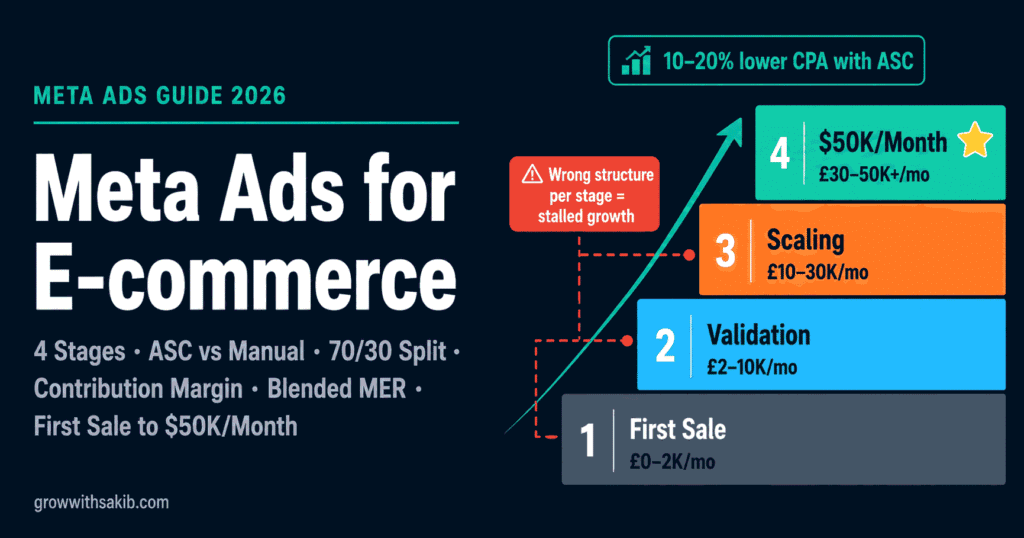
There is a structure problem at the heart of most e-commerce Meta accounts. Either the account is wildly over-complicated — 15 campaigns, 40 ad sets, micro-audiences split by age and interest — or it is a single boosted post hoping for the best. Both fail, for opposite reasons.
The over-complicated account starves every ad set of the data it needs to optimise. The too-simple account never builds the structure to scale. And here is the part almost every guide misses: the right structure is not the same at every stage. The account that gets you your first consistent sales is not the account that gets you to $50K/month.
This guide gives you the structure for each stage of the journey — from your first sale, through validation, into scaling, and up to $50K/month — plus the decision framework for ASC versus manual, the creative volume the algorithm now demands, and the profitability metrics that tell you whether you are actually making money or just generating revenue — all within the complete Meta Ads framework.
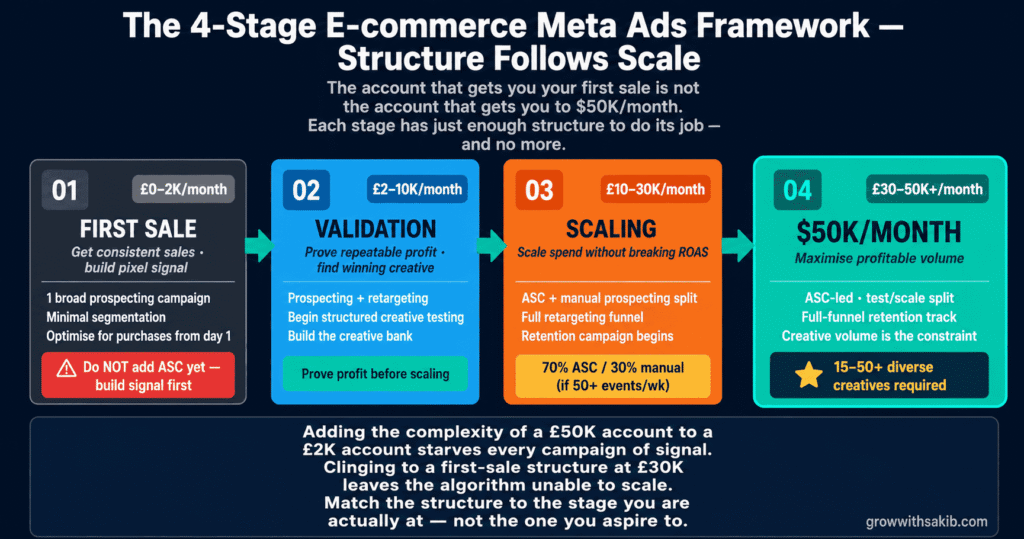
The Spend-Stage Framework: Structure Follows Scale
The biggest mistake in e-commerce Meta advertising is using the wrong structure for your stage. A brand doing its first sales needs a fundamentally different account from one spending £50K/month. Here is the framework that maps structure to stage.
The four stages
| Stage | Monthly Spend | Primary Goal | Structure |
| 1. First Sale | £0-2K | Get consistent sales, build pixel signal | 1 broad prospecting campaign; minimal segmentation |
| 2. Validation | £2-10K | Prove repeatable profit; find winning creative | Prospecting + retargeting; begin testing |
| 3. Scaling | £10-30K | Scale spend without breaking ROAS | ASC + manual prospecting + retargeting + retention |
| 4. $50K/Month | £30-50K+ | Maximise profitable volume | ASC-led + test/scale split + full-funnel retention |
Stage 1 — First Sale: Structure for When You Have No Signal
The hardest stage is the first one, because you are asking Meta’s algorithm to find buyers with almost no data to learn from. Your pixel has fired a handful of purchases at most. The structure here is about simplicity and signal accumulation, not optimisation.
The first-sale structure
- Run one broad prospecting campaign. Do not segment by interest, age, or geography beyond your shipping area — test different ad formats early to understand which perform best before narrowing creative variables. As Stackmatix advises, give the algorithm room to operate. With little data, narrow targeting only starves an already data-poor account.
- Optimise for purchases, not clicks or add-to-carts. Even with low volume, optimise for the event you actually want. If purchase volume is far too low to optimise, temporarily optimise for add-to-cart to give the algorithm more signal, then move to purchase as sales grow.
- Get tracking right before spending. Your Meta Pixel and Conversions API must fire purchase events with values from day one. At this stage, every conversion signal is precious — losing 25-30% to broken tracking is fatal when you only have a handful to begin with.
- Lead with strong creative. With little audience data, your creative does the targeting. A few genuinely good ads matter more than any targeting setting at this stage.
Stage 2 — Validation: Proving Repeatable Profit
Once you have consistent sales, the validation stage is about proving the profit is repeatable and finding the winning creative that will carry your scaling. You now have enough signal to add a second campaign and begin systematic testing.
The validation structure
- Prospecting campaign (broad). Your main acquisition engine, still broad, now with accumulated signal working in your favour.
- Retargeting campaign. Now that prospecting generates site traffic, a retargeting campaign captures the warm audience it produces. Segment by intent — product viewers and cart abandoners — for the highest return.
- Begin structured creative testing. Start finding winners systematically through creative testing. This is where you build the creative bank that scaling will burn through.
What validation actually means
Validation is not ‘I got some sales.’ It is ‘I can reliably acquire a customer below my break-even cost, and I have at least one or two creatives that consistently win.’ Until both are true, scaling will only accelerate losses. As covered later, the metric that proves this is contribution margin after ad cost, not platform ROAS.
Stage 3 — Scaling: Where Advantage+ Shopping Takes Over
At the scaling stage, with consistent profit and 50+ weekly purchase events, Advantage+ Shopping Campaigns become the engine of growth. This is the stage where the account structure shifts from manual-led to ASC-led.
Why ASC becomes the workhorse
Advantage+ Shopping Campaigns hand Meta’s Andromeda system full control over targeting, placement, and delivery across the funnel. As AskNeedle describes it, you feed it creative, budget, and country, and it finds customers — becoming the single highest-performing campaign for many DTC brands. Our full Advantage+ Shopping guide covers setup in depth; here the focus is how it fits the scaling structure.
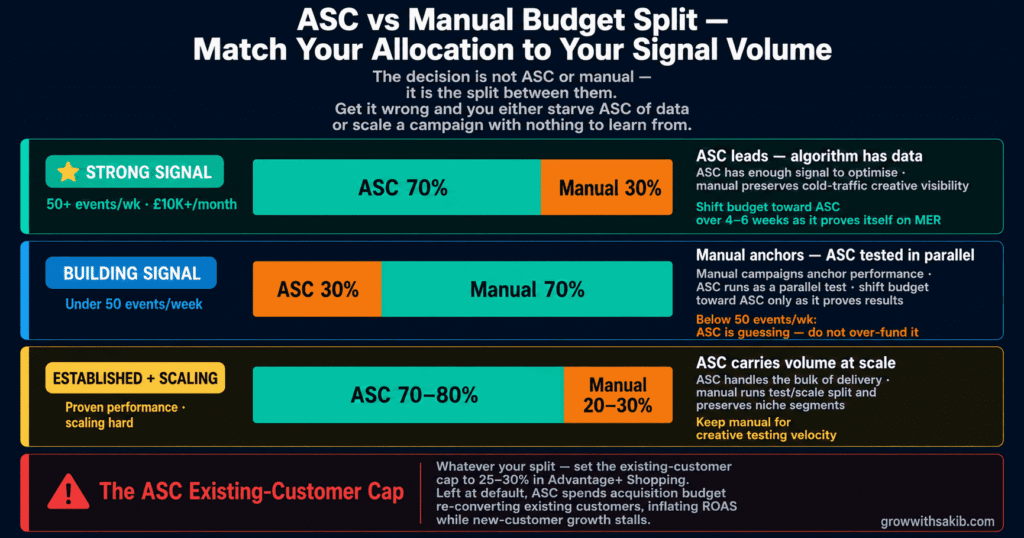
The ASC-plus-manual budget split
The decision is not ASC or manual — it is the split between them, and it depends on your signal volume. As AdLibrary documents, a common starting split is 70% ASC and 30% manual for established accounts with strong conversion signal. For accounts under £10K/month or fewer than 50 weekly purchase events, flip it: run 30% ASC as a test while manual campaigns anchor performance, then shift budget toward ASC over 4-6 weeks as it proves itself on blended MER.
| Account Signal | ASC / Manual Split | Reasoning |
| Strong (50+ events/wk, £10K+/mo) | 70% ASC / 30% manual | ASC has enough signal to optimise; manual preserves cold-traffic visibility |
| Building (under 50 events/wk) | 30% ASC / 70% manual | Manual anchors performance; ASC tested in parallel until proven |
| Established + scaling hard | 70-80% ASC / 20-30% manual | ASC carries volume; manual runs test/scale and niche segments |
Stage 4 — Scaling to $50K/Month: Creative Volume Is the Constraint
At the top stage, the binding constraint is no longer structure or targeting — it is creative. Scaling to £50K/month and beyond is gated by how fast you can produce fresh, genuinely diverse creative, because the algorithm burns through it far faster at high spend.
Why creative becomes the bottleneck
As Alex Neiman’s playbook puts it bluntly, the secret to scaling Advantage+ Shopping is not increasing budget — it is increasing creative volume and quality. At £50K/month, the same audience sees your ads far more often, so creative fatigues in days rather than weeks. The structure that scales is the one that feeds the algorithm a constant stream of new concepts.
The test-and-scale structure
As Flighted’s account-structure analysis lays out, segmenting the account into ‘Test’ and ‘Scale’ campaigns is essential to allow high creative testing velocity without resetting your largest campaigns into the learning phase. You test new concepts in a dedicated test campaign, and you migrate only proven winners into the scale campaign — so your biggest-spending campaigns are disrupted far less often because only winners enter them.
- Test campaign: high velocity of new concepts, where learning resets do not matter because spend is lower.
- Scale campaign (often ASC): only proven winners enter, minimising disruption to your highest-spend delivery.
- Retention track: a full Meta Ads retargeting strategy covering win-back sequences, post-purchase upsells, and lapsed-customer campaigns that run separately from the prospecting engine.
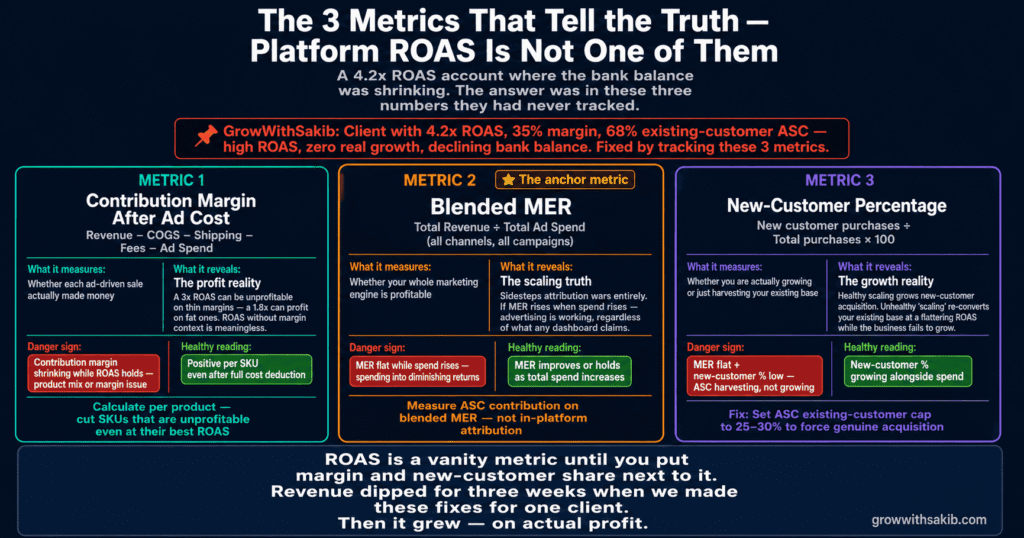
The Metrics That Actually Matter: Beyond Platform ROAS
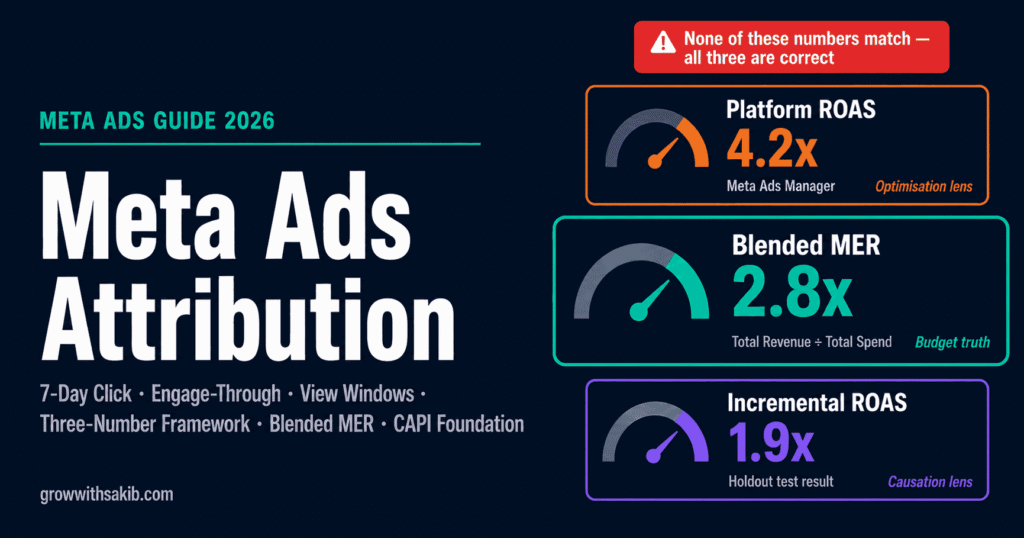
Here is where most e-commerce advertisers go wrong, and it costs them real money. They optimise for platform-reported ROAS — the number in Ads Manager — and scale the campaigns with the highest ROAS. For e-commerce specifically, that number can be actively misleading.
Why platform ROAS misleads e-commerce
Platform ROAS overstates your real return for the same reasons covered in our attribution guide: it claims credit for conversions that organic, email, and direct would have driven anyway, and it is inflated most for retargeting — exactly the campaigns that look most profitable. An e-commerce brand that scales toward its highest platform-ROAS campaigns often scales toward the ones claiming the most undeserved credit.
The two numbers that tell the truth
- Contribution margin after ad cost. Revenue minus cost of goods, shipping, fees, AND ad spend. This is the number that tells you whether a sale actually made money. A 3x ROAS sale can be unprofitable if your margins are thin; a 1.8x ROAS sale can be profitable if your margins are fat. ROAS without margin context is meaningless.
- Blended MER (Marketing Efficiency Ratio). Total revenue divided by total ad spend across everything. As AdLibrary stresses, you measure ASC’s real contribution on blended MER, not in-platform attribution. If MER rises when you increase spend, the spend is working — whatever any single campaign’s dashboard claims. This is the anchor metric for scaling Meta Ads profitably — it tells you whether your overall spend level is returning enough revenue to justify the investment, independent of any single campaign’s dashboard.
New-customer percentage: the e-commerce health metric
One more number matters specifically for e-commerce scaling. As AdLibrary notes, if MER is flat and new-customer percentage is low, ASC is harvesting warm audiences rather than generating incremental demand. Track what share of your purchases come from new versus existing customers. Healthy scaling grows new-customer acquisition; unhealthy ‘scaling’ just re-converts your existing base at a flattering ROAS while the business fails to actually grow.
Why Consolidation Beats Complexity in 2026
Across every stage runs one principle: consolidate — a principle reinforced throughout the Meta Ads Guide campaign structure framework. The instinct to build more campaigns, more ad sets, and more granular audiences actively harms performance in 2026. Understanding why makes the whole framework click.
The mechanism is the learning phase. Every ad set needs roughly 50 conversion events per week to exit learning and optimise properly. As OptiFOX confirms, this 50-events-per-week threshold is the 2026 standard. When you split your budget across 15 campaigns and 40 ad sets, you divide your conversion events so finely that almost none reach the threshold — so almost none ever optimise. Fragmentation does not give you control; it gives you a permanently under-learning account.
As Stackmatix concludes, brands running 15+ campaigns with micro-segmented audiences are fighting the algorithm instead of leveraging it, and three-to-four-campaign structures outperform them. The Andromeda algorithm has become good at finding buyers — but only when you concentrate enough signal in each campaign for it to learn. Consolidation is how you do that.
6 E-commerce Meta Ads Mistakes That Stall Growth
Mistake 1: Running the wrong structure for your stage
A first-sale store with a £50K account structure starves every campaign of signal; a £30K store on a first-sale structure cannot scale. Match the structure to your actual spend stage. The single most common reason e-commerce accounts stall is running a stage they have not reached or clinging to one they have outgrown.
Mistake 2: Over-fragmenting the account
Fifteen campaigns and forty micro-audiences feel like control but guarantee a permanently under-learning account. Each ad set needs ~50 events per week to optimise. Consolidate to 3-4 campaigns so each accumulates enough signal to leave the learning phase.
Mistake 3: Switching to ASC before you have signal
Advantage+ Shopping needs ~50 weekly purchase events to optimise. Switching to ASC at the first-sale stage hands the keys to an algorithm with nothing to learn from. Build signal with manual broad prospecting first, then transition to ASC as covered in the Advantage+ Shopping guide.
Mistake 4: Leaving the existing-customer cap at default
An uncapped ASC quietly spends your acquisition budget re-converting existing customers, inflating ROAS while new-customer growth stalls. Set the existing-customer cap to 25-30% so ASC actually acquires new customers instead of harvesting your base.
Mistake 5: Optimising for platform ROAS instead of profit
Platform ROAS ignores margin and overclaims credit. A high-ROAS account can lose money on thin margins or be re-converting existing customers. Track contribution margin after ad cost and blended MER — the numbers that actually reflect profit.
Mistake 6: Treating creative as an afterthought when scaling
At scale, creative volume is the binding constraint — the algorithm needs 15-50+ diverse creatives and burns through them fast. A brand that scales budget without scaling its creative production pipeline hits a ceiling within weeks as the algorithm runs out of fresh concepts to test.
Frequently Asked Questions
How should I structure Meta ads for e-commerce?
Run a simple, consolidated structure matched to your spend stage — typically three to four campaigns: broad prospecting (often an Advantage+ Shopping Campaign), retargeting, retention, and optionally testing. As Stackmatix documents, simplified structures outperform complex ones in 2026 because the Andromeda algorithm finds buyers better with room to operate. Brands running 15+ micro-segmented campaigns are fighting the algorithm rather than leveraging it.
Is Advantage+ Shopping better than manual campaigns for e-commerce?
For most e-commerce brands with sufficient signal, yes — Adverge Media reports 10-20% lower CPA from ASC versus manual structures. But ASC needs roughly 50 weekly purchase events to optimise. Below that, run mostly manual and test ASC in parallel. Most established brands run a 70% ASC / 30% manual split, keeping a manual prospecting campaign to preserve cold-traffic creative visibility.
How many campaigns should an e-commerce store run?
Three to four maximum for most stores: one broad prospecting, one retargeting, one retention, and optionally one testing campaign. As Stackmatix advises, this beats complex structures because each campaign accumulates enough conversion signal to exit the learning phase. The exact number scales with spend — a first-sale store may run just one prospecting campaign, while a $50K/month account adds a test/scale split.
What is a good ROAS for e-commerce on Meta?
There is no universal number, because ROAS only means something next to your margin. A 3x ROAS loses money on thin margins; a 1.8x ROAS profits on fat ones. Track contribution margin after ad cost and blended MER instead. As covered in our attribution guide, platform ROAS also overclaims credit — so measure profitability on blended metrics, not the dashboard number, and benchmark against your category’s cost data.
How do I scale my e-commerce Meta ads from the first sale?
Progress through stages. At first sale (£0-2K/month), run one broad prospecting campaign optimised for purchases to build signal. At validation (£2-10K), add retargeting and begin creative testing. At scaling (£10-30K), introduce Advantage+ Shopping as the workhorse. Toward $50K/month, split test and scale campaigns and treat creative volume as the constraint. Match the structure to the stage you are at.
What is the existing-customer cap in Advantage+ Shopping?
It is a setting that limits how much of your ASC budget targets existing customers versus new ones. As Adligator recommends, start at 25-30%. Left at default or set too high, ASC spends acquisition budget re-converting existing customers — inflating ROAS while real growth stalls. The cap forces ASC to acquire new customers rather than harvest your existing base, which is essential for genuine e-commerce scaling.
How much creative do I need to scale e-commerce Meta ads?
In 2026, Meta’s algorithm needs 15-50+ active, genuinely diverse creatives to optimise properly, per OptiFOX’s data. At higher spend, creative fatigues faster because the same audience sees ads more often, so creative volume becomes the binding constraint on scaling. As Alex Neiman notes, scaling Advantage+ Shopping is about increasing creative volume and quality, not just budget. A standing creative pipeline is essential.
Key Takeaways
- Structure follows scale. The right campaign structure evolves through four stages — first sale, validation, scaling, and $50K/month. Running the wrong stage’s structure is the most common reason e-commerce accounts stall.
- Consolidate to 3-4 campaigns. Fragmented accounts starve every ad set of the ~50 weekly events needed to exit the learning phase. In 2026, simplified structures beat complex ones because the algorithm needs concentrated signal.
- Build signal before switching to ASC. Advantage+ Shopping needs ~50 weekly purchase events to optimise. Start with manual broad prospecting at the first-sale stage; transition to an ASC-led split once signal is strong.
- Use the ASC/manual split by signal volume: 70% ASC / 30% manual for established accounts, flipped to 30/70 for those still building signal. Keep a manual prospecting campaign to preserve cold-traffic visibility.
- Set the existing-customer cap to 25-30%. Left at default, ASC harvests your existing base and inflates ROAS while real growth stalls. The cap forces genuine new-customer acquisition.
- Measure contribution margin and blended MER, not platform ROAS. ROAS without margin context is meaningless, and platform ROAS overclaims credit. Profit and MER are the numbers that tell the truth.
- Track new-customer percentage. If MER is flat and new-customer share is low, you are harvesting warm audiences, not growing. Healthy scaling grows new-customer acquisition.
- At scale, creative volume is the constraint. The algorithm needs 15-50+ diverse creatives and burns through them fast at high spend. A standing creative pipeline is the real scaling lever toward $50K/month.