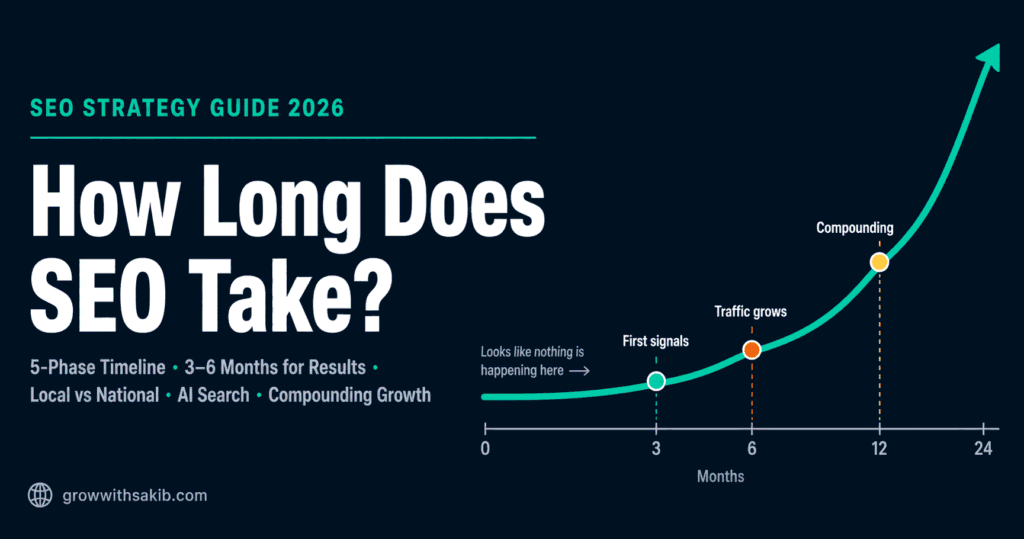
If you have been doing SEO for a few weeks and your rankings have not moved, you are not failing. You are in the part of the curve where SEO looks like nothing is happening — even though, behind the scenes, plenty is. This guide gives you a realistic timeline for how long SEO actually takes, broken into phases tied to what you can see in your own dashboards. No vague reassurances. No agency upsells.
If you want the wider context for how SEO works before reading the timeline, the complete small business SEO guide on GrowWithSakib covers the foundations.
What the Data Actually Says About SEO Timelines
Google itself has weighed in. In a widely-cited video on the topic, former Google search engineer Maile Ohye said: “In most cases, the SEO will need four months to a year to help your business first implement improvements and then see the potential benefit.” That quote, referenced in Search Engine Land’s guide on SEO timelines, remains the most authoritative single answer to this question.
Industry data supports a similar window. A poll of 3,680 SEO practitioners by Ahrefs found the most common answer was 3 to 6 months. Separately, Ahrefs’ research into SEO statistics shows that the average top-10 ranking page is about two years old, and the average #1 ranking page is nearly three years old. Older pages with established authority rank for more keywords.
Google’s John Mueller has also said it can take up to a year for Google to figure out where to rank a new site — sometimes referred to in the SEO community as the ‘Google sandbox’ effect.
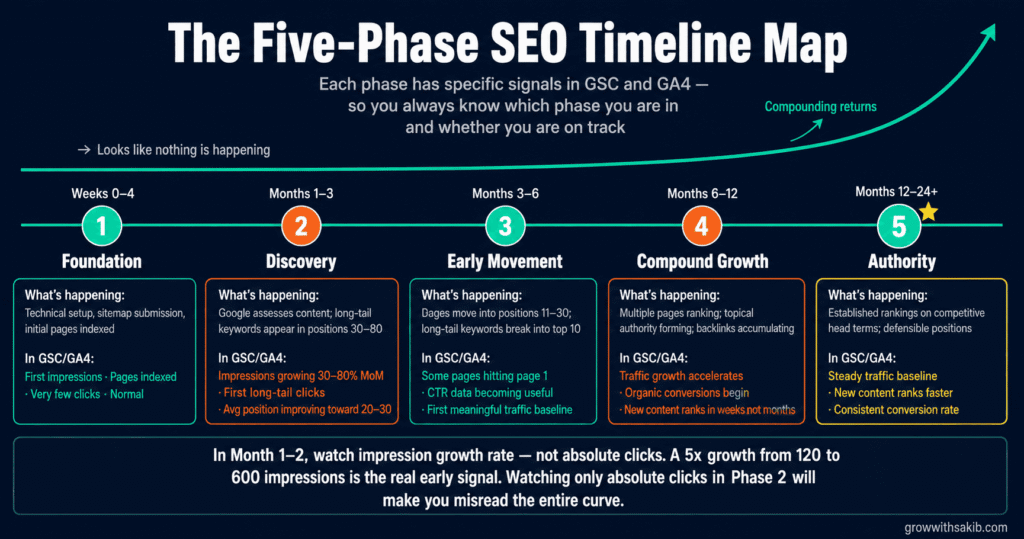
The Five-Phase SEO Timeline Map
Rather than expressing the timeline as a single range, it is more useful to break it into phases. Each phase has specific signals you will see in Google Search Console and Google Analytics 4 — so you always know which phase you are in.
- Phase: Foundation – Timeframe: Weeks 0–4 / What’s Happening: Site setup, technical fixes, sitemap submission, initial content live – What You’ll See in GSC/GA4: Pages getting indexed; first impressions appearing; very few clicks
- Phase: Discovery – Timeframe: Months 1–3 / What’s Happening: Google crawls and assesses content; long-tail keywords appear in positions 30–80; topical relevance starts to register – What You’ll See in GSC/GA4: Impressions grow week-over-week; first clicks on long-tail queries; average position improving but still 30+
- Phase: Early Movement – Timeframe: Months 3–6 / What’s Happening: Pages move into positions 11–30; targeted long-tail keywords break into top 10; first meaningful organic traffic – What You’ll See in GSC/GA4: Visible impression growth; CTR data becoming useful; some pages hitting page 1
- Phase: Compound Growth – Timeframe: Months 6–12 / What’s Happening: Multiple pages ranking; topical authority forming; backlinks accumulating; content depth paying off – What You’ll See in GSC/GA4: Traffic growth accelerates; conversions from organic search begin; brand impressions rising
- Phase: Authority – Timeframe: Months 12–24+ / What’s Happening: Established rankings on competitive head terms; consistent traffic; defensible positions – What You’ll See in GSC/GA4: Steady traffic baseline; new content ranks faster; established conversion rate
Phase 1 — Foundation (Weeks 0–4)
This is the phase that confuses most small business owners. Almost no visible movement is happening on the SERPs — but the most important work is invisible: Google is crawling your site, building a model of what it is about, and beginning to index pages.
By the end of Week 4, you should see in Google Search Console:
- Most or all of your important pages indexed (check the Pages report)
- First impressions appearing for very long-tail queries (often single digits to low double digits)
- Average position likely around 30–60 — looks bad, is normal
- Click data sparse and unreliable at this stage
Do not panic if traffic is near zero. Impressions appearing at all is the early-stage signal that matters.
Phase 2 — Discovery (Months 1–3)
Google has now seen your site enough to start placing it in real SERPs. This is the phase where impressions multiply faster than clicks — which is the correct order of events.
Expected dashboard signals:
| Metric | Typical Range at End of Phase 2 |
| Impressions | Growing 30–80% month-over-month from a low base |
| Clicks | Still low — single digits to low hundreds per month |
| Average position | Improving from 50+ down toward 20–30 |
| Indexed pages | 90%+ of important URLs indexed |
| First long-tail rankings | Some queries hitting positions 11–20 |
Phase 3 — Early Movement (Months 3–6)
This is where most readers expect SEO to ‘turn on’. It does — but not for every keyword. The pattern is typically a small number of pages breaking into page one for long-tail terms while the rest of the site continues building authority.
By month 6, you should see:
- 3–10 pages on page one of Google for low-to-medium competition keywords
- Impression-to-click ratio improving as more pages hit positions 1–10
- CTR data finally useful — pages with CTR below 1% in positions 5–10 are title/meta opportunities you can identify in Google Search Console.
- First measurable organic traffic baseline (often 100–800+ sessions per month for small sites)
- Beginning to see organic conversions — if you have set up conversion tracking
Phase 4 — Compound Growth (Months 6–12)
This is the phase that rewards consistency. The pages you published in Months 1–3 are now mature enough to rank, and the new content you publish builds on top of established topical authority. Growth often feels exponential here — not because anything magical happened, but because foundations laid earlier are compounding.
Expected signals:
- Traffic growth accelerating beyond linear — often doubling or tripling between Months 6 and 12
- Multiple pages now ranking for variations of the same topic (topical authority)
- New blog posts ranking within 2–4 weeks rather than 2–4 months
- Steady backlink growth from quality referring domains
- Organic conversions becoming a predictable channel
Phase 5 — Authority (Months 12–24+)
By 12+ months, well-executed SEO produces a defensible asset. New content ranks faster, head-term keywords become reachable, and your traffic baseline becomes stable enough to forecast revenue from.
For competitive head-term keywords — the ones with thousands of monthly searches and Keyword Difficulty above 40 — expect 12 to 24+ months of consistent work to rank in the top 10.
What About AI Search? How GEO Changes the Timeline in 2026
AI Overviews, ChatGPT Search, Perplexity, and other generative engines have changed the SEO timeline in ways most competitor articles still ignore. The Google Search Central guidance on creating helpful content for AI search makes clear that generative engines surface content based on similar quality signals to traditional ranking — but the citation lag is different.
Three practical observations for 2026:
| AI Search Reality | Effect on Your Timeline |
| AI Overviews often surface content from pages ranking positions 5–20 | Pages in your Phase 3 ranking range may start being cited in AI answers before they rank #1 in blue links |
| AI engines re-crawl and re-cite content less frequently than Google’s traditional index | Once you earn an AI citation, it tends to persist — but new citations take longer to accumulate |
| Brand entity signals (mentions, structured data, consistent NAP) matter more for AI citation than for blue links | Authority Phase (Phase 5) becomes easier to enter if you build entity signals early |
The practical conclusion: AI search has not made traditional SEO faster or slower — but it has made brand entity work (consistent naming, structured data, mentions on authoritative sites) a parallel timeline that compounds with the ranking timeline. Sites that invest in both see broader visibility earlier — the complete GEO guide covers the entity and content signals that compound with traditional SEO timelines.
Why Doesn’t SEO Have a Fixed Timeline?
The honest answer is: too many variables. Six factors materially change the timeline, and they interact with each other.
| Factor | Impact on Timeline |
| Domain age and history | New domains can take 6–12 months longer to rank in the same niche as established domains |
| Niche competition (Keyword Difficulty) | KD 0–20 keywords can rank in 1–3 months; KD 50+ can take 12–24+ months |
| Content velocity | Publishing 2 quality articles per week vs. 1 per month accelerates topical authority by months |
| Backlink growth rate | Quality referring domains compound — sites with steady link building rank faster |
| Technical foundations | Sites with poor Core Web Vitals, indexing issues, or thin content can stay stuck in Phase 1–2 for months — all covered in the small business SEO foundation guide. |
| Strategy consistency | Frequently changing keyword targets, content angles, or site structure resets progress |
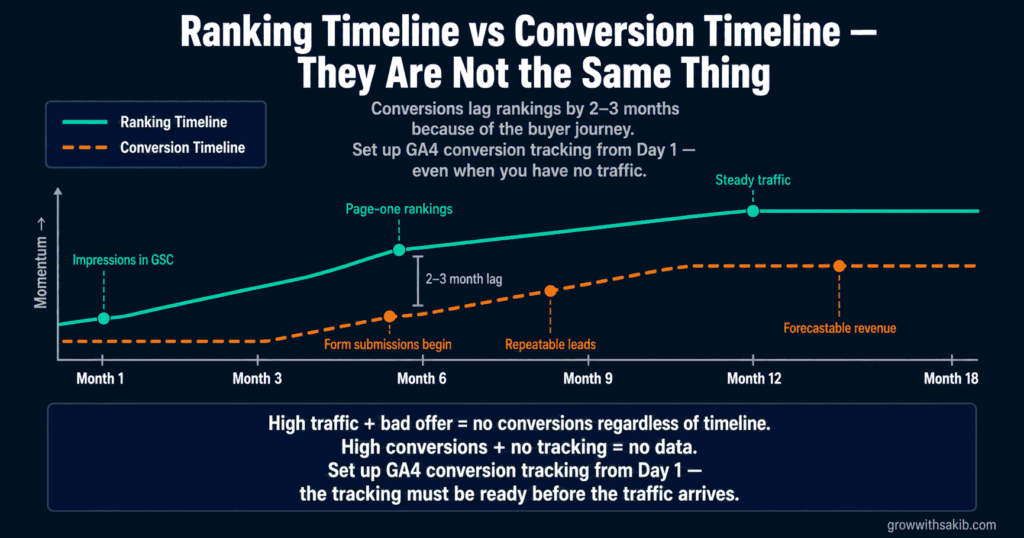
The Conversion Timeline Is Different from the Ranking Timeline
Most articles conflate these. They are not the same thing. A page can rank without converting, and conversions can lag rankings by 2–3 months because of the buyer journey.
| Stage | Ranking Timeline | Conversion Timeline |
| First signals | Impressions in Month 1 | Form submissions in Month 4–6 |
| Visible traction | Page-one rankings in Month 3–6 | Repeatable leads in Month 6–9 |
| Predictable channel | Steady traffic in Month 9–12 | Forecastable revenue in Month 9–18 |
This is why setting up conversion tracking in Google Analytics 4 from Day 1 matters — even when you have no traffic. The tracking has to be ready before the traffic arrives. For the full setup, the guide on tracking SEO results on GrowWithSakib walks through the dashboard configuration.
Local SEO Timeline: Why It’s Often Faster
Local SEO often moves faster than national SEO. According to Google’s Business Profile help documentation, a well-optimised Google Business Profile can start appearing in the local pack within days of verification — far faster than blue-link rankings.
| Local SEO Phase | Typical Timeframe |
| Google Business Profile appearing in local pack | 1–4 weeks after verification and optimisation |
| Top-3 local pack for branded searches | 4–8 weeks |
| Top-3 local pack for moderate-competition geo-modified keywords | 2–4 months |
| Page-one rankings for competitive ‘service + city’ keywords | 4–9 months |
| Defensible local authority across multiple service-area keywords | 9–18 months |
Local SEO compounds with citations, Google reviews, and local backlinks. For a deeper dive, see the Google Business Profile optimisation guide on GrowWithSakib.
Common Mistakes That Stretch the Timeline
- Mistake: Changing keyword strategy every few weeks – Why It Slows You Down: Resets topical authority signals; Google has to re-learn your site’s focus – What to Do Instead: Pick a topical area and stay consistent for at least 6 months
- Mistake: Publishing inconsistently – Why It Slows You Down: Crawl frequency drops; Google deprioritises sites without a fresh content cadence – What to Do Instead: Set a publishing rhythm (1–2 quality pieces per week) and protect it
- Mistake: Targeting head terms too early – Why It Slows You Down: Wastes effort on keywords you cannot rank for in your current authority bracket – What to Do Instead: Pages that receive 3+ internal links from authoritative pages on your site rank faster — and you can identify which pages need more links using the Links report in Search Console.
- Mistake: Ignoring Core Web Vitals – Why It Slows You Down: Poor LCP, INP, or CLS scores actively hold back rankings – What to Do Instead: Fix CWV issues in the Foundation phase — they get harder later
- Mistake: Skipping internal linking – Why It Slows You Down: New pages take longer to be discovered and ranked – What to Do Instead: Add 2–3 internal links to every new page from existing relevant content
- Mistake: Buying low-quality backlinks – Why It Slows You Down: Triggers manual or algorithmic suppression – What to Do Instead: Build links slowly through real outreach, guest posting, and digital PR — the link building guide covers each method step by step.
How to Speed Up Your SEO Timeline (Realistically)
There is no magic acceleration, but a few tactics genuinely compress the timeline:
- Start with KD 0–20 long-tail keywords — they can rank in Months 1–3 and build early momentum
- Refresh existing content quarterly — published pages updated with new data tend to see ranking lifts within weeks
- Win featured snippets — adding a clear 40–60 word direct answer to a question can fast-track positions for pages already ranking 2–10
- Internal link consistently — pages that receive 3+ internal links from authoritative pages on your site rank faster
- Build entity signals in parallel — consistent NAP, structured data, and brand mentions on authoritative sites help both AI search and traditional SEO timelines
- Publish consistently — content velocity compounds; a steady 2/week often outpaces 8/month bursts
Honest Limitations of SEO Timeline Estimates
Every timeline in this article — including the Five-Phase Map — comes with caveats. These are the honest ones most agency articles will not tell you:
- Algorithm updates can reset or accelerate timelines — a core update during Month 8 can push you forward or backward by 3–6 months overnight
- New sites in highly competitive niches may never reach Phase 5 — competing with sites that have 10+ years of authority requires sustained, exceptional investment
- Average position in GSC averages everything — your real per-query rankings vary widely from the report’s single number
- Conversion timelines depend on offer-market fit — high traffic + bad offer = no conversions regardless of timeline
- Industry seasonality changes the curve — tax services, holiday retail, education, and travel sites have built-in cyclical patterns that distort linear timeline thinking
If you are stuck in Phase 1 or 2 longer than expected, the issue is usually one of three things: technical foundations, content quality, or topic competition. For each of these, see the on-page SEO guide on GrowWithSakib, the technical SEO fundamentals article, and the keyword research guide.
Frequently Asked Questions
1. How long does SEO take to show results?
SEO typically takes 3 to 6 months to show meaningful results, according to a poll of 3,680 SEO practitioners by Ahrefs. Google’s former search engineer Maile Ohye stated SEO usually needs 4 months to a year to first implement improvements and then see the potential benefit. New sites in competitive niches can take 12–24+ months for full results.
2. Can SEO work in 30 days?
Significant rankings for new sites in 30 days are extremely rare and usually involve very low-competition long-tail keywords on aged domains. In 30 days, you should expect indexing of your pages, first impressions in Google Search Console, and possibly long-tail rankings in positions 30–80 — not page-one traffic for commercial keywords. Be cautious of agencies guaranteeing 30-day rankings.
3. Why is my SEO taking so long?
Six factors typically extend the timeline: low domain age, high keyword competition, slow content velocity, weak backlink profile, poor technical foundations (especially Core Web Vitals), and inconsistent strategy. The most common single culprit for small businesses is targeting head-term keywords too early instead of building authority through low-competition long-tail keywords first.
4. How long does it take a new website to rank on Google?
Google’s John Mueller has stated that it can take up to a year for Google to figure out where to rank a new site. New websites should expect first indexing within 1–4 weeks, long-tail rankings in 1–3 months, and competitive rankings in 6–18 months. The Ahrefs study shows the average #1 ranking page is nearly three years old.
5. How long does local SEO take to work?
Local SEO is often faster than national SEO. A well-optimised Google Business Profile can appear in the local pack within 1–4 weeks of verification. Top-3 local pack rankings for moderate-competition geo-modified keywords typically take 2–4 months. Defensible local authority across multiple service-area keywords takes 9–18 months.
6. Is SEO faster than PPC?
No. PPC delivers traffic within hours of campaign launch; SEO takes 3 to 12 months for meaningful traffic. However, SEO produces a compounding asset — every dollar invested keeps generating traffic long after the work is done — whereas PPC traffic stops the moment you stop paying. Most small businesses benefit from running both: PPC for short-term cash flow, SEO for long-term compound growth.
7. How long until SEO produces revenue, not just traffic?
Traffic typically appears in Months 3–6; revenue typically appears in Months 6–9. The gap exists because of the buyer journey — organic visitors usually need multiple touchpoints before converting. Forecastable, predictable revenue from SEO usually arrives in Months 9–18 depending on your industry, offer, and conversion funnel quality. Set up conversion tracking from Day 1 so you can measure this.
8. Has AI search changed how long SEO takes?
Not for traditional rankings, but yes for visibility. AI Overviews and generative engines like ChatGPT Search often surface content from pages ranking in positions 5–20, meaning some pages get cited in AI answers before they reach position 1 in blue links. Brand entity signals (consistent naming, structured data, mentions on authoritative sites) now run as a parallel timeline that compounds with traditional SEO.
Key Takeaways
- SEO typically takes 3–6 months for meaningful results, 6–12 months for compound growth, and 12–24+ months for competitive head-term rankings — confirmed by Google’s Maile Ohye and an Ahrefs poll of 3,680 practitioners.
- Think in five phases (Foundation, Discovery, Early Movement, Compound Growth, Authority), each with specific signals you can see in Google Search Console and Google Analytics 4.
- In Month 1–2, watch impression growth rate — not absolute clicks. A 5x growth from 120 to 600 impressions is the real early signal.
- Conversion timelines lag ranking timelines by 2–3 months. Set up GA4 conversion tracking from Day 1 so you can measure it when it happens.
- Local SEO is often faster than national SEO — local pack rankings can appear in 1–4 weeks; competitive ‘service + city’ keywords in 4–9 months.
- AI search has not changed traditional SEO timelines but has added a parallel brand-entity timeline. Sites investing in both see broader visibility earlier.
- The most common timeline-killer for small businesses is changing strategy too often. Topical consistency for at least 6 months is non-negotiable.
- Start with KD 0–20 long-tail keywords — they rank in Months 1–3 and create early momentum that builds authority for harder keywords later.