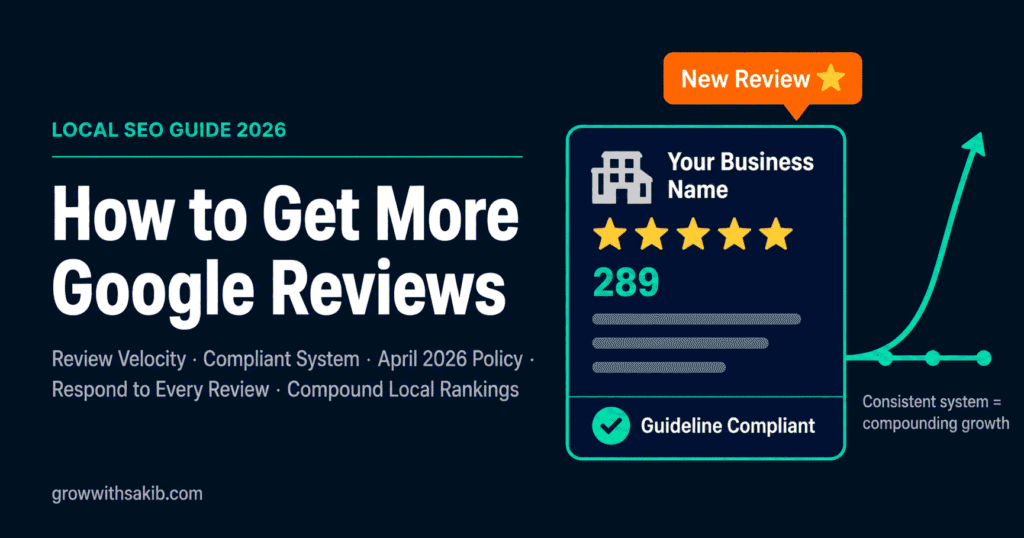
A plumber in my network has 289 Google reviews. His website has not changed since 2011. He does not post on Instagram. His logo is nothing special. But he shows up in the top three map results for every ‘plumber near me’ search in his area. His competitor — better website, active social media — has zero reviews and is not even on the map.
That gap is not luck. It is a system.
Google reviews are the one marketing asset that works while you sleep, compounds over time, and directly affects your local SEO for small business rankings. According to BrightLocal’s Consumer Review Survey, 70% of consumers will leave a review when asked — but fewer than 10% do it without any prompt. That gap between those two numbers is your entire opportunity.
There is a complication in 2026: Google has significantly tightened its review policies, adding new prohibited practices in April that most businesses do not know about yet. Reviews are being removed automatically. Profiles are being restricted. And the old tactics — in-store kiosks, asking customers to mention staff by name, running review contests — are now violations.
This guide covers both sides of the problem: how to get more reviews consistently, and how to do it without losing the ones you earn.
Why Google Reviews Matter More Than Most Businesses Realise
Most business owners think of reviews as social proof — a trust signal for potential customers. That is true, but it is only half the picture. Reviews are also a direct local ranking signal.
According to Whitespark’s Local Search Ranking Factors study, review signals account for approximately 16% of local pack ranking factors. That makes reviews the second or third most important factor for appearing in the Local 3-Pack — the three business listings that appear above organic results and capture the majority of local clicks. Google evaluates three review dimensions simultaneously, and understanding all three is what separates businesses with strong local visibility from businesses with stagnant rankings:
| Review Dimension | What It Is | How to Improve It |
| Volume | Total number of reviews on your profile | Build a consistent request system — volume grows with process, not luck, just like link building for local businesses compounds with a repeatable outreach system. |
| Recency | How recently reviews were posted | Maintain weekly review velocity — a business getting 5 reviews per week outranks one with 500 old reviews |
| Diversity | Reviews from different accounts, times, and locations | Request from every customer — not just regulars — and across different channels |
The conversion impact is equally significant. Research from Media Spearhead shows that businesses with 4.5+ average rating and 50+ reviews get 20–30% higher click-through rate in local search results. Profiles with zero reviews see conversion rates drop by 40%. The numbers are unambiguous: reviews drive both discovery and decision-making.
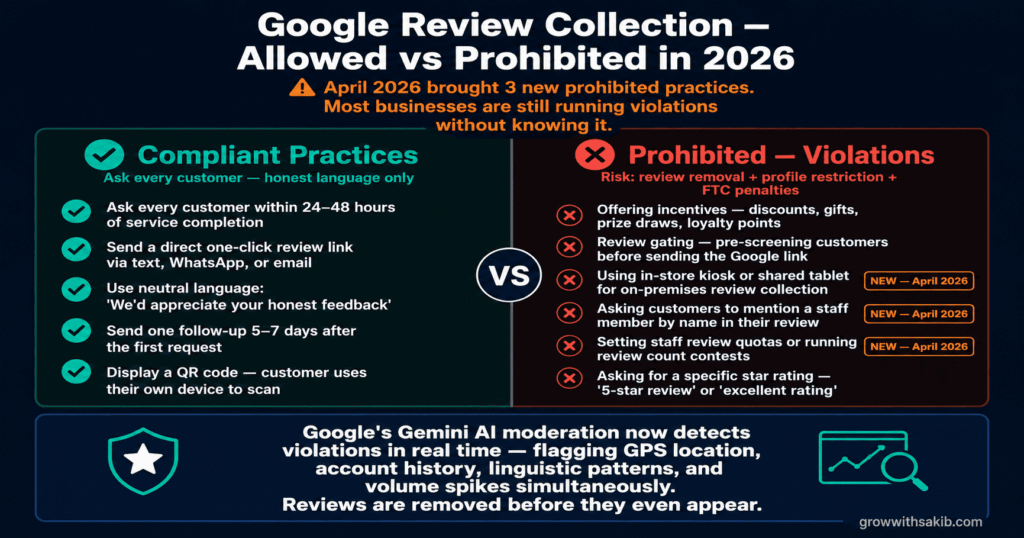
Google’s Review Policy in 2026 — What Is and Is Not Allowed
Before building any review strategy, you need to understand the current rules. Google updated its review policy in April 2026 with the most significant changes in years — and most businesses are still running practices that are now explicit violations.
According to Google’s official review policy, all reviews must be based on real, first-hand experiences and be unbiased. What changed in April 2026 is how specific Google is about what counts as manipulation.
What Is Prohibited — The Complete 2026 List
| Prohibited Practice | Added/Updated | Why Google Prohibits It |
| Offering any incentive for a review (discounts, gifts, loyalty points, prize draws) | Existing — now more actively enforced | Incentivised reviews do not reflect genuine experience; FTC civil penalties now apply |
| Review gating — pre-screening customers and sending only happy ones to Google | Existing — enforcement amplified in 2026 | Produces an artificially skewed rating that does not reflect actual customer experience |
| Using in-store kiosks, tablets, or shared devices to collect on-premises reviews | NEW — April 2026 | Google’s AI flags GPS, IP, and wifi network as review originated from business premises |
| Asking customers to mention a staff member by name in their review | NEW — April 2026 | Constitutes directing specific review content — now explicitly prohibited |
| Setting staff review quotas or running review count contests | NEW — April 2026 | Directing staff to hit a specific number of reviews is now a policy violation |
| Discouraging or blocking negative reviews | Existing | Prevents authentic representation of customer experience |
| Reviews from employees, family members, or people with a conflict of interest | Existing | Inherently biased — not genuine customer feedback |
| Posting reviews from multiple accounts under one person’s direction | Existing | Coordinated fake engagement |
The enforcement mechanism has also changed. According to reporting on the April 2026 update, Google now uses Gemini-powered AI moderation that reads four signals simultaneously: GPS and IP location (flagging reviews submitted from inside your business), account history (flagging brand-new accounts dropping five-star reviews), linguistic patterns (clustering reviews that use similar phrasing), and timing (flagging volume spikes that do not match normal customer flow).
The practical implication: techniques that used to produce reviews without triggering removal are now being caught automatically, in real time, before the review even appears on your profile.
What Is Review Gating — and Why It Will Eventually Cost You
Review gating is the practice of asking customers how their experience went before sending them a review link — routing satisfied customers to Google and unhappy ones to a private feedback form. The intent is to improve your average star rating. The result is a profile that does not accurately reflect your real customer experience.
Google has prohibited review gating since 2018, but the April 2026 enforcement update has made detection significantly more reliable. Sterling Sky has documented businesses losing hundreds of reviews to enforcement of this rule.
What review gating looks like in practice:
- Post-service email: ‘How was your experience?’ → Happy customers get the Google link. Unhappy customers get a contact form.
- Automated review platform: ‘Rate us 1–5 stars’ → 4 or 5 star responses go to Google. 1–3 star responses go to an internal survey.
- Staff conversation: ‘Did everything go well today?’ → Staff only send the Google link if the answer is positive.
The compliant alternative: send the same review request to every customer, regardless of how the experience appeared to go. Use honest language: ‘We would appreciate your honest feedback on Google.’ Do not pre-screen. Do not filter. Every customer gets the same ask.
Businesses worry that removing gating will invite negative reviews. In practice, the mix of reviews matters less than the response to them. A business with 120 reviews averaging 4.3 stars, with professional responses to every negative review, outperforms a gated 4.9-star profile with 15 reviews in both trust and ranking signals.
How to Build a Review Acquisition System That Actually Works
The businesses with the strongest review profiles are not the ones who tried the hardest to get reviews. They are the ones who built a system and applied it consistently to every single customer.
Step 1: Create Your Direct Review Link
Your direct review link eliminates friction — one click takes the customer directly to the review form without requiring them to search for your business.
- Go to your Google Business Profile dashboard and sign in
- In the left menu, select your business
- Scroll down to ‘Get more reviews’
- Copy the direct link — it looks like: g.page/[your-business-name]/review
- Shorten it using bit.ly or a branded shortener for easier sharing in messages
Important: Create this link from your GBP dashboard. Do not use the direct Google Maps URL — the dashboard generates a link that goes directly to the review form on mobile and desktop.
Step 2: Choose Your Request Channel
The channel you use significantly affects conversion rate. Podium’s data on SMS versus email review requests shows that SMS and WhatsApp requests convert at 7–8x the rate of email for review collection. Phone is even higher when done personally at the right moment.
| Channel | Conversion Rate | Best For | Compliance Note |
| Text / WhatsApp | Highest — typically 25–40% | Service businesses, trades, healthcare, personal services | Always get opt-in consent before messaging |
| Moderate — typically 5–15% | E-commerce, professional services, B2B | Works well for longer relationships; lower open rate on mobile | |
| In-person verbal | High when timed correctly | Restaurants, retail, any business with regular face-to-face interaction. For local businesses also running Meta Ads for local business, review acquisition pairs well with retargeting campaigns to recent customers. | Cannot hand device to customer — new 2026 prohibition |
| QR code (printed) | Variable — depends on placement | Restaurants, salons, reception areas, invoice footers | Compliant if customer uses their own device — not a shared kiosk |
| Email signature | Low but passive | All businesses | Keeps the link present without requiring an active ask |
Step 3: Time the Ask Correctly
The timing of your request determines whether you catch the customer at peak satisfaction or after the moment has passed. There are two optimal windows:
- Within 24–48 hours of service completion: Satisfaction is highest. The experience is fresh. The customer has not yet moved on mentally. This window converts at the highest rate for service businesses.
- Immediately after a positive signal: If a customer says ‘everything was great’ or completes a positive purchase, the verbal or in-person ask at that moment — followed by the link — captures the sentiment before it fades. Do not hand them your phone or device — new 2026 policy. Give them the link and let them use their own.
What to avoid: Asking weeks after a service when the customer has moved on. Asking before the work is complete. Asking when the customer has already expressed dissatisfaction — this reads as pressure, not a genuine request.
Step 4: Use the Right Language
The wording of your review request affects both conversion rate and compliance. Google’s policy prohibits asking for a specific rating or specific content — your request must ask for honest feedback, not 5-star feedback.
What not to say: ‘Please leave us a 5-star review.’ / ‘Tell them [staff member] was amazing.’ / ‘Rate us as excellent.’ These are now explicit policy violations under the April 2026 update.
Step 5: Follow Up Once
A single follow-up, sent 5–7 days after the first request, is compliant and effective. Many customers intend to leave a review but forget. One reminder catches them without crossing into pressure. Never send more than one follow-up. If a customer has not responded after two asks, they are unlikely to review — and repeated requests damage the relationship and risk being flagged as spam.
How to Respond to Reviews — and Why It Matters More Than Most Businesses Think
Most businesses treat review responses as customer service. They are also a ranking signal and a conversion driver — and part of a broader local SEO strategy that compounds over time.
Google’s official documentation states explicitly: ‘Responding to reviews shows that you value your customers and their feedback.’ Google tracks response rate and response speed as signals of an active, engaged, trustworthy business.
The conversion impact is equally significant. A Harvard Business Review study found that businesses that respond to reviews see 35% higher conversion than those that do not — and that well-handled responses to negative reviews often convert wavering prospects more effectively than positive reviews alone.
Responding to Positive Reviews
Keep responses personal, specific, and short. Reference something the reviewer mentioned. Do not use the same template for every response — Google’s algorithm notices, and so do readers.
| What to Include | Example |
| Thank the reviewer by name | ‘Thank you so much, [Name]’ |
| Reference what they mentioned specifically | ‘We’re so glad the installation went smoothly’ |
| Reinforce the value statement | ‘That kind of feedback genuinely helps a small business like ours’ |
| Keep it under 3 sentences | Longer responses read as marketing — not authenticity |
Responding to Negative Reviews — The Framework That Converts
A negative review responded to well is not a disaster. It is an opportunity. Potential customers reading negative reviews are specifically evaluating how you handle adversity before deciding whether to contact you.
| Step | What to Do | What Not to Do |
| 1. Respond within 24 hours | Speed signals you care and actively manage your business | Waiting days or weeks signals indifference |
| 2. Acknowledge the specific issue | ‘We’re sorry to hear the installation took longer than expected’ | ‘We’re sorry you had a bad experience’ — too generic |
| 3. Apologise for the experience | Apologise for the outcome, not the facts | Don’t admit fault for something that was not your error |
| 4. Move resolution offline | ‘Please contact us directly at [email/phone] so we can make this right’ | Never argue publicly or ask for detail publicly |
| 5. Never offer an incentive to revise | This is a 2026 policy violation and potentially an FTC issue | Never offer refunds, discounts, or free services in exchange for review revision |
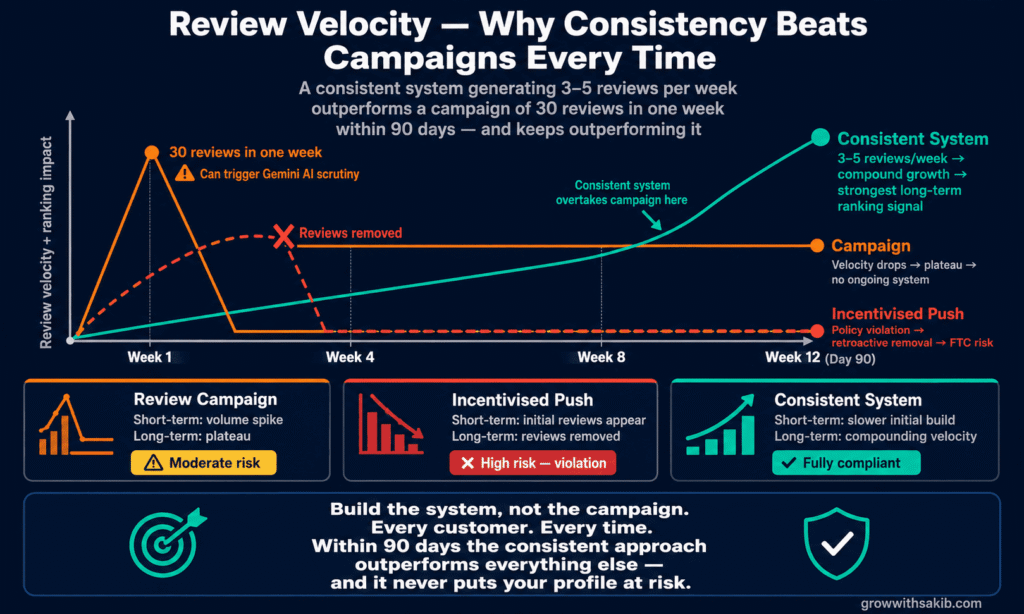
Review Velocity — Why Consistency Beats Volume
Volume matters. But velocity — how consistently you receive new reviews — matters more for ranking maintenance.
Google’s local algorithm weights recent reviews more heavily than historical ones — just as it weighs NAP consistency signals across citations. Research consistently shows that more than two-thirds of consumers say reviews from the past three months are highly or moderately important in their decision-making, while only 39% consider reviews older than a year. Google mirrors consumer behaviour — fresh reviews signal an active, current business.
What this means practically: a review campaign — a burst of 30 reviews in one week — will produce a short-term local search ranking lift followed by a plateau. A consistent system that generates 3–5 reviews per week will outperform the campaign within 90 days and continue compounding. Build the system, not the campaign.
| Approach | Short-Term Result | Long-Term Result | Compliance Risk |
| Review campaign (bulk ask to all past customers) | Volume spike — potential short-term ranking improvement | Plateau as velocity drops — no ongoing system | Moderate — volume spike can trigger Gemini AI scrutiny |
| Incentivised push (‘Leave a review, get 10% off’) | Initial volume — reviews may appear | Reviews removed retroactively; potential FTC exposure | High — explicit policy violation |
| Consistent system (every customer, every time) | Slower initial build | Compounding velocity — strongest long-term ranking signal | None — fully compliant |
The Review Mistakes That Cost Businesses Rankings and Reviews
| Mistake | What Happens | The Fix |
| Offering incentives — discounts, prize draws, loyalty points | Reviews removed; FTC civil penalty risk post-October 2024; profile may be restricted | Ask for honest feedback with no conditions attached — ever |
| Using an in-store tablet or kiosk for reviews | Google’s Gemini flags GPS/IP as business premises; reviews removed in real time | Give customers the link; let them use their own device in their own time |
| Review gating — routing happy customers to Google, unhappy ones to internal form | Profile with artificially skewed rating — enforcement removes reviews; no recovery | Send the same ask to every customer regardless of expected sentiment |
| Asking customers to mention staff by name | New April 2026 violation — constitutes directing specific review content | Ask for honest feedback about their experience; let them choose what to mention |
| Setting staff review quotas | New April 2026 violation — review contest programs are now prohibited | Build a process; never tie staff performance or incentives to review count |
| Ignoring negative reviews | Signals indifference; potential customers read this as poor customer care | Respond to every review within 24 hours — negative ones especially |
| Not following up after the initial ask | 30–50% of eventual reviews come from a single follow-up — left on the table | Send one follow-up 5–7 days after the first ask; never more than one |
| Asking too long after the experience | Satisfaction decays rapidly; conversion rate drops significantly after 1 week | Build the ask into your completion process — send within 24–48 hours |
KEY TAKEAWAYS
- Ask every customer — not just happy ones. Review gating (pre-screening before sending a Google link) is a prohibited practice under Google’s policy and is now actively detected by Gemini AI moderation — and sits alongside NAP consistency as one of the most commonly overlooked local SEO compliance issues.
- The fastest way to get more Google reviews is a direct one-click link from your GBP dashboard, sent via text or WhatsApp within 24–48 hours of service completion. This channel converts at 7–8x the rate of email.
- Review velocity matters more than volume for ranking maintenance. A consistent 3–5 reviews per week outperforms a campaign of 30 reviews in one week within 90 days — and keeps outperforming it.
- Never offer incentives for reviews — no discounts, gifts, prize draws, or loyalty points. This is a policy violation, and post-October 2024 FTC enforcement makes it a potential civil penalty for US businesses.
- April 2026 brought three new prohibited practices: in-store kiosks and tablets, asking customers to mention staff by name, and setting staff review quotas. Stop any of these immediately.
- Respond to every review within 24 hours — especially negative ones. Google tracks response rate as a ranking signal, and Harvard Business Review data shows businesses that respond see 35% higher conversion.
- Use honest language in your request: ‘We’d appreciate your honest feedback.’ Never ask for a specific star rating or specific content. This is now an explicit policy violation.
One follow-up is compliant and captures 30–50% of eventual reviewers who forgot the first ask. More than one follow-up crosses into pressure and risks being marked as spam.
Frequently Asked Questions
Q1: How many Google reviews does a small business need to rank in the local 3-pack?
There is no fixed threshold. Review count is one of several ranking factors — volume, recency, and diversity all matter. In practice, businesses with 50+ genuine reviews and a 4.5+ average star rating see 20–30% higher click-through rates in local search. More important than hitting a specific number is maintaining consistent review velocity: new reviews every week signal an active business to Google’s ranking algorithm.
Q2: Can I ask customers for Google reviews?
Yes — Google explicitly permits asking customers for reviews. What Google prohibits is asking selectively (only happy customers), asking for specific content (a 5-star rating or mentioning a staff member by name), offering incentives (discounts, gifts, prize draws), and using shared devices or kiosks. Ask every customer, use neutral language requesting honest feedback, and send a direct link — that is fully compliant.
Q3: What is review gating and why is it prohibited?
Review gating is the practice of pre-screening customers — asking how their experience went before sending a review link, then routing satisfied customers to Google and dissatisfied ones to an internal feedback form. Google prohibits it because it produces an artificially inflated rating that does not reflect real customer experience. Compliant collection means every customer receives the same review request, regardless of expected satisfaction level.
Q4: Does responding to Google reviews improve rankings?
Google’s official documentation confirms that responding to reviews demonstrates value for customer feedback and is a signal of active profile management. A Harvard Business Review study found businesses that respond to reviews see 35% higher conversion than those that do not. Respond to every review — positive and negative — within 24 hours.
Q5: What happens if I get a fake negative review from a competitor?
Report the review through Google Maps using the flag/report option. Include specific reasons why the review is fake: the reviewer was never a customer, the details described do not match any real transaction, or the review appears coordinated with others. Document your case with any supporting evidence. Google does investigate and remove reviews that violate its policies, though the process can take time. Do not respond to fake reviews in a way that appears to confirm any details.
Q6: Can I ask customers to update or remove a negative review?
You can ask a customer to update their review if you have genuinely resolved their issue — but only through private communication, not in your public response. You cannot offer any incentive (refund, discount, free service) in exchange for revising or removing a review. Google explicitly prohibits this under its April 2026 policy update. The FTC’s 2024 rule also makes incentivised review revision a potential civil penalty in the US.
Q7: Why are my Google reviews disappearing?
Google’s Gemini-powered moderation (introduced April 2026) removes reviews that trigger its detection signals: reviews submitted from inside your business premises (flagged via GPS and IP), reviews from brand-new Google accounts, reviews using similar phrasing to other recent reviews (linguistic clustering), and volume spikes inconsistent with normal customer flow. If reviews are disappearing, audit your collection process against the current prohibited practices list and eliminate any non-compliant methods.
Q8: Is it legal to buy Google reviews?
No — on multiple levels. Google’s policy prohibits fake or incentivised reviews. The FTC’s Rule on Fake Reviews and Testimonials (October 2024) makes buying or posting fake reviews subject to civil penalties for US businesses. Google’s Gemini AI moderation actively detects purchased reviews through linguistic pattern analysis, account history, and timing signals. Beyond the risk of removal, businesses caught buying reviews face potential profile suspension. The risk is entirely disproportionate to any short-term gain.