I have audited local business profiles for years. The pattern repeats almost every time. A business has decent content, a reasonable number of reviews, a claimed Google Business Profile — and still cannot crack the local 3-pack. Then you check their citations. One directory has the wrong phone number. Three have a trading name instead of the registered company name. The old address is still live on Yelp.
None of these look serious in isolation. Together, they create a business that Google cannot confidently identify — and Google does not rank businesses it cannot trust.
This guide covers everything you need to understand NAP consistency deeply, audit it efficiently, and fix it in a way that actually moves your local rankings.
What Does NAP Actually Mean — and Why Does Google Care?
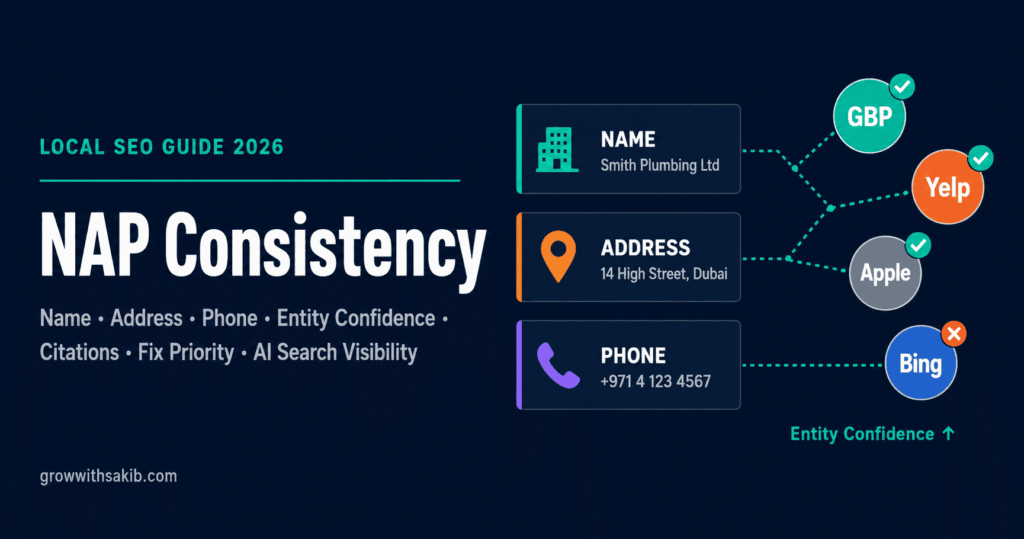
NAP stands for Name, Address, Phone number. These are the three core data points that search engines use to verify your business is real, that it operates at the location you claim, and that it serves the area you say it does.
Google cross-checks your NAP data across dozens of sources simultaneously — your Google Business Profile, your website footer, your social media profiles, Yelp, Apple Maps, Bing Places, and dozens of industry directories. When the data matches, Google gains confidence. When it conflicts, Google interprets the discrepancy as uncertainty — and responds by ranking you lower or not ranking you at all.
Think of it as identity verification. A person trying to open a bank account whose name is spelled differently on three forms of ID faces problems — not because the differences are large, but because the system cannot confidently confirm who they are. NAP works the same way. Google needs corroboration.
The Moz Local Search Ranking Factors survey — the most referenced study in local SEO — consistently identifies citation signals as a top-five factor influencing local pack rankings. According to Whitespark’s Local Search Ranking Factors 2025, consistent citations remain in the top five ranking signals, with the strongest effect felt by newer and lower-authority businesses.
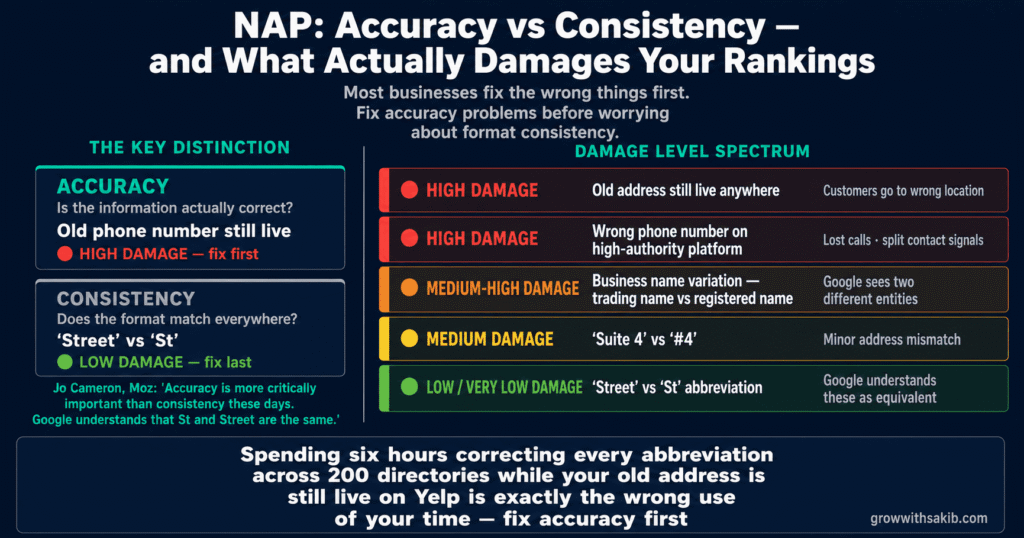
Accuracy vs Consistency — The Distinction Most Guides Miss
Most NAP guides treat accuracy and consistency as the same thing. They are not — and understanding the difference prevents wasted effort.
| Concept | What It Means | What It Affects |
| Accuracy | Your NAP reflects genuinely correct, current information — the right number, the right address, the right legal name | Critical — incorrect information sends customers to the wrong place and costs calls |
| Consistency | Your NAP appears in an identical format across all platforms | Important — but minor formatting variations (‘St’ vs ‘Street’) rarely cause ranking damage |
Jo Cameron from Moz put it clearly: “Accuracy is more critically important than consistency these days. Google (and humans) understand, for the most part, that ‘St’ and ‘Street’ are the same. Accuracy is the key.”
What this means practically: an old phone number is a crisis. ‘Avenue’ vs ‘Ave’ is not. Spending six hours correcting every abbreviation across 200 directories while your old address is still live on Yelp is exactly the wrong use of your time. Fix accuracy first. Then worry about format consistency.
How Google Actually Uses Your NAP Data
Google does not simply read your Google Business Profile and trust it. It runs a verification process — cross-referencing your GBP data against dozens of third-party sources to confirm that the business it sees at one location is the same business it sees referenced elsewhere.
This process involves what Google refers to as entity confidence — its level of certainty that multiple mentions across the web all refer to the same real-world business. The higher your entity confidence score, the more likely Google is to rank your profile — which is why this sits at the core of any effective SEO for small business strategy.
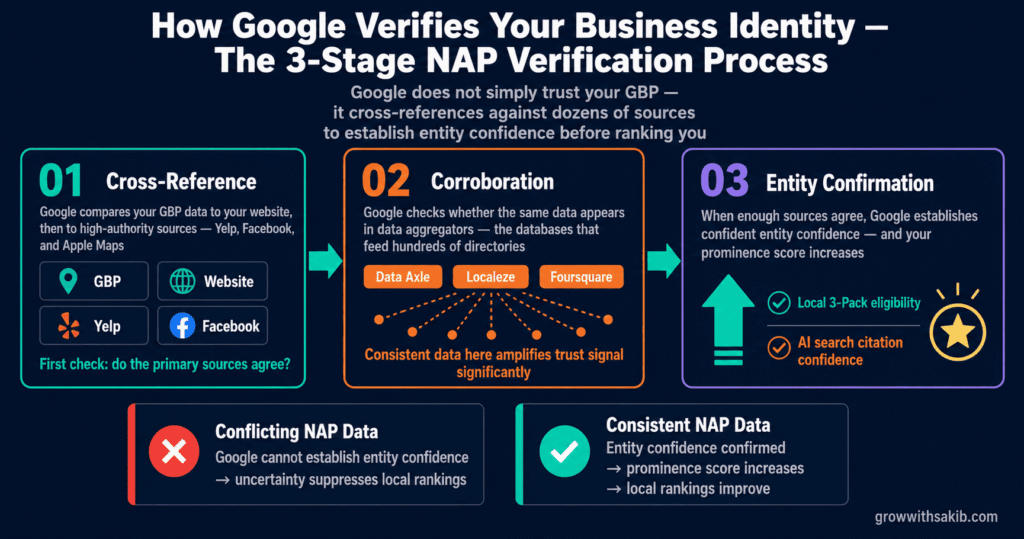
The three-stage verification process:
- Stage 1 — Cross-reference: Google compares your GBP data to your website, then to high-authority sources like Yelp, Facebook, and Apple Maps.
- Stage 2 — Corroboration: Google checks whether the same data appears in data aggregators (the databases that feed hundreds of directories). Consistent data here significantly amplifies your trust signal.
- Stage 3 — Entity confirmation: When enough sources agree, Google establishes confident entity confidence — and your prominence score increases.
According to research on NAP consistency and Google Business Profile rankings, when matching signals appear across platforms, Google reduces uncertainty and is more likely to display your business in local results. The inverse is also true — conflicting signals actively suppress ranking confidence, even when other signals like reviews and content are strong.
NAP Consistency in the Age of AI Search — The 2026 Dimension
In 2026, NAP consistency matters beyond traditional Google local rankings. ChatGPT, Gemini, Perplexity, and other AI-driven discovery platforms now pull business information from a wide range of sources — a shift covered in depth in the complete guide to generative engine optimization. When a user asks “Who is the best accountant near me?” or “What are the opening hours of [business name]?” — AI systems need to confidently identify your business, its location, and its contact details. If your data conflicts across the web, AI systems may express lower confidence or present incorrect information.
The Most Common NAP Inconsistencies (and How They Happen)
Most NAP inconsistencies are not intentional errors. They accumulate over time through predictable patterns — and they consistently suppress visibility in local SEO for small business. Understanding how they happen is the first step to preventing them.
| Inconsistency Type | How It Happens | Damage Level |
| Old address still live | Business moved but did not update all directories. Old address persists on aggregators for months. | 🔴 High — customers go to wrong location, signals conflict |
| Old phone number | Changed number without updating citations. Call tracking number used site-wide. | 🔴 High — lost calls, split contact signals |
| Trading name vs registered name | GBP uses registered name; some directories use trading name. Franchise or DBA situations. | 🟠 Medium-High — Google sees two different entities |
| Keyword stuffing in business name | “Smith Plumbing — Emergency Plumber Dubai” on some directories but clean name on GBP. | 🟠 Medium — guideline violation risk; inconsistency |
| Missing suite or unit number | Added to GBP but not to older directory listings. | 🟡 Medium — address mismatch |
| Inconsistent phone number format | +971 vs 00971 vs 04-xxx on different platforms. | 🟢 Low — Google resolves these; minor signal noise |
| ‘St’ vs ‘Street’ abbreviation | Auto-populated from different data sources using different conventions. | 🟢 Low — Google understands these as equivalent |
The Tracking Number Trap
Call tracking numbers are a common source of NAP inconsistency for businesses running marketing campaigns. A tracking number routes callers through a different number before reaching your main line — which is useful for measuring which campaign drove the call, but damaging if that tracking number appears on your GBP, website footer, or directory listings instead of your real local number.
The correct setup: use your real local number on GBP, your website footer, all directory listings, and every citation. Use tracking numbers only in paid ad destination numbers and landing pages — never as your main published contact.
How to Audit Your NAP Consistency — Step by Step
An NAP audit has one goal: produce a complete picture of everywhere your business appears online, and identify every instance where the data does not match your master NAP record.
Step 1: Create Your Master NAP Record
Before you audit anything, establish the authoritative version of your business information. Every subsequent fix will use this document as the reference.
| Field | Your Official Entry |
| Business name (exact legal name) | |
| Address line 1 | |
| Address line 2 (suite, unit, floor) | |
| City | |
| Country / State / Emirate | |
| Postcode / ZIP | |
| Primary phone number (with country code) | |
| Website URL (include https://) | |
| Primary business category | |
| Business hours (for each day) | |
| Secondary phone (if any) |
Save this document. Copy and paste from it every time you update a citation — never type it from memory.
Step 2: Run an Automated Citation Audit
Manual checks can only cover a fraction of the web. Use automated tools to scan comprehensively:
- BrightLocal’s Citation Audit — Scans 50+ directories simultaneously and produces a consistency report with specific discrepancies flagged.
- Moz Local — Checks your NAP across all major data aggregators and high-authority directories.
- Whitespark Citation Finder — Strong for identifying which directories your competitors are listed on that you are not.
- Yext — Enterprise-level automated listing management. Powerful for multi-location businesses.
For a UAE-based business, also manually check: Google Business Profile, Apple Maps, Bing Places, Yelp, Facebook Business, LinkedIn, Yellow Pages UAE, Dubai Chamber directory, Gulf Business Directory, Bayut (if property-related), and any UAE trade association directory relevant to your sector — as these local directories also function as valuable local citation links.
Step 3: Manual Checks for Platforms Tools Miss
- Google search your exact business name in quotes: Review the first three pages of results. Check every mention of your business name for correct address and phone.
- Search your old phone number: If you have ever changed your number, search it — old directories often retain the previous number for months or years.
- Search your old address: If you have ever moved premises, search the old address alongside your business name to find listings that have not been updated.
- Check aggregators directly: Data Axle (infoUSA), Localeze, and Foursquare are the primary aggregators for the US/UK. In the UAE, check Kompass ME and similar regional business databases.
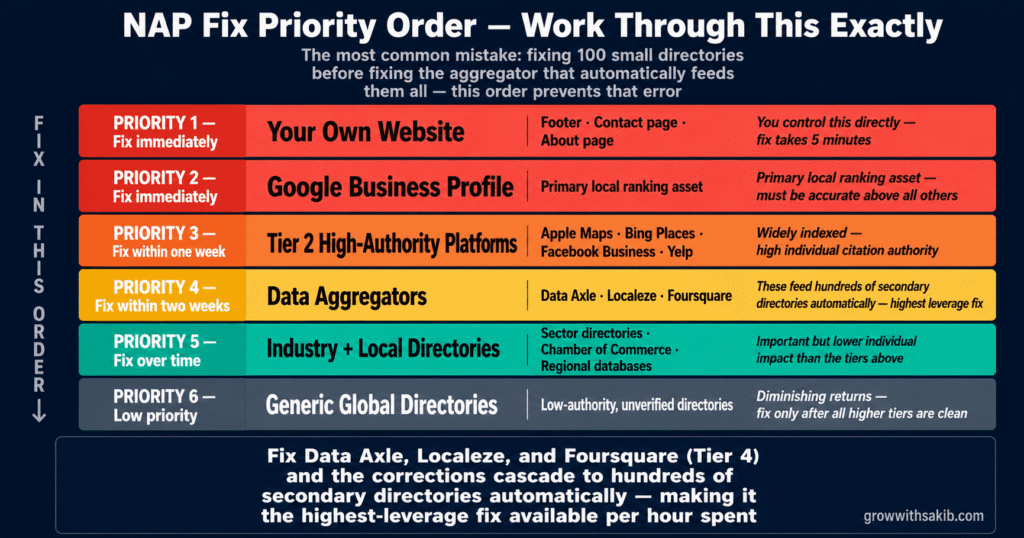
Step 4: Build a Fix Priority List
Not all inconsistencies are worth equal effort. Fix in this order:
| Priority | Platform Type | Why This Order |
| 1 — Fix immediately | Your own website (footer, contact page, about page) | You control this directly — fix takes 5 minutes |
| 2 — Fix immediately | Google Business Profile | Primary local ranking asset — must be accurate |
| 3 — Fix within one week | Apple Maps, Bing Places, Facebook Business, Yelp | Tier 2 high-authority platforms — widely indexed |
| 4 — Fix within two weeks | Data aggregators (Data Axle, Localeze, Foursquare) | These feed hundreds of secondary directories automatically |
| 5 — Fix over time | Industry-specific directories and local business directories | Important but lower individual impact than the above |
| 6 — Low priority | Generic global directories with low authority | Diminishing returns — fix only after high-priority sources are clean |
How to Fix NAP Inconsistencies — The Right Process
Once your audit is complete and your priority list is built, work through fixes systematically. Each platform has its own update process — but the approach is the same.
- Log in with the account that owns the listing: If you do not have login credentials, use the platform’s ‘Claim this business’ process. Never try to create a duplicate listing — always claim the existing one.
- Update fields directly from your master NAP document: Copy and paste. Do not type from memory.
- Request removal of duplicate listings: If you find multiple listings for the same business on the same platform, use the platform’s reporting tool to request the duplicate be removed or merged. On GBP, this is done through the ‘Suggest an edit’ process.
- Submit to aggregators directly: Correcting the data at the aggregator level (Data Axle, Localeze) propagates the change to hundreds of directories automatically — more efficient than updating each one individually.
- Verify the update went live: Return 48–72 hours after submitting any change to confirm it appears correctly. Some platforms have moderation queues.
- Document what you fixed: Add a column to your audit spreadsheet tracking the fix date and status for each platform. This becomes your ongoing maintenance reference.
Real-World Example: How NAP Inconsistency Cost a Business Four Months of Visibility
Ongoing NAP Maintenance — How to Stay Consistent Without Constant Manual Work
NAP consistency is not a one-time project. Business information changes. Aggregators auto-populate incorrect data. Third parties suggest edits to your GBP. Building a maintenance routine prevents the gradual drift that most businesses experience — and fits naturally into a broader local SEO strategy.
| Frequency | What to Check | Tool / Method |
| Monthly | Google Business Profile — check for unauthorised suggested edits | GBP dashboard — check ‘Manage’ for pending edits |
| Monthly | Top 5 high-priority directories (Yelp, Apple Maps, Facebook, Bing, Yell) | Manual check of each platform |
| Quarterly | Full citation sweep — run automated audit | BrightLocal or Moz Local report |
| Quarterly | Check Google Search Console for NAP-related search queries | Search Console — filter by business name + old address |
| On any business change | Update master NAP document first, then all platforms systematically | Update GBP and website first within 24 hours of any change |
| Immediately after a move | Correct aggregators before high-priority directories | Data Axle / Localeze — changes propagate automatically |
Common NAP Mistakes That Cost Local Rankings
| Mistake | What It Costs | The Fix |
| Ignoring NAP after a business move | Rankings drop gradually as old address persists — customers call old number or go to wrong location | Update aggregators within 24 hours of moving; correct GBP and website same day |
| Using call tracking numbers site-wide | NAP inconsistency across citations that use real number vs tracking number | Use real local number everywhere; tracking numbers in paid ads only |
| Creating a new GBP listing instead of claiming existing one | Duplicate listings split reviews and create conflicting signals | Always search for existing listing before creating new — claim it if it exists |
| Outsourcing citation building without providing master NAP | Agencies and VAs often use slightly different formats, creating variations | Provide master NAP document; require confirmation before any listing is submitted |
| Ignoring user-suggested edits on GBP | Auto-applied incorrect edits change your address, hours, or phone without notification | Set up GBP email notifications; review ‘Manage’ section monthly |
| Prioritising low-authority directories over aggregators | Fixing 100 small directories before fixing the aggregator that feeds them all | Fix Data Axle, Localeze, and Foursquare first — the rest propagate automatically — for broader off-page authority building, the link building guide covers citation strategy in full. |
KEY TAKEAWAYS
- NAP consistency means your Name, Address, and Phone number are identical everywhere online — and it is a top-five local ranking signal according to Moz’s annual Local Search Ranking Factors survey.
- Accuracy matters more than perfect formatting consistency. An old phone number or previous address causes far more ranking damage than ‘Street’ vs ‘St’. Fix the substance before the style.
- Google cross-references your NAP across dozens of sources to establish entity confidence. Conflicting data creates uncertainty — and uncertainty suppresses local rankings.
- Fix aggregators first (Data Axle, Localeze, Foursquare). They feed hundreds of secondary directories automatically. Correcting them at the source is dramatically more efficient than updating each directory individually.
- Call tracking numbers belong in paid ads only — never on your GBP, website footer, or directory listings. Tracking numbers create NAP inconsistency across any citation that uses your real number.
- In 2026, NAP consistency also affects AI search visibility. ChatGPT, Gemini, and Perplexity rely on consistent business identity signals to confidently surface your business in local AI recommendations.
- Businesses that move premises and do not immediately update their aggregators are the most common NAP disaster cases. Update GBP and your website the day you move; update aggregators within the week.
- Build a quarterly audit into your routine using BrightLocal or Moz Local. Monitor your GBP monthly for unauthorised suggested edits. Consistency is maintained through systems, not memory.
Frequently Asked Questions
Q1: What exactly is NAP consistency in local SEO?
NAP consistency means your business Name, Address, and Phone number are identical across every online platform where your business appears — including your Google Business Profile, website, Yelp, Apple Maps, Bing Places, Facebook, and all directory listings. Consistent data helps Google confidently identify your business and rank it in local results. Inconsistent data creates uncertainty that suppresses local visibility.
Q2: Does every minor variation in NAP hurt my rankings?
No. Minor formatting differences like ‘St’ vs ‘Street’ or ‘00971’ vs ‘+971’ rarely cause meaningful ranking damage — Google understands these as equivalent. What genuinely hurts rankings is accuracy problems: an old phone number, a previous address still live on directories, or a business name that varies significantly across platforms. Fix accuracy first; perfect formatting consistency is secondary.
Q3: How do I find all the places my business is listed online?
Start with an automated audit tool — BrightLocal and Moz Local both scan 50+ directories and produce consistency reports. Then manually search your business name in quotes on Google, check your old phone number and old address, and review high-authority platforms like Yelp, Apple Maps, and Facebook Business directly.
Q4: What is the fastest way to fix NAP inconsistencies?
Fix aggregators first — Data Axle, Localeze, and Foursquare. These feed hundreds of secondary directories automatically, so correcting the source propagates changes broadly. Simultaneously update your website and GBP, then work through your Tier 2 platforms (Yelp, Apple Maps, Facebook, Bing Places). This order produces the most improvement per hour of effort.
Q5: Can call tracking numbers hurt my NAP consistency?
Yes — if they appear on your GBP, website footer, or directory listings. Call tracking numbers differ from your real local number, creating NAP inconsistency across any citation that uses your real number. Use your real local number everywhere it is publicly published. Reserve call tracking numbers for paid ad destination URLs and landing pages only, where they serve their measurement purpose without polluting your citation data.
Q6: How does NAP consistency affect AI search in 2026?
AI search platforms including ChatGPT, Gemini, and Perplexity pull local business information from multiple web sources when answering local queries. Inconsistent NAP data reduces their confidence in your business identity and can result in incorrect information being surfaced or your business being passed over in AI-generated local recommendations. Consistent NAP contributes to what AI systems treat as entity confidence — a key signal for citation eligibility.
Q7: How often should I audit my NAP consistency?
Run a full automated audit quarterly using a tool like BrightLocal or Moz Local. Check your Google Business Profile monthly for unauthorised suggested edits — Google sometimes auto-applies third-party edits that change your address or phone number without notification. Any time your business information changes (new address, new phone, rebranding), update your master NAP document first and then update GBP and your website within 24 hours.
Q8: Does NAP consistency matter for businesses without a physical address?
Yes. Service-area businesses — plumbers, consultants, cleaners, anyone who goes to the customer — can hide their address on GBP but still need consistent NAP signals. Use a consistent service area description across all platforms. Your phone number and business name must still match everywhere. The absence of a public address reduces one dimension of NAP, but consistency across the remaining signals still influences local ranking.