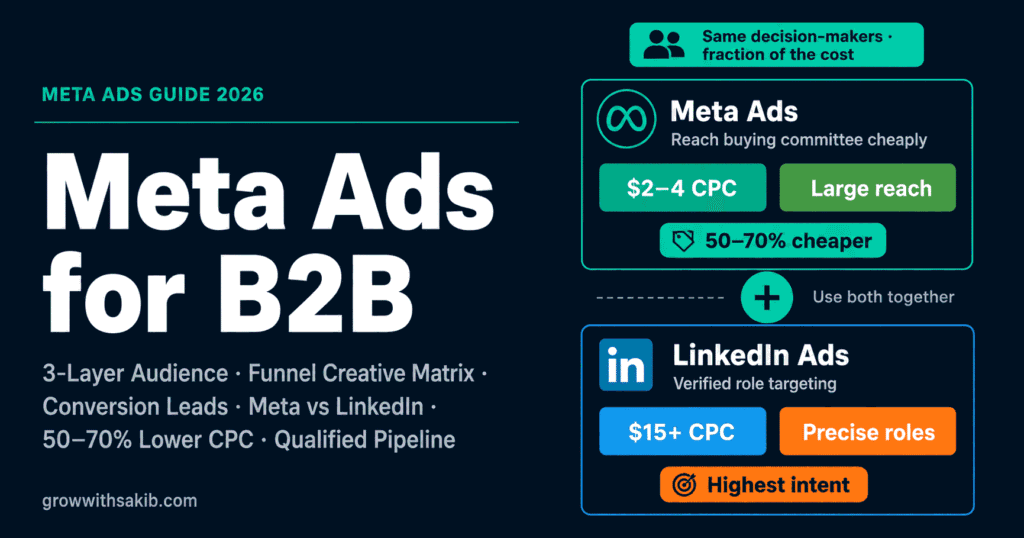
The biggest myth in B2B marketing is that your decision-makers are not on Facebook and Instagram. They are. The same CFO who ignores your LinkedIn InMail scrolls Instagram on the sofa at 9pm. The difference is mindset, not presence — they are on Meta in personal mode, not work mode.
The real B2B challenge on Meta is the opposite of the B2C challenge. In B2C you have a huge audience and need to find the buyers. In B2B you have a tiny audience — sometimes a few thousand companies in the entire world that fit your profile — and the old approach of narrowing your targeting settings to find them no longer works the way it did.
This guide is built around that constraint — and sits within the complete Meta Ads framework covering the full campaign architecture these B2B tactics build on.
Why B2B Targeting on Meta Has Fundamentally Changed
If your B2B Meta strategy is built on stacking job-title and industry interests to narrow your audience, you are running a 2021 playbook in a 2026 platform. The mechanics of how Meta finds your buyers have changed, and the change is especially consequential for B2B.
Creative is now your primary targeting mechanism
The single most important shift: with Advantage+ Audience and the Andromeda algorithm, creative has become the primary way you target. As Conversios’s 2026 targeting analysis puts it plainly, creative is now your primary targeting mechanism. The algorithm reads who engages with and converts on your ad, then finds more people like them — which means the ad itself does the targeting work that interest settings used to do, following the same logic explained in the Meta ads learning phase guide.
For B2B this is profound. A piece of creative that says ‘For warehouse operations managers running 3+ distribution centres’ will be ignored by everyone except warehouse operations managers running multiple distribution centres. The creative qualifies the audience. You do not need a perfect job-title filter when your hook does the filtering.
Narrow targeting now hurts more than it helps
Over-segmenting collapses delivery. As Stackmatix’s B2B targeting guide advises, the minimum viable audience for B2B lead gen should sit between 200,000 and 500,000 people — oversegmenting below that collapses delivery and inflates CPMs. Very narrow audiences under 10,000 people struggle to deliver at all and pay punishing CPMs for the privilege.
This feels counterintuitive for B2B, where precision is the instinct. But the algorithm now optimises better with a larger pool to learn from, using your conversion data and creative signals to find the right buyers within a broad audience — rather than you trying to pre-define them with settings.
B2B Audience Architecture: How to Reach a Tiny Market
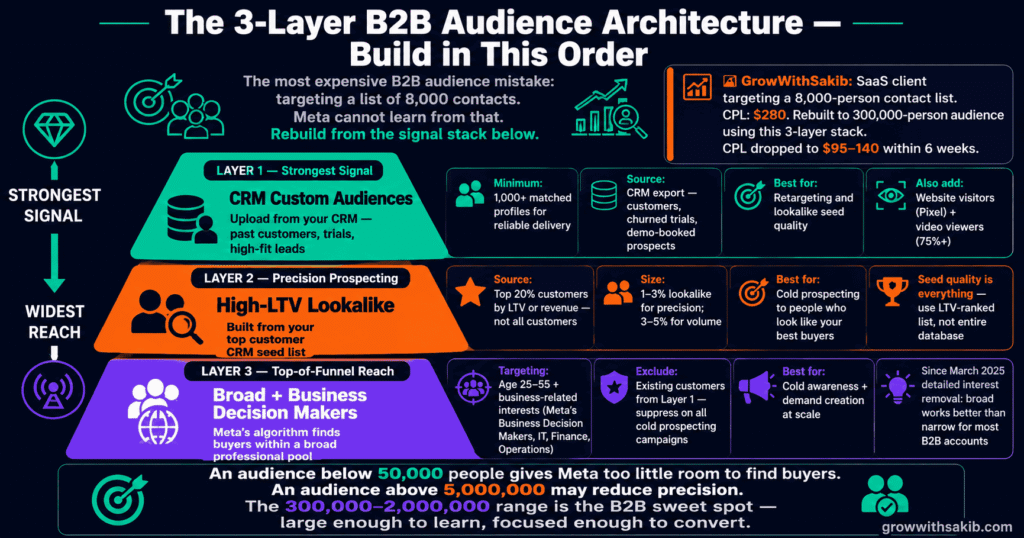
Reaching a small B2B market on Meta is a layered exercise. No single audience does the job. The architecture combines your own data, lookalikes built from it, and broad delivery guided by creative.
Layer 1: CRM custom audiences (your strongest signal)
Your CRM data is your most reliable B2B signal on Meta. As Stackmatix documents, uploading your customer list, target-account list, or churned-customer file as a custom audience lets Meta match them to active profiles — typically at a 50-70% match rate for business email addresses. Meta requires a minimum of 100 matched profiles to activate a custom audience, and 1,000+ for reliable performance — the full setup process is in the Meta Business Manager guide.
- Target-account lists: upload your ABM target accounts and the named contacts within them. This is as close to account-based targeting as Meta gets.
- Closed-won customers: your best lookalike seed (covered next) and a strong exclusion list to avoid advertising to existing customers.
- Churned customers: a re-engagement audience with tailored win-back messaging.
Layer 2: High-LTV lookalike audiences
The lookalike audience is the most effective tool for scaling B2B reach beyond your own data. But the seed matters more than anything. As HT&T Consulting’s B2B guide stresses, the ideal seed is not your full customer list — it is your highest-LTV customers or the leads that actually became customers. Seed quality determines audience quality. A lookalike built from 1,000 closed-won accounts will dramatically outperform one built from 10,000 raw leads of mixed quality.
You need 1,000+ matched profiles to build a reliable 1% lookalike. A list of 500-1,000 closed-won accounts usually generates enough matches to work with. Start at 1% for precision, then test 3% and 5% as you scale.
Layer 3: Broad with the Business Decision Makers segment
For prospecting beyond your data, the detailed targeting ‘Business Decision Makers’ behavioural segment is one of the most underused tools in B2B. As Stackmatix notes, it is broad and self-reported, but combined with one industry or job-title layer it removes a large chunk of non-business users while keeping the audience large enough to deliver. This is the pool where creative-as-targeting does the heavy lifting.
| Audience Layer | Source | Best Use | Minimum Size |
|---|---|---|---|
| CRM custom audience | Your customer / target-account lists | ABM, retargeting, exclusions | 100 matched (1,000+ ideal) |
| High-LTV lookalike | 1% LAL from closed-won customers | Prospecting with precision | 1,000+ matched seed |
| Broad + Business Decision Makers | Detailed targeting behavioural segment | Top-of-funnel prospecting | 200k-500k audience |
| Retargeting | Site visitors, video viewers, lead-form openers | Nurturing the long cycle | Builds over time |
B2B Creative: The Ad That Qualifies Its Own Audience
Since creative is now your primary targeting mechanism, B2B creative has one job above all others: make the right buyer self-identify and everyone else scroll past. This is the opposite of B2C creative, which tries to appeal broadly.
Call out the buyer explicitly
The most effective B2B hook names the buyer and their specific problem in the first line. ‘If you run RevOps for a Series B SaaS company…’ or ‘Procurement managers in manufacturing: this is for you.’ This does two things — it stops the right person scrolling, and it signals to the algorithm exactly who converts, sharpening its targeting over time. Sharpen your buyer language by running competitor analysis to see how rivals frame the same role and problem.
This connects directly to effective ad copy principles — specificity outperforms breadth. In B2B the specificity is doing double duty: persuasion and targeting at once.
Lead with the business outcome, not the feature
B2B buyers care about business outcomes their boss will notice — time saved, cost reduced, risk avoided, revenue gained. The creative should lead with the outcome, quantified where possible, and leave the feature detail for the landing page or the sales call. ‘Cut your month-end close from 10 days to 3’ beats ‘automated reconciliation software.’
Use UGC and founder-led content
B2B does not have to mean corporate. As covered in our guide to UGC ads on Meta, authentic creator and founder-led content outperforms polished corporate video even in B2B — because it bypasses ad-skepticism and feels like a peer sharing insight rather than a company selling. A founder talking to camera about the problem they built their product to solve is one of the highest-performing B2B formats in 2026.
Match format to funnel stage
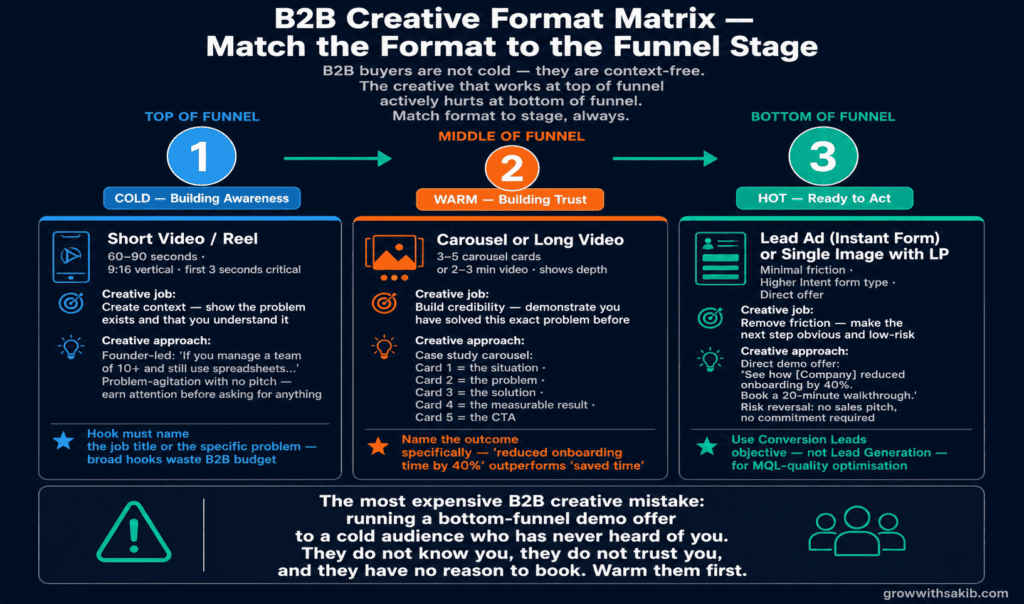
| Funnel Stage | Format | Creative Job |
|---|---|---|
| Top (cold) | Short video, founder-led, thought leadership | Stop the right buyer; introduce the problem |
| Middle (engaged) | Carousel, case study, comparison | Build credibility; address objections |
| Bottom (in-market) | Lead ad, demo offer, direct CTA | Convert intent into a booked conversation |
Generating Qualified Leads, Not Just Cheap Ones
The fastest way to make B2B Meta ads look like a failure is to optimise for cheap leads. Meta will happily deliver a flood of low-cost form fills from people who will never buy. The entire game in B2B is lead quality, not lead volume.
Use Higher Intent lead forms with qualifying questions
As covered in depth in our Meta Lead Ads guide, B2B campaigns should use Higher Intent Instant Forms — which add a confirmation step — rather than More Volume forms. Add qualifying questions that require deliberate answers: company size, role, budget range, or timeline. A question like ‘How many employees does your company have?’ with a disqualifying low-end option filters out leads below your threshold before they ever reach your sales team.
Optimise for Conversion Leads, not Leads
The most impactful quality lever is switching your optimisation goal from Leads to Conversion Leads, which feeds qualified-lead status back to Meta from your CRM via the Conversions API. This tells the algorithm to find people who become qualified leads downstream, not just people who fill in forms. For B2B, where the gap between a form-fill and a qualified opportunity is enormous, this is the difference between a campaign that generates pipeline and one that generates noise.
Pre-qualify with the ad and the offer
Your offer is a quality filter. A free 30-minute strategy call attracts a different (higher-intent) lead than a downloadable checklist. If you want sales-ready leads, your offer should require enough commitment that only genuinely interested buyers convert. If you want top-of-funnel volume to nurture, a lower-commitment content offer is appropriate — but do not confuse the two or measure them the same way.
Building a Funnel for the Long B2B Sales Cycle
B2B purchases are not made on the first ad impression. A 60-to-180-day sales cycle with a multi-person buying committee needs a full-funnel architecture that nurtures across months, not a single conversion campaign.
The three-stage B2B funnel
- Top of funnel — awareness and problem framing. Broad prospecting with thought-leadership and founder-led content. The goal is not a lead yet; it is to enter the consideration set and build a retargeting pool. Optimise for video views and engagement, then retarget the engaged.
- Middle of funnel — nurture and credibility. Retarget engagers with case studies, comparison content, and social proof. As Involve Digital’s funnel framework describes, this stage turns cold engagement into qualified intent through repeated, value-led touchpoints across the consideration window.
- Bottom of funnel — conversion. Retarget warm audiences who visited pricing or product pages with direct-response lead ads and demo offers. This is where you ask for the conversation, because the audience now knows who you are.
Retargeting is non-negotiable for B2B
In B2C you can convert cold. In B2B, expecting a decision-maker to book a demo from a single cold ad is unrealistic. The retargeting sequence is where B2B Meta campaigns actually generate pipeline. Build retargeting audiences from website visitors, video viewers (50%+), and lead-form openers who did not submit, and serve them a deliberate sequence of credibility-building content over the consideration window.
Measuring B2B Meta Ads When the Sales Cycle Is Months Long
Platform attribution breaks down completely for B2B. A conversion window of 7 days is meaningless when your sales cycle is 120 days. Measuring B2B Meta ads requires looking beyond the dashboard.
Why platform attribution fails for B2B
Meta’s attribution windows max out far short of a B2B sales cycle. As covered in our Meta Ads attribution guide, the platform credits conversions within a 7-day click window by default. A B2B deal that closes four months after the first touch will never be attributed to the Meta ad that started it. The dashboard will show your campaign generated leads but appear to generate little revenue, because the revenue lands long after the attribution window has closed.
The three measurement methods that actually work for B2B
- Self-reported attribution. Add a ‘How did you hear about us?’ field to your forms and sales qualification calls. As Stackmatix’s B2B measurement guidance notes, this is one of the most reliable B2B signals precisely because platform tracking misses so much of the long, cross-device journey.
- CRM-based matching. Feed lead status back from your CRM to Meta via CAPI, and track which Meta-sourced leads progress to opportunity and closed-won inside your CRM — over the real sales-cycle timeframe, not Meta’s window.
- Blended and pipeline metrics. Track Meta-influenced pipeline and cost per qualified opportunity, not just platform CPL. The honest question is whether total qualified pipeline rises when you increase Meta spend — the same blended logic that governs scaling decisions.
The metric that matters: cost per qualified opportunity
Forget cost per lead as your headline B2B metric. The number that matters is cost per qualified opportunity — the cost to generate a lead that your sales team accepts as a genuine, in-profile prospect worth pursuing. A campaign with a £40 CPL and a 50% qualification rate (£80 per qualified lead) beats a £10 CPL with a 5% qualification rate (£200 per qualified lead) every time, despite looking four times more expensive on the dashboard.
Meta vs LinkedIn for B2B: An Honest Comparison
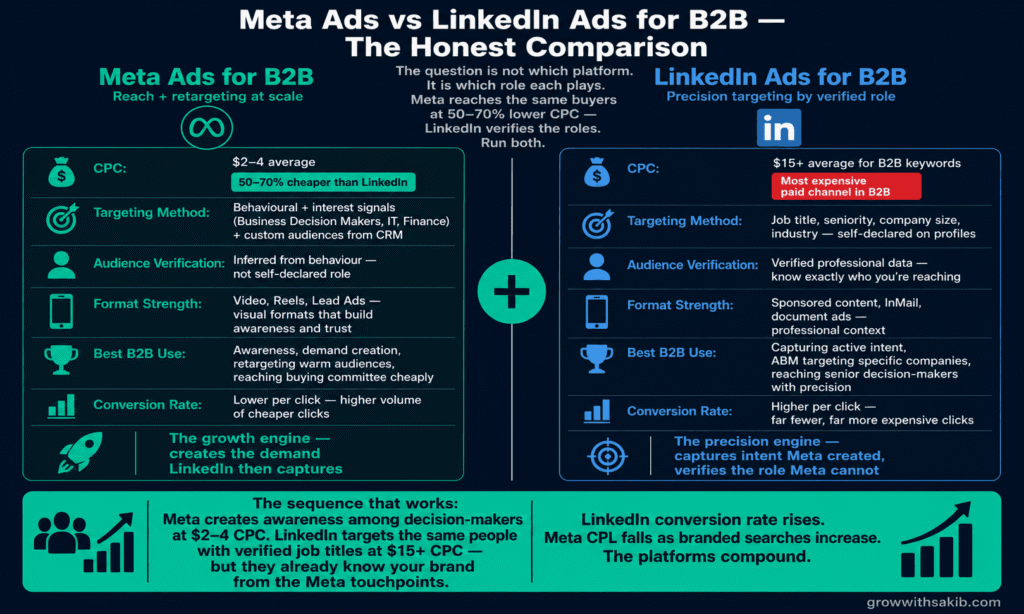
The Meta-versus-LinkedIn question does not have a universal answer. Each platform has genuine strengths, and for many B2B programmes the right answer is both — the Meta Ads Guide covers how the full platform strategy fits together. Here is the honest framework.
| Dimension | Meta | |
| Targeting precision | Self-reported, broad; creative does the qualifying | Verified job function, title, company — most precise |
| Cost per click | 50-70% lower | Highest CPCs of any major platform |
| Audience mindset | Personal / leisure mode | Professional / work mode |
| Best for | Awareness, retargeting, lookalike expansion, volume | Precise targeting of verified roles; ABM |
| Creative tolerance | Native, authentic, UGC wins | More tolerant of professional / corporate |
| Lead cost (B2B SaaS) | £30-100 CPL typical | Often 2-4x higher CPL |
The pragmatic conclusion: if you can only afford one and need verified-role precision for a very high-ACV product, LinkedIn may justify its premium. For most B2B programmes, Meta delivers qualified leads at a fraction of the cost, and the strongest programmes run both — LinkedIn for precise targeting of the highest-value roles, Meta for cost-efficient awareness, retargeting, and reaching the same buyers in a different context. Complement both with SEO for small business to capture the active searchers no paid channel can reach as cheaply. The cost difference means Meta can sustain the frequency that B2B nurture requires without exhausting the budget.
6 B2B Meta Ads Mistakes That Waste Budget
Mistake 1: Targeting an audience that is too small
The instinct to narrow B2B targeting to a few thousand perfect-fit people collapses delivery and inflates CPMs. Keep your audience at 200k-500k minimum and move the precision into the creative. The hook qualifies the buyer better than the targeting settings do in 2026.
Mistake 2: Running B2C campaigns with professional copy pasted in
As Involve Digital identifies, the core reason most B2B Meta campaigns fail is that they are structured like B2C campaigns with professional-services copy dropped in — broad interest targeting, generic creative, CPL-only measurement, and no retargeting logic for long cycles. B2B needs its own architecture, not a B2C campaign in a suit.
Mistake 3: Optimising for cheap leads instead of qualified ones
Meta will deliver a flood of £9 leads that never close if you let it. Optimise for Conversion Leads via CRM feedback, use Higher Intent forms with qualifying questions, and measure cost per qualified opportunity. A higher CPL is often the sign of a healthier B2B campaign.
Mistake 4: Expecting cold conversions in a long-cycle category
Asking a decision-maker to book a demo from a single cold ad ignores how B2B buying works. Build a full-funnel retargeting sequence that nurtures across the 60-180 day consideration window. The pipeline comes from the sequence, not the first impression.
Mistake 5: Judging B2B campaigns on platform attribution
A 7-day attribution window cannot capture a 120-day sales cycle. Judging B2B Meta performance on platform-reported revenue makes profitable campaigns look like failures. Use self-reported attribution, CRM matching, and pipeline metrics measured over the real cycle, as covered in the Meta Ads account audit guide.
Mistake 6: Building lookalikes from low-quality seeds
A lookalike is only as good as its seed. Building one from all your raw leads — including the unqualified ones — teaches Meta to find more unqualified leads. Seed your lookalikes from closed-won, high-LTV customers only. Seed quality is audience quality.
Frequently Asked Questions
Do Meta ads work for B2B lead generation?
Yes. Meta ads generate qualified B2B leads at 50-70% lower cost than LinkedIn or Google Search when set up correctly. As Involve Digital documents, nearly half of business decision-makers use Facebook for B2B research. The challenge is not reach — it is that most B2B campaigns are built like B2C campaigns with professional copy pasted in. Meta works for B2B with account-based audience structure, business-specific creative, lead-quality systems, and long-cycle retargeting.
How do I target decision-makers on Facebook?
Combine three layers: upload your CRM and target-account lists as custom audiences, build lookalike audiences from your highest-LTV closed-won customers, and use broad targeting with the ‘Business Decision Makers’ behavioural segment plus one industry layer. Keep audiences at 200k-500k minimum and let your creative qualify the buyer — in 2026, the ad does more targeting work than the settings.
Is Facebook or LinkedIn better for B2B?
It depends on your priorities. LinkedIn offers the most precise verified-role targeting but at the highest cost. Meta delivers qualified leads at 50-70% lower CPC and excels at awareness, retargeting, and lookalike expansion. As Stackmatix advises, most strong B2B programmes run both — LinkedIn for precise high-value targeting, Meta for cost-efficient frequency across the buying committee.
What is a good cost per lead for B2B on Meta?
Most B2B SaaS campaigns using native lead ads see CPLs of £30-100, per Stackmatix’s B2B benchmarks. But CPL is the wrong headline metric for B2B. Cost per qualified opportunity — the cost of a lead your sales team accepts as in-profile — matters far more. A higher CPL with a high qualification rate beats a low CPL with a low one. Optimise for qualified pipeline, not cheap form fills.
Why are my B2B Facebook leads low quality?
Usually four causes: a More Volume lead form instead of Higher Intent, no qualifying questions, optimising for Leads instead of Conversion Leads, and a low-commitment offer. Switch to a Higher Intent form with qualifying questions, optimise for Conversion Leads via CRM feedback, and use an offer that requires genuine intent (a strategy call rather than a generic download). Expect CPL to rise and qualified-lead rate to improve.
How do I measure B2B Meta ads with a long sales cycle?
Platform attribution fails for B2B because Meta’s 7-day window cannot capture a 120-day cycle. Use three methods instead: self-reported attribution (a ‘How did you hear about us?’ field), CRM-based matching (feed lead status back via CAPI and track Meta-sourced leads to closed-won), and blended pipeline metrics. Measure cost per qualified opportunity over the real sales cycle, not platform CPL.
How big should my B2B audience be on Meta?
Keep prospecting audiences between 200,000 and 500,000 people. As Stackmatix’s targeting guide notes, very narrow audiences under 10,000 struggle to deliver and pay high CPMs, and oversegmenting collapses delivery. In 2026, you reach a small B2B market not by narrowing settings but by running broad with creative specific enough that only your ideal buyer responds.
Key Takeaways
- Decision-makers are on Meta — nearly half use Facebook for B2B research, at 50-70% lower cost than LinkedIn. The problem is never reach; it is running B2C campaigns with professional copy pasted in.
- Creative is now your primary targeting mechanism. Reach a tiny B2B market with broad delivery and creative so specific that only the right buyer responds — not by narrowing targeting settings.
- Keep prospecting audiences at 200k-500k minimum. Oversegmenting below this collapses delivery and inflates CPMs. The hook does the qualifying the narrow settings used to do.
- Seed lookalikes from closed-won, high-LTV customers only. A lookalike built from raw leads teaches Meta to find more raw leads. Seed quality is audience quality.
- Optimise for qualified leads, not cheap ones. Use Higher Intent forms, qualifying questions, and Conversion Leads via CRM. Measure cost per qualified opportunity — a higher CPL is often a healthier B2B campaign.
- B2B needs full-funnel retargeting for the long cycle. Cold conversions are unrealistic for 60-180 day cycles. Pipeline comes from the nurture sequence across the consideration window, not the first impression.
- Platform attribution fails for B2B. A 7-day window cannot capture a 120-day cycle. Use self-reported attribution, CRM matching, and blended pipeline metrics measured over the real sales cycle.
- Run Meta and LinkedIn together for the buying committee. LinkedIn for precise verified-role targeting, Meta for cost-efficient awareness, retargeting, and frequency across the same decision-makers in a different context.