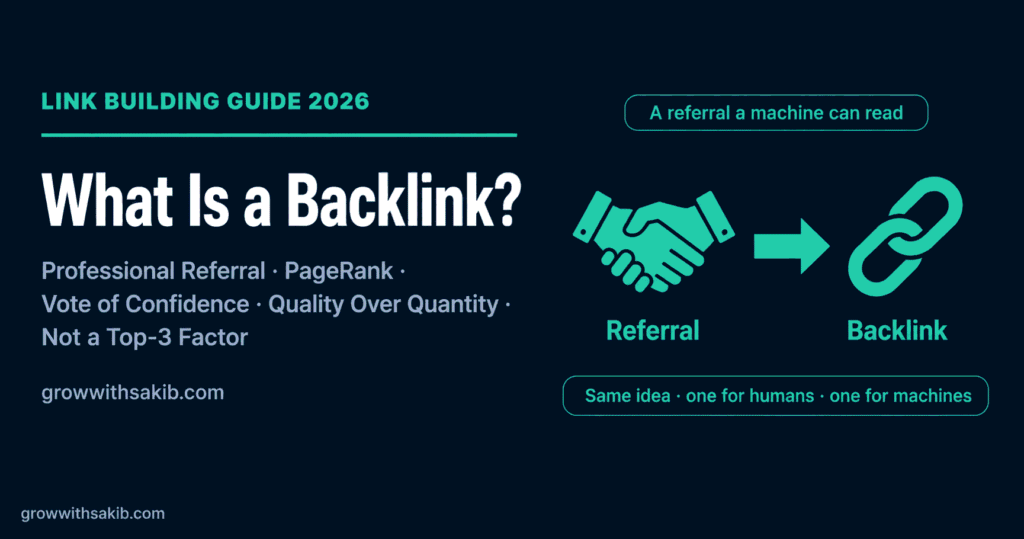
If you’ve started reading about SEO, “backlinks” comes up within minutes – usually wrapped in jargon like link equity, PageRank, and dofollow. Underneath the terminology, though, the idea is simple, and it’s one you already understand from everyday life: a backlink is a recommendation.
This is the entry point to the link building guide for beginners on GrowWithSakib. Start here, get the mental model right, and everything else in link building will make sense – including the parts most guides get wrong.
What Is a Backlink?
A backlink (also called an inbound link or incoming link) is a hyperlink on another website that points to a page on your website. If a local news site writes about your bakery and links to your homepage, that link is a backlink to you.
Three terms you’ll meet immediately, in plain English:
- Backlink – a link from another site to yours.
- Referring domain – the website the link comes from. Ten links from one site count as one referring domain; ten links from ten different sites are far more valuable.
- Anchor text – the visible, clickable words the link is placed on. It tells Google what the linked page is about.
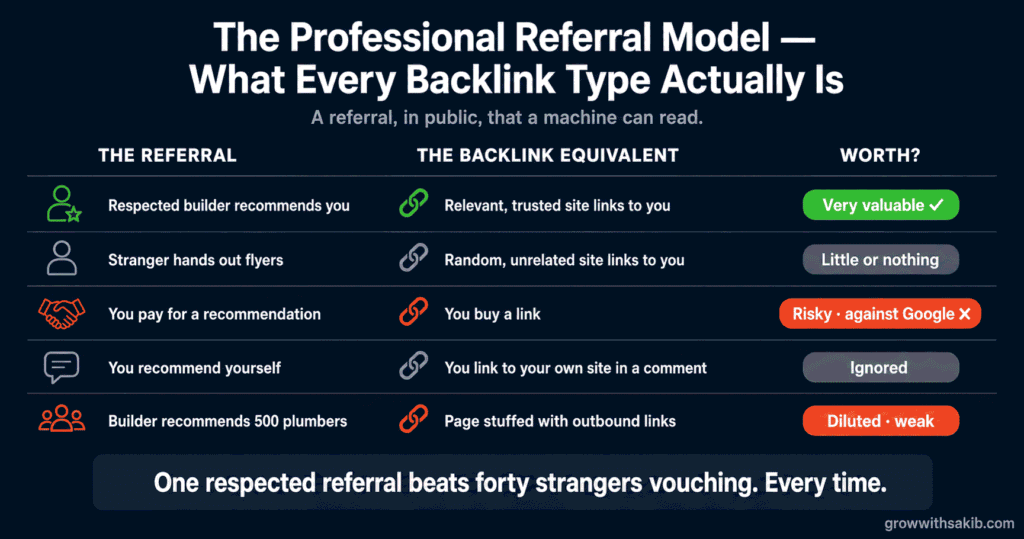
The Professional Referral Model
Here’s the mental model that makes everything else click. Imagine you’re a plumber, and you want new customers. Which of these actually helps your reputation?
| The Referral | The Backlink Equivalent | Worth? |
|---|---|---|
| A respected builder recommends you to a client | A relevant, trusted site links to you | Very valuable |
| A stranger hands out flyers with your name | A random, unrelated site links to you | Little or nothing |
| You pay someone to recommend you | You buy a link | Risky – against Google’s rules |
| You recommend yourself | You link to your own site in a comment | Ignored |
| A builder recommends 500 plumbers, including you | A page stuffed with outbound links | Diluted, weak |
That’s really all a backlink is: a professional referral, in public, that a machine can read. A referral from a respected specialist in your field carries weight. A referral from a stranger with no reputation carries none. And a referral you paid for isn’t a referral at all – it’s advertising pretending to be one, which is exactly why Google treats bought links as spam.
Where This Came From: PageRank
Google itself was built on this idea. As Stanford students, Larry Page and Sergey Brin created an algorithm called PageRank, inspired by academic citation analysis: in research, a paper cited by many other respected papers is probably important. They applied that logic to the web – a page linked to by many good pages is probably worth showing.
The two insights that made PageRank powerful still hold today:
- Links are votes – each link to a page is a signal that someone found it worth pointing to.
- Votes are weighted – a vote from an important page counts for more than a vote from an unimportant one. Not all links are equal; that was the breakthrough.
PageRank is why an early Google beat its competitors: it didn’t just read your page, it looked at what the rest of the web said about your page. Modern Google is vastly more sophisticated – hundreds of signals, machine learning, language understanding – but this citation principle is still in the foundation.
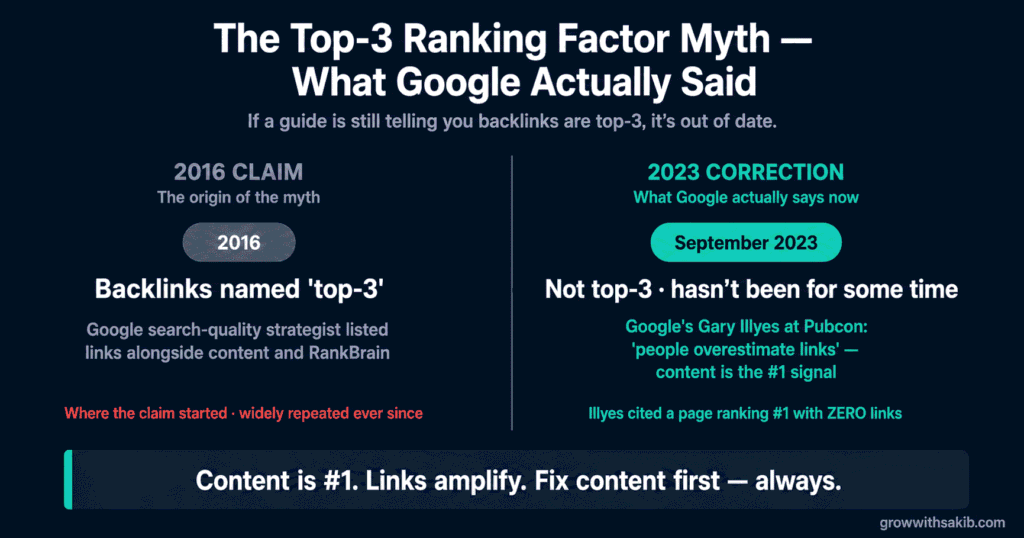
Are Backlinks Really a ‘Top 3’ Ranking Factor?
You’ll read everywhere that backlinks are one of Google’s top three ranking factors. Google says that’s not true – and it’s important that you hear this before you spend months chasing links.
Illyes even gave an example of a page ranking at position one with zero internal or external links pointing to it – Google had only discovered it through a sitemap. It ranked purely on the quality of its content.
So what should a beginner take from this? Links still matter – Google’s own people say so, and they remain one of the strongest ways to build authority and get discovered. But they are not the whole game, and they will never rescue weak content. Get your content right first (that’s the content strategy work on GrowWithSakib), then earn links to amplify it. A site with brilliant content and few links can win. A site with many links and thin content usually can’t.
How Google Evaluates a Backlink
Not all links carry the same weight. These are the factors that decide whether a link helps you, does nothing, or hurts you:
| Factor | What Google Looks For | Beginner Takeaway |
|---|---|---|
| Relevance | Is the linking site related to your topic? | A link from your industry beats a random one |
| Authority | Is the linking site trusted and established? | Trusted sources pass more value |
| Editorial intent | Was the link given freely, or paid/manipulated? | Earned links count; bought links are spam |
| Anchor text | What words is the link placed on? | Natural, descriptive anchors – never stuffed |
| Placement | Is it in the main content, or a footer/sidebar? | In-content links carry more weight |
| Link attributes | Is it marked nofollow, sponsored, or ugc? | These tell Google how to treat the link |
| Diversity | Are links coming from many different sites? | Many referring domains beat many links from one |
The single biggest beginner mistake is chasing volume. Five relevant links from trusted sites in your field will out-perform five hundred low-quality ones – and the five hundred may actively harm you.
Dofollow, Nofollow, and What They Really Mean
By default, a link is what SEOs call dofollow: it passes ranking value (“link equity”) to the page it points to. A site owner can add an attribute to change that:
- rel=”nofollow” – tells Google not to pass ranking credit through this link. Common on comments, forums, and user-generated content.
- rel=”sponsored” – marks paid or advertising links. If you ever pay for a link, it must be marked this way.
- rel=”ugc” – marks links in user-generated content, like comments.
Internal vs External Links
Beginners often confuse these, so here’s the clean distinction:
| Link Type | Definition | What It Does for You |
|---|---|---|
| Internal link | A link from one page on your site to another page on your site | You control it; guides users and spreads authority around your own site |
| External (outbound) link | A link from your site to someone else’s | Cites sources; builds trust; costs you nothing |
| Backlink (inbound) | A link from someone else’s site to yours | The vote of confidence; you must earn it |
Here’s the part most beginner guides skip: internal links matter too. Authority earned by one page doesn’t stay locked there – it flows through your internal links to the other pages you link to. So when a blog post earns a great backlink, the pages that post links to benefit as well. That’s why deliberate internal linking, like the structure used in a content cluster on GrowWithSakib, multiplies the value of every backlink you earn. Backlinks bring authority in; internal links put it to work.
Two More Myths Worth Killing Early
- “Domain Authority is a Google ranking factor.” It isn’t. Domain Authority (Moz) and Domain Rating (Ahrefs) are useful third-party estimates invented by SEO tool companies. Google doesn’t use them and has said as much. Use them as a rough guide to a site’s strength – never as gospel.
- “You can just buy backlinks.” Buying or exchanging links to manipulate rankings violates Google’s spam policies, and the penalties are real. Cheap link packages are the single fastest way for a small business to damage its site.
How to See Your Own Backlinks (Free)
Curious what already links to you? Open Google Search Console and go to the Links report. It’s free, and it shows your top linking sites, your most-linked pages, and your most common anchor text – straight from Google, no tools required. It’s the same free setup covered in the Google Search Console guide on GrowWithSakib.
Most small businesses are pleasantly surprised – you usually have more links than you think, from suppliers, directories, local press, and partners. That’s your starting point, and knowing it is the first step of any real link-building effort.
Common Backlink Mistakes Beginners Make
| Mistake | Why It Hurts | Do This Instead |
|---|---|---|
| Buying links | Violates Google’s policies; risks penalties | Earn links through genuinely useful content |
| Chasing quantity over quality | Low-quality links do nothing or harm | Target a few relevant, trusted sites |
| Believing links are the top factor | Neglects content, which matters more | Fix content first; use links to amplify |
| Ignoring nofollow mentions | Misses traffic, brand, and future links | Value good mentions, not just followed tags |
| Treating DA/DR as Google metrics | Chases a score Google doesn’t use | Judge relevance and trust, not a number |
| Stuffing exact-match anchor text | Looks manipulative | Use natural, descriptive anchors |
| Neglecting internal links | Wastes the authority you earn | Link deliberately between your own pages |
Frequently Asked Questions
1. What is a backlink in simple terms?
A backlink is a link on someone else’s website that points to your website. Search engines treat it as a vote of confidence – much like a professional referral. If a respected, relevant site links to you, it’s publicly vouching for you, and Google counts that as a signal your page is trustworthy and worth showing. The idea comes from PageRank, the algorithm Google was originally built on, which treated links between pages like citations between academic papers.
2. Are backlinks still a top-3 Google ranking factor?
No. Google’s Gary Illyes said in September 2023 that links are important but people overestimate them, and that he doesn’t agree they’re in the top three – and haven’t been for some time. He also said there isn’t really a universal top three, and that content is the number-one signal. Another Google team member has said backlinks now have far less impact than in Google’s early days. Links still matter and are worth earning, but they won’t rescue weak content.
3. Can a page rank without any backlinks?
Yes. Google’s Gary Illyes described a page ranking at position one with zero internal or external links pointing to it – Google had discovered it only through a sitemap, and it ranked purely on the quality of its content. This doesn’t mean links are worthless; in competitive niches they help considerably. But it does prove that excellent, genuinely useful content can rank on its own, and that beginners should fix their content before chasing links.
4. What is the difference between a dofollow and nofollow link?
A dofollow link is the default: it passes ranking value (link equity) to the page it points to. A nofollow link carries a rel=”nofollow” attribute telling Google not to pass ranking credit. Importantly, since 2019 Google treats nofollow as a hint rather than a strict rule, so those links may still be considered. Don’t dismiss nofollow mentions – a nofollow link from a major publication still drives traffic, builds your brand, and often leads to genuine followed links later.
5. What is the difference between internal and external links?
An internal link points from one page on your site to another page on your site – you control these completely. An external (outbound) link points from your site to someone else’s. A backlink is the reverse: a link from someone else’s site to yours, which you must earn. All three matter. Internal links are especially underrated, because authority earned by one page flows through them to other pages, multiplying the value of every backlink you earn.
6. What makes a good backlink?
Relevance and trust, above all. A good backlink comes from a site related to your topic, is genuinely trusted and established, was given editorially (not bought), sits within the main content rather than a footer, and uses natural, descriptive anchor text. Diversity matters too – links from many different websites beat many links from a single site. Five relevant links from respected sites in your field will outperform hundreds of low-quality ones, which may actively harm you.
7. Is Domain Authority a Google ranking factor?
No. Domain Authority (a Moz metric) and Domain Rating (an Ahrefs metric) are third-party scores invented by SEO tool companies to estimate a site’s strength. Google doesn’t use them in its algorithm and has said so. They’re useful as a rough guide when judging whether a site is worth pursuing a link from, but chasing a higher DA score as if it were a Google ranking factor is a beginner’s mistake. Judge sites by relevance and genuine trust instead.
8. Can I buy backlinks?
You shouldn’t. Buying or exchanging links to manipulate rankings violates Google’s spam policies, and the penalties are real – sites can lose their rankings and take months or longer to recover. Cheap ‘hundreds of backlinks’ packages typically come from spam networks and are the fastest way for a small business to damage its site. If you ever do pay for placement legitimately, the link must be marked rel=”sponsored”. Earning a few genuine links is slower and far safer.
Key Takeaways
- A backlink is a link from someone else’s website to yours – think of it as a professional referral that a machine can read.
- The idea comes from PageRank, built by Larry Page and Sergey Brin: links are votes, and votes from important pages count for more.
- Google says backlinks are NOT a top-three ranking factor and haven’t been for some time – content is the number-one signal.
- Pages can rank without any backlinks at all; Google has cited a page ranking at position one with zero links, found only via a sitemap.
- Quality and relevance beat quantity: five trusted, relevant links outperform hundreds of low-quality ones, which can actively harm you.
- Google weighs relevance, authority, editorial intent, anchor text, placement, link attributes, and the diversity of referring domains.
- Since 2019 nofollow is a hint, not a strict directive – so don’t dismiss nofollow mentions, which still drive traffic and often lead to followed links.
- Domain Authority and Domain Rating are third-party tool metrics, not Google ranking factors – and buying links violates Google’s spam policies.