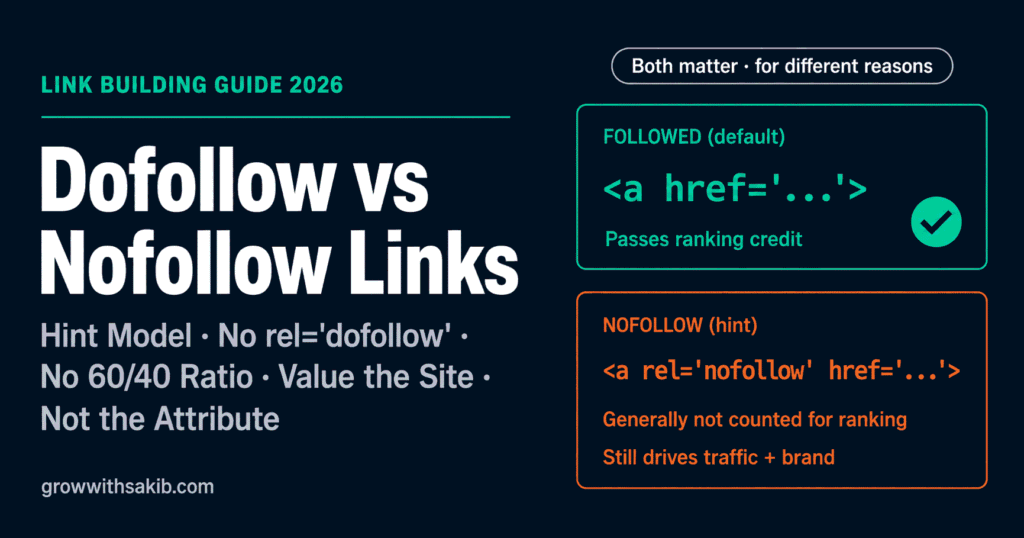
No topic confuses beginners more than this one – largely because the advice online contradicts itself. Half the guides say nofollow links are worthless. The other half say Google now counts them. Both are wrong, and one of them will waste months of your effort. Let’s fix that with what Google has actually published.
This goes deep on the link-types table in the link building guide for beginners on GrowWithSakib. If you’re not yet clear on what a backlink is at all, start with the beginner’s guide to backlinks on GrowWithSakib and come back.
First, a Myth: There Is No rel=”dofollow”
Some popular guides tell you to “add a dofollow attribute” like rel=”dofollow”. Don’t – it does nothing. There is no such attribute in HTML, and Google doesn’t recognise it.
The Five Link Types, Untangled
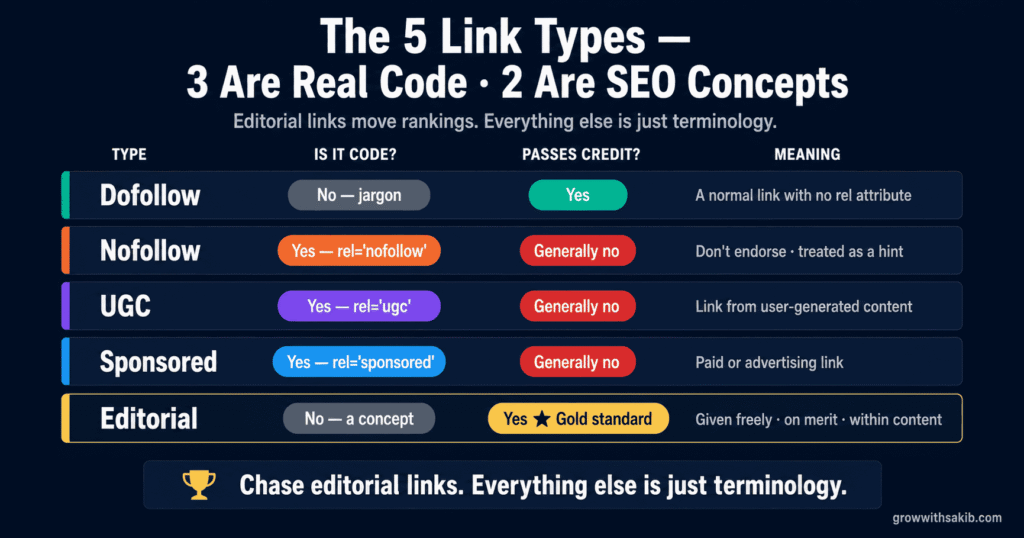
The pillar lists five types, and it helps enormously to know that they aren’t the same kind of thing. Three are real HTML attributes you can add to a link. Two are SEO concepts describing how a link came about:
| Type | Is It Real Code? | What It Means | Passes Ranking Credit? |
|---|---|---|---|
| Dofollow | No – jargon | A normal link with no rel attribute | Yes |
| Nofollow | Yes – rel=”nofollow” | Don’t endorse or pass credit to this link | Generally no |
| UGC | Yes – rel=”ugc” | This link came from user-generated content | Generally no |
| Sponsored | Yes – rel=”sponsored” | This link is paid or an advertisement | Generally no |
| Editorial | No – a concept | Given freely, on merit, within content | Yes – the gold standard |
The editorial link is the one to care about most. It isn’t a tag – it’s a link someone chose to give you because your content deserved it. Those are the links that move rankings, and they’re what a real link building strategy on GrowWithSakib is built to earn.
The Hint Model: What Google Actually Said
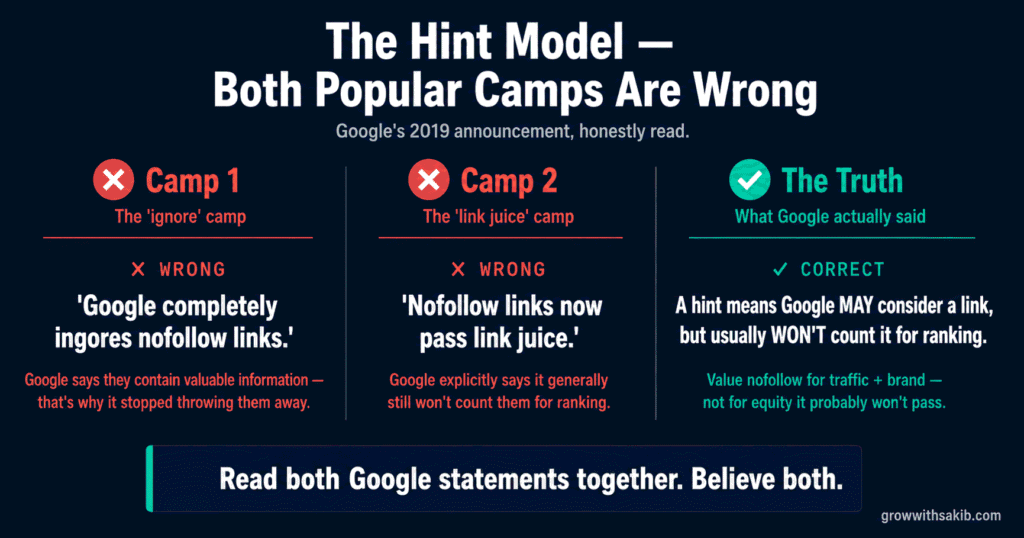
On 10 September 2019, Google announced two new link attributes and changed how it treats them. This is the paragraph that everyone misquotes, from Google’s official Search Central announcement:
Read those two statements together and the honest conclusion is clear – and it contradicts both camps:
- Camp 1 is wrong – “Google completely ignores nofollow links.” It doesn’t. Google says the links contain valuable information (like how anchor text describes a page, and how to spot unnatural link patterns), which is exactly why it stopped throwing them away.
- Camp 2 is wrong – “Nofollow links now pass link juice.” Google explicitly said it will generally still not consider them for ranking. Never build a strategy expecting a nofollow link to lift your rankings.
- The truth – a hint means Google may consider a link, but usually won’t count it for ranking. So value nofollow links for what they reliably deliver, not for link equity they probably won’t pass.
Why Nofollow Links Still Matter
Here’s the beginner mistake this article exists to prevent: dismissing a great opportunity because the link is nofollow. A nofollow mention from a major publication is worth far more to a small business than a followed link from a nobody. Four reasons:
- Real traffic – a nofollow link from a busy, relevant site sends actual visitors who can become customers. Rankings aren’t the only way to get found.
- Brand visibility and trust – being named on a respected site builds credibility with humans, who don’t check rel attributes.
- Discovery, which leads to followed links – people who see you on a big site may write about you themselves, and their links are usually followed. Nofollow mentions seed real links.
- A natural profile – real websites earn a mix. A profile of nothing but followed links from guest posts looks engineered; nofollow links from social, news, and forums look like a real business.
Notice that many of the web’s biggest sites – Wikipedia, Reddit, most social platforms and news comment sections – mark their outbound links nofollow by default. If you refuse anything nofollow, you’re refusing coverage from some of the most visible places on the internet.
What Is a Healthy Dofollow-to-Nofollow Ratio?
You’ll see a “60/40” or “70/30” ratio quoted as the ideal. Here’s the honest answer: Google has never published a target ratio, and there is no magic number to hit. Those figures are SEO folklore – loose observations dressed up as rules.
Which Attribute Should You Use on Your Own Links?
This matters too – Google expects you to qualify your own outbound links properly. Straight from Google’s link qualification documentation:
| Situation | Attribute to Use | Why |
|---|---|---|
| Citing a source you genuinely recommend | None (a normal followed link) | Editorial endorsement – the default |
| An ad, paid placement, or affiliate link | rel=”sponsored” | Required – unmarked paid links are link spam |
| Links in comments or forum posts | rel=”ugc” | You didn’t add it editorially |
| Linking to a site you don’t want to endorse | rel=”nofollow” | No endorsement implied |
| A sponsored link inside user comments | rel=”ugc sponsored” | You can combine attributes – both apply |
Two rules worth burning in. First, any paid link must be marked – Google prefers sponsored, accepts nofollow, and treats unmarked paid links as a link scheme. Second, don’t nofollow everything. Some site owners nofollow every outbound link to “preserve” authority; it doesn’t work, it makes your site look untrusting, and Google’s guidance is to reserve nofollow for links you genuinely don’t vouch for. Link out generously to good sources – it costs you nothing and builds trust.
How to Check If a Link Is Nofollow
- Right-click and Inspect – find the link in the code and look for a rel attribute. No rel attribute means it’s a normal followed link.
- View the page source – press Ctrl+U (Cmd+U on Mac), then search for the anchor text and check for rel=”nofollow”.
- Use a browser extension – SEO toolbars from tools like Ahrefs or Moz will highlight link types on the page as you browse.
Useful for research – but don’t let the result decide whether an opportunity is worth pursuing. Judge the site’s relevance, its audience, and its trustworthiness first. Sort out which of your existing links are which during a backlink audit on GrowWithSakib.
Common Dofollow vs Nofollow Mistakes
| Mistake | Why It Hurts | Do This Instead |
|---|---|---|
| Ignoring nofollow opportunities | Loses traffic, brand, and future followed links | Judge the site, not the rel attribute |
| Adding rel=”dofollow” | Does nothing – it isn’t a real attribute | Leave normal links alone; they’re followed |
| Expecting nofollow to pass equity | Builds strategy on a misreading of Google | Value nofollow for traffic and brand |
| Chasing a 60/40 ratio | Optimises a number Google never published | Earn good links; the mix sorts itself out |
| Nofollowing every outbound link | Looks untrusting; gains nothing | Link out freely to sources you vouch for |
| Not marking paid links | Violates Google’s policies – a link scheme | Use rel=”sponsored” on every paid link |
| A profile of 100% followed links | Looks manufactured to Google | Let natural nofollow mentions accumulate |
Frequently Asked Questions
1. What is the difference between a dofollow and nofollow link?
A dofollow link is a normal link with no special attribute – it passes ranking credit to the page it points to. A nofollow link carries the rel=”nofollow” attribute, which tells Google not to treat it as an endorsement or pass ranking credit. Importantly, “dofollow” isn’t real code: links are followed by default, and you never need to add anything to make them so. You only add an attribute when you want to tell Google not to count a link.
2. Do nofollow links help SEO?
Not directly for rankings, but they’re far from worthless. Google says nofollow is now a hint rather than a strict rule, yet also says it will generally still not count these links for ranking – so don’t expect them to pass link equity. What they reliably deliver is real referral traffic, brand visibility on respected sites, discovery that leads other people to link to you with followed links, and a natural-looking link profile. Ignoring a great nofollow opportunity is a classic beginner mistake.
3. Is rel=”dofollow” a real HTML attribute?
No. It’s SEO jargon, not code, and Google doesn’t recognise it. Several popular guides wrongly tell beginners to add rel=”dofollow” to links – doing so has no effect whatsoever. Links are followed by default: a standard link with no rel attribute already passes ranking credit. The accurate term is a “followed link.” You only ever add a rel attribute (nofollow, sponsored, or ugc) when you want to tell Google not to treat a link as your endorsement.
4. What is a healthy dofollow to nofollow ratio?
There isn’t an official one. Google has never published a target ratio, and the commonly quoted 60/40 or 70/30 figures are SEO folklore, not rules. Chasing a specific number is itself the mistake. Two extremes are worth watching: a profile of 100% followed links looks manufactured, because real sites naturally pick up nofollow links from social, forums, and news; and zero followed links suggests you’ve never earned a genuine editorial endorsement. Otherwise, earn good links and the mix appears naturally.
5. What do rel=”sponsored” and rel=”ugc” mean?
Google introduced both in September 2019. Use rel=”sponsored” for any link that exists because of advertising, sponsorship, or payment – marking paid links is required, and unmarked ones count as a link scheme. Use rel=”ugc” for links in user-generated content like blog comments and forum posts, where you didn’t add the link editorially. You can combine attributes when both apply: rel=”ugc sponsored” is perfectly valid for a paid link inside a user comment.
6. Does Google crawl nofollow links?
It may. Since 1 March 2020, nofollow has been a hint for crawling and indexing rather than a strict directive, so Google can choose to crawl a nofollow link. Google’s documentation notes that links with these attributes generally won’t be followed, but the linked pages can still be discovered by other means, such as sitemaps or links from other sites. The practical takeaway is not to rely on nofollow to keep a page out of Google – use the noindex robots rule for that.
7. Should I nofollow all my outbound links?
No. Some site owners nofollow every external link hoping to hoard authority – it doesn’t work, and it makes the site look untrusting. Google’s guidance is to reserve nofollow for links you genuinely don’t want to vouch for, such as untrusted sources or competitors you’re citing without endorsement. Linking out to genuinely useful, authoritative sources costs you nothing, helps your readers, and supports your credibility. Mark paid links as sponsored and user links as ugc – and leave the rest followed.
8. Should I turn down a nofollow link opportunity?
Almost never. A nofollow mention from a large, relevant publication is usually worth far more to a small business than a followed link from an obscure site – it sends genuine traffic, builds credibility with human readers who never check rel attributes, and often triggers followed links from others who discover you through it. Many of the web’s biggest platforms mark outbound links nofollow by default. Judge an opportunity by the site’s relevance, audience, and reputation – not by its link attribute.
Key Takeaways
- A dofollow link is simply a normal link with no rel attribute – links are followed by default, and rel=”dofollow” is not real code.
- Of the five link types, three are real HTML attributes (nofollow, sponsored, ugc) and two are SEO concepts (dofollow, editorial).
- Since 2019 Google treats nofollow, sponsored, and ugc as hints – but Google also says it will generally still not count them for ranking.
- So both popular claims are wrong: Google doesn’t fully ignore nofollow links, and they don’t pass link equity either.
- Nofollow links still matter for referral traffic, brand visibility, discovery that seeds followed links, and a natural-looking profile.
- There is no Google-endorsed dofollow-to-nofollow ratio – chasing 60/40 is folklore; only the extremes (100% followed, or zero followed) are red flags.
- On your own site: mark paid links rel=”sponsored” (required), user links rel=”ugc”, and leave genuine citations followed – don’t nofollow everything.
- Editorial links – given freely because your content earned them – are the gold standard, and the only type that reliably moves rankings.