Most advertisers think they retarget. What they actually do is build one audience called ‘website visitors — 30 days,’ point a generic ad at it, and call that a retargeting strategy. Everyone in that audience sees the same message — the person who bounced off your homepage in three seconds and the person who abandoned a full cart get the identical ad.
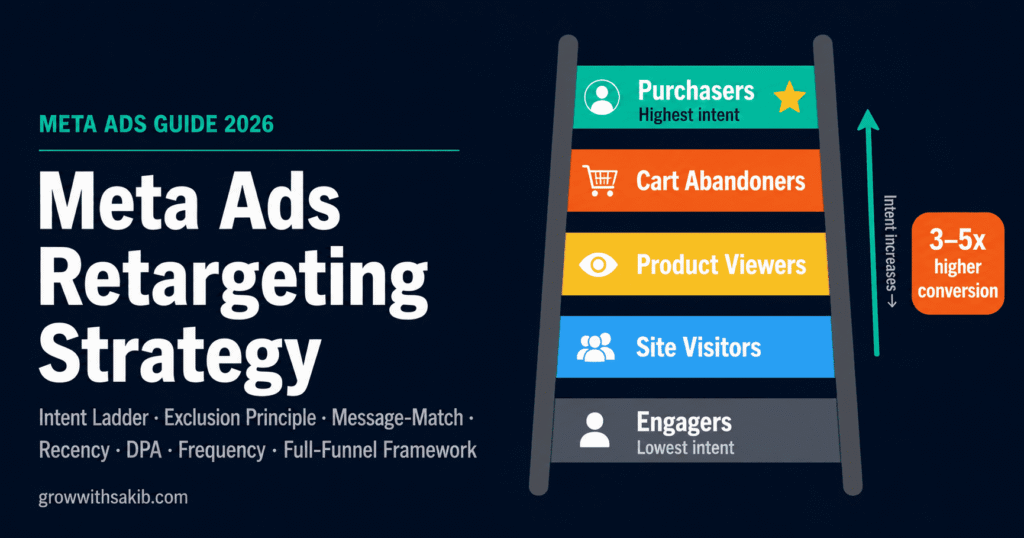
That is not retargeting. That is remarketing to a crowd. Real retargeting treats intent as a ladder: someone who watched 15 seconds of a video has shown less intent than someone who viewed a product page, who has shown less than someone who added to cart. Each rung deserves a different message — and, crucially, each rung must exclude the rungs below it.
This guide gives you the full-funnel framework: how to segment your warm audiences by intent and recency, the exclusion principle that keeps them from overlapping, the exact message each segment needs, how to control frequency before it fatigues, and how to measure retargeting honestly — all grounded in the complete Meta Ads framework.
Retargeting Is an Intent Ladder, Not an Audience
The single shift that separates effective retargeting from generic remarketing is this: stop thinking of your warm traffic as one audience, and start thinking of it as a ladder of intent. Each rung represents a stronger signal that the person is close to buying, and each deserves a different message.
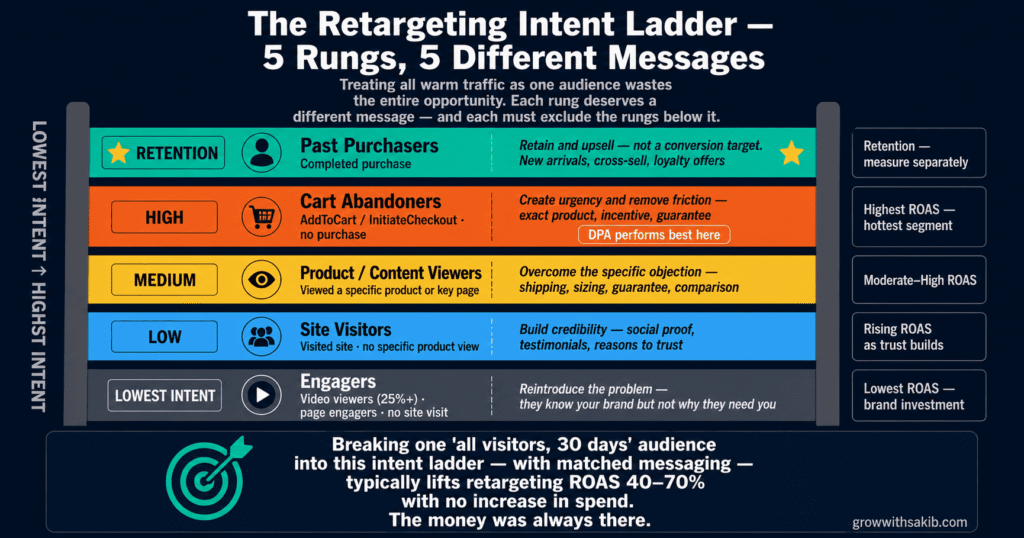
The rungs of the ladder, from lowest to highest intent
- Engagers (lowest intent): people who watched your video (25%+), engaged with a post, or interacted with your page but never visited your site. They know your brand exists. Barely warm.
- Site visitors: people who visited your website but viewed no specific product. General interest, no specific intent yet — and for local businesses, these visitors often come from Meta Ads for local business campaigns that drive traffic from specific geographic areas.
- Product/content viewers: people who viewed a specific product or key page. Now you know what they are interested in.
- Add-to-cart / initiate-checkout abandoners (highest intent): people who got most of the way to buying and stopped — and the Meta Pixel events that capture these actions must be correctly configured before you can target this segment. As Neogen Media’s funnel framework calls it, this is your hottest retargeting segment — they didn’t convert for a specific, addressable reason.
- Past purchasers (retention): people who already bought. Not a conversion target — a retention and upsell target with entirely different messaging.
As Neogen Media documents, running all these stages simultaneously with matched messaging is what separates a campaign from a system. Most advertisers run one retargeting campaign and call it a strategy. The ladder is the system.
The Exclusion Principle: The Backbone of Every Retargeting Funnel
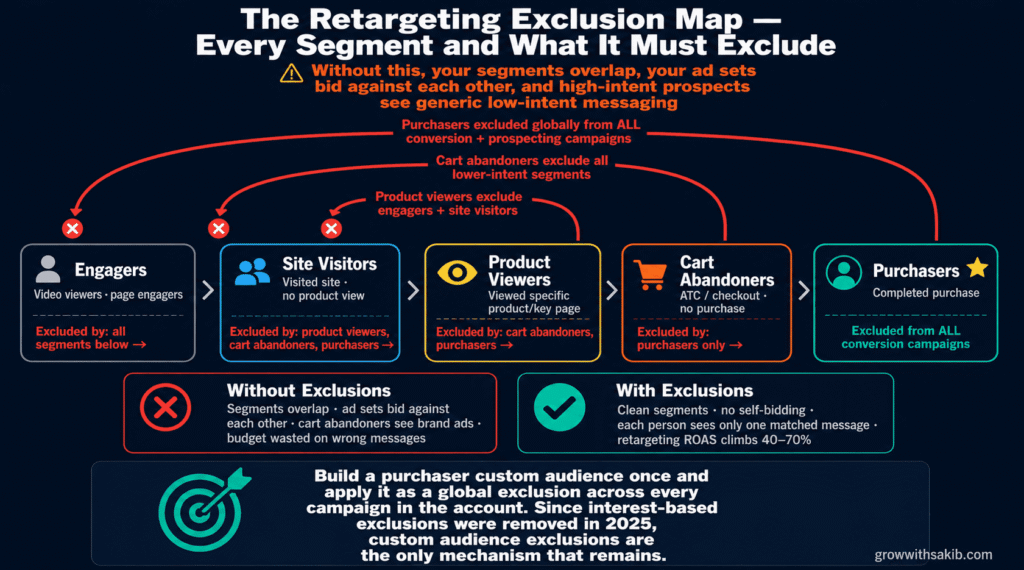
If the intent ladder is the strategy, the exclusion principle is the structure that makes it work. Without it, your segments overlap, your ads compete against each other, and you pay to show the wrong message to the wrong person. This is the single most important mechanic in retargeting, and the one most advertisers skip.
The rule: every segment excludes those further down the funnel
As Benly’s retargeting guide states the rule: each audience should exclude people who have progressed further in the funnel. Your add-to-cart audience should exclude purchasers. Your product-viewer audience should exclude cart abandoners. This prevents wasting budget showing generic messaging to highly-qualified prospects, and avoids bidding against yourself in Meta’s auction system.
The mechanism is twofold. First, message integrity: a cart abandoner should see a cart-recovery message, not a generic ‘discover our brand’ ad — excluding them from the lower-intent audiences guarantees they only get the right one. Second, auction efficiency: if the same person sits in three of your audiences, your three ad sets bid against each other for that one impression, inflating your own costs.
The full exclusion map
| Segment | Targets | Must Exclude |
|---|---|---|
| Engagers | Video viewers, page engagers (no site visit) | Site visitors, product viewers, cart abandoners, purchasers |
| Site visitors | Visited site, no product view | Product viewers, cart abandoners, purchasers |
| Product viewers | Viewed specific product/key page | Cart abandoners, purchasers |
| Cart abandoners | Add-to-cart / checkout, no purchase | Purchasers |
| Purchasers (retention) | Completed purchase | (Exclude from all prospecting + conversion retargeting) |
Matching the Message to the Intent: What Each Segment Needs to Hear
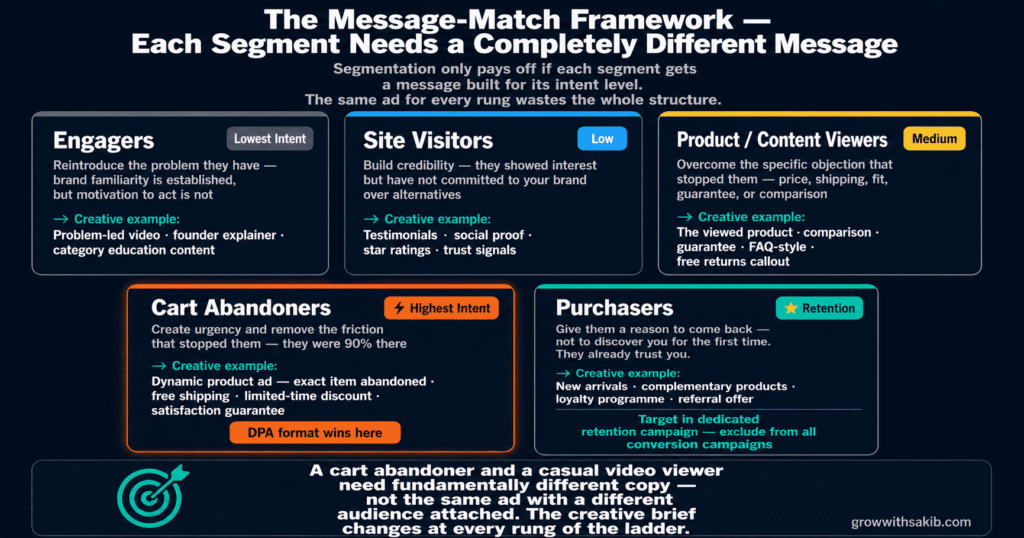
Segmentation only pays off if each segment gets a message built for its intent level. The same ad shown to every rung wastes the whole structure. Here is the specific job each message must do.
The message-match framework
As Neogen Media’s framework frames the warm-traffic principle: these people know you, and they didn’t convert for a reason — price, trust, timing, or distraction. Address it directly. The message changes as intent rises:
- Engagers — reintroduce the problem. Low intent. They know your brand but not why they need you. Lead with the problem you solve, the same way you would for cold traffic but with brand familiarity already established.
- Site visitors — build credibility. They showed general interest. Give them social proof, testimonials, and reasons to trust — move them from curious to considering.
- Product viewers — overcome the specific objection. They looked at a specific thing and hesitated. Address the likely objection: shipping, sizing, guarantees, comparisons. Show the product they viewed.
- Cart abandoners — create urgency and remove friction. Highest intent. They almost bought. A reminder of the exact item, a limited-time incentive, a guarantee, or free shipping often closes them. This is where dynamic product ads shine.
- Purchasers — social proof and new products. As Neogen notes, give them a reason to come back, not a reason to discover you. New arrivals, complementary products, loyalty offers.
This message-to-intent matching is where your ad copy and creative formats do their hardest work. A cart abandoner and an engager need fundamentally different copy, not the same ad with a different audience attached.
| Segment | Message Job | Creative Example |
| Engagers | Reintroduce the problem | Problem-led video, founder explainer |
| Site visitors | Build trust | Testimonials, social proof, Google reviews |
| Product viewers | Overcome objection | Comparison, guarantee, FAQ-style, the viewed product |
| Cart abandoners | Urgency + remove friction | Dynamic product ad, discount, free shipping, scarcity |
| Purchasers | Retain + upsell | New arrivals, complementary products, loyalty |
The Recency Dimension: Time Since Intent Matters as Much as Intent
Intent is one axis of segmentation. Recency is the second. Someone who abandoned a cart yesterday is a dramatically different prospect from someone who abandoned one 45 days ago — even though they sit on the same rung of the intent ladder. The freshness of the intent signal changes both the message and the bid.
Why recency changes everything
As Benly’s guide explains, recent visitors (last 7 days) have your brand fresh in mind and respond to different messaging than someone who visited 60 days ago. Create separate audiences for different recency windows and adjust bid strategy accordingly — recent visitors typically deserve higher bids because of their stronger intent signal.
The mechanism: intent decays with time. A cart abandoned an hour ago is a near-miss you can often recover with a simple reminder. A cart abandoned six weeks ago belongs to someone who has likely moved on, solved the problem elsewhere, or forgotten you entirely — they need re-warming, not a checkout nudge.
Practical recency windows
- 0-7 days (hot): freshest intent. Highest bids, most direct conversion messaging. The cart-recovery sweet spot.
- 8-14 days (warm): intent cooling. Add an incentive or stronger social proof to re-motivate.
- 15-30 days (cooling): needs re-engagement, not just a reminder. Reintroduce value, not just the product.
- 31-90 days (cold warm): treat closer to prospecting. A win-back or new-angle message; lower bids.
Dynamic Product Ads: The Retargeting Workhorse
For e-commerce retargeting, dynamic product ads (DPAs) are the highest-leverage format available. They automatically show each person the exact products they viewed or added to cart — turning the abstract idea of message-matching into automated, individualised creative at scale.
How dynamic product ads work
A DPA connects your product catalogue to your Meta Pixel and Conversions API so that when someone views Product X and leaves, Meta automatically serves them an ad featuring Product X — not a generic brand ad. As MetaMkt’s full-funnel analysis documents, dynamic remarketing consistently outperforms generic retargeting because it addresses individual user interests based on demonstrated behaviour rather than showing everyone the same creative.
What DPAs require
- A product catalogue in Commerce Manager: complete, accurate product data — titles, images, prices, availability.
- Pixel events with content IDs: your
- CAPI for signal reliability: server-side tracking ensures the product-view and cart events that power DPAs are captured even when browser tracking fails.
When DPAs beat static retargeting
DPAs win decisively for catalogue businesses with many SKUs and for cart-abandoner retargeting, where showing the exact abandoned item is the most powerful possible nudge. Static retargeting still has a role for single-product brands, for service businesses without a catalogue, and for upper-funnel re-engagement where the message is about the brand rather than a specific product.
Controlling Frequency Before It Becomes the Stalker Effect
Retargeting has a unique failure mode: because the audience is small and warm, it is easy to show the same person your ad far too many times. Crossing that line turns retargeting from helpful reminder into the creepy ‘this brand is following me everywhere’ effect that damages your brand and wastes budget.
The frequency signature of fatigue
Watch frequency alongside CTR. When frequency climbs and click-through rate falls, the audience has seen the ad too many times — the same fatigue signature covered in our account audit framework. For warm retargeting audiences, which are small by definition, frequency accumulates faster than in prospecting, so the fatigue point arrives sooner.
Frequency control tactics
- Set frequency caps on retargeting campaigns. Meta’s frequency controls let you limit impressions per person over a time window. For warm retargeting, a cap that prevents more than a handful of impressions per week keeps the reminder helpful rather than oppressive.
- Refresh creative on a schedule. Because warm audiences burn through creative fast, rotate retargeting creatives more often than prospecting ones. Keep a queue of fresh
- Use the recency windows as natural frequency control. Moving people out of the hot 0-7 day window after a week naturally limits how long they see the most aggressive messaging.
- Cap the funnel duration. If someone has been in your retargeting funnel for 60-90 days without converting, they are unlikely to. Stop spending on them or move them to a low-frequency, low-bid win-back — a decision framework covered in the Meta Ads cost guide.
Retargeting and Advantage+ Shopping: Manual Funnel or Let AI Absorb It?
A genuine 2026 question: with Advantage+ Shopping Campaigns (ASC) handling prospecting and retargeting automatically within one campaign, does a manual retargeting funnel still make sense? The answer depends on your business, and often it is both.
As Stackmatix’s funnel guide describes it, Advantage+ Shopping Campaigns automatically find audiences across prospecting and retargeting segments and allocate budget dynamically without manual ad set segmentation — a model covered in full in the Meta Ads Guide. ASC works best for e-commerce businesses with broad catalogues and sufficient conversion volume. For lead generation or complex sales cycles, a manual funnel gives more control over messaging at each stage.
The decision framework
| Your Situation | Recommended Approach |
|---|---|
| E-commerce, broad catalogue, high conversion volume | ASC as primary; it absorbs much of the funnel automatically |
| E-commerce, but want message control by segment | Manual retargeting funnel alongside ASC prospecting |
| Lead generation / B2B / long sales cycle | Manual full-funnel retargeting — ASC is built for purchases |
| Lower volume / niche | Manual funnel; ASC needs volume to optimise |
The common pattern that works: run ASC for the bulk of prospecting and broad retargeting, and run a manual retargeting funnel alongside it for the high-intent segments where message control matters most — especially cart abandoners and a dedicated retention track. As covered in our Advantage+ Shopping guide, many advertisers dedicate 20-30% of budget to a manual structure running parallel to ASC. For B2B retargeting, the manual funnel remains essential because the long consideration cycle needs deliberate, sequenced messaging ASC is not built to deliver — similar to how Meta Ads for local business campaigns need manual control over geographic and intent targeting rather than broad AI delivery.
Measuring Retargeting Honestly: The Incrementality Caveat
Here is the uncomfortable truth most retargeting guides avoid. That headline 3-5x conversion rate is real, but it is partly an illusion of attribution — the same challenge that makes Meta Ads attribution one of the most misunderstood topics in paid advertising. Retargeting audiences are, by definition, people already interested in buying — so a large share of them would have converted anyway, with or without your ad. The ad claims credit it did not fully earn.
This is the core measurement problem covered in depth in our attribution guide. A retargeting ad shown to someone who already had your checkout page open will claim the conversion, but its incremental contribution — the sales it actually caused that would not have happened otherwise — is far smaller than the platform-reported ROAS suggests. Mid-funnel retargeting is often the most over-credited spend in an entire account.
How to measure retargeting truthfully
- Run a holdout test. Withhold retargeting from a random slice of your warm audience and compare conversion rates. The difference is the true incremental lift — the only honest measure of whether your retargeting is causing sales or claiming them.
- Watch blended metrics. If you turn retargeting off and total revenue barely moves, the retargeting was mostly claiming organic conversions that SEO was generating independently. If it drops meaningfully, the retargeting was incremental. This blended logic governs
- Be most skeptical of the hottest segments. Cart-abandoner ROAS looks spectacular precisely because those people were most likely to convert anyway. It is still worth running — recovering even a fraction of abandoned carts is profitable — but do not mistake its reported ROAS for its true contribution.
6 Retargeting Mistakes That Waste Warm Traffic
Mistake 1: One audience, one message for all warm traffic
Treating every warm visitor as a single audience wastes the entire opportunity. A cart abandoner and a casual engager need completely different messages. Build the intent ladder and match the message to the rung — this single change typically lifts retargeting ROAS 40-70%, and understanding Meta Ads costs by funnel stage helps you budget each rung correctly.
Mistake 2: Not excluding down-funnel segments
Without the exclusion principle, your segments overlap, your ad sets bid against each other, and high-intent prospects see generic low-intent messaging. Every segment must exclude those further down the funnel. This is the structural backbone, not an optional refinement.
Mistake 3: Retargeting people who already purchased
Showing ‘complete your purchase’ ads to existing customers wastes spend and damages the brand experience. Build a purchaser custom audience and exclude it globally from all conversion campaigns. Target purchasers only in deliberate retention and upsell campaigns with appropriate messaging.
Mistake 4: Ignoring frequency until it becomes stalking
Warm audiences are small, so frequency accumulates fast — particularly when running alongside a Meta Lookalike Audiences strategy that feeds new cold traffic into the funnel continuously. Unchecked, retargeting becomes the creepy ‘following me everywhere’ effect that harms your brand. Set frequency caps, refresh creative often, and cap how long someone stays in the funnel before you stop spending on them.
Mistake 5: Using generic creative where dynamic would win
For catalogue e-commerce, showing a generic brand ad to a cart abandoner instead of the exact product they left behind leaves money on the table — the right Meta ad format makes this automatic at scale. Dynamic product ads serve each person their viewed or abandoned items automatically — usually the highest-ROAS format in the account for cart recovery.
Mistake 6: Trusting retargeting ROAS at face value
Retargeting’s reported ROAS is inflated by people who would have converted anyway. As covered in the
Frequently Asked Questions
What is a Meta ads retargeting strategy?
A Meta ads retargeting strategy re-engages people who already interacted with your brand — site visitors, video viewers, cart abandoners — with messaging matched to their intent level. The most effective approach is a graded intent ladder rather than one warm audience, where each segment excludes those further down the funnel. As Benly documents, retargeting delivers 3-5x higher conversion rates than cold prospecting because these audiences already know your brand.
How should I segment my retargeting audiences?
Segment by intent depth and recency. By intent: engagers, site visitors, product viewers, cart abandoners, and purchasers — each a rung on a ladder needing a different message. By recency: 0-7, 8-14, 15-30, and 31-90 day windows, with higher bids for fresher intent. As Neogen Media advises, running these stages with matched messaging is what turns a campaign into a system. Start with high-value combinations and add segments only as volume allows.
What is the exclusion principle in retargeting?
The exclusion principle means every audience excludes people who progressed further down the funnel. Your cart-abandoner audience excludes purchasers; your product-viewer audience excludes cart abandoners. As Benly explains, this prevents wasting budget on generic messaging to qualified prospects and stops your ad sets bidding against each other in the auction. It is the structural backbone of any working retargeting funnel.
How often should retargeting ads show to the same person?
It depends on intent and recency. A fresh cart abandoner can tolerate several impressions in the first 48 hours; a low-intent engager will feel stalked by the same frequency. Use Meta’s frequency controls per segment, watch for the fatigue signature (rising frequency, falling CTR), refresh creative often, and stop spending on anyone who has been in the funnel 60-90 days without converting.
Do dynamic product ads work for retargeting?
Yes — for catalogue e-commerce, dynamic product ads (DPAs) are usually the highest-ROAS retargeting format. They automatically show each person the exact products they viewed or abandoned, which is the most powerful possible nudge for cart recovery. As MetaMkt documents, dynamic remarketing consistently outperforms generic retargeting. DPAs require a product catalogue and Pixel events with matching product IDs.
Should I use a manual retargeting funnel or Advantage+ Shopping?
Both, often. Advantage+ Shopping Campaigns handle prospecting and retargeting automatically and work best for e-commerce with broad catalogues and high volume. A manual funnel gives message control for high-intent segments and is essential for lead gen, B2B, and long sales cycles. As Stackmatix notes, many advertisers run a manual funnel on 20-30% of budget alongside ASC — letting AI handle the bulk while controlling the highest-intent messaging manually.
Is retargeting ROAS trustworthy?
Treat it with caution. Retargeting audiences are people already likely to buy, so a large share would convert without the ad — meaning platform-reported ROAS overstates retargeting’s true contribution, especially for hot segments like cart abandoners. As covered in our attribution guide, measure incremental lift with a holdout test: withhold retargeting from a random slice and compare. The difference is the honest measure of what retargeting actually caused.
Key Takeaways
- Retargeting is an intent ladder, not one audience. Segment warm traffic by intent depth — engagers, site visitors, product viewers, cart abandoners, purchasers — and match a specific message to each rung.
- The exclusion principle is the structural backbone. Every segment must exclude those further down the funnel, preventing audience overlap, self-bidding, and mismatched messaging.
- Match the message to the intent. Engagers need the problem reintroduced; cart abandoners need urgency and friction removed. The same ad for everyone wastes the whole structure.
- Layer recency onto intent. A cart abandoned yesterday is not the same as one abandoned six weeks ago. Fresher intent deserves higher bids and more direct conversion messaging.
- Dynamic product ads are the e-commerce retargeting workhorse. For cart abandoners especially, showing the exact abandoned product is usually the highest-ROAS ad in the account.
- Control frequency before it becomes stalking. Warm audiences are small, so frequency accumulates fast. Cap it per segment, refresh creative often, and stop spending after 60-90 days.
- Always exclude purchasers from conversion campaigns. Build a purchaser custom audience once and apply it globally. Target purchasers only in deliberate retention and upsell tracks.
- Measure retargeting honestly with a holdout. Reported ROAS is inflated by people who would have converted anyway. Incremental lift — not the dashboard — is the truth, especially for your hottest segments.