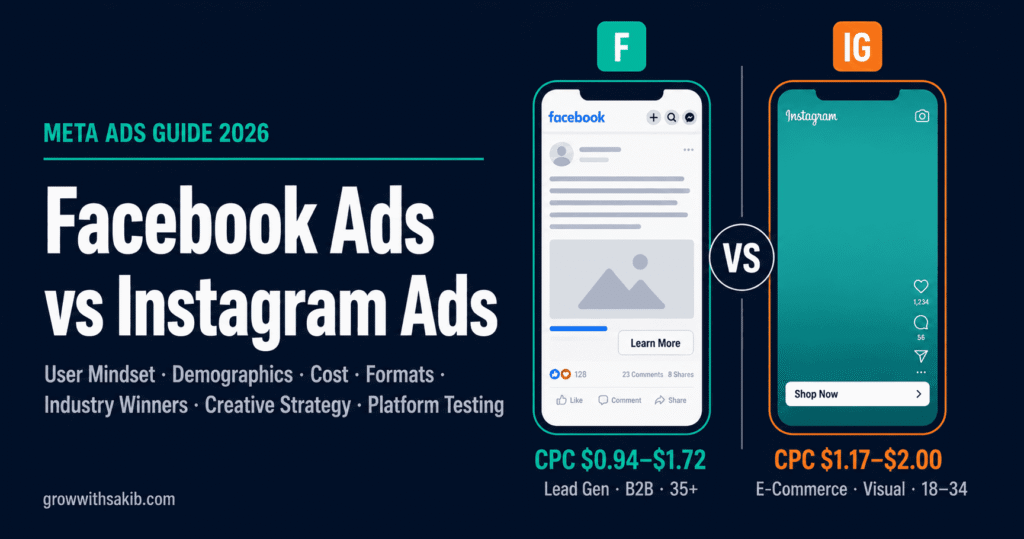
They run on the same ad system. They share the same targeting options. They use the same Ads Manager, the same Pixel, the same campaign objectives. And yet advertising on Facebook and advertising on Instagram are meaningfully different experiences — for both the advertiser and the person seeing the ad.
The question ‘Facebook ads or Instagram ads?’ comes up constantly. And the honest answer is not ‘it depends’ in the evasive way that phrase usually lands. It depends on specific, knowable things: your audience’s age, your product’s visual appeal, your campaign objective, and what your users are doing when they encounter your ad.
This guide makes that comparison concrete. By the end, you will know exactly which platform fits your business, which situations call for both, and how to test your way to a data-backed answer rather than relying on general benchmarks that may not reflect your specific audience.
The Fundamental Difference Nobody Explains Properly
Both platforms are owned by Meta. Both use the same ad technology. Both reach billions of users. So why do they perform so differently for the same campaign?
The answer is not demographics — though that matters too. The real answer is user intent and mindset.
Facebook users are in link-clicking mode
When someone opens Facebook, they are in a discovery-and-information frame of mind. They scroll through news, read posts from friends and family, engage with Groups, check Marketplace, and — crucially — they regularly click on links to external websites. This is platform-native behaviour on Facebook. Users expect to leave and return. They are comfortable with that.
This makes Facebook exceptionally strong for campaigns where the desired next step is a click to an external URL — a landing page, a lead form hosted on your site, an article, a product page. The user’s willingness to leave the platform is a feature, not a friction point.
Instagram users prefer to stay in the app
Instagram’s environment is fundamentally different. Users open it for visual inspiration, entertainment, and discovery. The default behaviour is scrolling, watching, and tapping — not clicking out to external websites. When Instagram users do click on an ad, the friction of leaving the app is real. Conversion rates to external URLs are typically lower than on Facebook for this reason.
This is why Instagram’s most powerful commercial formats — Shopping Ads, Collection Ads, Reels — keep users inside the app as much as possible. The platform is designed for in-app discovery and in-app purchase. Advertisers who fight that design by pushing users immediately to external landing pages see worse results than those who meet users where they are.
| Dimension | ||
|---|---|---|
| User mindset | Information seeking, community, link clicking | Visual discovery, inspiration, entertainment |
| Off-platform behaviour | Comfortable leaving the app for external content | Prefers staying in-app; lower external link CTR |
| Content consumption | Text + image + video; longer captions read | Image + video dominant; copy plays supporting role |
| Session intent | Social connection + information | Entertainment + discovery |
| Purchase behaviour | Research-led; higher consideration before buying | Discovery-led; impulse-friendly product categories |
| Ad receptivity | Accustomed to informational, problem-solving ads | Responds to visual, aspirational, identity-aligned ads |
Audience Demographics: Who You Actually Reach on Each Platform
Demographics are not the whole story — but they matter, and the differences between the two platforms are significant enough to be decisive for many businesses.
| Demographic | Facebook (2026) | Instagram (2026) | What It Means for Advertisers |
|---|---|---|---|
| Monthly Active Users | 3.07 billion | 2.04 billion | Facebook reaches a larger total audience; Instagram reaches a more concentrated one |
| Core age group | 30–65+ (largest segment: 35–54) | 18–44 (largest segment: 25–34) | Facebook skews older; Instagram skews younger — but both have substantial 25–44 overlap |
| Gender split | 51% female / 49% male | 54% female / 46% male | Similar split; slight female skew on Instagram |
| Daily usage time | ~33 minutes/day | ~29 minutes/day | Facebook users spend slightly more time — but Instagram sessions are more focused |
| Fastest growing segment | 50+ (growing 6% YoY) | 35–44 (growing 8% YoY) | Instagram’s older segment is growing; the ‘Instagram is only for young people’ assumption is outdating |
| Urban vs rural split | Strong rural and suburban presence | Stronger urban concentration | Facebook reaches geographically diverse audiences; Instagram skews more urban |
| Overlap | 65% of Instagram users also use Facebook | 65% of Instagram users also use Facebook | Most of your audience is reachable on both — use this for multi-touch strategy |
The most important demographic insight in 2026: Instagram is no longer exclusively a young person’s platform. The 35–44 segment is its fastest-growing user group. If you dismissed Instagram for your older target demographic two years ago, it may be worth revisiting with fresh creative tailored to that audience.
Ad Formats: Where Each Platform Has a Native Advantage
Both platforms offer the full range of Meta ad formats — image, video, carousel, collection, lead ads, stories, reels. But some formats are significantly more effective on one platform than the other because they align with how users naturally behave there.
Formats where Facebook has the advantage
- Lead Ads (Instant Forms): Facebook’s Lead Ads with Instant Forms are the most friction-free lead capture format on the platform. Pre-filled contact details, a form that opens inside Facebook, and users already in link-clicking mode. Facebook Lead Ads consistently deliver 20–40% lower CPL than the same format on Instagram for B2B and professional services.
- Link Ads (Traffic campaigns): Facebook’s feed is designed for link sharing. Text-rich ads with detailed explanations and long-form copy work here in a way they simply do not on Instagram. If your conversion requires reading before clicking, Facebook’s feed gives you the space to make that case.
- Messenger Ads: Ads that open a Messenger conversation are uniquely powerful on Facebook. The immediacy of direct messaging suits service businesses where the sale happens in conversation — home services, local businesses, consultancies.
- Marketplace Ads: Facebook Marketplace has a price-conscious, purchase-intent audience that Instagram does not have an equivalent of. For product businesses with competitive pricing, Marketplace placement is worth testing.
Formats where Instagram has the advantage
- Reels Ads: Instagram Reels is the single fastest-growing ad placement in 2026. Following the removal of the scrollable Instagram Explore feed in January 2026, that traffic shifted into Reels — expanding inventory while CPMs remain relatively low. Instagram Reels CPC averages $1.28, versus $1.72 on Facebook Feed — a 26% cost advantage. The Instagram Ads guide covers the full Reels creative framework and the 90-day roadmap for building Instagram performance from scratch. Vertical video content that looks native to Reels consistently outperforms content that looks like a traditional ad.
- Stories Ads: Instagram Stories reach over 500 million daily users. The full-screen immersive format with swipe-up functionality works exceptionally well for e-commerce — particularly time-sensitive offers, product reveals, and retargeting warm audiences with a specific CTA. Instagram Stories ads consistently deliver lower CPA than Facebook Stories for visual product categories.
- Shopping Ads: Instagram Shopping integration is native in a way Facebook’s version is not. Product tags in feed posts, Shopping in Reels, and the in-app checkout experience are seamlessly embedded in how Instagram users already behave. For e-commerce brands with visually appealing products, Instagram Shopping is one of the highest-performing formats available on Meta.
- Carousel Ads (visual storytelling): Both platforms support carousel, but Instagram’s visual-first environment makes the format particularly effective for before/after storytelling, product range showcasing, and tutorial-style content. The swipe interaction matches how Instagram users naturally engage with content.
| Format | Facebook Performance | Instagram Performance | Recommendation |
|---|---|---|---|
| Lead Ads / Instant Forms | Excellent — pre-filled fields, high completion | Good — available but lower intent environment | Facebook as primary; Instagram for visual lead magnets |
| Reels (video) | Strong — growing but less dominant | Excellent — platform’s most-watched format | Instagram primary; Facebook secondary |
| Stories | Moderate — less user habit here | Excellent — 500M+ daily users | Instagram primary for conversion; Facebook for broad reach |
| Shopping / Collection | Available via Shops | Native integration — strongest e-commerce format | Instagram primary for product discovery |
| Carousel | Strong (more copy space) | Strong (more visual weight) | Match to objective: FB for education, IG for visual storytelling |
| Messenger Ads | Unique to Facebook — strong for conversational sales | Not available | Facebook only — service businesses, local leads |
| Right Column | Desktop only — low CPM, low engagement | Not available | Retargeting only — not a primary format |
Cost Comparison: What You Actually Pay (And Why Cheaper Isn’t Always Better)
Facebook is cheaper on most surface metrics — CPC, CPM, CPL. But cheaper clicks do not always mean lower cost per customer. The metric that matters is CPA — what you pay for a completed conversion — and on that metric, Instagram frequently wins for certain product categories despite higher click costs.
Headline cost benchmarks (2026)
| Cost Metric | Context | ||
|---|---|---|---|
| Average CPC | $0.94 – $1.72 | $1.17 – $2.00 | Facebook is 20–40% cheaper per click across most industries |
| Average CPM | $11.20 – $14.00 | $12.00 – $16.00 | Facebook slightly cheaper for pure impression volume |
| Instagram Reels CPC | N/A (platform-specific) | $1.28 (26% below FB Feed) | Reels is the cost-efficient Instagram format in 2026 |
| Stories CPC | $0.70 – $1.20 | $0.35 – $0.70 | Instagram Stories can be cheaper than Facebook Feed on CPC |
| Lead Gen CPL (B2B) | $30 – $80 (typically lower) | $40 – $100 (typically higher) | Facebook wins on CPL for professional services and B2B |
| E-commerce CPA (visual products) | $20 – $40 | $17 – $35 (often lower) | Instagram can deliver lower CPA despite higher CPC — higher intent to purchase from visual discovery |
The counterintuitive finding: Instagram’s CPC is higher, but for fashion, beauty, home décor, food, and lifestyle products, Instagram CPA frequently beats Facebook. Why? Because Instagram users who click on a visually compelling product ad are in a higher purchase-intent state than Facebook users who click on the same ad. The click costs more; the customer costs less.
Facebook’s lower CPC makes it the efficiency winner for campaigns where volume of clicks matters — traffic campaigns, content distribution, awareness — and for categories where users need to read before they decide. Instagram’s higher engagement density makes it the efficiency winner for categories where the product sells itself visually.
Engagement Rates: The 14x Gap That Changes the Algorithm
Engagement on Meta platforms is not just a vanity metric. Meta’s ad auction factors in your estimated action rate — a prediction of how likely users are to engage with your ad based on your creative quality and relevance. Higher engagement signals lead to lower effective CPMs and better delivery.
And on this metric, the gap between platforms is enormous.
| Engagement Metric | Practical Impact | ||
| Average engagement rate | 0.06% | 0.83% | 14x difference — Instagram’s interactive environment drives far more organic engagement |
| Reels engagement | 0.12% | 1.23% | Instagram Reels generates the highest engagement of any format on either platform |
| Stories interaction rate | 0.06% | 0.80% tap-forward; 75% take action | Instagram Stories users actively respond to content — polls, sliders, replies |
| CTR (Click-Through Rate) | 1.20% (Link Ads) | 0.68% (all formats) | Facebook users click links more — but Instagram users engage in more ways |
| Video completion rate | ~25–35% | ~40–50% (Reels) | Instagram video holds attention better in short-form formats |
The engagement gap does not mean Instagram always delivers better results. It means the nature of the engagement is different. Instagram engagement is visual and emotional — likes, saves, shares of aesthetic content. Facebook engagement is intentional — link clicks, form fills, purchases of researched products.
Match your expectation of what ‘engagement’ means to the platform where you are advertising. A Facebook campaign measured on link clicks and form fills should not be compared to an Instagram campaign measured on story interactions and video saves. They are measuring different parts of the buyer journey.
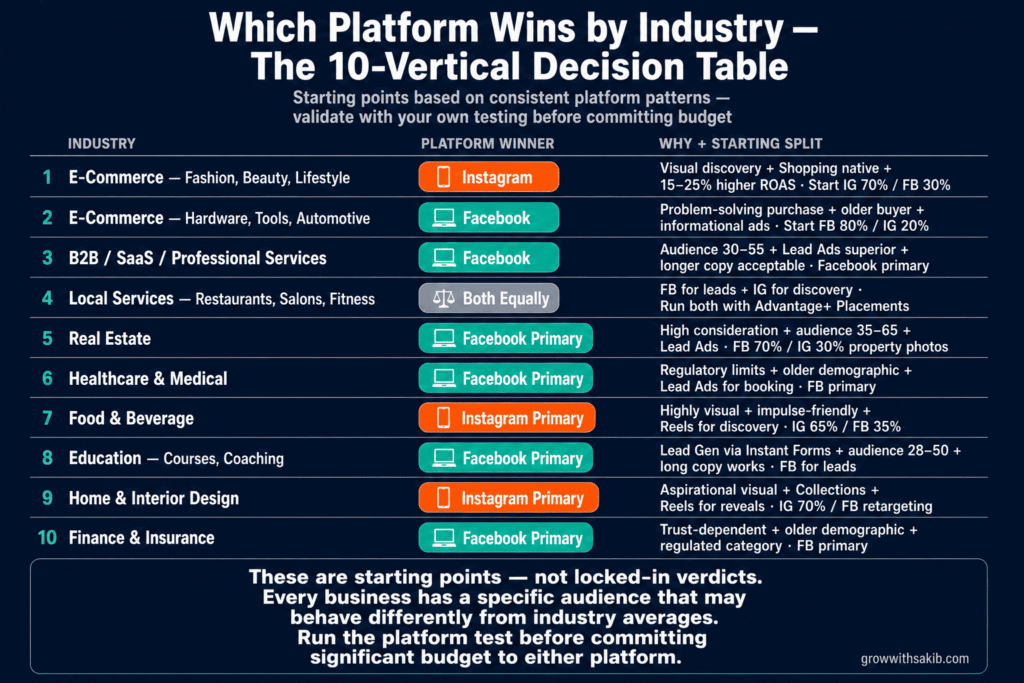
Which Platform Wins by Industry: The 10-Vertical Decision Table
This is the section most guides avoid because it requires taking a position. The table below reflects consistent patterns from platform data and agency-level campaign management — not universal laws, but reliable starting points that you can then validate with your own testing.
| Industry / Category | Platform Winner | Why | Starting Recommendation |
| E-commerce (fashion, beauty, lifestyle) | Visual discovery environment; Shopping native integration; impulse purchase behaviour; 15–25% higher ROAS | Start Instagram (70%) + Facebook retargeting (30%) | |
| E-commerce (hardware, tools, automotive) | Problem-solving purchase behaviour; older buyer demographic; informational ad content; comparison-driven decision | Start Facebook (80%) + Instagram awareness (20%) | |
| B2B / SaaS / Professional Services | Audience skews 30–55; Lead Ads superior; problem-solution ads outperform visual; longer copy is acceptable | Facebook primary; Instagram for thought leadership only | |
| Local services (restaurants, salons, fitness) | Equal / both | Both platforms reach local audiences; Facebook for leads, Instagram for brand and discovery | Run both with Advantage+ Placements and location targeting |
| Real estate | Facebook primary | Higher-consideration purchase; audience 35–65; educational content + Lead Ads for valuation tools; Groups engagement | Facebook 70% / Instagram 30% for property photography |
| Healthcare & medical | Facebook primary | Regulatory constraints limit creative; older demographic; information-seeking intent; Lead Ads for appointment booking | Facebook primary; Instagram for health content / clinic brand |
| Food & beverage | Instagram primary | Highly visual; impulse-friendly; younger diner demographics; Reels for food discovery performs exceptionally | Instagram 65% / Facebook 35% for local awareness |
| Education (courses, coaching) | Facebook primary | Lead generation via Instant Forms; audience 28–50; decision requires reading; Webinar/free content lead magnets work here | Facebook for leads; Instagram for organic-style thought leadership |
| Home & interior design | Instagram primary | Aspirational visual content; design-minded audience; Collections and Shopping integration; Reels for room reveals | Instagram 70% / Facebook for retargeting |
| Finance & insurance | Facebook primary | Trust-dependent decisions; regulatory ad category; older demographic; informational content + Lead Ads | Facebook primary; Instagram brand-building only in early funnel |
Creative Strategy: Why the Same Ad Rarely Works on Both Platforms
One of the most costly mistakes in cross-platform advertising is treating Facebook and Instagram as interchangeable display surfaces. They are not. The creative language that works on Facebook — longer copy, problem-solution framing, factual benefit statements — frequently underperforms on Instagram, and vice versa.
Facebook creative language
Facebook users are in a reading and evaluating mindset. They will engage with longer copy if it is relevant. They appreciate specific claims, testimonials, and structured arguments. They are comfortable with an ad that looks more like a Facebook post than a polished brand production.
- Copy length: Facebook allows and rewards longer primary text. Up to 3–5 sentences above the fold before ‘See More’ is acceptable and often performs well. Use this space to make your case.
- Format: Image ads work, but Facebook video — particularly native-style, subtitled, phone-shot content — often outperforms polished productions. The key is authenticity over aesthetics.
- Tone: Conversational and informative. Problem-solution framing — ‘Are you a small business owner struggling with [X]?’ — performs consistently on Facebook because users recognise themselves in specific situations.
- CTA: Specific and action-oriented. ‘Get your free quote’ or ‘Download the guide’ outperforms ‘Learn more’ on Facebook because users are primed to take the next step.
Instagram creative language
Instagram users respond to visual stimulation first. The image or first frame of video is everything — the copy exists to reinforce, not to sell. If your visual does not create an immediate reaction (desire, recognition, curiosity), the rest of the ad is irrelevant because the user has already scrolled past.
- Copy length: Short. The primary text should reinforce the visual in 1–2 sentences, not explain it. If your ad needs long copy to make sense, the visual is not strong enough for Instagram.
- Format: Vertical. Reels-style video that looks native to the platform consistently outperforms horizontal repurposed content. 9:16 for Stories and Reels, 4:5 for feed.
- Tone: Aspirational or relatable. Instagram ads that feel like content from a brand you follow outperform ads that feel like commercials. The ‘UGC-style’ trend — creator-filmed, authentic, slightly imperfect — works on Instagram in a way it does not on Facebook.
- CTA: Simple and low-friction. ‘Shop now’, ‘See collection’, ‘Swipe up’. Instagram users are not in decision-making mode — they are in discovery mode. Your CTA should feel like the natural next step, not a commitment.
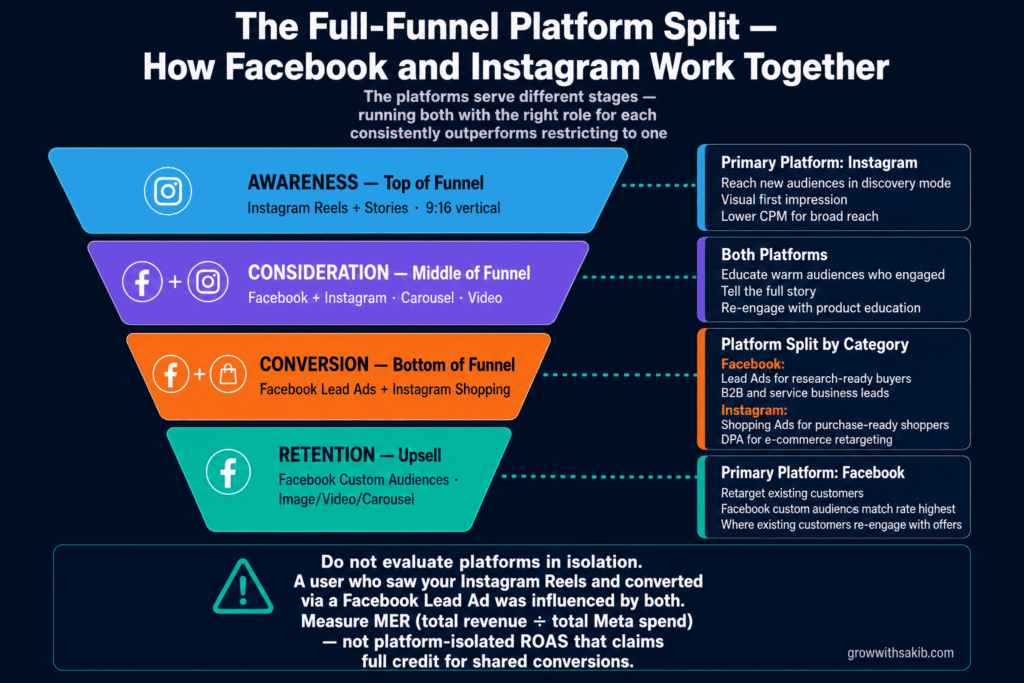
Running Both Platforms: The Strategy That Usually Wins
The ‘Facebook vs Instagram’ framing is useful for understanding each platform’s strengths. But in practice, most successful Meta advertisers eventually run both — because the platforms serve different stages of the buyer journey and because Meta’s algorithm performs best when it has flexibility across surfaces.
Why Advantage+ Placements changes the question
When you enable Advantage+ Placements (formerly Automatic Placements) in Ads Manager, you are not choosing between Facebook and Instagram. You are giving Meta’s algorithm the freedom to deliver your ad on whichever surface produces the best result for your specific audience at any given moment.
The performance case for this is strong. Meta’s internal data shows Advantage+ Placements delivers 30% better cost-per-result compared to manual placement selection for most campaign types — a principle explained fully in the Meta Ads Guide campaign structure section. When Instagram CPMs spike during Black Friday, the algorithm automatically shifts budget to Facebook Feed to maintain CPA stability. When Reels inventory is cheap and your vertical video is strong, it allocates there. You are not renting space on a specific platform — you are renting access to your audience wherever they happen to be.
When manual placement separation makes sense
Advantage+ Placements is the right default for most campaigns. But there are three situations where manually separating Facebook and Instagram placements into different ad sets is worth the extra complexity:
- When you want to run different creative on each platform — a text-heavy Facebook version and a visual-first Instagram version — without the algorithm mixing and matching inconsistently.
- When you are testing which platform performs better for your specific objective, using identical creative and targeting as the only variable — the Meta Ads A/B testing guide covers exactly how to set up this controlled platform comparison correctly.
- When you need to exclude specific placements for brand or policy reasons — for example, excluding Audience Network for B2B campaigns where that traffic quality is poor.
The funnel split that works best across industries
For advertisers with sufficient budget to run proper full-funnel campaigns, a platform split by funnel stage often outperforms running everything on one platform:
| Funnel Stage | Primary Platform | Format | Role |
| Awareness (TOFU) | Instagram (Reels + Stories) | Vertical video, 9:16 | Reach new audiences in discovery mode; visual first impression; lower CPM for broad reach |
| Consideration (MOFU) | Facebook + Instagram | Carousel, video, collection | Educate warm audiences who engaged with awareness content; tell the full story |
| Conversion (BOFU) | Facebook (Lead Ads) + Instagram (Shopping) | Lead forms, shopping ads, DPA | Close warm audiences; Facebook for research-ready leads — using Meta Custom Audiences to retarget your warmest segments — Instagram for purchase-ready shoppers |
| Retention / Upsell | Facebook (custom audiences) | Image, video, carousel | Retarget existing customers on the platform where they are most likely to re-engage with offers |
B2B Advertising on Facebook vs Instagram: The Underexplored Comparison
Most Facebook vs Instagram guides are written entirely through a B2C lens. B2B advertisers reading the standard ‘Instagram is for younger audiences and lifestyle brands’ framing often conclude Instagram is irrelevant for them. That conclusion is worth questioning.
Facebook for B2B: the default choice for good reasons
Facebook remains the stronger direct-response B2B platform. Lead Ads with Instant Forms consistently outperform cold traffic landing page campaigns for B2B lead generation. The audience skews older, which matches many B2B buyer profiles. Groups allow genuine community engagement with industry-specific audiences. And Facebook’s long-copy ad environment is better suited to the informational, problem-solution ads that B2B buyers respond to.
- Facebook B2B CPL benchmark (2026): $50–$150 for professional services; $80–$200 for B2B SaaS. High CPL, but justified by high LTV.
- Facebook B2B formats that work: Lead Ads with qualifying questions, video ads with testimonials or case study content, carousel ads for feature comparisons or team introductions.
- Facebook B2B targeting: Job title targeting on Facebook is limited compared to LinkedIn but works when layered with interest targeting (industry publications, software tools, professional organisations).
Instagram for B2B: underused and increasingly effective
Here is the B2B insight most guides miss: 73% of professionals use Instagram daily in 2026 — not for work, but they are there. The opportunity is not direct response (yet), but brand presence, thought leadership, and employer branding that influences buying decisions indirectly.
- B2B Instagram content that works: Reels and carousels that share genuine industry insight (not promotional content). Behind-the-scenes team and culture content. Data-led infographics. Expert commentary on industry news.
- The B2B Instagram play: Build authority through educational content. Retarget Instagram engagers on Facebook with Lead Ads. The two platforms work as a sequence — Instagram establishes credibility, Facebook captures the lead.
- What does not work: Running the same B2B messaging on Instagram that works on Facebook. Long copy, product feature lists, and aggressive CTAs perform poorly in Instagram’s visual-first environment.
How to Run a Proper Platform Test (And Find Your Real Numbers)
Industry benchmarks give you a starting point. Your own data gives you a decision. If you want to know definitively whether Facebook or Instagram performs better for your specific business, here is the testing framework that produces reliable answers.
Step 1: Isolate platform as the only variable
Create two identical ad sets — one Facebook-only, one Instagram-only. Everything else must be identical: the same creative assets, the same audience targeting, the same campaign objective, the same budget, the same bid strategy. The only difference is placement.
Step 2: Set the minimum viable test budget
Each platform needs enough budget to generate at least 50 optimisation events in 7–14 days. If your target CPA is £40, you need £2,000 per platform over two weeks (50 events × £40). Underfunding the test means you are measuring noise, not performance. Use an identical daily budget for both ad sets.
Step 3: Track the metrics that matter — not the superficial ones
Many advertisers compare CPC across platforms and declare a winner. That is the wrong metric. Track:
- Cost per landing page view (not just click — are Instagram clickers actually loading your page?)
- Conversion rate from landing page view to the desired action
- Cost per result (lead, purchase, trial signup — your actual conversion goal)
- ROAS or cost per customer acquired
Step 4: Run for 14 days minimum before drawing conclusions
Allow both ad sets to exit the learning phase. The learning phase requires approximately 50 optimisation events — if your budget does not generate that in 7 days, extend to 14. Do not pause or significantly modify either ad set during this period.
Step 5: Allocate budget based on results
After the test: the platform with lower CPA gets 60–70% of ongoing budget. The other platform gets 30–40% — not zero, because the cross-platform funnel effect is real and difficult to measure in isolation. Run the test quarterly, because platform performance shifts with seasonal competition, new ad inventory, and audience behaviour changes.
Frequently Asked Questions
Is Facebook or Instagram better for advertising?
Neither is universally better — each is better for specific objectives, industries, and audiences. Facebook wins for lead generation, B2B, audiences 35+, long-form informational content, and direct response campaigns where users click to external pages. Instagram wins for e-commerce (especially visual products), younger demographics, brand building, and product discovery. For most businesses with sufficient budget, running both with Advantage+ Placements and letting Meta’s algorithm optimise across surfaces produces better results than restricting to one.
Are Facebook ads cheaper than Instagram ads?
Facebook has a lower average CPC ($0.94–$1.72 vs Instagram’s $1.17–$2.00) and slightly lower CPM. However, for e-commerce and visual product categories, Instagram often delivers a lower CPA despite the higher CPC — because Instagram users who click on product ads convert at higher rates. Facebook is cheaper per click; Instagram is sometimes cheaper per customer. The relevant benchmark is CPA (cost per conversion), not CPC in isolation.
Should I run Facebook and Instagram ads at the same time?
Yes, in most cases. Running both with Advantage+ Placements enabled is Meta’s recommended approach and typically outperforms restricting to one platform by 25–30% on cost-per-result. The algorithm distributes your budget in real time to whichever surface produces the most efficient conversions for your specific audience. Running both also allows you to serve users at different stages — Instagram for discovery and brand-building, Facebook for conversion and lead capture.
Which platform is better for small businesses with limited budgets?
For small businesses, the starting point depends on what you are selling. If you run a local service business (plumbing, cleaning, fitness) or a B2B consultancy, start with Facebook Lead Ads — they generate leads at lower friction and cost. If you run a product-based business with visually appealing products, start with Instagram, where lower-cost Reels inventory and Shopping integration give you maximum visibility for a modest budget. With limited budget, concentrate entirely on one platform rather than spreading thinly across both.
What is the difference between Facebook ads and Instagram ads technically?
Technically, there is almost no difference. Both are managed through Meta Ads Manager. Both use the same audience targeting options, the same Pixel for conversion tracking, the same campaign objectives, and the same bidding strategies. The difference is in delivery — where the ad appears, who sees it, and how they interact with it. When you create a campaign in Ads Manager, you choose placements: Facebook-only, Instagram-only, or both. The ad system, tracking, and reporting are unified.
Can I use the same creative on Facebook and Instagram?
You can, but you generally should not — at least not without adaptation. The same image or video will render on both platforms, but the creative language that performs on Facebook (longer copy, informational tone, link-clicking intent) often underperforms on Instagram, where visual impact dominates and copy plays a supporting role. At minimum, create a vertical 9:16 version for Instagram Stories and Reels, and a 4:5 or 1:1 version for feeds. Ideally, adapt the copy tone to each platform’s environment as well.
What happened to Instagram Explore ads?
Meta removed the scrollable Instagram Explore feed in January 2026. Ads that previously ran in the Explore feed now deliver through Instagram Reels instead. The Explore Home grid (the tile layout when you tap the Explore tab) still exists and uses 1:1 format, but the main Explore feed inventory shifted to Reels. This effectively increased Reels inventory and contributed to Instagram Reels maintaining relatively lower CPMs compared to Feed placements.