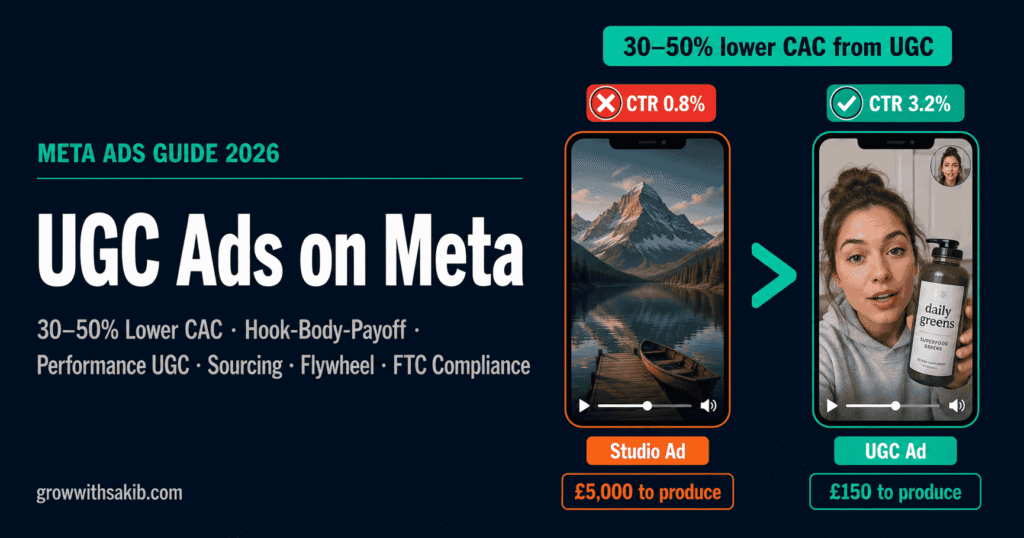
There is a strange paradox in Meta advertising in 2026. The ads that look the most expensive — polished, colour-graded, studio-lit, professionally produced — frequently perform the worst. The ads that look like someone filmed them on a phone in their kitchen frequently perform the best.
This is not a small effect at the margins. Across thousands of accounts, authentic UGC consistently lowers customer acquisition cost by 30-50% compared to traditional studio creative. The gap is large enough that for most direct-response advertisers, the question is no longer whether to use UGC — it is how to produce enough of it.
This guide explains why UGC works at a psychological level, the critical distinction between UGC that looks authentic and UGC that actually converts, how to source it, how to structure it, and how to build a production system that keeps your account fed with fresh creative — all as part of the complete Meta Ads playbook.
Why UGC Outperforms Professional Creative: The Mechanism
Most guides explain UGC’s success with one word: authenticity. That is correct but incomplete. Understanding the actual mechanism — why authentic content converts better — is what lets you produce UGC that works rather than UGC that just looks the part.
It bypasses ad-skepticism
People have spent two decades learning to recognise and ignore advertising. The moment a piece of content registers as ‘an ad,’ a mental filter engages and attention drops. Polished production values are one of the strongest signals that something is an ad. When content looks professionally produced, the skepticism filter activates before the message lands.
UGC sidesteps this. As Stackmatix’s UGC ads strategy analysis explains, UGC ads bypass ad skepticism and tap directly into social proof — when you see someone who feels like a peer using a product in a real environment, it triggers a form of validation that no brand-produced claim can replicate. The content reaches the viewer before the ‘this is an ad’ filter engages.
It is native to the feed
A UGC ad on Instagram or Facebook looks identical to the organic content surrounding it. Users engage with it before they realise it is an ad. This native quality is not a cosmetic preference — it directly affects delivery. Meta’s Andromeda algorithm and Advantage+ system reward content that generates genuine engagement, and native-feeling content generates more of it — which is why exiting the Meta ads learning phase faster is a direct benefit of high-engagement UGC creative.
As Adligator’s UGC creator network guide documents, Meta’s Advantage+ system rewards authentic-looking creative, and media buying teams that feed it a steady stream of UGC consistently outperform those relying on polished studio assets alone. The format and the algorithm reinforce each other.
It delivers peer-based social proof
A brand telling you its product is great is marketing. A person who appears to be a regular customer showing you the product working is evidence. The human brain weights these two signals completely differently. Social proof from an apparent peer is one of the most powerful persuasion mechanisms in existence, and UGC is social proof in its most native advertising form.
The Critical Distinction: Organic UGC vs Performance UGC
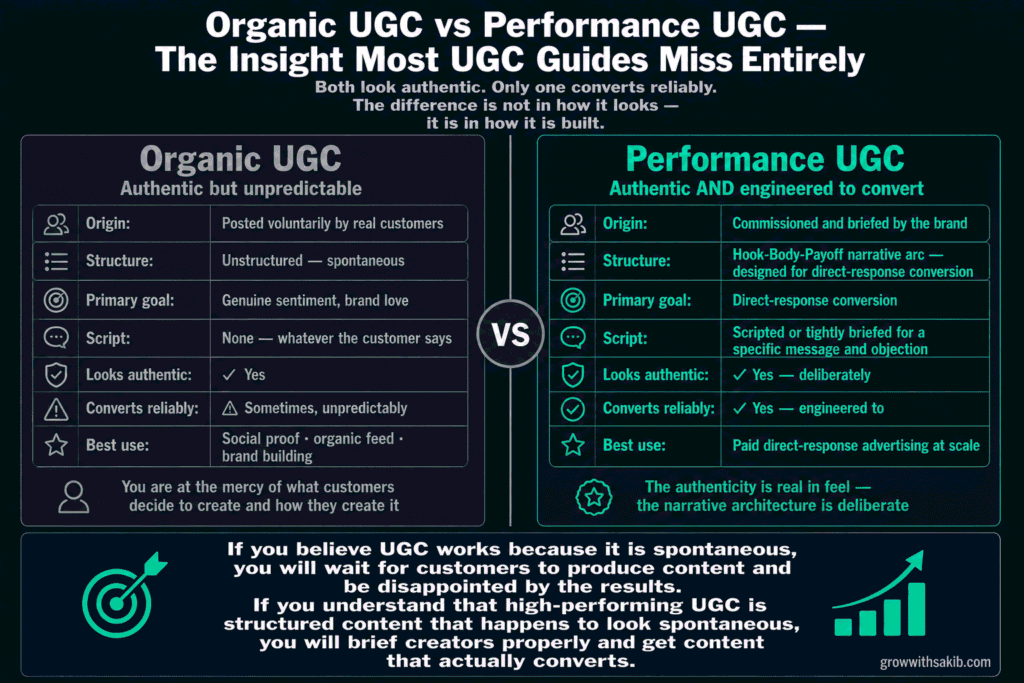
Here is the insight most UGC guides miss entirely. Not all UGC converts. Content that looks authentic but has no persuasion structure will get views and engagement without driving sales. The UGC that actually moves revenue is a specific, engineered thing.
1. Origin
- Dimension: Origin
- Organic UGC: Posted voluntarily by real customers
- Performance UGC: Commissioned and briefed by the brand
2. Structure
- Dimension: Structure
- Organic UGC: Unstructured, spontaneous
- Performance UGC: Hook-Body-Payoff narrative arc designed for conversion
3. Primary goal
- Dimension: Primary goal
- Organic UGC: Genuine sentiment, brand love
- Performance UGC: Direct-response conversion
4. Script
- Dimension: Script
- Organic UGC: None — whatever the customer says
- Performance UGC: Scripted or tightly briefed for a specific message and objection
5. Looks authentic?
- Dimension: Looks authentic?
- Organic UGC: Yes
- Performance UGC: Yes — deliberately
6. Converts reliably?
- Dimension: Converts reliably?
- Organic UGC: Sometimes, unpredictably
- Performance UGC: Yes — engineered to
7. Best use
- Dimension: Best use
- Organic UGC: Social proof, organic feed, brand building
- Performance UGC: Paid direct-response advertising at scale
As GetKoro’s 2026 UGC strategy guide documents, successful UGC in 2026 is less about serendipitous customer reviews and more about Performance UGC — strategically briefed, scripted, and edited content that mimics organic user behaviour while delivering a specific direct-response message. The authenticity is real in feel but engineered in function.
This distinction matters because it changes how you source and brief UGC. If you believe UGC works because it is spontaneous, you will wait for customers to produce content and be disappointed by the results. If you understand that high-performing UGC is structured content that happens to look spontaneous, you will brief creators properly and get content that converts.
The Hook-Body-Payoff Structure That Makes UGC Convert
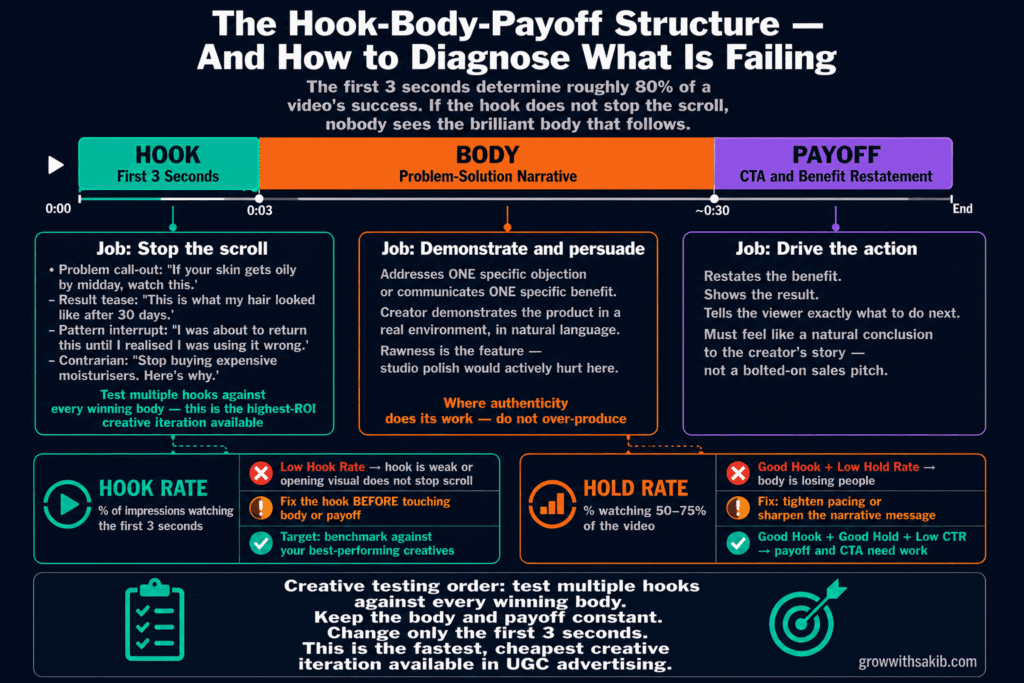
High-performing Performance UGC follows a consistent three-part narrative arc. Each part has a specific job, and the first part does most of the heavy lifting.
The Hook (first 3 seconds)
The first three seconds determine the fate of the entire ad. As GetKoro’s UGC analysis puts it, the first 3 seconds determine 80% of a video’s success. If the hook does not stop the scroll, nothing else in the video matters because nobody sees it.
The hook is also the element you should test most aggressively. The standard practice among high-performing accounts is to keep the body of a winning video and test multiple different hooks against it — the fastest, cheapest creative iteration available.
Hook types that work in UGC:
- The problem call-out: ‘If your skin gets oily by midday, watch this.’ Names the viewer’s exact problem in the first second.
- The result tease: ‘This is what my hair looked like after 30 days.’ Shows the payoff up front to create curiosity about the method.
- The pattern interrupt: ‘I was about to return this until I realised I was using it wrong.’ An unexpected statement that breaks the scroll rhythm.
- The contrarian hook: ‘Stop buying expensive moisturisers. Here’s why.’ Challenges a category assumption.
The Body (problem-solution narrative)
The body delivers the substance: what the problem is, how the product solves it, and why this product specifically. In Performance UGC, the body addresses one specific objection or communicates one specific benefit. Trying to communicate everything dilutes the message and reduces conversion.
The body is where authenticity does its work. The creator demonstrates the product in a real environment, speaks in natural language, and shows rather than claims. This is the section where studio production would actively hurt — the rawness is what makes it believable.
The Payoff (the CTA)
The payoff resolves the narrative and drives the action. It restates the benefit, shows the result, and tells the viewer exactly what to do next. The payoff should feel like a natural conclusion to the creator’s story, not a bolted-on sales pitch.
The two diagnostic metrics: Hook Rate and Hold Rate
Before conversion data accumulates, two leading indicators tell you whether your UGC is working — alongside tracking your overall Meta Ads attribution data to understand the full conversion picture. As GetKoro documents, Hook Rate (the percentage of impressions that watch the first 3 seconds) and Hold Rate (the percentage that watch 50-75% of the video) diagnose creative health before your CPA data is statistically meaningful.
- Low Hook Rate: the first 3 seconds are failing. The hook is weak, or the opening visual does not stop the scroll. Fix the hook before anything else — the same principle that applies when writing Facebook ad copy hooks for static and carousel formats.
- Good Hook Rate, low Hold Rate: the hook works but the body loses people. The narrative is not holding attention — tighten the pacing or sharpen the message.
- Good Hook and Hold Rate, low CTR: people watch but do not click. The payoff and CTA need work, or the offer itself is not compelling enough.
Where to Source UGC: The Four Sourcing Channels
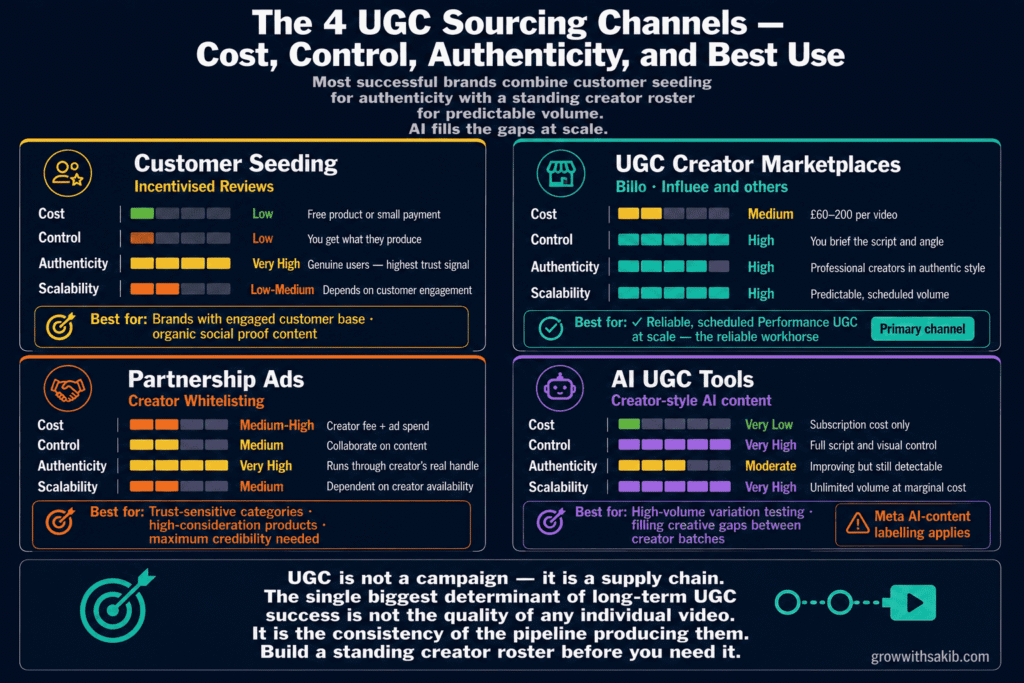
The hardest part of UGC is not understanding that it works — it is producing enough of it consistently. There are four sourcing channels, each with different cost, control, and scalability tradeoffs.
1. Customer seeding (incentivised reviews)
- Source: Customer seeding (incentivised reviews)
- Cost: Low — free product or small payment
- Control: Low — you get what they produce
- Authenticity: Highest — genuine users
- Best For: Brands with an engaged customer base; social proof content
2. UGC creator marketplaces (Billo, Influee, etc.)
- Source: UGC creator marketplaces (Billo, Influee, etc.)
- Cost: Medium — £60-200 per video
- Control: High — you brief the script and angle
- Authenticity: High — professional creators in authentic style
- Best For: Reliable, scheduled volume of Performance UGC
3. Partnership Ads / creator whitelisting
- Source: Partnership Ads / creator whitelisting
- Cost: Medium-High — creator fee + ad spend
- Control: Medium — collaborate on content
- Authenticity: Very High — runs through creator’s real handle
- Best For: Trust-sensitive categories; maximum credibility
4. AI UGC tools
- Source: AI UGC tools
- Cost: Lowest — subscription cost
- Control: Highest — full script and visual control
- Authenticity: Moderate — improving but detectable
- Best For: High-volume variation testing; filling creative gaps
Customer seeding: the most authentic, least controllable
Sourcing from your existing customer base produces the most believable content because the users are genuine. As Stackmatix recommends, source creators from your existing customer base first — genuine users produce the most believable and converting content, especially when you already have a strong Google reviews base that signals real customer satisfaction. The tradeoff is control: you cannot fully direct what a customer produces, and quality varies widely.
UGC creator marketplaces: the reliable workhorse
For predictable, scheduled volume, professional UGC creator marketplaces are the backbone of most serious UGC operations — and the engagement data from these campaigns feeds powerful Meta lookalike audiences for cold prospecting. As Influee’s UGC ads guide notes, partnering with professional UGC creators who understand brand guidelines produces high-quality, authentic-looking content on demand — ensuring consistency, legal compliance, and content optimised for ad performance. Cost typically runs £60-200 per video depending on creator experience and deliverables.
AI UGC: the emerging volume play
AI UGC tools generate creator-style content from scripts without filming. As Design Revision’s UGC guide observes, brands that cannot source enough organic video UGC increasingly turn to AI UGC tools to fill the gap with creator-style content at scale. The quality is improving rapidly, though AI-generated content remains detectable to some viewers and carries specific disclosure requirements covered later in this guide.
Partnership Ads: Running UGC Through the Creator’s Handle
Partnership Ads — formerly called whitelisting — let you run ads through a creator’s own Instagram or Facebook handle rather than your Meta Business Manager brand account. According to Meta’s Partnership Ads documentation, this displays the creator as the primary voice with your brand as a partner, rather than the content appearing as a brand advertisement.
The performance impact is significant. As GetKoro’s analysis documents, running ads through a creator’s handle significantly boosts trust and CTR compared to brand-handle ads. The reason connects directly to the ad-skepticism mechanism: content from an individual’s account carries more credibility than content from a brand account, because viewers apply less skepticism to apparent peers than to brands.
When to use Partnership Ads
- Trust-sensitive categories: supplements, skincare, finance, anything where credibility is the primary purchase barrier. The creator’s apparent endorsement carries weight.
- Creator-led content: when the creator has genuine following or authority in your category, running through their handle leverages their established trust.
- High-consideration products: where the viewer wants reassurance from a real person before committing.
How to Produce UGC That Performs: Practical Guidelines
Whether you source from customers, creators, or AI, certain production principles separate UGC that converts from UGC that just exists.
Film vertical, film on a phone
As the 2026 Meta Ads Blueprint documents, vertical video designed for Reels and Stories is the top-performing format on Meta in 2026, followed by authentic UGC-style content that looks like it could have been posted by a friend. Do not overproduce. A modern smartphone camera is all the production quality UGC needs — and often more than it should have. Pair your UGC with the right Meta ad format for each placement to maximise its impact across Feed, Reels, and Stories.
Design for sound-off viewing
The majority of Meta users watch video with sound off. Captions are not optional — they are essential. Every UGC ad should be fully comprehensible with no audio, with clear, readable captions burned into the video. The hook in particular must work visually, because many viewers will never hear the opening line.
Match the format to placement
UGC should be produced for the placement it will run in. Content for Reels and Stories needs to be vertical, fast-paced, and front-loaded. Feed content can be slightly longer. Producing one horizontal video and forcing it into every placement wastes the format advantage that makes UGC work in the first place.
Produce variations, not single videos
The Andromeda-era reality is that creative volume drives performance. As covered in our guide to Advantage+ Shopping Campaigns, Meta’s algorithm needs creative diversity to find winners. A single UGC video is a starting point. The same video with five different hooks, in three different formats, is a creative testing programme. Plan to produce variations from every shoot.
FTC Disclosure and Meta’s AI-Content Rules
UGC advertising carries compliance obligations that many brands overlook until they become a problem. Two areas require specific attention: FTC disclosure of material connections, and Meta’s labelling requirements for AI-generated content.
FTC material connection disclosure
The FTC’s endorsement guidelines require clear and conspicuous disclosure whenever there is a material connection between a brand and the person creating content. If a creator received free product, payment, or any form of compensation, the content must disclose that relationship — typically with #ad or #sponsored, clearly visible, not buried.
This applies to UGC ads. A creator video you commissioned and are running as a paid ad has an obvious material connection — the same applies to any Meta custom audience retargeting using creator content from past engagers. The disclosure protects both you and the creator, and Meta’s own policies require compliance with applicable advertising laws.
Meta’s AI-content labelling requirement
If you use AI UGC tools — or Meta’s own Advantage+ Creative generative features — Meta requires transparency. Per Meta’s AI disclosure policy, ad images created or materially edited using generative AI are labelled with an ‘AI info’ tag visible in the ad menu. Understand which of your creative tools trigger this label and factor it into your creative strategy.
Building the UGC Content Flywheel
The brands that win with UGC long-term do not run UGC campaigns. They build UGC systems — self-reinforcing loops where success generates more of the input that drives success.
As Design Revision describes it, the content flywheel works like this: as your brand grows, more customers create UGC organically. More UGC means more ad creative. More ad creative means lower CPAs through better testing and less fatigue — and stronger Meta retargeting strategy as UGC video viewers become warm retargeting audiences. Lower CPAs mean more customers. More customers mean more UGC. The flywheel compounds over time.
The components of a working UGC system
- A standing creator roster: 3-5 vetted creators producing a predictable number of videos per month — managed through your Meta Ads account and Business Manager setup for proper rights and billing.
- A customer seeding programme: a systematic way to incentivise and collect content from real customers continuously.
- A briefing template: a repeatable brief that communicates your hooks, objections to address, and brand guidelines so every creator produces on-message content.
- A testing cadence: a system for testing new hooks and concepts on a regular schedule, using A/B testing discipline to identify winners reliably.
- A refresh trigger: a defined point — typically when CTR drops 20% from baseline or frequency exceeds 3.5 — at which you rotate in fresh creative before performance collapses.
5 UGC Ad Mistakes That Waste the Format’s Advantage
Mistake 1: Over-producing the content
Adding professional lighting, colour grading, and polished editing to UGC defeats its entire purpose. The rawness is the feature. When you polish UGC, you reintroduce the production signals that trigger ad-skepticism — turning your authentic content back into an obvious advertisement.
Fix: resist the urge to make UGC look professional. Film on a phone, keep the editing minimal, and let the authenticity show.
Mistake 2: Treating UGC as spontaneous rather than structured
Believing UGC works because it is unscripted leads to unstructured content that looks authentic but does not convert. Organic-feeling does not mean unstructured. The best UGC follows the Hook-Body-Payoff arc deliberately.
Fix: brief and structure your UGC as Performance UGC. The authenticity is in the delivery; the structure is in the architecture.
Mistake 3: Running UGC as a one-off instead of a pipeline
Commissioning a handful of videos and running them until they fatigue, with no replacement pipeline, guarantees a performance collapse in 4-8 weeks. UGC fatigues like all creative — faster, in fact, because the same authentic video becomes familiar quickly — the same compounding logic that makes SEO for small business a complementary channel that builds value without creative fatigue.
Fix: build a standing creator relationship and a content flywheel. Treat UGC as a supply chain, not a campaign.
Mistake 4: Neglecting the hook
Spending all the effort on the product demonstration and treating the first three seconds as an afterthought wastes the most important part of the video. If the hook does not stop the scroll, the brilliant body never gets seen.
Fix: test multiple hooks against every winning body. Make the hook the primary unit of creative iteration. Monitor Hook Rate as your first diagnostic.
Mistake 5: Skipping FTC disclosure
Running commissioned creator content without disclosure to avoid ‘looking like an ad’ creates legal exposure and risks Meta ad rejection. The performance cost of disclosure is negligible; the cost of skipping it can be severe.
Fix: always disclose material connections per FTC guidelines, and understand Meta’s AI-content labelling requirements. Compliance and performance are not in conflict.
Frequently Asked Questions
What are UGC ads?
UGC (user-generated content) ads are paid advertisements that use authentic, customer-style content — usually smartphone-shot video — as the creative, designed to look like organic social posts rather than produced advertisements. On Meta, they consistently outperform polished studio creative because they bypass viewer ad-skepticism and deliver peer-based social proof. As Design Revision’s UGC guide notes, the entire point is that they look like organic content, not ads.
Why do UGC ads perform better than professional ads?
UGC outperforms professional creative for three connected reasons: it bypasses the mental filter people apply to obvious advertising, it blends natively into the feed so users engage before realising it is an ad, and it delivers social proof from apparent peers — which the brain weights far more heavily than brand claims. Polished production signals ‘advertisement’ and triggers skepticism; authentic content reaches viewers before that filter engages.
What is the difference between organic UGC and Performance UGC?
Organic UGC is content customers post voluntarily — authentic but unstructured, and unpredictable as ad creative. Performance UGC is content that is briefed, scripted, and structured for direct-response conversion while still looking authentic. As GetKoro documents, Performance UGC follows a deliberate Hook-Body-Payoff arc. The authenticity is real; the narrative structure is engineered. Performance UGC is what drives reliable advertising results.
Where can I find UGC creators for Facebook ads?
Four channels: customer seeding (incentivise existing customers — most authentic), UGC creator marketplaces like Billo or Influee (reliable, scheduled volume at £60-200 per video), Partnership Ads with creators who have genuine followings, and AI UGC tools for high-volume variation testing. Most successful brands combine customer seeding for authenticity with a standing creator roster for predictable volume.
How do I structure a UGC ad that converts?
Use the Hook-Body-Payoff structure. The Hook (first 3 seconds) stops the scroll — this determines roughly 80% of the video’s success. The Body delivers a problem-solution narrative addressing one specific objection or benefit, demonstrated authentically. The Payoff restates the benefit and drives a clear action. Monitor Hook Rate and Hold Rate as leading indicators of creative health before conversion data accumulates.
Do UGC ads need FTC disclosure?
Yes. The FTC’s endorsement guidelines require clear and conspicuous disclosure whenever a material connection exists between a brand and a content creator. If a creator received free product, payment, or any compensation, the UGC ad must disclose it — typically with a visible #ad or #sponsored. Disclosure does not meaningfully reduce performance, and skipping it risks FTC enforcement and Meta ad rejection.
Are AI-generated UGC ads allowed on Meta?
Yes, but with transparency requirements. Per Meta’s AI disclosure policy, ad creative created or materially edited using generative AI — including Meta’s own Advantage+ Creative features — is labelled with an ‘AI info’ tag. AI UGC tools are increasingly used to produce creator-style content at scale, though AI-generated content remains somewhat detectable and should be tested against authentic creator content rather than assumed equivalent.
Key Takeaways
- UGC ads lower customer acquisition cost by 30-50% versus polished studio creative because they bypass ad-skepticism, blend natively into the feed, and deliver peer-based social proof.
- Authenticity is necessary but not sufficient. The UGC that converts is Performance UGC — briefed and structured for direct response while still looking authentic.
- The Hook-Body-Payoff structure drives conversion. The first 3 seconds determine roughly 80% of a video’s success — make the hook your primary unit of testing.
- Hook Rate and Hold Rate diagnose creative health before conversion data is statistically meaningful. Use them to pinpoint whether the hook, body, or payoff needs work.
- UGC is a supply chain, not a campaign. The brands that win build a content flywheel: a standing creator roster, customer seeding, and a refresh cadence that rotates creative before fatigue.
- Partnership Ads (running through the creator’s handle) boost trust and CTR in trust-sensitive categories by leveraging the credibility of an individual over a brand account.
- Always disclose material connections per FTC rules and understand Meta’s AI-content labelling. Disclosure costs almost nothing in performance and protects against serious downside.
- Do not over-produce. Polish reintroduces the production signals that trigger ad-skepticism. Film vertical, film on a phone, and let the rawness do its work.