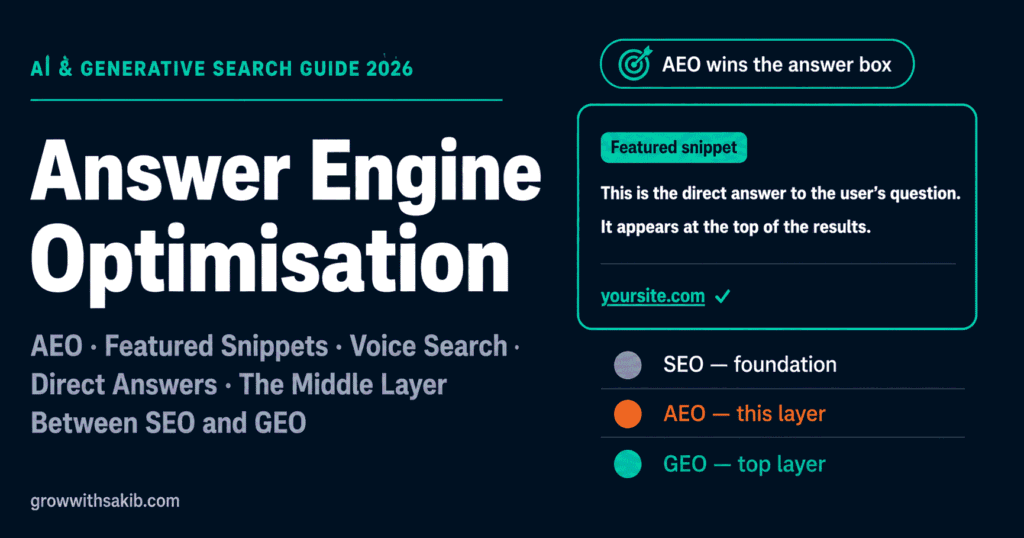
Ranking on Google used to be the finish line. Now there’s a step beyond it: becoming the answer the platform reads aloud, boxes at the top, or feeds into an AI summary. That’s what answer engine optimisation is for – and it’s a distinct skill from both classic SEO and GEO.
This guide defines AEO as the third layer of 2026 visibility, shows how it differs from GEO, and – importantly – gives you the current picture on FAQ schema, which most guides get badly wrong. It sits within the complete guide to generative engine optimization on GrowWithSakib and bridges into content strategy and technical SEO.
SEO, AEO, GEO: The Three Layers of 2026 Visibility
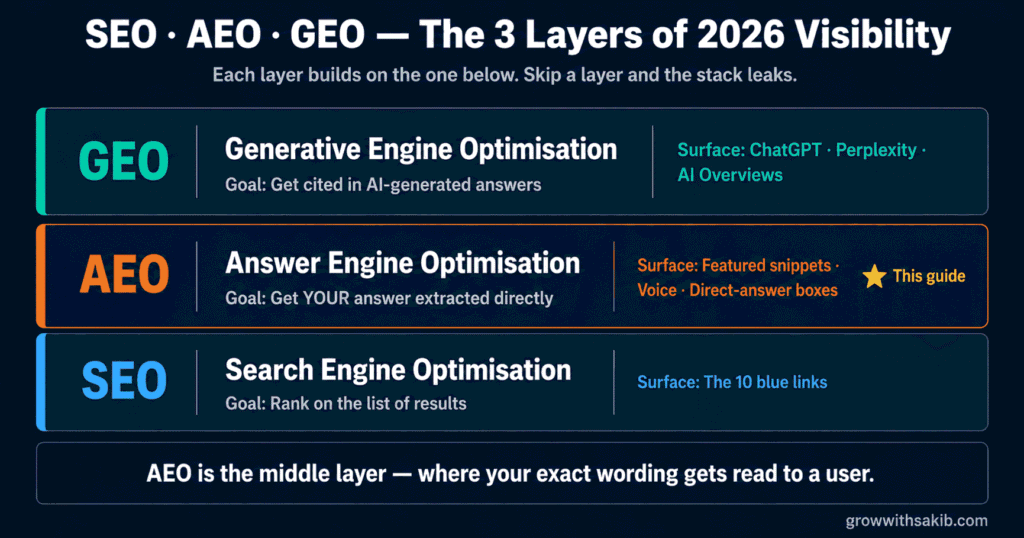
The clearest way to understand AEO is to see where it sits. Think of modern visibility as three stacked layers, each building on the one below.
| Layer | Goal | Where You Show Up |
|---|---|---|
| SEO | Rank in the list of links | Traditional organic results |
| AEO | Become the extracted answer | Featured snippets, PAA, voice, answer boxes |
| GEO | Get cited and recommended by AI | ChatGPT, Perplexity, Gemini, AI Overviews |
In one line: SEO gets you onto the page, AEO makes you the answer on that page, and GEO gets AI to recommend you beyond it. They’re not rivals – they’re a progression. Each sits on the same foundation of crawlable, helpful, trustworthy content, which is why roughly 70-80% of the work overlaps with solid SEO. Start from the small business SEO guide on GrowWithSakib and layer up.
What Is Answer Engine Optimisation, Exactly?
AEO is optimising your content to be selected as the single direct answer a platform serves, instead of one blue link among ten. The term is generally credited to Jason Barnard of Kalicube, who framed it around “position zero” – featured snippets and voice-assistant answers – before AI Overviews existed.
The core mechanic has stayed constant even as the surfaces multiplied: be chosen as the answer, not just as a result. Whether it’s Google boxing your paragraph as a featured snippet, Alexa reading it aloud, or an AI Overview pulling it into a summary, the same qualities win – a clear, self-contained, direct answer to a specific question.
How Is AEO Different From GEO?
This trips up almost everyone, because the terms overlap and many people use them interchangeably. Here’s the honest distinction most practitioners settle on:
- AEO focuses on being extracted as the answer on answer surfaces – featured snippets, People Also Ask, voice, and Google’s own AI features.
- GEO focuses on being cited and recommended inside generative AI responses from third-party models like ChatGPT, Perplexity, and Claude.
In practice, AEO is often treated as one part of a broader GEO strategy, and the tactics overlap heavily – both reward clear, structured, direct answers. The clean way to hold it: AEO is about the answer box, GEO is about the AI recommendation. For the deeper comparison of GEO against traditional search, see GEO vs SEO on GrowWithSakib.
| Dimension | AEO | GEO |
|---|---|---|
| Primary surface | Snippets, PAA, voice, AI Overviews | ChatGPT, Perplexity, Gemini, Claude |
| Goal | Be extracted as the answer | Be cited and recommended |
| Typical timeline | Often 30-60 days | Often 3-6+ months |
| Core unit | The direct answer passage | The cited source and entity |
| Relationship | A layer on top of SEO | Broader; often includes AEO |
How Do You Win Featured Snippets?
Featured snippets are the original AEO surface and still one of the highest-leverage, because Google’s AI features often pull from them. To win one, give Google a clean answer that’s easy to lift.
- Target a specific question – find the exact question (People Also Ask and autocomplete are goldmines) and make it a heading.
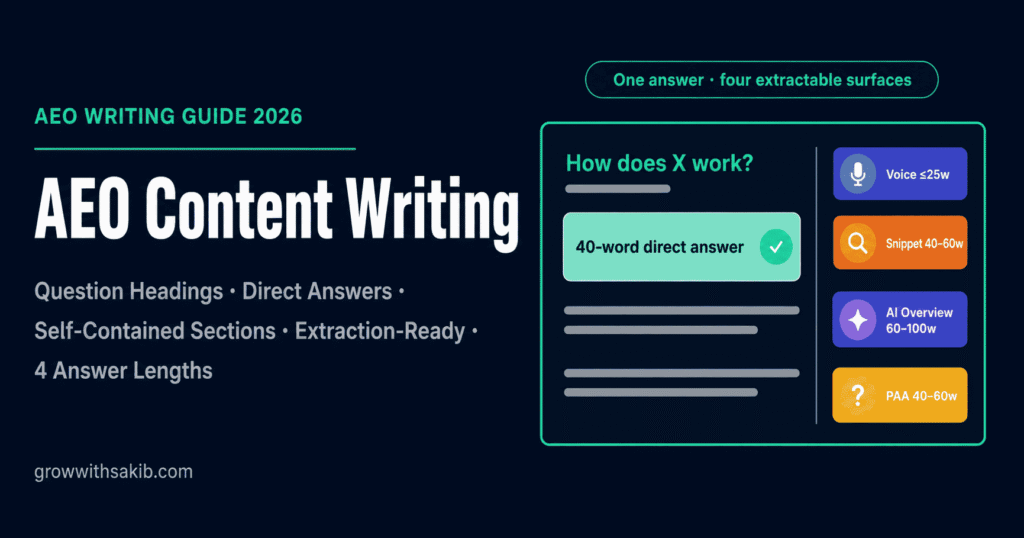
- Answer in 40-60 words, immediately – put a direct, self-contained answer right under the question heading, before you expand.
- Match the current format – if the live snippet is a list, write a list; if it’s a table, build a table; if a paragraph, lead with one.
- Target queries where you already rank 2-10 – snippets usually come from page-one results, so these are the recoverable wins.
This is the same answer-first discipline that wins AI citations, covered in depth in how to structure content for AI summaries on GrowWithSakib. Do it once, benefit across snippets, voice, and AI answers.
How Do You Optimise for Voice Search?
Voice search optimisation means writing the way people speak, because voice queries are longer and more conversational than typed ones. When someone asks a smart speaker a question, the assistant usually reads back a single concise answer – often sourced from a featured snippet.
- Use natural-language questions – target “how much does X cost?” rather than “X price,” matching how people actually talk.
- Answer conversationally and concisely – a clear one-to-two sentence spoken-style answer is what gets read aloud.
- Win the featured snippet first – since voice assistants often pull from snippets, snippet optimisation is voice optimisation.
- Cover local phrasing – many voice queries are local (“near me”), so keep your local details clear and current.
A caveat on honesty: you’ll see dramatic voice-search statistics quoted everywhere, and many vary wildly by source. Voice matters, but treat the eye-catching percentages with caution and focus on the durable habit – write clear, conversational answers – which helps every answer surface at once.
Does FAQ Schema Still Work in 2026?
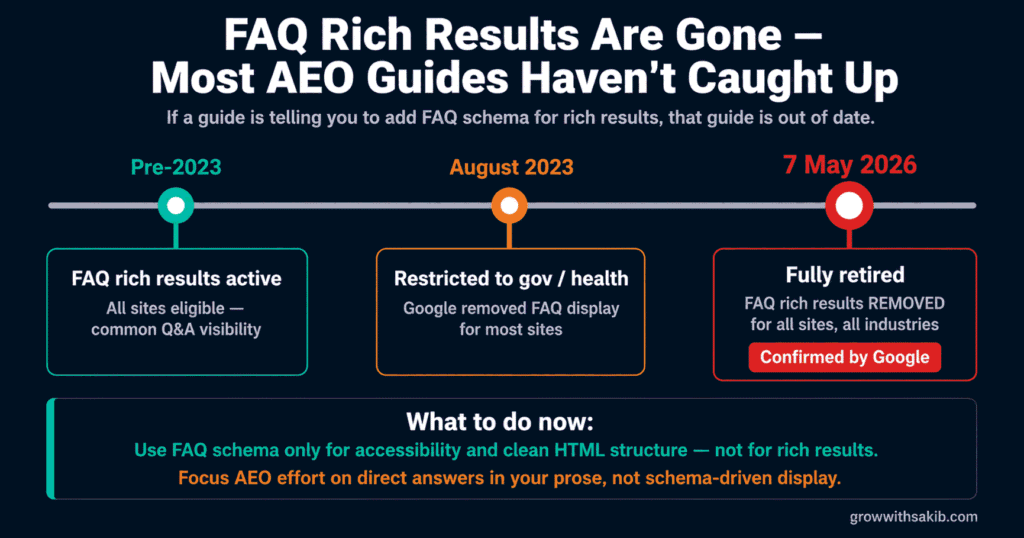
Here’s where almost every AEO guide is now wrong. The short answer: the FAQ rich result is gone, so FAQ schema is no longer a way to win extra search real estate – but well-structured Q&A content still matters.
So what should you actually do? Focus on the content, not the markup.
- Keep genuinely useful FAQ content – real questions your customers ask, answered clearly, still build topical coverage and help readers.
- Don’t chase the dead rich result – adding FAQPage schema to win a snippet no longer works, because that snippet is gone.
- Leave existing valid markup in place – Google confirms unused structured data causes no problems, and other crawlers may still parse it.
- Never make FAQ answers promotional – Google’s guidance is explicit that FAQ content shouldn’t be advertising; keep it genuinely helpful.
The honest bottom line: the active ingredient was always the clear Q&A content, not the JSON-LD. AI systems and search engines pull from clean, self-contained answers whether the markup is there or not. Build the answers; treat schema as an optional, accurate description of what’s already visible. For the wider structured-data picture, see the technical SEO guide on GrowWithSakib.
The AEO Implementation Checklist
Here’s the consolidated, current checklist – no obsolete tactics. Work top to bottom.
| Step / Action | Why It Matters |
|---|---|
| 01. Rank on page one first | Answer surfaces pull from top results |
| 02. Phrase headings as real questions | Matches the queries answer engines serve |
| 03. Give a 40-60 word direct answer under each | The exact unit snippets and AI extract |
| 04. Match the answer format (list/table/para) | Snippets reward format-matched answers |
| 05. Write conversationally for voice | Voice reads back natural, concise answers |
| 06. Keep genuine FAQ content (skip the schema chase) | Content works; the rich result is gone |
| 07. Back answers with specific facts | Verifiable specifics get extracted and cited |
| 08. Keep high-value pages fresh | Freshness is a trust signal across surfaces |
| 09. Test on real answer engines monthly | The only honest way to measure AEO |
Measure AEO differently from SEO: watch Search Console for the tell-tale high impressions, lower clicks pattern on question queries (a sign you’re appearing in an answer surface), and manually test your target questions on Google, voice, and AI tools. The approach mirrors the measurement method in the guide to tracking SEO results on GrowWithSakib.
Honest Limits of AEO
Be realistic about what AEO does and doesn’t do:
- It sits on SEO, not instead of it – you generally need to rank on page one before you can be the extracted answer. No foundation, no snippet.
- Answer surfaces can reduce clicks – winning a snippet or being read aloud can satisfy the user without a visit, so pair AEO with a plan to earn the click that matters.
- The stats are noisy – many circulating AEO figures are vendor-stated or fast-changing; follow the durable direction, not any single percentage.
- Surfaces change fast – Google retired FAQ and HowTo rich results; features come and go, so optimise for the underlying signal (be the clear answer), not one box.
The reassuring part: because every layer rewards the same core – clear, credible, well-structured answers – the work compounds. Nail AEO and you’re most of the way to GEO too, which is exactly the path the complete GEO guide lays out.
Common AEO Mistakes
| Mistake | Why It Hurts | Do This Instead |
|---|---|---|
| Adding FAQ schema for rich results | That result was retired in 2026 | Keep useful Q&A content; skip the schema chase |
| Burying the answer mid-section | Answer engines can’t extract it | Lead with a 40-60 word direct answer |
| Ignoring the snippet’s format | Format mismatch loses the box | Match list/table/paragraph to the live snippet |
| Writing only in keyword phrases | Misses conversational voice queries | Phrase headings as natural questions |
| Treating AEO as separate from SEO | You skip the ranking prerequisite | Rank first, then optimise the answer |
| Chasing vanity SERP features | Features get retired | Optimise the underlying answer signal |
| Trusting inflated AEO stats | Many are shaky or dated | Follow the durable direction, test yourself |
Frequently Asked Questions
1. What is answer engine optimisation (AEO)?
Answer engine optimisation (AEO) is structuring your content so search platforms use it as the direct answer – in featured snippets, People Also Ask boxes, voice assistant replies, and AI answer boxes – rather than just one link in a list. You win by leading each section with a clear 40-60 word answer to a specific question, matching the expected format, and keeping content genuinely helpful. AEO sits between SEO and GEO in the visibility stack.
2. How is AEO different from GEO?
AEO focuses on being extracted as the answer on answer surfaces like featured snippets, People Also Ask, voice, and Google’s AI features. GEO focuses on being cited and recommended inside generative AI responses from third-party models like ChatGPT, Perplexity, and Claude. The tactics overlap heavily, and AEO is often treated as one part of a broader GEO strategy. In short: AEO is the answer box, GEO is the AI recommendation.
3. Is AEO different from SEO?
Yes, but it builds on SEO. SEO gets your page ranked in the list of links; AEO gets your content selected as the direct answer on that page – the featured snippet, voice reply, or answer box. Roughly 70-80% of the work overlaps, since both need crawlable, helpful, well-structured content. AEO is best seen as a layer on top of solid SEO, not a replacement for it.
4. Does FAQ schema still work in 2026?
Not for winning rich results. Google restricted FAQ rich results in 2023 and fully retired them in May 2026, so the expandable FAQ dropdown no longer appears for virtually any commercial site. FAQPage remains valid markup and needn’t be removed, but the value is now in the clear Q&A content itself, not the schema. Build genuinely useful answers rather than chasing a retired feature.
5. How do I win a featured snippet?
Target a specific question as a heading, then give a direct 40-60 word answer immediately under it, before expanding. Match the current snippet format – write a list if the live snippet is a list, a table if it’s a table. Focus on queries where you already rank in positions 2-10, since snippets usually come from page-one results. Clean, format-matched, self-contained answers win the box.
6. How do I optimise for voice search?
Write the way people speak. Voice queries are longer and conversational, so target natural-language questions like “how much does X cost?” and answer them concisely in one or two spoken-style sentences. Because voice assistants often read back featured snippets, winning the snippet is winning voice. Keep local details clear too, since many voice queries are local “near me” searches.
7. How long does AEO take to show results?
Often faster than classic SEO. Because answer surfaces pull from pages that already rank, AEO changes to a page ranking on page one can show up in featured snippets or answer boxes within roughly 30-60 days of Google recrawling it. GEO results from third-party AI models typically take longer – often several months – since those models update on different cycles. Both depend on a solid SEO foundation first.
8. Can small businesses win at AEO?
Yes, often faster than at broad SEO. Answer surfaces reward the clearest, best-formatted answer to a specific question, so a smaller site targeting precise long-tail questions can win snippets and answer boxes without huge authority. Niche topical depth matters more than overall domain strength here. Focus on genuinely useful, well-structured answers to the exact questions your customers ask, and test which ones you’re winning.
Key Takeaways
- Answer engine optimisation (AEO) makes your content the direct answer – in featured snippets, PAA, voice, and AI answer boxes – not just a link in the list.
- Hold the three-layer model: SEO gets you on the page, AEO makes you the answer, GEO gets AI to recommend you beyond it.
- AEO means being extracted as the answer on answer surfaces; GEO means being cited by generative AI – and AEO is often one part of a broader GEO strategy.
- FAQ schema no longer wins rich results – Google restricted them in 2023 and fully retired them in May 2026 – so build clear Q&A content instead of chasing the box.
- Win featured snippets with a 40-60 word direct answer under a question heading, matched to the live snippet’s format (list, table, or paragraph).
- Optimise for voice by writing conversational, natural-language questions and concise spoken-style answers – and by winning the featured snippet first.
- AEO sits on an SEO foundation, shows results faster than SEO (often 30-60 days), and rewards the clearest, best-formatted answer.
- Treat AEO stats with caution, optimise for the underlying answer signal rather than any single retired feature, and test on real answer engines monthly.