The number one reason small business content flops isn’t bad writing – it’s that it was written for nobody in particular. Generic content that could have come from any brand gets ignored, and in a world where AI can churn out infinite bland copy, knowing precisely who you’re writing for is the single biggest differentiator you have.
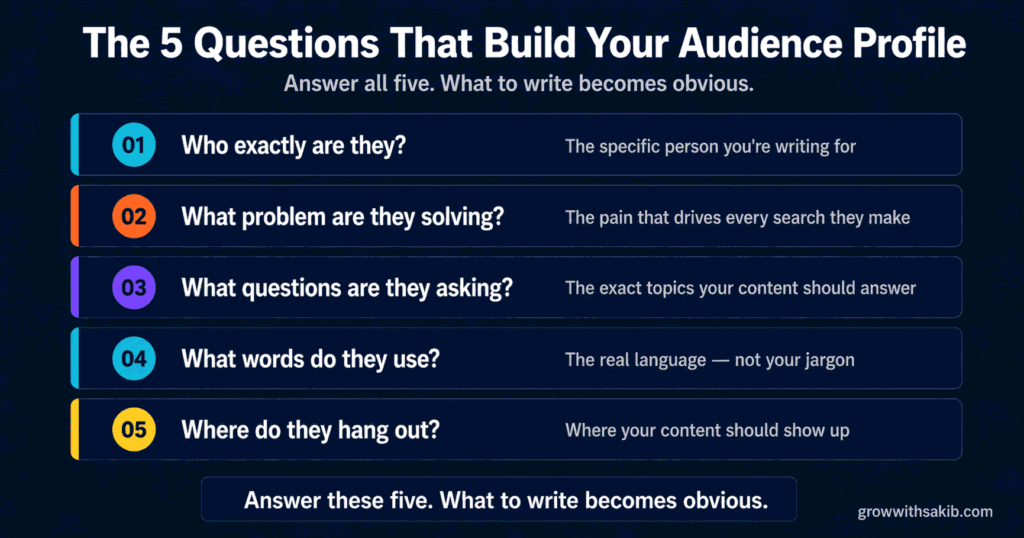
This guide shows you how to build a content audience profile – a simple research tool that tells you what to write – using five questions and free methods anyone can run today. It’s step two of the content strategy for small business guide on GrowWithSakib, and it pairs with setting your content marketing goals on GrowWithSakib. Goals tell you why you’re writing; the audience profile tells you what.
Question 1: Who Is the One Person You’re Writing For?
What it reveals: Focus. Content written for “everyone” connects with no one. Picking one specific person makes every later choice – topic, tone, depth – obvious.
How to find the answer: Look at who already buys from and engages with you. Scan your best customers, your most engaged followers, and the people who leave reviews. Don’t invent a fictional character – describe a real, representative person: their situation, their role, and what’s going on in their life when they need you.
Example: Not “small business owners aged 30-50.” Instead: “A solo founder who just launched, is doing their own marketing at night after client work, and feels overwhelmed by conflicting advice.” That person you can write for.
Question 2: What Problem Are They Trying to Solve?
What it reveals: Your topic territory. People don’t read content for fun – they read to solve a problem or reach a goal. Their problems are your content topics.
How to find the answer: Review mining and Reddit/Quora research. Read reviews of products like yours (and your competitors’) and note the recurring frustrations and desires – people describe their real problems there in detail. On Reddit and Quora, search your topic and read what people struggle with in their own threads. The pains that come up again and again are the ones worth writing about.
Example: Mining reviews of accounting tools, a bookkeeper notices the same complaint repeatedly – “I don’t understand which expenses I can actually claim.” That’s not a feature request; that’s a content topic with an audience already asking for it.
Question 3: What Questions Are They Actually Asking?
What it reveals: Your titles and headings. The exact questions your audience asks are the exact titles your content should answer – and the phrasing AI answer engines look for.
How to find the answer: Several free sources. Use question tools like AnswerThePublic and AlsoAsked to see what people search around your topic. Read the actual questions on Reddit and Quora threads. Check Google’s “People Also Ask” boxes and autocomplete. And mine your own inbox, DMs, and sales calls for the questions you get asked over and over. Because so much search is now question-based, this also feeds directly into answer engine optimisation on GrowWithSakib.
Example: “How much should a small business spend on marketing?” asked fifty times across forums isn’t one question – it’s a proven article title with built-in demand.
Question 4: What Words Do They Use?
What it reveals: Your language. Writing in your audience’s own words – not your industry jargon – is what makes content feel like it “gets” them, and it matches the terms they actually search.
How to find the answer: Voice-of-customer capture. As you mine reviews, Reddit, and Quora, copy the exact phrases people use – word for word. Note the words they choose for their problem, their goal, and the outcome they want. Build a running “swipe file” of their language. Customers rarely use the technical terms you do; they say “my books are a mess,” not “I require bookkeeping reconciliation.”
Example: Your industry calls it “client onboarding automation.” Your audience says “stop chasing new clients for the same info five times.” Write the second one – it’s their language, and it’s what they search.
Question 5: Where Do They Hang Out and What Do They Trust?
What it reveals: Your format and distribution. Knowing where your audience spends time and whom they trust tells you what content types to make and where to share them.
How to find the answer: Competitor comment analysis and observation. Look at where your competitors get engagement – which platforms, which posts, what people say in the comments. Notice which subreddits, forums, groups, newsletters, and creators your audience already follows and references. The comment sections reveal both where they gather and what they respond to.
Example: If your audience lives in a specific subreddit and devours long how-to threads, long-form blog posts and detailed guides will land – not fifteen-second videos. Match the format to where they already pay attention.
The 4 Free Research Methods, Step by Step
Those five questions are answered by four simple, free research methods. Here’s how to run each one.
1. Customer Conversations and Interviews
The richest source, and you may already have access. Talk to a few real customers – even three or four – or mine past conversations, support tickets, and sales calls. Ask open questions: what were they struggling with before they found you, what almost stopped them, how would they describe the problem to a friend. Listen for problems and language, not compliments.
2. Reddit and Quora Research
Search your topic on both. On Reddit, find the subreddits where your audience gathers and read the top and most-commented threads. On Quora, read the questions and the answers people upvote. You’re hunting for recurring problems, the exact questions asked, and the words people use. Sort by top or most comments to find what resonates most.
3. Review Mining
Read reviews of competitors and comparable products on Google, Amazon, app stores, and industry sites. Five-star reviews reveal what people value; one- and two-star reviews reveal the frustrations and unmet needs – often your best content angles. Copy standout phrases verbatim for your language swipe file.
4. Competitor Comment Analysis
Go where your competitors publish – their blog comments, social posts, and YouTube videos – and read the responses. What do people ask? What do they complain the content missed? Gaps in a competitor’s comments are topics you can own by covering them properly.
| Question | Reveals | Best Free Method |
|---|---|---|
| 1. Who is the one person? | Focus | Your existing customers and reviews |
| 2. What problem? | Topics | Review mining + Reddit/Quora |
| 3. What questions? | Titles and headings | Question tools, Reddit/Quora, your inbox |
| 4. What words? | Language and phrasing | Voice-of-customer capture from reviews |
| 5. Where and what trust? | Format and distribution | Competitor comment analysis |
Your Completed Content Audience Profile (Template)
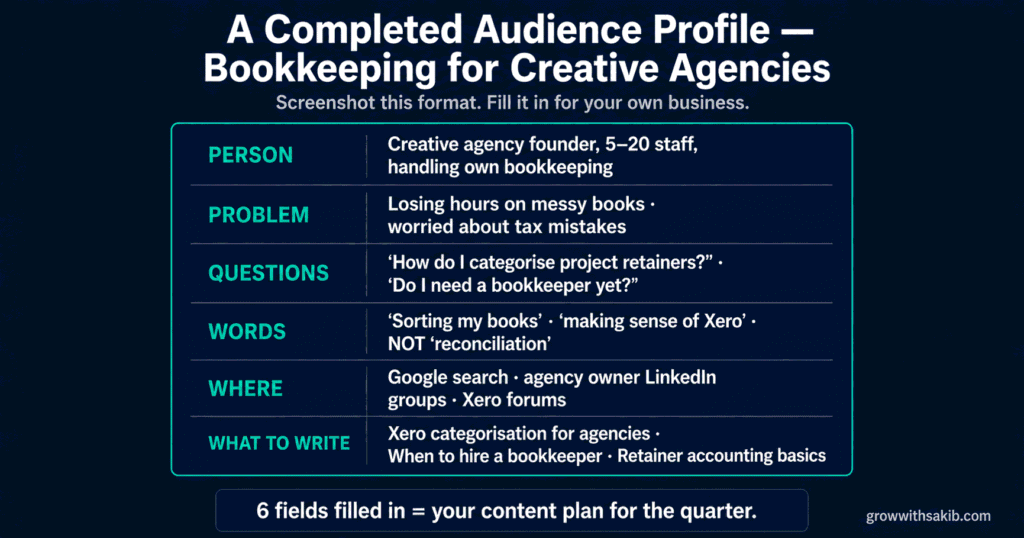
Pull your research together into one simple profile. Here’s a completed example for a fictional small bookkeeping business, followed by the blank template to copy.
Completed Example
| Profile Field | Example Answer |
|---|---|
| The one person | A solo tradesperson, 2-3 years in, doing their own books at the kitchen table on Sundays |
| Their main problem | Terrified of getting tax wrong and missing claimable expenses |
| Top questions they ask | “What can I actually claim?” “Do I need an accountant or an app?” “How do I avoid a tax bill shock?” |
| Their words | “My books are a mess,” “I don’t want a nasty surprise,” “keep it simple” |
| Where they hang out | Trade-specific subreddits and Facebook groups; trust plain-talking peers over big firms |
| What to write | Plain-English guides on claimable expenses, app-vs-accountant, avoiding tax surprises |
Blank Template to Copy
| Profile Field | Your Answer |
|---|---|
| The one person (who exactly) | … |
| Their main problem | … |
| Top 3-5 questions they ask | … |
| Their words (exact phrases) | … |
| Where they hang out / trust | … |
| What to write (topics + format) | … |
That bottom row is the payoff: once the first five fields are filled, what to write becomes obvious. Keep the profile handy, revisit it every few months as you learn more, and run every content idea against it. Turn the topics into a connected plan using the guide to topical authority on GrowWithSakib, and structure each piece with the guide to structuring content on GrowWithSakib.
Honest Limits of a Content Audience Profile
Keep a few honest caveats in mind:
- It’s a starting point, not gospel – a profile from a small sample is a strong hypothesis, not proof. Let real content performance refine it over time.
- Watch for small-sample bias – a handful of loud reviews or threads aren’t the whole audience. Look for patterns that repeat across sources, not one vivid comment.
- It evolves – your audience and their questions shift, so revisit the profile every few months rather than treating it as fixed.
- Public voices skew – people who post reviews and forum threads are more vocal than average. Balance them with direct customer conversations where you can.
None of that undermines the method – it just keeps you honest. Even a rough, research-grounded profile beats writing blind, and it improves every time you use it. In a sea of generic AI content, the business that genuinely knows its reader wins – as content strategists increasingly note, audience understanding is now the core differentiator.
Common Audience Research Mistakes
| Mistake | Why It Hurts | Do This Instead |
|---|---|---|
| Writing for ‘everyone’ | Connects with no one | Pick one specific person |
| Stopping at demographics | Age and income don’t tell you what to write | Research problems, questions, and language |
| Inventing the audience | You guess wrong and write blind | Mine what real people already say |
| Using your own jargon | Feels distant; misses their searches | Swipe your audience’s exact words |
| Ignoring free sources | You miss goldmines of insight | Mine Reddit, Quora, reviews, comments |
| Never writing it down | Insight fades and isn’t reused | Capture it in one reusable profile |
| Treating it as final | Audiences change over time | Revisit and refine every few months |
Frequently Asked Questions
1. What is a content audience profile?
A content audience profile is a simple research tool that tells you what to write by answering five questions: who is the one person you’re writing for, what problem are they solving, what questions are they asking, what words do they use, and where do they hang out. Unlike a broad buyer persona focused on demographics, a content audience profile focuses on your audience’s problems, questions, and language – the things that actually drive content decisions.
2. How is a content audience profile different from a buyer persona?
A buyer persona is a broad marketing tool describing who your customer is – demographics, income, job title – for ad targeting and positioning. A content audience profile is narrower and built for one purpose: deciding what to write. It focuses on your audience’s problems, exact questions, and language rather than their age or income. You can have a detailed persona and still not know what content to create; the profile fixes that specific gap.
3. How do I research my audience for free?
Mine what your audience already says in public. Read reviews of your competitors and similar products for recurring problems and language; search Reddit and Quora for the questions and struggles in your topic; check Google’s People Also Ask and autocomplete; and read competitor comment sections. Add a few real customer conversations where you can. These free methods reveal problems, questions, and exact wording – no survey tools or budget required.
4. What are the five questions to ask about my audience?
Who is the one person you’re writing for? What problem are they trying to solve? What questions are they actually asking? What words do they use to describe it? And where do they hang out and what do they trust? Each answer drives a content decision – focus, topics, titles, language, and format respectively. Together they tell you exactly what to write and how to write it.
5. How do I find out what my audience is searching for?
Use free question tools like AnswerThePublic and AlsoAsked to see what people search around your topic, read the actual questions on Reddit and Quora, and check Google’s People Also Ask boxes and autocomplete suggestions. Also mine your own inbox, DMs, and sales calls for questions you’re asked repeatedly. The exact questions your audience asks become the exact titles and headings your content should use.
6. Why does using my audience’s own words matter?
Because content written in your audience’s language feels like it truly understands them, and it matches the words they actually type into search. Customers rarely use industry jargon – they say “my books are a mess,” not “bookkeeping reconciliation.” Capturing their exact phrases from reviews and forums and using them in your headlines and copy makes your content more relatable and more findable at the same time.
7. How many people do I need to research to build a profile?
You don’t need a large sample to start. A handful of customer conversations plus mining a few dozen reviews and forum threads is enough to spot clear patterns and build a working profile. Treat it as a strong starting hypothesis rather than proof, look for problems and phrases that repeat across sources, and refine the profile over time as your real content performance teaches you more.
8. How often should I update my content audience profile?
Revisit it every few months, and whenever you notice your content resonating differently or your audience shifting. A content audience profile is a living tool, not a one-time document – audiences, their questions, and their language evolve. Regularly re-reading fresh reviews and forum threads keeps it current, and your own content performance data will steadily sharpen who you’re really writing for.
Key Takeaways
- A content audience profile answers one question – what should I write? – and is more practical than a demographics-based buyer persona.
- Build it from five questions: who is the one person, what problem, what questions, what words, and where they hang out.
- Each question drives a content decision: focus, topics, titles, language, and format.
- You don’t need surveys – mine what your audience already says free on Reddit and Quora, in reviews, and in competitor comment sections.
- Capture your audience’s exact words in a swipe file and write in their language, not your jargon – it connects better and matches their searches.
- The exact questions your audience asks become the exact titles your content should answer, which also helps with AI answer engines.
- Pull everything into one reusable profile ending in ‘what to write,’ and run every content idea against it.
- Treat the profile as a living hypothesis – watch for small-sample bias and refine it every few months as you learn more.