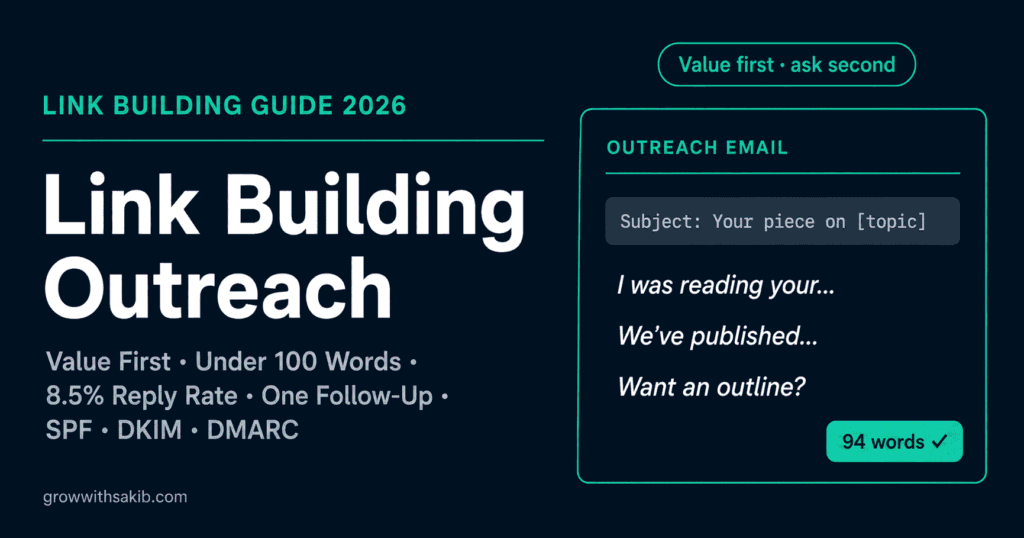
You know the email. “Hi, I love your blog! I noticed you have a great article about [topic]. I’ve written something similar – would you consider linking to it?” It gets deleted in about three seconds. You’ve received it. Your targets receive it dozens of times a week.
Outreach is the delivery mechanism for almost every strategy in the link building guide for beginners on GrowWithSakib – broken link building, the skyscraper technique, guest posting, gap analysis. Get it wrong and every one of them fails, no matter how good your research was.research was.
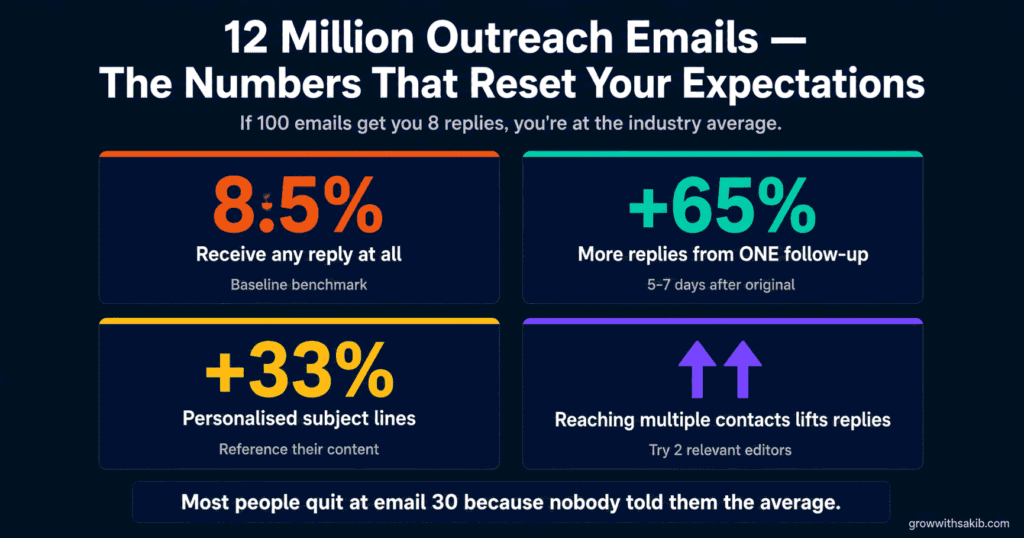
The Number That Should Reset Your Expectations
Why Most Outreach Fails: Three Structural Problems
Problem 1: Leading With the Ask
The standard email is: brief hello, vague compliment, link request. Every part of that structure serves you. The recipient – a stranger who owes you nothing – is being asked to do unpaid work for someone they’ve never met. The principle that makes outreach work is reciprocity: value has to arrive before the request, not after it.
Problem 2: Fake Personalisation
“I really enjoyed your article [Article Title]” is worse than no personalisation at all, because it proves an automation tool merged a field. Real personalisation requires having actually read the page – and it shows, because you can say something only a reader could say.
Problem 3: The Wrong Person
Pitching a guest post to a founder who hasn’t touched the blog in three years produces nothing, however good the email. Finding the person who can actually place the link is not admin – it is the work.
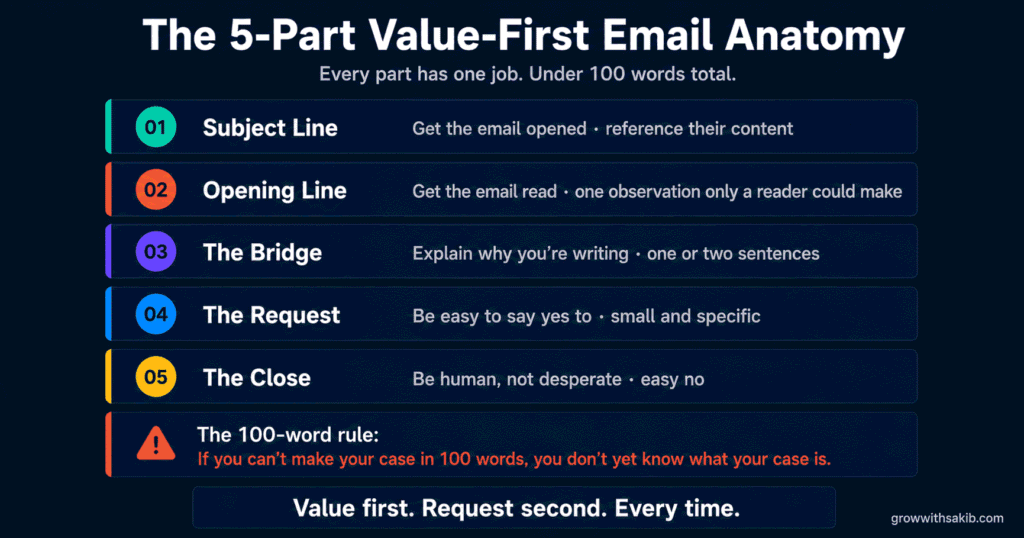
The Value-First Framework: The Five-Part Anatomy
| Part | Its One Job | How to Do It |
|---|---|---|
| 1. Subject line | Get the email opened | Specific and referential: ‘Your piece on X’. Personalised subject lines earn ~a third more replies |
| 2. Opening line | Get the email read | ONE specific observation only a real reader could make. No compliments |
| 3. The bridge | Explain why you’re writing | One or two sentences connecting your observation to your reason for emailing |
| 4. The request | Be easy to say yes to | Small and specific. ‘Want me to send an outline?’ beats ‘will you link to me?’ |
| 5. The close | Be human, not desperate | ‘No problem if it’s not a fit’ – removing pressure genuinely raises replies |
Find the Right Contact First
- The About or Team page – look for Editor, Content Editor, Managing Editor. Not ‘info@’.
- The byline – who actually writes in this category? Their name is on the article.
- Hunter.io – enter the domain and it returns known addresses and the format they use. The free tier is enough for small campaigns.
- Standard patterns – firstname@, firstname.lastname@, f.lastname@. Verify before sending; hard bounces damage your sender reputation.
- LinkedIn, as a last resort – a short professional message beats guessing at an address that will bounce.
And per the 12-million-email data, reaching more than one relevant contact at a publication measurably raises your chances – so if there are two plausible editors, it’s legitimate to try both.
Five Templates – One Per Strategy
These are frameworks, not scripts. Send any of them verbatim and you’ll get the results a verbatim template deserves.
Template 1: Broken Link (highest response rate)
The strongest opener in outreach, because it asks for nothing. Pairs with broken link building on GrowWithSakib.
| Subject: Broken link on your [page topic] page Hi [Name], I was reading your [specific page] and the link to [broken URL] under “[anchor text]” is 404ing. Thought you’d want to know. [Your name] |
Why it works: it’s pure gift. The recipient’s response is gratitude, not suspicion – and gratitude is the ideal condition in which to mention, in your reply, that you happen to have a replacement.
Template 2: Skyscraper / Resource Replacement
Pairs with the skyscraper technique on GrowWithSakib.
| Subject: Your [specific topic] piece Hi [Name], Your article on [topic] – in the section on [specific point], you link out to [existing resource]. We’ve just published something on the same subject that adds [ONE specific thing: 2026 data / a free calculator / results from our own tests]: [URL] If it’s useful there, feel free to use it. If not, no problem at all. [Your name] |
Why it works: it references their link neutrally rather than attacking it, and names one concrete improvement. “More comprehensive” is what everyone says; “includes a free calculator” is a reason to edit a live page.
Template 3: Guest Post Pitch
Pairs with guest posting on GrowWithSakib – and note the framing. Google’s John Mueller has said links you place in your own guest posts should be nofollowed and are largely ignored, so pitch for the audience, never for the link.
| Subject: Article idea: [specific headline] Hi [Name], Your piece on [specific recent article] made a point I keep seeing with my own clients – [one genuine observation]. I’d like to write a follow-up for [Publication]: “[Proposed headline]” – [one line on the angle]. I’m [one line of relevant credibility]. Want me to send an outline? [Your name] |
Why it works: it asks for an outline, not publication – a tiny commitment is far easier to accept. And it never mentions links, which is the fastest way to get deleted.
Template 4: Resource Page / Gap Link
Pairs with backlink gap analysis on GrowWithSakib – and it’s strongest when their page already lists your competitors.
| Subject: Your [topic] resource list Hi [Name], Your [topic] resources page is one of the more genuinely curated lists out there – you’ve included [X] and [Y]. We publish [your resource], which covers [the specific thing your resource adds]: [URL] If it fits the list, great. If not, no problem. [Your name] |
Why it works: naming the actual entries on their list proves you read it. And when a page lists every competitor but you, you’re not asking a favour – you’re pointing out an omission.
Template 5: Unlinked Brand Mention (the warmest of all)
Someone already mentioned you without linking. They like you already.
| Subject: Thanks for the mention Hi [Name], Just saw you mentioned [your brand] in [specific article] – genuinely appreciated, thank you. One small thing: it isn’t linked, so readers who want to find us have to search. If you’re able to add the link, here it is: [URL] Either way, thanks for the mention. [Your name] |
Why it works: gratitude first, and the request is framed around reader benefit, not your SEO. It’s also the highest-conversion outreach there is, because the editorial decision to mention you has already been made.
The Follow-Up: Exactly One
Skipping the follow-up wastes most of your work: the data shows a single follow-up produces roughly 65% more replies. But there’s a real tension worth being honest about – the same study finds that emailing repeatedly gets more responses still, while every extra chase costs you goodwill with someone who owes you nothing. My rule errs toward the relationship:
- One follow-up, 5-7 days later – long enough that they’ve genuinely had the chance to see it.
- Shorter than the original – two or three sentences. It’s a reminder, not a re-pitch.
- Add one new thing – a fresh thought or detail beats “just bumping this.”
- Then stop – a third email converts a stranger’s indifference into active irritation. You will want that relationship later.
| Hi [Name], Floating this back up in case it got buried. [One new sentence: a fresh detail, or a genuine remark about something they’ve published since.] No reply needed either way. [Your name] |
Deliverability: The Silent Killer
The best outreach email in the world earns nothing from a spam folder. Almost no outreach guide covers this, and it’s why many campaigns “fail” without ever being read.
| Rule | Why It Matters |
|---|---|
| Set up SPF, DKIM and DMARC | These DNS records authenticate your domain. Without them, major providers filter you by default |
| Warm up a new sending domain | A new address sending 50 cold emails in week one is a textbook spam signal. Build volume gradually |
| Cap volume (roughly 50/day/domain) | High volume from one domain trips filters regardless of how good the content is |
| Verify every address before sending | Hard bounces damage sender reputation, which degrades every future campaign |
| Avoid spam-trigger phrasing | ‘Free’, ‘opportunity’, ‘partnership’, ‘collaboration’, ‘I wanted to reach out’ – all common filter triggers |
| Send from a real human address | name@company.com, not outreach@ or marketing@ |
Relationships Beat Cold Emails
The best outreach is sent to someone who already recognises your name. That familiarity is built long before you need anything:
- Comment substantively on their work – adding something, not complimenting.
- Share their content with a specific observation about why it’s good.
- Cite them in your own writing – and tell them you did. This is genuine value, given first.
- Reply thoughtfully to their posts – visibility, earned over weeks, costs you nothing.
The cheapest version of this is the HARO and expert-sourcing route on GrowWithSakib, where journalists come to you. A cold email from a stranger and a cold email from someone whose name an editor has seen three times are, functionally, different emails.
Is Outreach Against Google’s Rules?
No. Contacting someone and telling them your content exists is not a link scheme. What Google’s spam policies prohibit is paying for links that pass ranking signals, exchanging links for goods or services, and large-scale article campaigns with keyword-rich anchors. Ask honestly, offer genuine value, never pay, and you’re firmly within the rules.
Common Outreach Mistakes
| Mistake | Why It Hurts | Do This Instead |
|---|---|---|
| Leading with the ask | Asks a stranger for unpaid work upfront | Value first, request second |
| Merged-field ‘personalisation’ | Recognised instantly; worse than none | Read the page; make one real observation |
| Emailing info@ or the founder | They can’t or won’t place the link | Find the editor who actually publishes |
| Sending 500 templated emails | ~1% replies, and your domain gets burned | 30 researched emails beat 500 merged ones |
| Skipping the follow-up | Forfeits ~65% more replies | One follow-up, 5-7 days later |
| Sending three or four follow-ups | Converts indifference into irritation | Stop after one |
| Ignoring deliverability | Perfect emails filtered as spam | SPF, DKIM, DMARC, warm-up, verify, cap volume |
| Mentioning links in a guest pitch | Signals you want to use them | Pitch the idea and the readers |
Frequently Asked Questions
1. What is a good response rate for link building outreach?
About 8.5% is the industry benchmark for receiving any reply at all – that figure comes from Backlinko and Pitchbox’s analysis of 12 million outreach emails. Note that a reply is not a link, so your link placement rate will be lower still. If you send 100 well-researched emails and get 8 replies, you’re performing at the average rather than failing. Well-targeted, genuinely personalised outreach to relevant sites can beat that, but nobody should expect 30%.
2. How long should a link building outreach email be?
Under 100 words in the body, excluding subject line and sign-off. Editors who receive dozens of these weekly have pattern recognition, and length is the tell: a long email signals someone who wants a lot from them. A short, specific one signals someone who respects their time. If you can’t make your case in 100 words, you probably haven’t worked out what your case is yet.
3. How many follow-ups should I send?
One, sent five to seven days after the original. Backlinko’s 12-million-email study found a single follow-up produces roughly 65% more replies, so skipping it wastes much of your work. Make it shorter than the original, add one genuinely new thought rather than ‘just bumping this’, and then stop. A third email converts a stranger’s indifference into irritation, and you may want that relationship later.
4. How do I find the right person to email?
Start with the About or Team page and look for an Editor, Content Editor, or Managing Editor – never ‘info@’. Check the byline on articles in your topic area to see who actually writes there. Use Hunter.io to find the domain’s email format, or try standard patterns like firstname@ or firstname.lastname@. Always verify the address before sending, since hard bounces damage your sender reputation. The data also shows that reaching more than one relevant contact raises your chances.
5. Why do my outreach emails get no response?
Usually one of three structural problems. You led with the ask, so a stranger is being asked to do unpaid work for you. Your ‘personalisation’ was a merged article title, which recipients recognise instantly and find worse than no personalisation. Or you emailed the wrong person entirely. A fourth possibility, and a common one, is that your emails never arrived at all – without SPF, DKIM and DMARC records, they’re quietly filtered as spam.
6. What makes a good outreach subject line?
Specificity. Reference their actual content: ‘Your piece on [topic]’ or ‘Broken link on your [topic] page’. Backlinko’s study found personalised subject lines earn roughly a third more replies than generic ones. Avoid clever, vague, or salesy lines, and avoid known spam triggers like ‘free’, ‘opportunity’, ‘partnership’, and ‘collaboration’, which can affect deliverability before a human ever sees the email.
7. Is link building outreach against Google’s guidelines?
No. Contacting someone to tell them your content exists is not a link scheme. Google’s spam policies prohibit paying for links that pass ranking signals, exchanging links for goods or services, and large-scale article campaigns with keyword-rich anchor text. Outreach that asks honestly and offers genuine value is entirely legitimate. What you must never do is pay for the placement – and if you ever do, the link must be marked rel=”sponsored”.
8. Should I use outreach automation tools?
Yes, for the mechanical parts – contact finding, address verification, sequence tracking, and follow-up reminders. No, for the writing. The moment a tool writes your emails, you’re sending exactly the merged, generic messages that recipients delete on sight, and you’ll burn your sending domain in the process. Use tools to handle the admin so you can spend your time on the one thing that actually converts: reading the page you’re writing about.
Key Takeaways
- Backlinko and Pitchbox analysed 12 million outreach emails: only about 8.5% receive any reply at all. If 100 emails get you 8 replies, you’re at the average – not failing.
- Lead with value, never the ask. A stranger who owes you nothing will not do unpaid work for you because you complimented their blog.
- Keep the body under 100 words. Length is the tell that separates someone who wants a lot from someone who respects your time.
- Open with ONE specific observation only a genuine reader could make – merged article titles are recognised instantly and are worse than no personalisation.
- Send exactly one follow-up, 5-7 days later: it’s worth roughly 65% more replies. A third email converts indifference into irritation.
- Personalised subject lines earn about a third more replies, and reaching more than one relevant contact raises your chances further.
- Deliverability decides everything: without SPF, DKIM and DMARC, a warmed-up domain, capped volume and verified addresses, your best emails are filtered unseen.
- Outreach is not against Google’s rules – paying for links is. Ask honestly, offer real value, and never pay for placement.