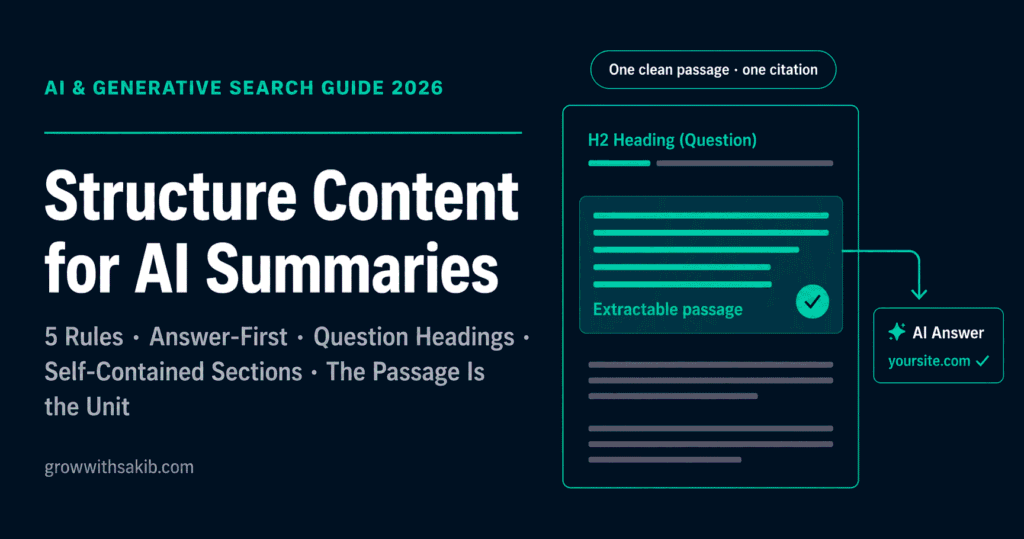
This is the most immediately actionable GEO skill you can learn. You don’t need new data or new tools – just a different way of arranging the words you already write. Learning to structure content for AI summaries can turn a page AI ignores into one it quotes, often without changing a single fact.
This guide gives you five concrete structuring rules, one simple test to check your work, and a full before/after rewrite you can copy. It expands one tactic from the complete guide to generative engine optimization on GrowWithSakib – the one you can apply this afternoon.
Why Does Structure Decide Whether AI Cites You?
AI engines don’t read your page top to bottom like a person. They break it into passages – sections of roughly a few hundred words – and retrieve only the chunks that match a question. Microsoft’s Azure AI Search documentation describes partitioning documents into chunks so models can process them, and NVIDIA’s research on chunking strategies treats how you split content as a core factor in retrieval quality.
The consequence is simple but profound: the passage, not the page, is the unit of citation. An AI might lift one section of your article into an answer and never touch the rest. If that section only makes sense after reading the three before it, the AI can’t use it. For the full mechanism, see how AI search systems actually work on GrowWithSakib.
The Standalone Section Test
Here’s the single principle that makes everything else simple. Before publishing, apply the Standalone Section Test to each section:
A named expert frames the same idea well: after studying AI patents and research, SEO analyst Olaf Kopp distilled it to structuring content as self-contained, answer-first chunks so language models can find, extract, and cite precise information, as documented by Lumar. The five rules below are simply how you pass that test.
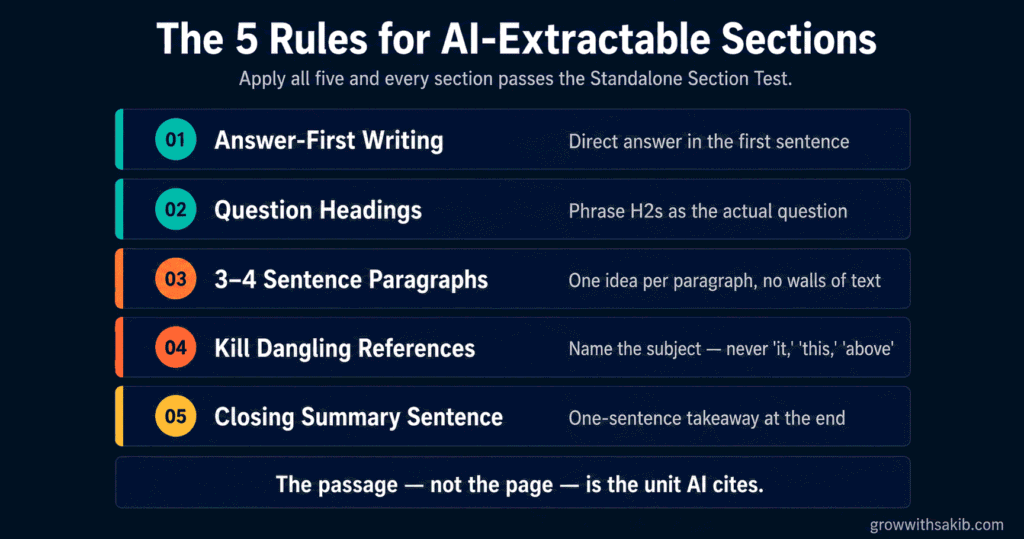
The Five Rules for AI-Extractable Sections
Rule 1: Lead With the Answer (Answer-First Writing)
Put the direct answer in the first sentence of each section, then explain. Most writing builds up to a conclusion; AI-friendly writing states the conclusion, then supports it. If your answer is buried in paragraph three, the AI may never reach it – and a reader arriving from an AI link won’t either.
A practical pattern: under each heading, write a 40-60 word direct answer, then expand. This doubles as featured-snippet bait. The on-page SEO checklist on GrowWithSakib covers the same answer-first habit for traditional snippets.
Rule 2: Phrase Headings as Real Questions
Turn vague labels into the actual questions people ask. “Pricing” tells an AI little; “How much does it cost?” matches a real query word for word. Question-based headings act as a map, signalling exactly which question each section answers.
Match the heading type to the answer format the question implies:
| Question Type | Heading Example | Answer Format |
|---|---|---|
| What is…? | What is passage extraction? | A clear one-to-two sentence definition |
| How do I…? | How do I structure a section? | A numbered or step-by-step list |
| Why does…? | Why does structure matter? | A reason-based explanation |
| X vs Y? | Is GEO different from SEO? | A comparison or short table |
Rule 3: Keep Paragraphs to 3-4 Sentences
Short paragraphs aren’t just easier to read – they’re easier to extract. A wall of text forces the AI to untangle multiple ideas from one block; a tight 3-4 sentence paragraph holds one clean idea it can lift whole. One idea per paragraph is the rule.
This isn’t dumbing down. You can keep full depth across a section – you’re just packaging it in liftable units instead of dense blocks. Notice every paragraph in this article follows the rule.
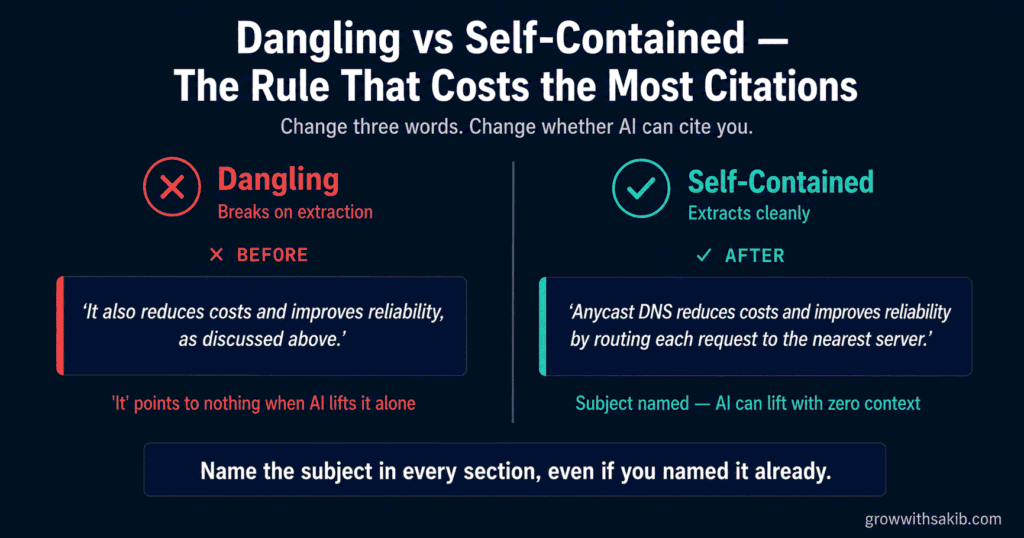
Rule 4: Make Every Section Self-Contained (Kill Dangling References)
This is the rule that breaks the most content. A dangling reference is a word like “it,” “this,” “these,” or “as we saw above” that points to something in another section. When an AI lifts your passage in isolation, those words point to nothing – and the passage becomes useless or confusing.
The fix: name the subject in each section, even if you named it already.
To audit for this, search your draft for “it,” “this,” “that,” and “these” at the start of sentences, and for phrases like “as mentioned earlier.” Each one is a place a passage might break when extracted alone.
Rule 5: Close Key Sections With a Summary Sentence
End your most important sections with a single sentence that restates the takeaway. This gives the AI a clean, pre-written summary to lift – and gives a skimming reader the point even if they read nothing else. A closing summary sentence is a small effort with an outsized extraction payoff.
The Restructuring Exercise: A Section Rewritten
Theory is cheap; let’s restructure a real section. Below is a typical “before” – well-meaning, readable, and almost invisible to AI. Then the same content, restructured with the five rules. Try this on one section of your own content as you read.
What’s wrong:
the heading is vague, the answer is buried and hedged, “this”/”it” dangle, and there’s no liftable fact. An AI asked “what’s the best time to send emails?” finds nothing clean to quote.
Every rule is now visible. The heading is the exact question. The first sentence is the direct answer. Each paragraph is short and holds one idea. The subject is named (“marketing emails,” not “this”). And the close is a clean, liftable takeaway. Same substance – completely different extractability.
Now do it yourself: pick one weak section, phrase the heading as a question, move the answer to the first sentence, kill every “it”/”this,” and add a closing takeaway. That single edit is the highest-leverage GEO change most pages need. Pair it with statistics-rich writing on GrowWithSakib and your sections become genuinely citable.
When Should You NOT Chunk? The Honest Limits
Structuring for extraction is powerful, but it isn’t right for everything. Forcing every piece into rigid modular blocks can flatten writing that earns its value from flow.
- Narrative and storytelling – a personal essay or a story-driven piece builds meaning progressively. Chopping it into standalone chunks can kill what makes it work.
- Persuasive arguments that build – when each point depends on the last to land, full modularity weakens the case. Some dependency is the point.
- Brand and opinion pieces – content meant to be read in full, not extracted, can prioritise voice over liftability.
- Anything where clarity would suffer – never make a sentence clunky just to name a subject. Readability for humans always comes first.
The rule of thumb: use modular, standalone structure for how-to guides, reference content, and informational articles – where people seek specific answers. Keep narrative flow for pieces meant to be read whole. Most business and SEO content is the former, which is why this skill pays off – but match the structure to the job.
Common Mistakes Structuring Content for AI
| Mistake | Why It Hurts | Do This Instead |
|---|---|---|
| Vague headings (‘Some thoughts’) | AI can’t tell what the section answers | Phrase headings as the real question |
| Burying the answer mid-section | AI may never reach it; readers bounce | Lead with a direct answer, then explain |
| Dangling ‘it’/’this’/’above’ | Passage breaks when extracted alone | Name the subject in each section |
| Walls of text | Multiple ideas tangled in one block | One idea per 3-4 sentence paragraph |
| Mechanical fixed-length chunking | Cuts across ideas; Google doesn’t require it | Chunk by meaning; aim for clarity |
| Chunking narrative that needs flow | Destroys progressive meaning | Keep narrative whole; chunk how-to content |
| No closing takeaway | No clean summary for AI to lift | End key sections with a one-line summary |
Frequently Asked Questions
1. How do I structure content for AI summaries?
Structure each section so it can be understood and lifted on its own. Lead with a direct answer, phrase headings as the questions people ask, keep paragraphs to 3-4 sentences, make every section self-contained with no dangling references, and close key sections with a one-sentence summary. AI engines retrieve passages, not whole pages, so the section is the unit you’re structuring.
2. What is answer-first writing?
Answer-first writing means putting the direct answer in the first sentence of a section, then explaining and supporting it. It reverses the usual build-up-to-a-conclusion style. This matters for AI summaries because engines extract passages and may never reach an answer buried in paragraph three – and readers arriving from an AI link want the answer immediately, not after a long warm-up.
3. Should my headings be questions?
Yes, where natural. Question-based headings match the way people actually query AI tools and search engines, so they signal exactly which question each section answers. “How much does it cost?” matches a real query far better than “Pricing.” Match the answer format to the question type: definitions for “what is,” steps for “how to,” and reasons for “why.”
4. How long should paragraphs be for AI extraction?
Keep paragraphs to 3-4 sentences, each holding one clear idea. Short paragraphs are easier for AI to extract because a tight block contains a single liftable thought, while a wall of text tangles several ideas together. This also improves readability for humans, so you lose nothing – you’re packaging the same depth in cleaner units.
5. What is a dangling reference and why does it hurt AI citation?
A dangling reference is a word like “it,” “this,” or “as we saw above” that points to something in another section. When an AI lifts your passage in isolation, those words point to nothing, making the passage confusing or useless. The fix is to name the subject in each section – even if you named it earlier – so every passage stands alone.
6. Does Google require content chunking for AI visibility?
No. Per Lumar, Google has publicly said content chunking is not required for visibility in its own AI systems. The real goal is clarity, not mechanical chunking. Well-structured, self-contained sections help human readers, many AI retrieval systems, and your broader GEO at once – so structure for understanding, not to game an algorithm.
7. Will structuring for AI hurt my content for human readers?
No – done well, it helps both. Answer-first openings, clear question headings, short paragraphs, and named subjects make content easier for people to scan and understand, not just for AI to extract. The one caution: never make a sentence clunky just to name a subject. Human readability always comes first, and good structure serves both audiences at once.
8. When should I not chunk my content?
Keep narrative flow for storytelling, personal essays, and persuasive pieces where each point builds on the last – chopping these into standalone chunks can destroy what makes them work. Use modular, standalone structure for how-to guides, reference content, and informational articles where people seek specific answers. Match the structure to the job rather than chunking everything by default.
Key Takeaways
- AI engines retrieve passages, not whole pages – so the section, not the article, is the unit you structure for AI summaries.
- Apply the Standalone Section Test: every section must make full sense read completely on its own, or an AI can’t extract and cite it.
- Lead each section with a direct answer (answer-first), then explain – don’t bury the point in paragraph three.
- Phrase headings as the real questions people ask, and match the answer format to the question type (what/how/why/vs).
- Keep paragraphs to 3-4 sentences with one idea each, and kill dangling references by naming the subject in every section.
- Close key sections with a one-sentence summary the AI can lift cleanly – small effort, big extraction payoff.
- Be honest: Google says chunking isn’t required, so aim for clarity, not mechanical fixed-length blocks.
- Use standalone structure for how-to and reference content; keep narrative flow for storytelling and arguments that build.