“Content strategy” and “content marketing” get used interchangeably all the time – but they’re not the same thing, and confusing them is why a lot of small business content quietly fails. The good news: the difference is simple once you see it, and understanding it changes how you approach everything you publish.
This is the entry point to the content strategy for small business guide on GrowWithSakib. Let’s clear up the distinction for good, show what a real strategy contains, and explain why the undocumented version in your head isn’t doing the job you think it is.
The Core Difference: Plan vs Execution
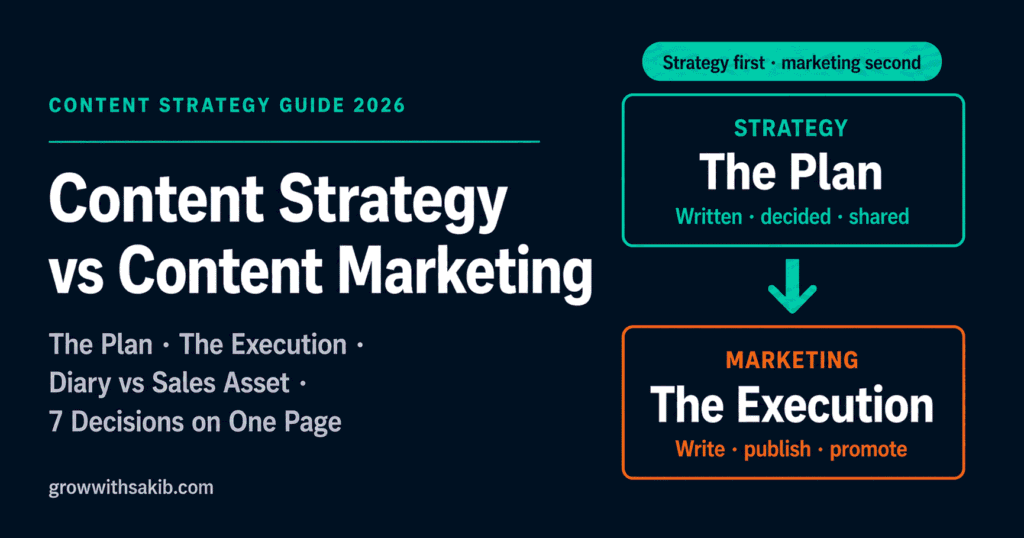
Here’s the whole distinction in one line: content strategy is the plan, and content marketing is the execution of that plan.
- Content strategy is the thinking that happens before you create anything: who you’re writing for, what business goal the content serves, which topics you’ll own, what formats and channels you’ll use, how often you’ll publish, and how you’ll measure success. It’s the documented blueprint.
- Content marketing is the doing: actually writing the blog post, recording the video, sending the email, and promoting it. It’s the visible output your audience sees and interacts with.
This maps to how the experts define each. Content strategy pioneer Kristina Halvorson of Brain Traffic frames strategy as guiding the creation, distribution, and governance of content – the planning layer. The Content Marketing Institute, which championed the term, defines content marketing as creating and distributing valuable content to attract and engage an audience – the execution layer. One decides; the other does.
The Diary vs the Sales Asset
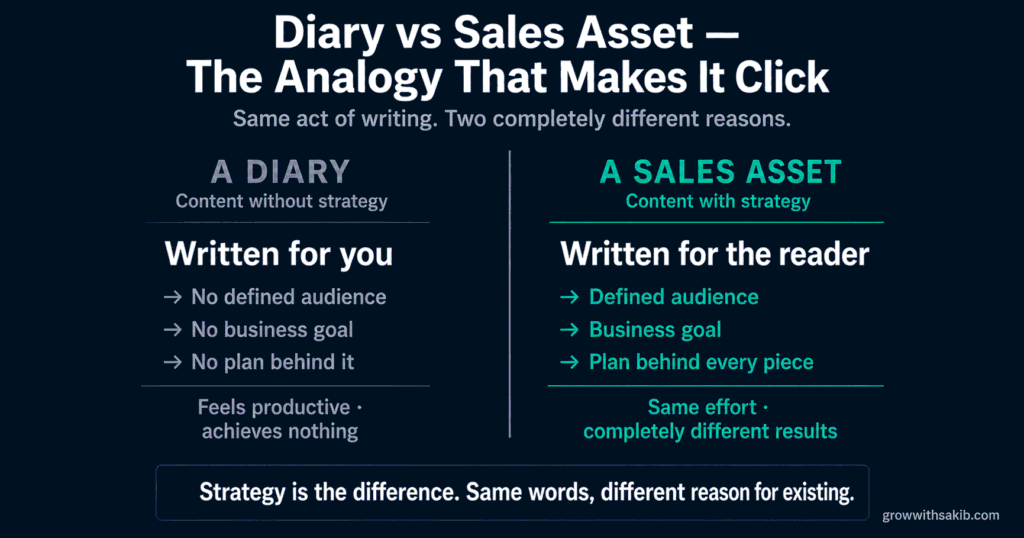
Here’s the analogy that makes it click. Most small business content is a diary. A strategic piece of content is a sales asset. The difference between them is strategy.
This is the trap most small businesses fall into. They’re busy “doing content marketing” – posting regularly, staying active – but every piece is a diary entry. There’s activity, but no plan tying it to who they serve or what they’re trying to achieve. The content isn’t bad; it just isn’t aimed at anything.
Why Small Business Owners Mix Them Up
There’s a specific reason this confusion hits small businesses harder than big companies. In a large company, the strategist and the marketer are different people on different teams, so the two jobs are obviously separate. In a small business, you are both people – often in the same hour.
When one person does both jobs, the planning step becomes invisible. You jump straight to execution because that’s the part that feels productive – you can see a finished blog post, but you can’t see “the strategy you didn’t write down.” So the plan gets skipped, and “content marketing” becomes a stream of diary entries. Recognising that you’re wearing two hats is the first step to doing the first job properly.
Content Strategy vs Content Marketing: Side by Side
| Dimension | Content Strategy | Content Marketing |
|---|---|---|
| What it is | The plan | The execution |
| Question it answers | Why and who for? | What and where? |
| When it happens | Before creating | During and after creating |
| Output | A documented plan | Blog posts, emails, videos |
| Timeframe | Long-term direction | Day-to-day activity |
| Analogy | The blueprint / the sales-asset plan | The build / the diary entries without it |
| If it’s missing | Content becomes aimless noise | The plan never reaches anyone |
What a Documented Content Strategy Actually Contains
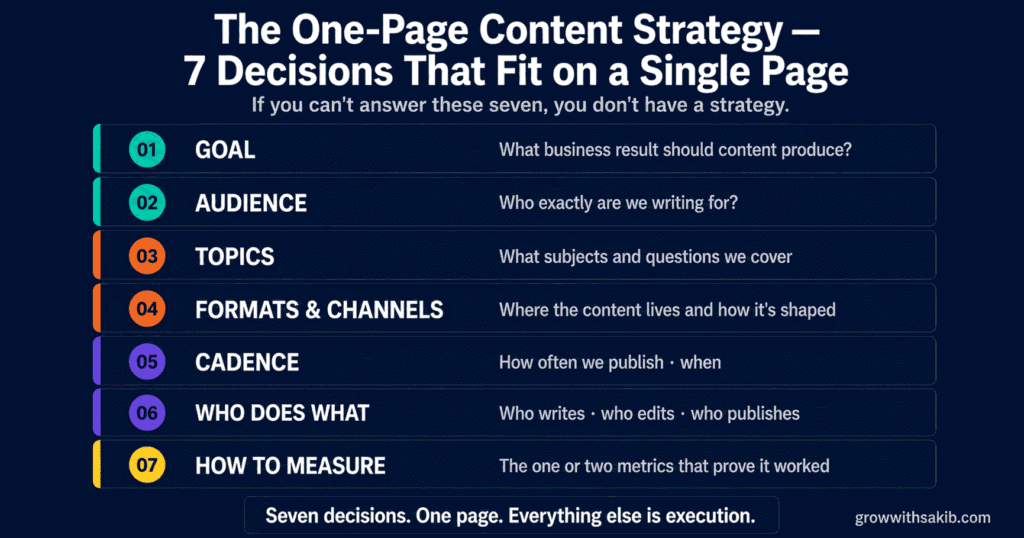
“Strategy” sounds intimidating, but for a small business it fits on one page. A documented content strategy simply writes down the decisions that turn diaries into sales assets. Here’s what to include:
- Your goal – the one primary business outcome your content serves (traffic, leads, authority, nurture, or sales), covered in the guide to content marketing goals on GrowWithSakib.
- Your audience – who you’re writing for, their problems, questions, and language, captured in a content audience profile on GrowWithSakib.
- Your topics – the handful of subjects you’ll own and cover in depth, building topical authority on GrowWithSakib.
- Your formats and channels – what content types you’ll make (blog, email, video) and where you’ll publish and promote them.
- Your cadence – how often you’ll publish, at a pace you can actually sustain.
- Who does what – even solo, noting who writes, edits, and publishes keeps it real and delegable later.
- How you’ll measure it – the one or two metrics that tell you it’s working, tied to your goal.
That’s it. Seven decisions, one page. Notice that the first two – your goal and your audience – are the foundation everything else rests on, which is why they each get their own guide in this series. Write these down and you have a real strategy; leave them in your head and you have a vibe.
Why Undocumented Strategies Fail
“But I have a strategy – it’s in my head.” This is the most common and most costly mistake in small business content. An undocumented strategy isn’t a strategy; it’s an intention. And intentions fail in specific, predictable ways.
- It drifts – without a written reference, each week’s content wanders based on your mood, the latest trend, or whatever a competitor just did. There’s nothing to check your decisions against, so consistency quietly erodes.
- It can’t be followed under pressure – when you’re busy (which is always), the plan in your head is the first thing to go. A written strategy survives a hectic month; a mental one doesn’t.
- It can’t be delegated – the moment you want help – a freelancer, a VA, a team member – an unwritten strategy can’t be handed over. You become the bottleneck for everything.
- It can’t be improved – you can’t review, refine, or learn from a plan you never wrote down. Documentation is what lets you see what’s working and adjust.
This isn’t just theory. Research from the Content Marketing Institute has consistently found that marketers with a documented content strategy report being significantly more effective than those with only a verbal or undocumented one – yet other research suggests only around 40% of marketers actually document theirs. The single act of writing it down is one of the biggest, cheapest advantages available to a small business.
You Need Both – and in This Order
Strategy and marketing aren’t rivals; they’re a sequence. One is useless without the other:
- Strategy without marketing is a plan that never ships – thinking with no output, so nobody ever sees your content.
- Marketing without strategy is busy work – endless diary entries that stay busy but rarely move the business.
The order matters: strategy comes first. You write the one-page plan, then execute against it, then use what you learn to refine the plan. Most small businesses have been stuck in execution-only mode, which is exactly why more effort hasn’t produced more results. Add the missing planning layer and the same effort starts compounding. Then bring your plan to life with strong SEO for small business on GrowWithSakib and well-structured content.
Common Mistakes With Strategy and Marketing
| Mistake | Why It Hurts | Do This Instead |
|---|---|---|
| Jumping straight to publishing | Content has no aim or plan | Write the one-page strategy first |
| Keeping the strategy in your head | It drifts and can’t be shared | Document it, even on one page |
| Confusing activity with progress | Busy but not effective | Tie every piece to a goal and audience |
| Thinking strategy is only for big brands | You skip the highest-leverage step | A solo owner needs it most |
| Overcomplicating the strategy | It never gets written | Keep it to one page, seven decisions |
| Never revisiting the plan | It goes stale | Review and refine it each quarter |
| Doing strategy but never executing | Nothing ever ships | Plan, then publish consistently |
Frequently Asked Questions
1. What is the difference between content strategy and content marketing?
Content strategy is the plan; content marketing is the execution. Strategy is the documented thinking – who you’re writing for, what goals the content serves, which topics and formats you’ll use, and how you’ll measure it. Content marketing is the doing – creating, publishing, and promoting the actual blog posts, emails, and videos. Strategy decides why and who for; marketing handles what and where. You need both to succeed.
2. Is content strategy the same as content marketing?
No. They’re closely related but distinct. Content strategy is the plan that guides your content – the blueprint. Content marketing is the execution of that plan – the visible output your audience sees. Think of strategy as deciding what to build and why, and marketing as actually building and delivering it. Using the terms interchangeably is common but leads to skipping the crucial planning step.
3. What does a content strategy contain?
A documented content strategy – which fits on one page for a small business – contains seven things: your primary goal, your target audience, the topics you’ll own, your formats and channels, your publishing cadence, who does what, and how you’ll measure success. The first two, goal and audience, are the foundation everything else rests on. Writing these decisions down is what turns a vague intention into a real, usable strategy.
4. Why do I need a documented content strategy?
Because an undocumented strategy fails in predictable ways: it drifts without a reference point, gets abandoned when you’re busy, can’t be delegated to anyone, and can’t be reviewed or improved. Content Marketing Institute research consistently shows marketers with a documented strategy report being far more effective than those without one. Writing your strategy down – even on a single page – is one of the cheapest, highest-impact moves a small business can make.
5. Which comes first, content strategy or content marketing?
Content strategy comes first. You write the plan – your goal, audience, topics, and metrics – then execute against it with content marketing, then use what you learn to refine the plan. Most small businesses get stuck in execution-only mode, publishing without a plan, which is exactly why more effort doesn’t produce more results. Adding the planning layer first is what makes your ongoing content actually compound.
6. Can a small business do content marketing without a strategy?
You can, but it rarely works. Content marketing without a strategy is like keeping a public diary – you post regularly, but every piece is aimed at no one in particular and serves no defined goal. You stay busy without moving the business forward. A small business, with limited time and budget, actually needs a strategy more than a big company does, because it can’t afford to waste effort on content that isn’t aimed at anything.
7. Isn’t content strategy just for big companies?
No – it’s arguably more valuable for small businesses. Big companies have separate strategists and marketers, so the planning happens by default. A solo owner does both jobs and tends to skip the invisible planning step, jumping straight to publishing. With limited resources, you can least afford aimless content, so the one-page strategy that ties every piece to a goal and audience is exactly the advantage a small business needs.
8. What is a content marketing strategy?
A content marketing strategy is where the two concepts meet – it’s applying strategic planning specifically to your content marketing execution. In practice, for a small business, it’s the same one-page document: your goal, audience, topics, formats, cadence, ownership, and metrics. The term simply emphasises that your marketing execution should be guided by a documented plan rather than done reactively. Call it a content strategy or a content marketing strategy; the important part is that it’s written down.
Key Takeaways
- Content strategy is the plan; content marketing is the execution – strategy decides why and who for, marketing handles what and where.
- Most small business content is a ‘diary’ (written for you, with no plan); strategy turns it into a ‘sales asset’ (written for the reader and a goal).
- Small business owners conflate the two because they’re both the strategist and the marketer, so the invisible planning step gets skipped.
- A documented strategy fits on one page: goal, audience, topics, formats and channels, cadence, who does what, and how you’ll measure it.
- Your goal and audience are the foundation of the strategy – which is why each gets its own dedicated step in this series.
- Undocumented strategies fail predictably: they drift, get abandoned under pressure, can’t be delegated, and can’t be improved.
- Content Marketing Institute research shows documented strategies are far more effective, yet only around 40% of marketers document theirs.
- You need both, in order: write the plan first, execute consistently, then refine the plan from what you learn.