If you run a small business, traditional search can feel rigged. Big brands with huge budgets and thousands of backlinks sit at the top, and catching them looks impossible. AI search quietly changes that maths – and this is one of the rare moments where being small is an advantage, not a handicap.
This guide makes the honest case for GEO for small business – with the research to back it – then gives you a free-first playbook you can start today. It expands the small-business angle of the complete guide to generative engine optimization on GrowWithSakib, and bridges to the broader SEO for small business guide on GrowWithSakib.
Why Does GEO Level the Playing Field?
GEO levels the playing field because AI answers are built from passages, not domains. When an AI tool assembles an answer, it pulls the clearest, best-supported passage that fits the question – and it doesn’t stop to check whether that passage came from a Fortune 500 site or a one-person shop. Clarity and proof win the slot, not brand size.
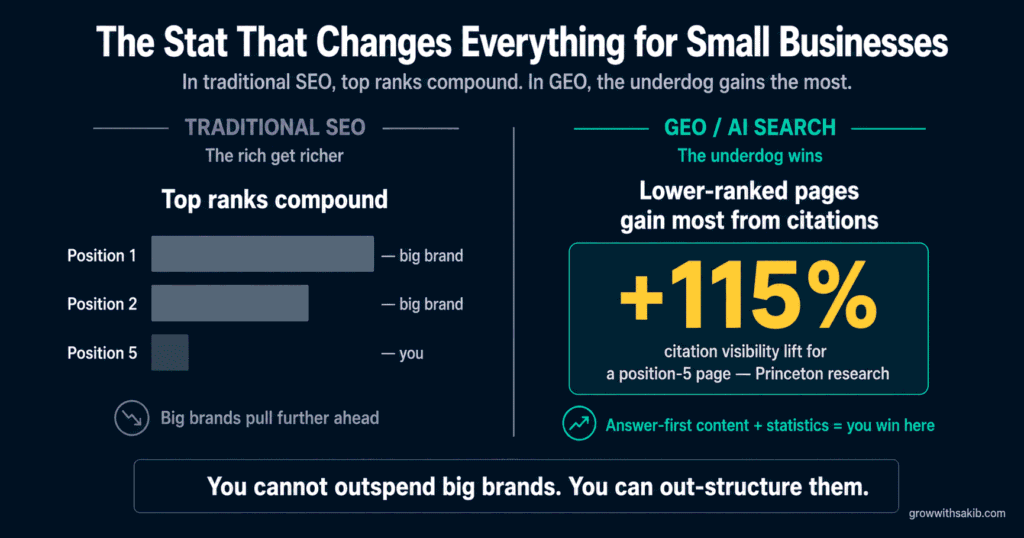
This isn’t wishful thinking – there’s research behind it. The foundational Princeton-led GEO study, presented at ACM KDD 2024, tested nine optimisation methods and found something striking for smaller sites: the pages that gained the most visibility were the ones that started lower in the rankings — a finding the complete GEO guide contextualises across all nine optimisation methods in full.
Read that again, because it’s the whole argument. In classic search, authority compounds and big brands pull away. In AI search, a well-structured, well-cited page from a small business can be lifted into an answer ahead of a vague page from a giant. You’re no longer fighting their domain authority – you’re competing on whether your passage answers the question better. That’s a fight you can win.
Where Do Small Businesses Actually Have the Advantage?
Levelling the field is one thing; small businesses actually hold real edges here that big brands struggle to match. Lean into these four.
1. Niche Depth Beats Broad Coverage
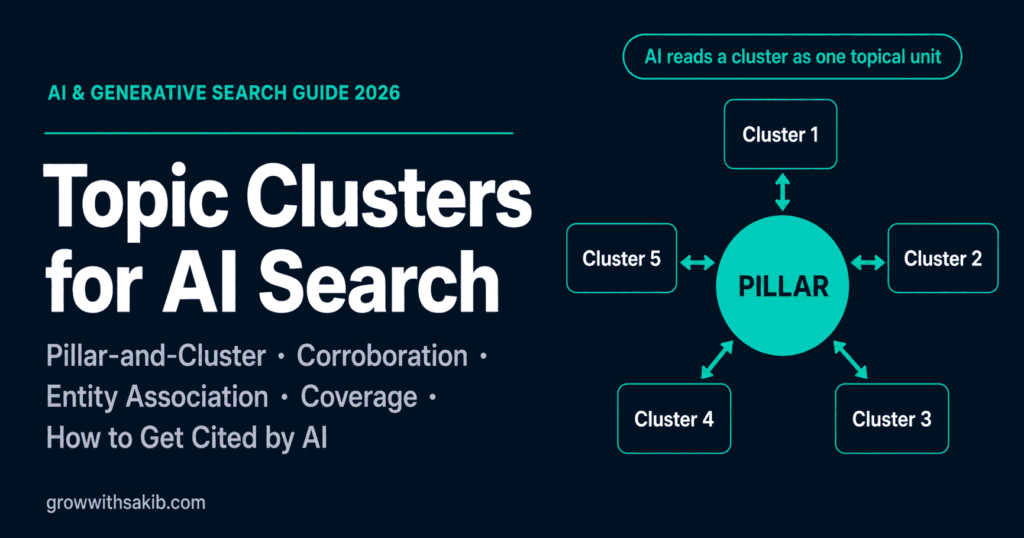
Big brands spread thin across huge topics. You can go deep on a narrow niche and become the most thorough source on it. AI rewards this – it recognises genuine topical depth and cites the specialist over the generalist. Cover every angle of your specific corner, using the approach in the topic clusters for AI search guide.
2. Specificity You Actually Have
You know your craft in concrete detail a big brand’s content team can only fake. Real prices, real processes, real edge cases, real client situations – that specificity is exactly what AI extracts and cites. “It depends on your soil type; here’s how to tell” beats “our premium solutions deliver results” every time.
3. Agility and Freshness
You can update a page today. A big brand needs three meetings and a compliance review. Since freshness is a trust signal – and Perplexity in particular favours current content – your speed is a genuine weapon. Publish on new developments while the giants are still scheduling the kickoff call.
4. Local and Reviews
If you serve a local market, that’s a moat. AI answers to “near me” and location-specific questions favour clearly-identified local businesses – and a complete Google Business Profile plus genuine reviews are signals you can build for free. A business with 200 honest reviews and detailed local info often gets recommended over a bigger name with a thin local presence.
The Free and Low-Cost GEO Playbook
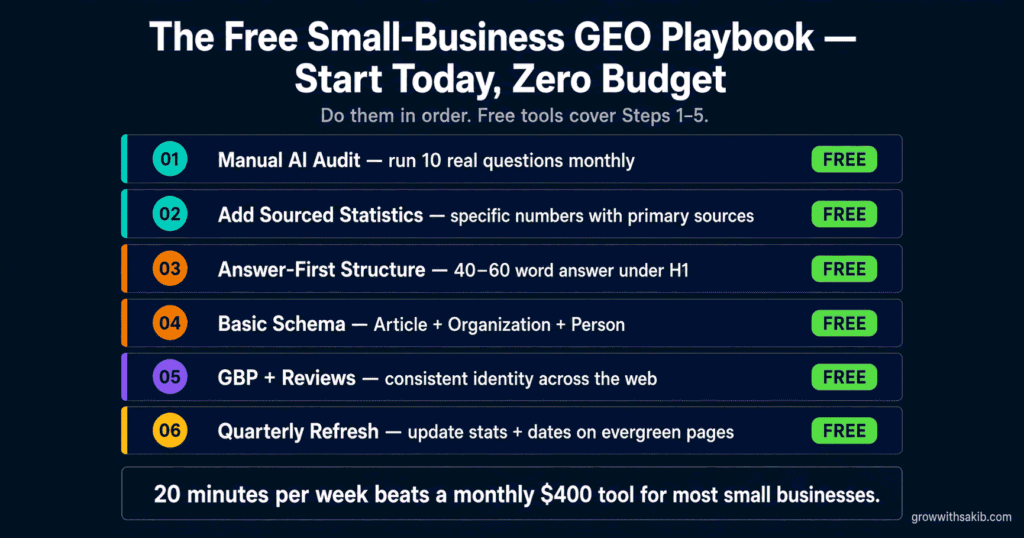
Here’s the part the pricing guides skip: most of GEO’s highest-impact work is free or nearly so. You trade money for a few hours a month. Work through these in order.
Step 1: Audit Your AI Visibility (Free)
Before fixing anything, see where you stand. Ask 15-20 real customer questions in ChatGPT, Perplexity, and Gemini, and note whether you’re mentioned, who is, and which competitors appear. This costs nothing but time and tells you exactly where the gaps are. The full method is in the guide to measuring GEO performance on GrowWithSakib.
Step 2: Add Free Statistics to Your Content
Since citing sources gave that position-five page its 115% lift, this is your highest-leverage free move. You don’t need paid data – pull real statistics from free primary sources and cite them clearly:
- Pew Research Center – free, high-quality survey data across many topics.
- Google Trends – free interest and demand trends you can screenshot and cite.
- Government and census data – free, authoritative figures for many industries and regions.
- Free tiers of Statista and industry reports – many headline stats are accessible without a subscription.
Add a relevant, sourced statistic to your key pages and link it to the original — the guide on how AI search systems work explains exactly why cited statistics increase citation probability from the AI’s retrieval perspective. The how-to is in statistics-rich content on GrowWithSakib.
Step 3: Structure Answers So AI Can Extract Them (Free)
Rewrite your key pages so each section leads with a direct answer to a real question, then expands. This costs nothing and is one of the biggest citation levers. Use natural customer questions as headings. The full method is in the answer engine optimisation guide on GrowWithSakib.
Step 4: Add Basic Schema (Free)
Basic structured data helps AI understand who you are. At minimum, add Organization (or LocalBusiness if you serve an area) and Person schema for your author, with consistent name, description, and details. It’s free to implement and reinforces your identity – the wider method is in the guide to entity optimisation for GEO on GrowWithSakib. Just keep markup honest and matched to your visible content.
Step 5: Claim Your Profile and Earn Reviews (Free)
Complete your Google Business Profile, fix inconsistent listings, and ask happy customers for honest reviews. These are free, they often show impact within weeks, and they’re exactly the trust signals AI weighs when recommending a business – especially locally.
Step 6: Set a Simple Refresh Schedule (Free)
Because you’re more agile than big brands, use it. Put a recurring reminder to update your key pages every quarter – refresh stats, dates, and examples. A visible “last updated” date and current information keep you competitive on freshness at zero cost.
| Step / Action | Cost / Impact |
| 1. Manual AI visibility audit | Free – See where you stand |
| 2. Add free, sourced statistics | Free – Highest citation lever |
| 3. Answer-first structure | Free – Makes passages extractable |
| 4. Basic Organization/LocalBusiness schema | Free – Reinforces identity |
| 5. Google Business Profile + reviews | Free – Fast local trust signal |
| 6. Quarterly content refresh | Free – Freshness advantage |
Honest Limits: What a Budget Still Buys
GEO levels the field, but let’s be straight about what money still helps with, so you set realistic expectations:
- Earned mentions at scale – getting cited across many third-party sites (digital PR) is powerful and hard to do for free. You can earn a few mentions with outreach and genuine expertise; scaling them is where budget helps.
- Tracking at scale – manual audits work for a small prompt set. Paid tools automate tracking across hundreds of prompts and competitors – useful later, not essential now.
- Time – free doesn’t mean effortless. The trade is money for hours, and consistency over months is what compounds.
- The ranking foundation – AI still draws heavily from pages that rank, so basic SEO underneath still matters. Build it with the SEO for small business guide on GrowWithSakib.
The honest bottom line: you can’t outspend the giants, and you don’t have to — but building domain authority alongside GEO compounds both signals simultaneously. The window is open precisely because most businesses – big and small – haven’t seriously started yet. Consistent, free, well-targeted GEO work now puts you ahead of competitors who are still waiting. Verify your own results with the GEO audit checklist on GrowWithSakib before you publish each page.
Common Small-Business GEO Mistakes
| Mistake | Why It Hurts | Do This Instead |
| Assuming AI only favours big brands | You never start, and lose the window | Compete on clarity and proof, not size |
| Trying to cover broad topics | You can’t out-broad a giant | Go deep on your specific niche |
| Vague, brochure-style copy | AI has nothing to extract | Use real numbers, prices, and specifics |
| Skipping free statistics | Misses the biggest citation lever | Cite free data on key pages |
| Ignoring Google Business Profile | Loses easy local trust signals | Complete it and earn honest reviews — see the guide to getting more Google reviews for the ethical review generation process |
| Paying for tools too early | Wastes a tight budget | Start free; add tools only when needed |
| Treating GEO as one-and-done | Freshness and citations fade | Refresh key pages every quarter |
Frequently Asked Questions
1. Can a small business really compete with big brands in AI search?
Yes, and more easily than in traditional search. AI answers are built from the clearest, best-supported passages, and the AI doesn’t weigh your domain’s size when choosing them. The Princeton GEO study even found lower-ranked pages gain the most from good optimisation. A specific, well-structured, well-cited page from a small business can be lifted into an answer ahead of a vague page from a giant.
2. Why do lower-ranked pages benefit most from GEO?
Because they have the most room to improve. In the Princeton study, a page ranked around position five that added credible citations saw its AI visibility rise by roughly 115%, while already-dominant top results had far less to gain. AI evaluates each passage on clarity and proof rather than domain authority, so a smaller site that structures and supports its content well can leapfrog bigger, vaguer competitors.
3. How can I do GEO for free?
Most high-impact GEO is free. Manually audit your AI visibility by asking customer questions in ChatGPT and Perplexity; add real statistics from free sources like Pew Research and Google Trends; rewrite pages to lead with direct answers; add basic Organization or LocalBusiness schema; complete your Google Business Profile and earn reviews; and refresh key pages quarterly. It costs a few hours a month, not a budget.
4. What free data sources can I use for statistics?
Several high-quality sources are free: Pew Research Center for survey data, Google Trends for demand and interest trends, government and census data for authoritative figures, and the free tiers of Statista and many industry reports for headline numbers. Cite the original source with an inline link. Adding sourced statistics is the single highest-leverage free GEO move, based on the Princeton findings.
5. Do I need to pay for a GEO tool as a small business?
Not to start. Manual testing – asking your target questions directly in ChatGPT, Perplexity, and Gemini – is free and works well for a small set of prompts. Paid tools become useful later, when you’re tracking hundreds of prompts and competitors at scale. Start with the free manual method, learn what you’re looking for, and only add a tool once manual tracking becomes too time-consuming.
6. How long does GEO take to work for a small business?
Some things move fast: completing your Google Business Profile and fixing listings can show impact within weeks. Content and authority work – citations, reviews, topical depth – typically build over three to six months. GEO is a compounding, consistent effort rather than a quick win, but small businesses often see movement sooner than in traditional SEO because there’s less entrenched competition in AI answers yet.
7. What gives small businesses an edge in AI search?
Four things: niche depth (you can out-specialise broad big-brand content), specificity (real prices, processes, and detail AI loves to cite), agility (you update pages faster, winning on freshness), and local presence (a complete Google Business Profile and genuine reviews). Big brands struggle to match these, so leaning into them is how a small business punches above its weight in AI answers.
8. Does traditional SEO still matter for GEO?
Yes. AI answers still draw heavily from pages that rank well, so a solid SEO foundation underpins your GEO efforts – they’re complementary, not competing. The good news is the work overlaps: clear, helpful, well-structured content performs in both. Build your fundamentals with a small business SEO approach, then layer GEO tactics on top rather than treating them as separate projects.
Key Takeaways
- GEO levels the playing field because AI builds answers from passages, not domains – it judges clarity and proof, not your brand size or budget.
- The Princeton study found lower-ranked pages gain most: a position-five page adding citations saw roughly a 115% visibility jump, the opposite of SEO’s rich-get-richer pattern.
- Small businesses hold real edges: niche depth, concrete specificity, agility and freshness, and local presence with reviews.
- Most high-impact GEO is free – the trade is a few hours a month, not a budget or an agency retainer.
- Your highest-leverage free move is adding real, sourced statistics from free data like Pew Research and Google Trends to key pages.
- Structure pages to lead with direct answers, add basic Organization or LocalBusiness schema, complete your Google Business Profile, and earn honest reviews.
- Be honest about limits: budget still helps with earned mentions at scale and automated tracking, and a ranking foundation still matters underneath.
- The window is open because most businesses haven’t started – consistent free GEO work now puts a small business ahead of competitors who wait.