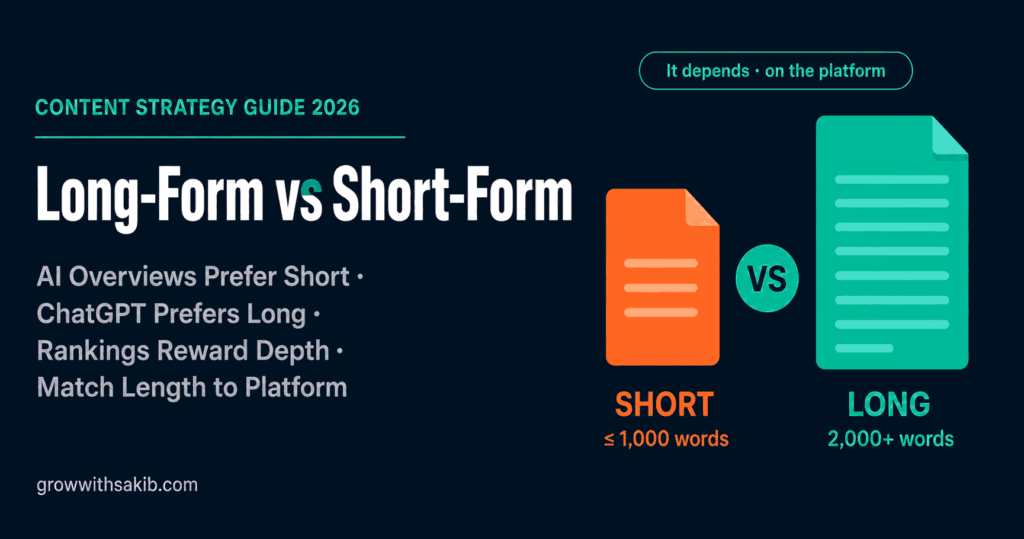
“Write longer content – it ranks better and gets cited more.” You’ve heard it a hundred times. But when you look at the actual large-scale data, the picture is far more nuanced, and in one big case it’s the opposite of the dogma. This guide walks through what the studies really show across three outcomes: Google rankings, AI citations, and social engagement.
It expands the format guidance in the content strategy for small business guide on GrowWithSakib, which recommends 1,500-3,000-word posts as a sensible default. That recommendation holds up – but for the right reasons, not because longer automatically means more AI citations. Let’s separate what’s true from what’s repeated.
Long-Form vs Short-Form: The Definitions
- Long-form content – typically 1,500-3,000+ words. Comprehensive guides, pillar pages, deep how-tos, and evergreen resources.
- Short-form content – typically under 800 words. Quick answers, news updates, simple definitions, product pages, and social posts.
Neither is “better” in the abstract. What matters is the outcome you’re optimising for and the topic you’re covering. Let’s take the three outcomes one at a time.
Outcome 1: Google Rankings
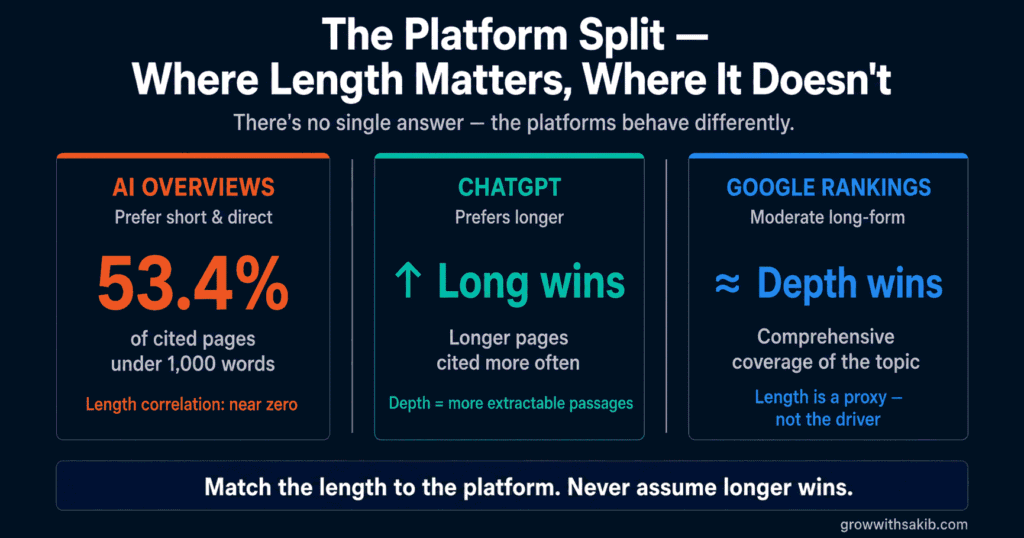
What the data says: moderate long-form content tends to correlate with better rankings – but through indirect effects, not word count itself. Longer, comprehensive pages historically earn more backlinks (they’re more link-worthy references), cover more sub-topics and long-tail queries, and demonstrate topical depth. Those are the real ranking drivers.
The crucial caveat, straight from Google Search Central: Google has no preferred word count and does not reward length for its own sake. Padding a 600-word answer to 2,000 words to “hit a number” doesn’t help and can hurt, by burying the answer and adding fluff.
Outcome 2: AI Citations (Where the Dogma Breaks)
This is where the “longer always wins” belief falls apart – and where the platform you’re targeting changes everything.
Google AI Overviews: Length Barely Matters
The single largest public study here is telling. Ahrefs analysed over 560,000 AI Overviews and more than 1.6 million cited URLs. The findings:
- The average cited page is about 1,282 words – but averages mislead.
- More than half (53.4%) of all citations go to pages under 1,000 words.
- The correlation between word count and citation is near-zero – and over 95% of short-content citations land in the top three positions.
Why? AI Overviews use a query fan-out process – splitting a search into sub-questions and pulling the best answer for each. A focused 600-word page that nails one sub-question competes on equal footing with a 5,000-word pillar page. For AI Overviews, length is simply not a major factor.
ChatGPT: Longer Content Does Help
The picture flips on ChatGPT. Research – including Neil Patel’s analysis of thousands of AI prompts – found that longer, comprehensive content gets cited more often by ChatGPT and similar generative tools, with a sweet spot often landing around 1,500-1,750 words. ChatGPT tends to favour thorough coverage it can synthesise, so here, moderate long-form has a real edge.
Outcome 3: Social Engagement
What the data says: short-form wins, clearly. Social platforms reward brevity, strong hooks, and snackable formats – a punchy post, a short video, a single-slide insight. Long-form rarely performs natively on social; people scroll past walls of text.
The smart move isn’t to choose social over blog – it’s to do both from one piece: write the long-form guide for search and AI, then break it into short-form social pieces. That’s the content repurposing approach on GrowWithSakib – one long asset feeding many short ones.
The Data at a Glance
| Outcome | What the Data Shows | Winner |
|---|---|---|
| Google rankings | Long-form correlates via backlinks + depth; no preferred word count | Moderate long-form (via depth) |
| AI Overviews | 53.4% of citations under 1,000 words; near-zero length correlation | Neither – length barely matters |
| ChatGPT citations | Longer, comprehensive content cited more | Long-form |
| Social engagement | Brevity, hooks, snackable formats win | Short-form |
The Real Lesson: Length Is a Proxy, Not a Cause
Put the outcomes together and a clear truth emerges: word count was never the real driver. When longer content wins, it usually wins because length is standing in for something else – depth, completeness, structure, backlinks, extractable answers. Strip those away and the words alone do nothing.
A well-structured 800-word page with clear question headings, direct answers, and specific data will out-cite a rambling 4,000-word essay every time. That’s why the way you structure content for AI on GrowWithSakib matters more than its length, and why answer-first AEO writing on GrowWithSakib gets extracted regardless of word count. Write to cover the topic completely – then stop.
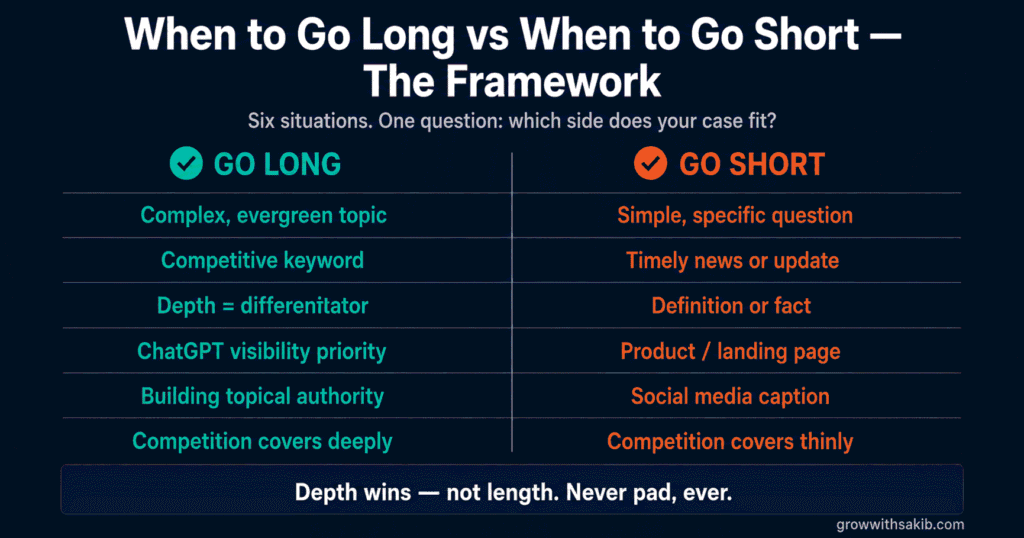
When to Go Long vs Short: A Framework
Match length to the topic and the goal, not to a dogma. Here’s the practical guide:
| Go Long-Form (1,500-3,000+) When… | Go Short-Form (Under 800) When… |
|---|---|
| The topic is genuinely complex or deep | The question has a simple, direct answer |
| It’s an evergreen pillar or authority piece | It’s timely, news, or a quick update |
| The keyword is competitive | It’s a definition or single fact |
| You’re targeting ChatGPT citations | It’s a product, utility, or listing page |
| You’re building topical depth | It’s for social or a quick FAQ answer |
| The top results are all comprehensive | The top results are short and direct |
The master rule: look at what already ranks and gets cited for your query, match that format and depth, and cover the topic completely without padding. Often the right answer isn’t one long page – it’s a content cluster on GrowWithSakib of focused pages that together build the depth, without any single page bloating.
An Honest Word on the Statistics
- Correlation isn’t causation – when studies show longer content ranking or getting cited more, length is usually a proxy for depth and quality, not the cause. Don’t add words expecting magic.
- The numbers are platform-dependent – a stat that’s true for ChatGPT can be false for AI Overviews. Always ask “on which platform?” before trusting a length claim.
- Be sceptical of ‘Xx more citations’ claims – many circulating multipliers are single-vendor and unverifiable. The large-scale studies (like Ahrefs’) are more trustworthy than a blog’s internal number.
- Your data beats any benchmark – test length on your own topics and audience, and let your results guide you rather than a one-size-fits-all rule.
Common Content-Length Mistakes
| Mistake | Why It Hurts | Do This Instead |
|---|---|---|
| Padding to hit a word count | Buries the answer; adds fluff | Cover the topic, then stop |
| Assuming longer = more AI citations | False for AI Overviews | Structure for extraction, not length |
| One length rule for all platforms | ChatGPT and AIO differ | Optimise for where your audience asks |
| Writing long on simple questions | Ranks and cites poorly | Answer simple questions briefly |
| Writing thin on complex topics | Loses to comprehensive rivals | Go deep where the topic needs it |
| Chasing a competitor’s word count | Copies their padding | Match depth and format, not word count |
| Ignoring social short-form | Misses reach | Repurpose long content into short |
Frequently Asked Questions
1. Is long-form or short-form content better for SEO?
It depends on the topic and goal – neither is universally better. Long-form (1,500-3,000+ words) tends to correlate with better rankings on competitive, evergreen topics because it earns backlinks and covers more sub-queries. But Google has no preferred word count, and a focused short page can outrank a padded long one on a simple query. The winning move is to match depth to the topic: go long when it genuinely needs depth, short when the answer is simple.
2. Does content length affect AI citations?
Less than most people think, and it depends on the platform. For Google AI Overviews, length is nearly irrelevant – Ahrefs’ analysis of 560,000+ AI Overviews found more than half of citations go to pages under 1,000 words, with near-zero correlation between word count and citation. For ChatGPT, longer comprehensive content does get cited more. The real driver across both is depth, structure, and how easily your answer can be extracted – not raw word count.
3. How long should a blog post be in 2026?
Long enough to cover the topic completely, then stop – there’s no magic number. For competitive, evergreen topics, that often means 1,500-3,000 words because they genuinely need depth. For simple questions, definitions, or timely updates, a focused 300-800 words is better and often gets cited more. Look at what already ranks and gets cited for your query, match that depth and format, and never pad to hit an arbitrary word count.
4. Does Google prefer longer content?
No. Google’s Search Central documentation states plainly that Google has no preferred word count and does not reward length for its own sake. Longer content often ranks well, but because comprehensive pages tend to be more useful, more linkable, and cover more of a topic – not because Google counts words. Padding a short, complete answer to hit a length target doesn’t help and can hurt by burying the answer under fluff.
5. Why do short pages get cited by AI Overviews?
Because AI Overviews use a query fan-out process – splitting a search into sub-questions and pulling the best, most extractable answer for each. A focused short page that perfectly answers one specific sub-question competes on equal footing with a long pillar page. In Ahrefs’ data, over 95% of short-content citations landed in the top three positions. When the answer is concise and direct, the AI can extract and credit it quickly and confidently.
6. When should I use short-form content?
Use short-form (under 800 words) when the question has a simple, direct answer; for definitions and single facts; for timely news or quick updates; for product, utility, or listing pages; and for social. If the top results for your query are short and direct, match them – forcing 2,000 words onto a simple question buries the answer and hurts both rankings and citations. Write short intentionally, not defensively.
7. Does long-form content get more backlinks?
Yes – this is one of the most consistent findings in SEO. Comprehensive long-form guides tend to earn more backlinks than short posts because they serve as definitive references other creators link to. This is a big reason long-form correlates with better rankings. But the backlinks come from the content being a genuinely useful, complete resource – not from its length alone. A long page that’s padded and shallow won’t attract links.
8. Should I make one long page or several short ones?
Often several focused pages beat one giant page. Instead of a single bloated 5,000-word article, a content cluster of focused pages – each thoroughly answering one sub-topic and linking to a pillar – builds the same topical depth without any page becoming padded or unfocused. This also gives you more individual pages that can each get cited for their specific sub-question. Match each page’s length to its specific topic, and let the cluster provide the overall depth.
Key Takeaways
- The ‘longer always wins’ rule is a myth – the data shows length matters far less than depth, structure, and extractability.
- For Google AI Overviews, length is nearly irrelevant: Ahrefs found 53.4% of citations go to pages under 1,000 words, with near-zero word-count correlation.
- For ChatGPT, longer comprehensive content does get cited more – so the right length depends on which platform you’re targeting.
- For Google rankings, moderate long-form (1,500-3,000 words) correlates with success via backlinks and depth – but Google has no preferred word count.
- For social engagement, short-form clearly wins – repurpose long content into short social pieces rather than choosing one.
- Length is a proxy, not a cause: a well-structured 800-word page out-cites a rambling 4,000-word one every time.
- Match length to the topic and goal – go long when a topic needs depth, short when the answer is simple; never pad to hit a number.
- Often a content cluster of focused pages builds more depth than a single bloated page, and gives you more pages that can each get cited.