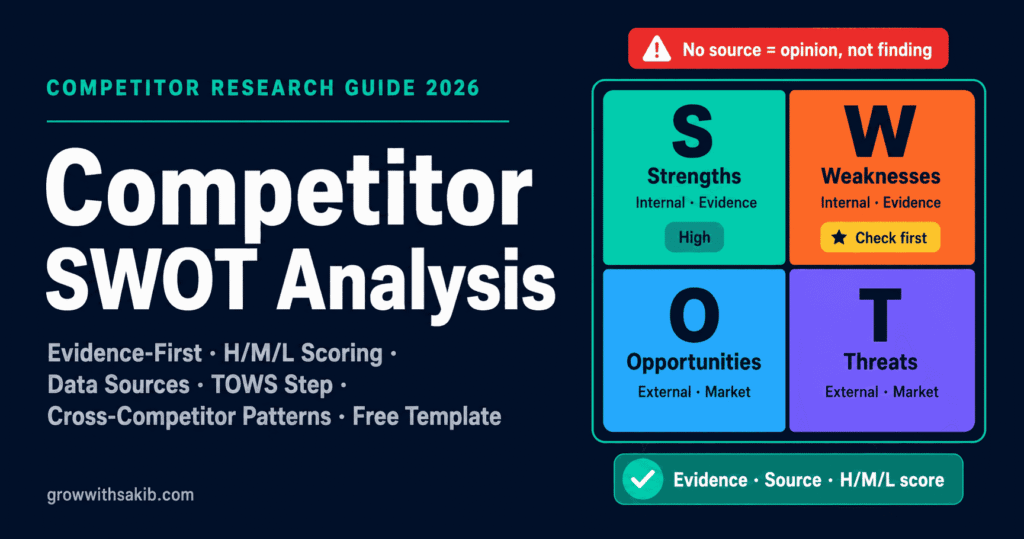
Most competitor SWOT analyses are guesswork dressed up as strategy. Someone opens a four-box grid, types whatever comes to mind, and calls it research. The grid looks tidy. It changes nothing.
A competitor SWOT analysis done well is different. It pulls real evidence into four buckets — Strengths, Weaknesses, Opportunities, Threats — so you can see exactly where a rival is strong, where they’re exposed, and where the gap for your business sits.
This guide shows you how to do it with evidence instead of opinion, plus a template you can copy and a worked example with real numbers. It expands on the SWOT step inside our complete guide to competitor research, so if you want the full research process first, start there.
What Is a Competitor SWOT Analysis?
A competitor SWOT analysis is a structured way to assess a single competitor across four dimensions: what they do well (Strengths), where they fall short (Weaknesses), the openings in their market (Opportunities), and the risks they face (Threats).
The first two are internal — things the competitor controls. The last two are external — forces in the market that affect everyone. Mixing these up is the most common mistake, and it quietly breaks the whole analysis.
The framework itself isn’t new. It traces back to work led by Albert Humphrey and a research team at the Stanford Research Institute in the 1960s, originally built to understand why corporate planning kept failing. Sixty years later it survives for one reason: four boxes force clarity.
What’s changed is the data. You no longer guess at a competitor’s strengths — you can measure their search rankings, read 200 customer reviews, and see every ad they’re running. That’s what turns a SWOT from a workshop doodle into something useful.
Why Bother SWOT-ing a Competitor At All?
Because most businesses fail for reasons a competitor SWOT would have caught early.
CB Insights found that 42% of startups fail because there’s no real market need for what they built — usually because nobody checked what competitors were already solving. A further chunk fail because they get outcompeted without ever differentiating.
A competitor SWOT attacks both problems. It shows you what the market already offers (so you don’t rebuild it) and where rivals are weak (so you have a reason to exist) — the same strategic thinking that shapes SEO for small business, where finding low-competition keyword gaps is the equivalent of finding weak competitor positions. It’s cheap insurance against expensive mistakes.
What Goes in Each SWOT Quadrant (and Where to Get the Data)
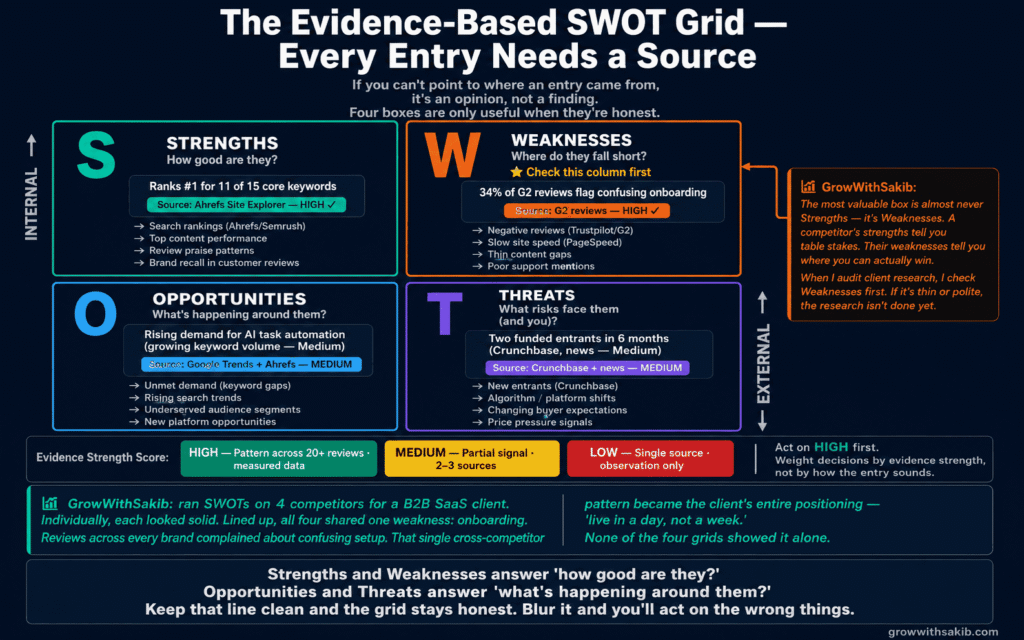
Here’s the part most guides skip: every quadrant has a source. If you can’t point to where an entry came from, it’s an opinion, not a finding.
| Quadrant | What it captures | Where the evidence comes from |
|---|---|---|
| Strengths (internal) | What the competitor does better than others | Search rankings, top content, review praise, funding, brand recall |
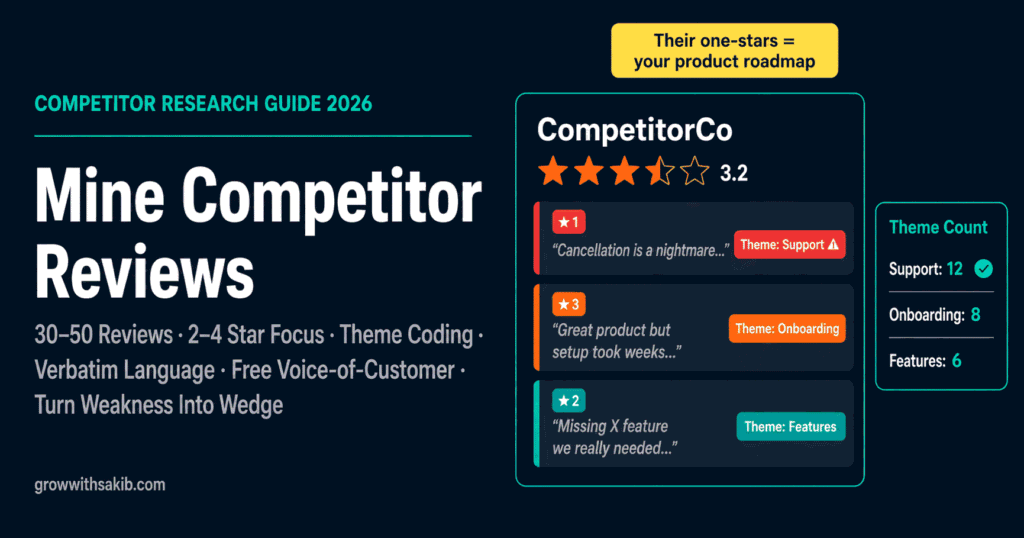
| Weaknesses (internal) | Where the competitor underperforms | Negative reviews, slow site, thin content, poor support mentions; see mining competitor reviews for the step-by-step method |
| Opportunities (external) | Market openings they could seize | Unmet demand, rising keywords, underserved segments, new platforms |
| Threats (external) | Risks pressing on them | New entrants, algorithm shifts, changing expectations, price pressure |
A practical rule: Strengths and Weaknesses answer “how good are they?” Opportunities and Threats answer “what’s happening around them?” Keep that line clean and the grid stays honest.
For the internal columns, customer reviews on Trustpilot and G2 are the richest source — people say things in reviews they’d never put in a survey. For Strengths tied to search, an SEO tool like Ahrefs or Semrush shows you which topics a competitor actually owns. We cover that in our guide on how to find content gaps competitors rank for with weak content.
How to Do a Competitor SWOT Analysis: 6 Steps
Work through these in order. Each step feeds the next.
Step 1: Pick the right competitor
Don’t SWOT a giant if you’re a small operator — the insights won’t scale to your situation. Start with a direct competitor serving your exact audience. If you’re not sure who that is, our pillar explains how to identify SEO and content competitors who may not be obvious.
Step 2: Gather evidence before you open the grid
Collect first, sort later. Spend an hour pulling: 20+ recent reviews, their top 10 ranking pages, their pricing page, and a scan of their active ads. Resist the urge to fill boxes while you research — you’ll bias toward whatever you found first.
Step 3: Fill Strengths and Weaknesses (internal)
Now sort your evidence. A strength needs proof: “ranks #1 for 14 of their 20 core keywords” beats “good at SEO.” A weakness needs the same: “32% of recent reviews mention slow support response” beats “weak support.”
Step 4: Fill Opportunities and Threats (external)
These aren’t about the competitor’s qualities — they’re about the market. An opportunity is a gap they could exploit (which tells you what’s up for grabs). A threat is pressure on them (which may also be pressure on you).
Step 5: Score each entry for evidence strength
Here’s the step that keeps a SWOT honest. Tag each entry High / Medium / Low based on how solid the evidence is. One angry review is Low. A pattern across 30 reviews is High. When you act later, weight the High entries.
Step 6: Repeat, then compare across competitors
A single SWOT is interesting. Four SWOTs side by side are strategic. When the same weakness shows up for three competitors, that’s not one company’s problem — it’s a market-wide gap you can build around.
Competitor SWOT Analysis Example (Worked)
Here’s a condensed, anonymised example for a mid-market project-management SaaS competitor we’ll call “Competitor A.”
| Quadrant | Entry | Evidence | Strength |
|---|---|---|---|
| Strengths | Ranks #1 for 11 of 15 core keywords | Ahrefs Site Explorer | High |
| Strengths | Strong brand recall in reviews | 40+ reviews mention by name | Medium |
| Weaknesses | Confusing onboarding | 34% of recent G2 reviews flag setup | High |
| Weaknesses | No native mobile app | Product pages, review requests | High |
| Opportunities | Rising demand for AI task automation | Growing keyword volume | Medium |
| Threats | Two funded entrants in 6 months | Crunchbase, news | Medium |
Read it as a story: Competitor A wins on search and brand, but loses on onboarding and mobile. The opportunity (AI automation) and the threats (new entrants) are pressing on everyone. So the opening for your business is clear — beat them on onboarding and mobile, where the evidence is High, rather than fighting their search dominance head-on.
That’s the whole point of the scoring column. It tells you to attack the High-evidence weaknesses, not the soft ones.
Turning Your SWOT Into Decisions (the TOWS Step)
A filled grid is not a strategy. The move most people miss is crossing the quadrants against each other — sometimes called a TOWS matrix.
Ask four questions:
- Strengths + Opportunities: How can your strengths capture the opening this competitor is leaving?
- Weaknesses + Opportunities: Which competitor weakness lines up with a market opportunity you can own?
- Strengths + Threats: Where can your strengths protect you from the same threats hitting them?
- Weaknesses + Threats: What shared vulnerability should you simply avoid?
In the example above, the sharpest move sits in Weaknesses + Opportunities: Competitor A’s onboarding weakness plus rising demand for fast setup equals a positioning angle. That’s a decision, not a grid.
Free Competitor SWOT Analysis Template
Copy this into a doc or sheet — one block per competitor.
| COMPETITOR: ____________________ Date: __________ Analyst: __________ INTERNAL Strengths (with evidence + H/M/L) – – Weaknesses (with evidence + H/M/L) – – EXTERNAL Opportunities (with evidence + H/M/L) – – Threats (with evidence + H/M/L) – – CROSS-COMPETITOR PATTERN (fill after 3-4 grids): – Shared weakness across competitors: – Market-wide opportunity this reveals: DECISION (TOWS): – Strongest move for us: |
The two fields at the bottom — cross-competitor pattern and decision — are what separate this from a generic template. Don’t leave them blank.
Common Mistakes to Avoid
- Filling boxes from memory. If there’s no source, it’s not a finding. Gather evidence first.
- Listing more strengths than weaknesses. Politeness kills usefulness. Dig until the Weaknesses column is honest.
- Confusing internal and external. Bad support is a Weakness. A new rival is a Threat. Don’t blur them.
- Stopping at one competitor. The real insight lives in the pattern across several grids.
- Never reaching a decision. A SWOT that doesn’t change what you do was a waste of an afternoon.
Where SWOT Falls Short (an Honest Note)
SWOT isn’t perfect, and pretending otherwise would be dishonest. It’s a snapshot — a competitor’s grid can be out of date within months, which is why our pillar recommends monitoring competitors continuously rather than treating research as one-and-done.
It also doesn’t weight or prioritise on its own — that’s exactly why the evidence-scoring step matters. And for very early-stage markets where there’s little data, a SWOT can feel empty; in those cases, customer interviews tell you more than a grid will.
Use it as one tool in the kit, not the whole kit. Paired with review mining and SEO gap analysis, it earns its place. Alone, it’s just four boxes — and the complete competitor research guide shows exactly how to combine it with the other methods in the right sequence.
Frequently Asked Questions
What is a competitor SWOT analysis?
A competitor SWOT analysis is a framework that maps a rival’s internal Strengths and Weaknesses against external Opportunities and Threats. Built from real evidence like reviews, rankings, and pricing, it shows where a competitor is strong, where they’re exposed, and where the gap for your business sits.
How do you do a SWOT analysis on a competitor?
Pick one direct competitor, gather evidence first (reviews, top pages, pricing, ads), then sort findings into the four quadrants with a source attached to each. Score entries High/Medium/Low for evidence strength, repeat for several competitors, and compare grids to find patterns you can act on.
What goes in each SWOT quadrant?
Strengths and Weaknesses are internal — what the competitor does well or poorly. Opportunities and Threats are external — market openings and risks affecting everyone. A simple test: the first two answer “how good are they?” and the last two answer “what’s happening around them?”
How many competitors should I SWOT?
Aim for three to five. A single SWOT shows you one company; comparing several reveals market-wide patterns. When the same weakness appears across multiple competitors, it points to a gap you can build your positioning around — which a lone grid would never surface.
What’s the difference between SWOT and TOWS?
SWOT lists the four quadrants. TOWS crosses them against each other to generate decisions — pairing your strengths with market opportunities, or matching a competitor’s weakness to a gap you can own. SWOT describes the situation; TOWS turns it into a move.
Is SWOT analysis still useful in 2026?
Yes, when it’s evidence-based. The framework, developed by Albert Humphrey’s team at the Stanford Research Institute, survives because four boxes force clarity. What’s outdated is filling it from opinion. Tie each entry to data from reviews and SEO tools and it stays relevant.
Where do I get data for a competitor SWOT?
Customer reviews on Trustpilot and G2 reveal strengths and weaknesses; SEO tools like Ahrefs or Semrush show which topics a competitor owns; pricing pages and ad libraries reveal positioning. The rule is simple — every quadrant entry needs a source, or it doesn’t belong in the grid.
Key Takeaways
- A competitor SWOT is only useful when each entry is tied to real evidence, not memory or opinion.
- Strengths and Weaknesses are internal; Opportunities and Threats are external — never blur the line.
- The Weaknesses quadrant is usually the most valuable, because it shows where you can actually win.
- Score every entry High/Medium/Low so you attack the best-supported weaknesses, not the softest ones.
- A single grid is interesting; comparing three to five reveals market-wide gaps worth owning.
- The TOWS step turns a finished grid into specific moves — without it, a SWOT changes nothing.
- SWOT is a snapshot, so pair it with continuous monitoring and refresh it regularly.