Your competitor paid to acquire every customer who left them a review. Then those customers wrote down, for free, exactly what they loved and hated. That’s market research your rival funded and you get to read.
Most businesses skim a competitor’s reviews for reputation gossip. Smart ones do competitor review analysis — mining those reviews systematically for the customer insights that sharpen their own product, messaging, and positioning.
This expands Step 5 of our complete guide to competitor research. Reviews are the richest free data source in the whole research process — here’s how to actually mine them.
Why Competitor Reviews Are Goldmine Data
Reviews matter to buyers — around 93% of consumers read online reviews before making a purchase, and they shape which business a customer picks — which is why your own Google reviews strategy is equally important to your competitive positioning. But for you, a competitor’s reviews are something else entirely: unfiltered voice of customer.
Surveys are biased by how you ask. Reviews aren’t — customers write them unprompted, in their own words, about what actually mattered. That makes them more honest than almost any research you could commission. And a competitor’s reviews reveal the things they’ll never put in their marketing: where they let customers down.
Where to Find Competitor Reviews
Spread your net across platforms — each attracts a different kind of feedback.
| Platform | Best for | Type of insight |
|---|---|---|
| Trustpilot | Services, ecommerce, SaaS | General sentiment, service issues |
| G2 / Capterra | B2B software | Feature gaps, onboarding, support |
| Google Reviews | Local & service businesses | Experience, location, staff |
| Amazon | Physical products | Product quality, durability, value |
| App Store / Play | Apps & mobile | Bugs, UX, missing features |
Don’t rely on one source. A SaaS competitor might look flawless on their own site but have revealing G2 reviews about clunky onboarding — the same kind of gap that shows up in competitor keyword analysis when their support and troubleshooting pages attract far more traffic than their feature pages. Cross-platform reading is where the honest picture forms.
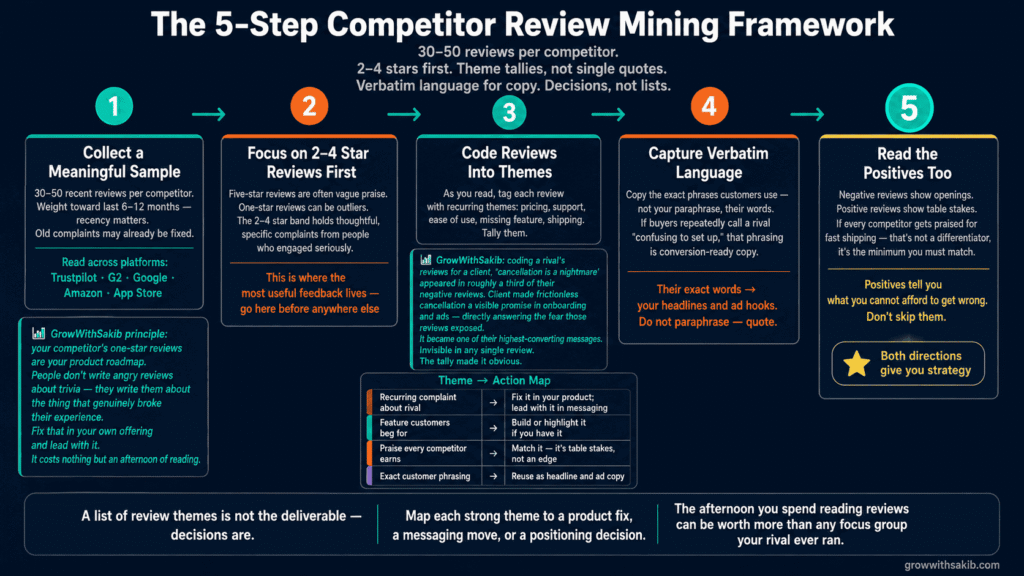
How to Mine Competitor Reviews: A Step-by-Step Method
Step 1: Collect a meaningful sample
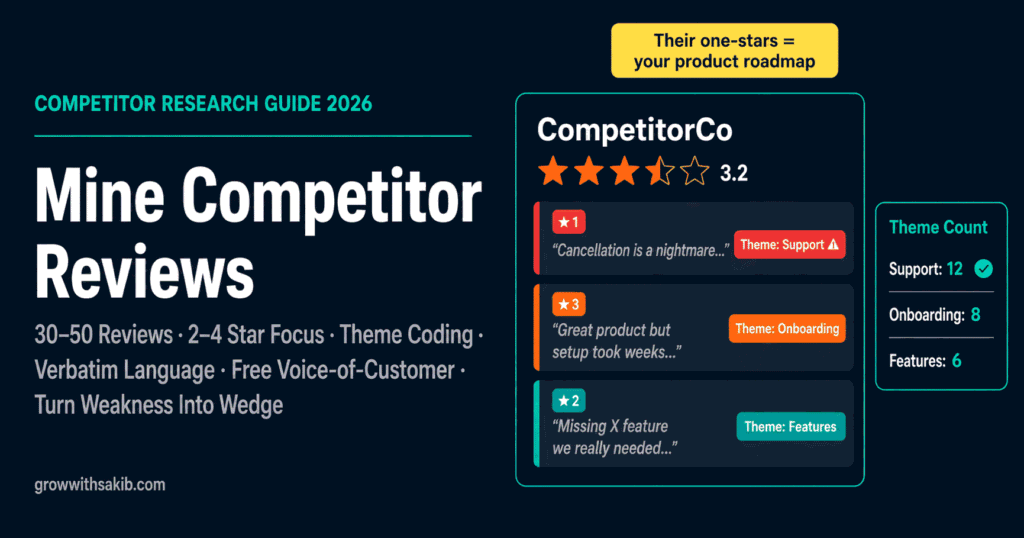
Don’t read five reviews and call it research. Aim for 30–50 recent reviews per competitor, weighted toward the last 6–12 months so you’re seeing the current experience, not ancient history. Recency matters — a product fixed last year shouldn’t count against them now.
Step 2: Focus on the 2–4 star reviews first
This is the move most people get wrong. Five-star reviews are often vague (“love it!”) and one-star reviews can be outliers from impossible-to-please customers. The middle band — two to four stars — is where thoughtful, specific feedback lives. These reviewers liked enough to engage but had real, articulate complaints.
Step 3: Code reviews into themes
As you read, tag each review with the themes it raises — pricing, support, ease of use, a missing feature, shipping. Tally them. After 40 reviews, patterns emerge: maybe 60% of complaints cluster on one issue. That cluster is your insight; a single review is just an anecdote.
Step 4: Capture verbatim language
Copy the exact phrases customers use — not your paraphrase, their words. If buyers repeatedly say a rival is “confusing to set up,” that phrasing is conversion-ready copy for your own pages and ads. This pairs perfectly with the messaging you find when studying competitor ads in the Meta Ad Library.
Step 5: Read the positives too
Negative reviews show openings; positive reviews show table stakes. If every competitor gets praised for fast shipping, that’s not a differentiator — it’s the minimum you must match. The positives tell you what you can’t afford to get wrong — the same table-stakes logic that applies to SEO for small business, where ranking basics like page speed and mobile optimisation are prerequisites, not advantages.
Turning Review Themes Into Action
A list of themes isn’t the deliverable — decisions are. Map each strong theme to a move:
| Review theme | Your move |
|---|---|
| Recurring complaint about a rival | Fix it in your product; lead with it in messaging |
| Feature customers beg for | Build or highlight it if you have it |
| Praise every competitor earns | Match it — it’s table stakes, not an edge |
| Exact customer phrasing | Reuse as headline and ad copy |
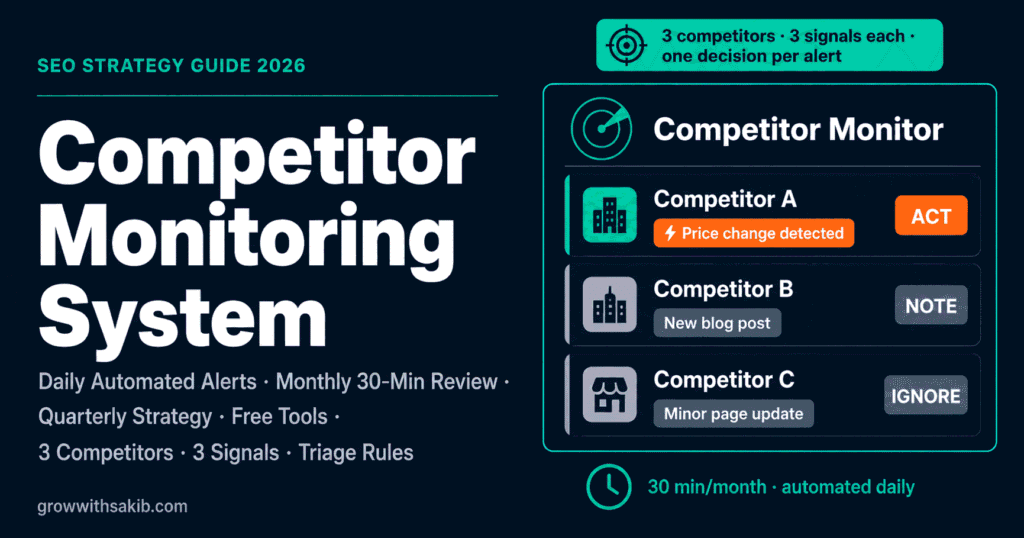
Feed these findings into a competitor SWOT analysis so review insight sits alongside your other research, and into identifying the market gaps competitors leave open — then track whether those gaps persist over time using a competitor monitoring system. Reviews are often where the clearest gaps first show up.
Common Mistakes to Avoid
- Reading too few reviews. Five reviews is an anecdote; 30–50 is a pattern.
- Obsessing over one-star outliers. The 2–4 star band holds the most useful feedback.
- Ignoring recency. Old complaints may already be fixed — weight toward recent reviews, and use a competitor monitoring cadence to catch fresh complaints as they appear rather than catching up quarterly.
- Paraphrasing instead of quoting. Customers’ exact words are your best copy.
- Stopping at sentiment. Themes only matter if you turn them into product or messaging moves.
An Honest Note on Review Mining
Reviews are powerful but imperfect data. They skew toward extremes — delighted and furious customers write more than satisfied-but-quiet ones — so they’re not a representative survey. And fake reviews are a real problem; a meaningful share of online reviews are estimated to be fake, so treat any single glowing or scathing review with caution and trust the patterns instead.
Volume also varies by business type. A large consumer brand may have thousands of reviews to mine; a niche B2B competitor might have a dozen, which limits what you can conclude. Where reviews are thin, pair them with direct customer conversations. Use review mining as one honest lens on your competitors — rich, free, but not the whole truth — and pair it with the other methods in the complete competitor research guide for a full picture.
Frequently Asked Questions
What is competitor review analysis?
Competitor review analysis is systematically reading a rival’s customer reviews to extract insight — their weaknesses, what customers value, and the exact language buyers use. You collect reviews across platforms, code them into recurring themes, and turn those patterns into product, messaging, and positioning decisions. It’s effectively free voice-of-customer research your competitor funded.
How do you analyse competitor reviews?
Collect 30–50 recent reviews per competitor across platforms like Trustpilot, G2, and Google. Focus first on two-to-four-star reviews, where the most specific feedback lives. Tag each review with themes — pricing, support, missing features — and tally them. The recurring clusters are your insights; capture customers’ exact wording for use in your own copy.
Where can I find competitor reviews?
Different platforms suit different businesses: Trustpilot for services and ecommerce, G2 and Capterra for B2B software, Google Reviews for local businesses, Amazon for physical products, and the App Store or Play Store for apps. Read across several rather than one — a competitor can look flawless on their own site but reveal real issues on third-party platforms.
What can you learn from competitor reviews?
A great deal: where a competitor consistently disappoints customers, which features buyers wish they had, what the market treats as table stakes, and the exact language customers use to describe problems. Negative reviews reveal openings you can exploit; positive reviews reveal the minimums you must match to compete at all.
Which competitor reviews are most useful?
The two-to-four-star reviews. Five-star reviews are often vague praise, and one-star reviews can be outliers from impossible-to-please customers. The middle band comes from people who engaged seriously but had specific, articulate complaints — the most actionable feedback for understanding a competitor’s real weaknesses and the gaps you could fill.
How many competitor reviews should I read?
Aim for 30 to 50 recent reviews per competitor. Fewer than that and you’re reading anecdotes; more and you start seeing reliable patterns. Weight toward the last 6–12 months so you capture the current experience rather than issues a competitor may have already fixed. The goal is recurring themes, not individual opinions.
Are competitor reviews reliable for research?
They’re valuable but imperfect. Reviews skew toward extremes, since delighted and angry customers write more than quiet, satisfied ones, so they aren’t a representative survey. Fake reviews also exist. Trust recurring patterns across many reviews rather than any single one, and for competitors with few reviews, supplement with direct customer conversations.
Key Takeaways
- A competitor’s reviews are free, unfiltered voice-of-customer research they paid to generate.
- Read across platforms — Trustpilot, G2, Google, Amazon — not just one source.
- Collect 30–50 recent reviews per competitor; recency matters.
- Focus on 2–4 star reviews — they hold the most specific, useful feedback.
- Code reviews into themes and tally them; patterns are insight, single reviews are anecdotes.
- Capture customers’ exact words — they’re conversion-ready copy.
- Turn recurring complaints into product fixes and lead messaging.
- Reviews skew to extremes and include fakes — trust patterns, not single reviews.