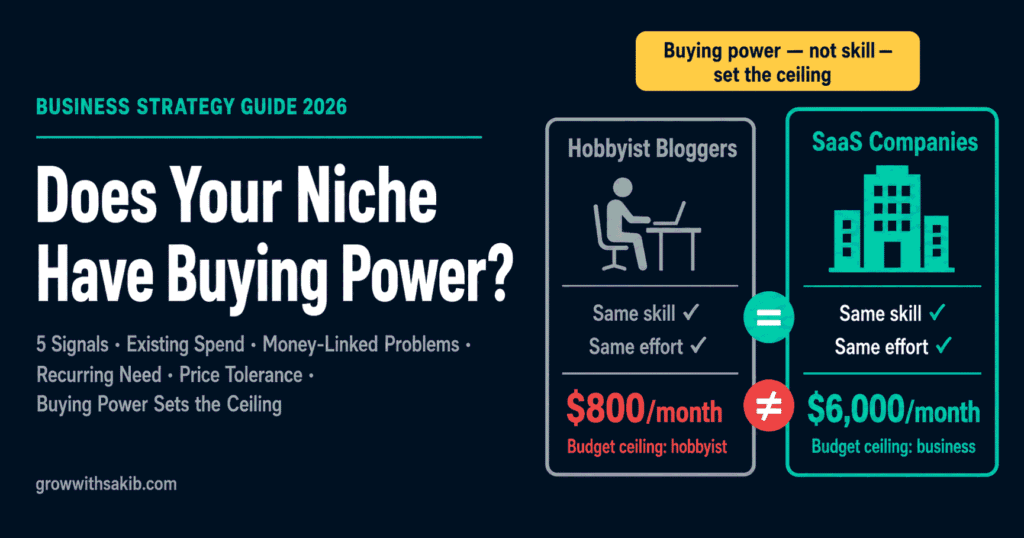
A niche has real buying power when its members have budget, urgency, and a track record of paying to solve the problem you address. The clearest signals are existing spend on similar solutions, a problem tied to making or saving money, recurring rather than one-off need, and buyers who don’t flinch at professional pricing.
Plenty of niches are full of interested people who will never pay you well. Interest is cheap; buying power is rare. A niche can have thousands of engaged followers and still be a financial dead end if nobody there has money to spend or a reason to spend it. This article expands the final step of the pillar guide on finding the right niche — confirming a niche can actually pay — into a full set of signals you can check before you commit.
What Is Buying Power in a Niche?
Buying power is a niche’s ability and willingness to pay for a solution. It combines two things: capacity (do they have the money?) and motivation (is the problem worth spending it on?). A niche needs both — budget without urgency sits idle, and urgency without budget can’t convert.
This is distinct from demand. Validating market demand confirms people want a solution; buying power confirms they’ll pay properly for one. You can have strong demand and weak buying power at the same time — a huge audience of people who expect everything free is the classic trap.
Why it matters so much: price is the most powerful lever in a business. McKinsey’s pricing research found that for a typical S&P 1500 company, a 1% rise in price lifts operating profit by around 8% when volume holds — a bigger impact than cutting costs or chasing more volume. A niche that lets you price well is worth far more than one that forces you to compete on cheapness — and building topical authority within that niche is how you command premium positioning over time without competing on price at all.
The 5 Signals of Real Buying Power
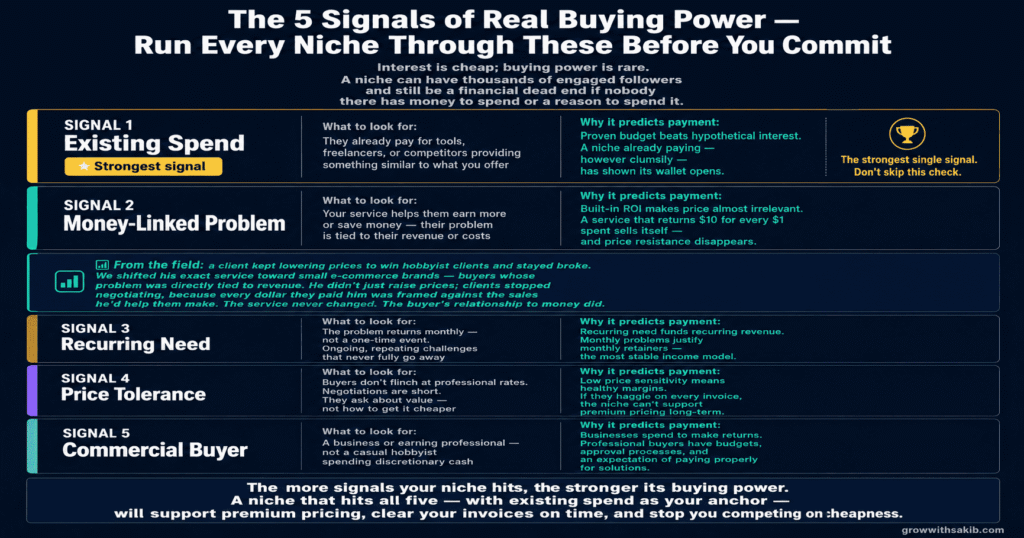
Run a candidate niche through these five signals. The more it hits, the stronger its ability to pay.
| Signal | What to look for | Why it predicts payment |
|---|---|---|
| Existing spend | They already pay for tools, freelancers, or competitors | Proven budget beats hypothetical interest |
| Money-linked problem | Your service helps them earn or save money | ROI justifies almost any price |
| Recurring need | The problem returns monthly, not once | Recurring need funds recurring revenue |
| Price tolerance | Buyers don’t flinch at professional rates | Low price sensitivity = healthy margins |
| Commercial buyer | A business or professional, not a casual hobbyist | Businesses spend to make returns |
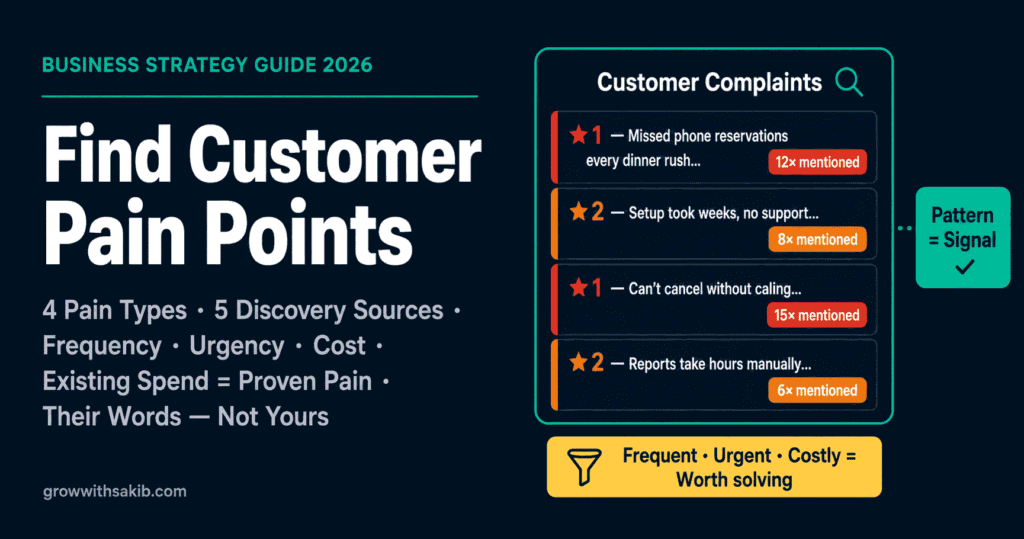
The strongest single signal is the first: people already spending money. A niche actively paying — however clumsily — has proven its wallet opens. That ties directly to the customer pain points they’re already paying to fix.
Why a Money-Linked Problem Changes Everything
The single biggest driver of buying power is whether your service touches the customer’s money. Problems that help someone earn more or save more carry built-in ROI, which makes price almost irrelevant — a service that reliably returns $10 for every $1 spent sells itself.
This is the logic behind value-based pricing, which sets price by the value delivered rather than the hours worked or what competitors charge. When a niche’s problem is tied to revenue, you can price against the outcome, not your time — and that’s where real margins live.
Contrast two niches. “Help hobby photographers organise photos” solves a nice-to-have for people spending their own discretionary cash. “Help wedding photographers book more $3,000 clients” solves a money problem for people whose income depends on it. Same skill set; completely different buying power — and the right choice starts with identifying the strongest deliverable skill you can apply to the higher-power context.
How to Test a Niche’s Buying Power
You don’t have to guess. These checks reveal whether the money is real before you commit.
- Look for existing competitors charging real prices. Paid competitors are proof the niche sustains paid work. Their pricing pages show you the ceiling — use the competitor pricing analysis guide to read those pages correctly and understand what the numbers actually signal.
- Scan marketplaces for active paid jobs. Live postings on Upwork or industry boards — and the rates attached — reveal what people actually pay.
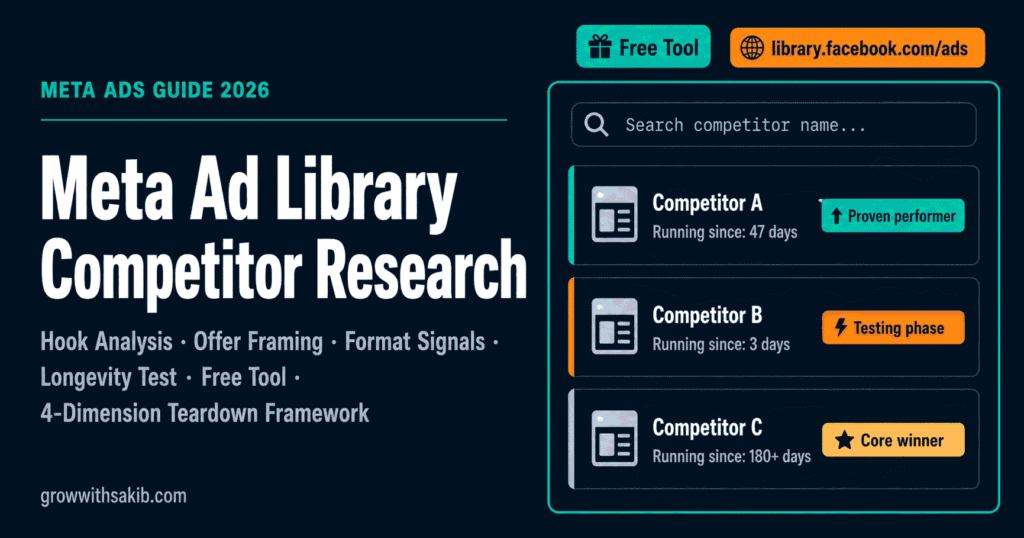
- Check whether they spend on adjacent tools. A niche already buying software, courses, or ads has demonstrated budget and a habit of spending.
- Ask about past spend in conversations. “What have you paid to solve this before?” surfaces real budgets far better than “what would you pay?”
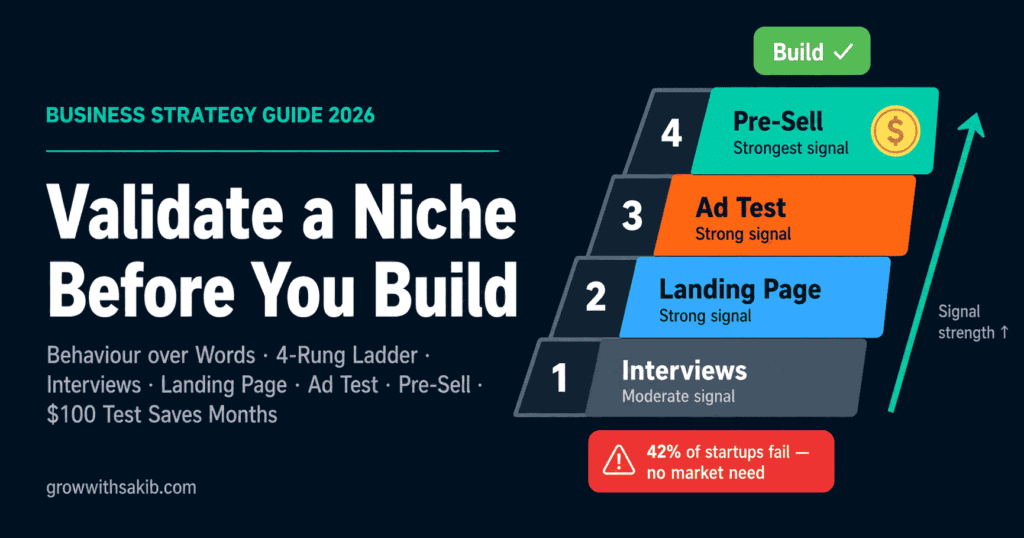
- Test a real price. The ultimate check is naming a professional price and watching the reaction — covered in depth in niche validation.
That last step connects to validating a niche before you build, where a real pre-sell or deposit confirms not just that they’ll pay, but how much.
High vs. Low Buying Power: Spotting the Difference
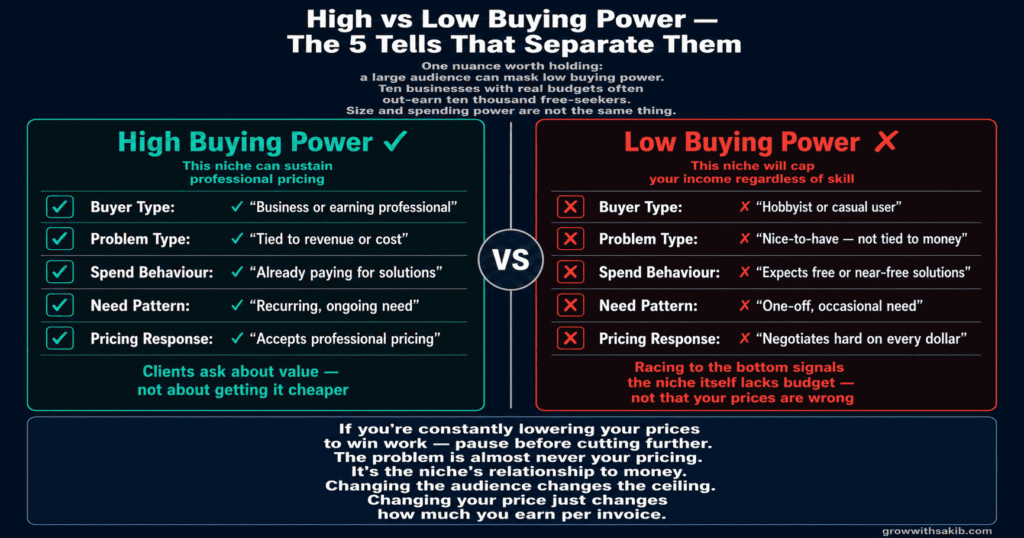
| High buying power | Low buying power |
|---|---|
| Buyer is a business or earning professional | Buyer is a hobbyist or casual user |
| Problem tied to revenue or cost | Problem is a nice-to-have |
| Already paying for solutions | Expects free or near-free |
| Recurring, ongoing need | One-off, occasional need |
| Accepts professional pricing | Negotiates hard on every dollar |
One nuance worth holding: a large audience can mask low buying power. Volume feels reassuring, but ten businesses with real budgets often out-earn ten thousand free-seekers. Size and spending power are not the same thing — and the specialist vs generalist data shows exactly why a narrow focus on funded buyers beats a broad appeal to everyone.
Common Mistakes When Judging Buying Power
- Mistaking audience size for buying power. A big crowd of non-spenders is still a dead end — the same mistake as chasing shiny object syndrome niches with large follower counts but no spending culture.
- Confusing interest with willingness to pay. Engagement and free downloads don’t prove anyone will open a wallet.
- Targeting buyers who spend their own discretionary cash. Business budgets convert far more easily than personal hobby budgets.
- Ignoring recurring potential. A one-off problem caps your revenue; a recurring one compounds it.
- Competing on price in a low-power niche. Racing to the bottom signals the niche itself lacks budget.
When Low Buying Power Can Still Work
Buying power isn’t the only thing that matters, and high-budget niches aren’t automatically the right choice. A niche with modest individual budgets can still build a strong business at volume — think low-priced, high-repeat services where many small payments add up. The model has to match the math.
There are also good reasons to serve a lower-power niche deliberately: mission, passion, or using it as an entry point while you build skill and proof. The honest caveat is to go in with eyes open. If you choose a low-buying-power niche, design for volume or efficiency from the start, and don’t expect premium pricing the market can’t support. Buying power sets the ceiling — just make sure your business model fits under it, as the complete guide to finding the right niche walks through each step of that decision systematically.
Frequently Asked Questions
How do I know if a niche has buying power?
Look for five signals: members already spend on similar solutions, the problem is tied to making or saving money, the need recurs rather than happening once, buyers accept professional pricing, and the buyer is a business or earning professional. The strongest proof is existing spend — a niche already paying for solutions has shown its budget is real.
What’s the difference between demand and buying power?
Demand confirms people want a solution; buying power confirms they’ll pay properly for one. You can have strong demand and weak buying power simultaneously — a large audience that expects everything free is the classic example. Validating demand measures interest; buying power measures budget and willingness to spend.
Why does a money-linked problem increase buying power?
Because a service that helps customers earn or save money carries built-in ROI, which makes price almost secondary. If you reliably return more than you cost, buyers stop negotiating. This is the basis of value-based pricing, where you charge for the outcome delivered rather than hours worked.
Does a bigger audience mean more buying power?
No. Audience size and buying power are different things. Ten businesses with real budgets often out-earn ten thousand people seeking free help. A large following can actually mask weak buying power if those people have no money or no urgent reason to spend it. Always weigh spending capacity over raw numbers.
How can I test buying power before committing?
Check for paid competitors and their price points, scan marketplaces like Upwork for active jobs and rates, see whether the niche buys adjacent tools or courses, and ask people what they’ve already paid to solve the problem. The ultimate test is naming a real price and watching the reaction, ideally through a pre-sell.
Can I succeed in a niche with low buying power?
Yes, but the model must fit. Low individual budgets can still work at volume through low-priced, high-repeat services where many small payments add up. Just go in knowingly — design for volume or efficiency and don’t expect premium pricing. Buying power sets the ceiling on what you can charge, so match your business model to it.
Key Takeaways
- Buying power is a niche’s ability and willingness to pay — capacity plus motivation, not just interest.
- Check five signals: existing spend, money-linked problem, recurring need, price tolerance, and a commercial buyer.
- Existing spend is the strongest signal — a niche already paying has proven its budget.
- Money-linked problems carry built-in ROI, letting you use value-based pricing instead of competing on cost.
- Price is the most powerful profit lever — a 1% price rise can lift operating profit by around 8%.
- Audience size is not buying power; a few funded businesses can beat a huge free-seeking crowd.
- Low-buying-power niches can work — but only with a volume or efficiency model designed to fit.