To validate market demand for a niche, confirm that people are actively searching for, talking about, and paying for a solution. Check search volume and trend direction in tools like Google Trends and Ahrefs, scan forums and marketplaces for active spending, then talk to real buyers. Demand is validated only when interest, intent, and money all line up.
A niche can feel exciting and still have no real demand behind it. Excitement is yours; demand belongs to the market. The gap between those two is where most service businesses quietly fail. The pillar guide on finding the right niche lists demand validation as a core step — this article gives you the exact tools, signals, and order of operations to do it properly before you commit time or money.
What Is Market Demand Validation?
Market demand validation is the process of gathering evidence that a real, paying audience exists for a niche before you invest in it. It answers one blunt question: will enough people pay to solve this problem to sustain a business?
It’s the difference between assuming and knowing. Skipping it is the single most common way new ventures fail — CB Insights found that 42% of startups fail because there was no market need for what they built. Validation is simply the work of making sure you’re not the next entry in that statistic.
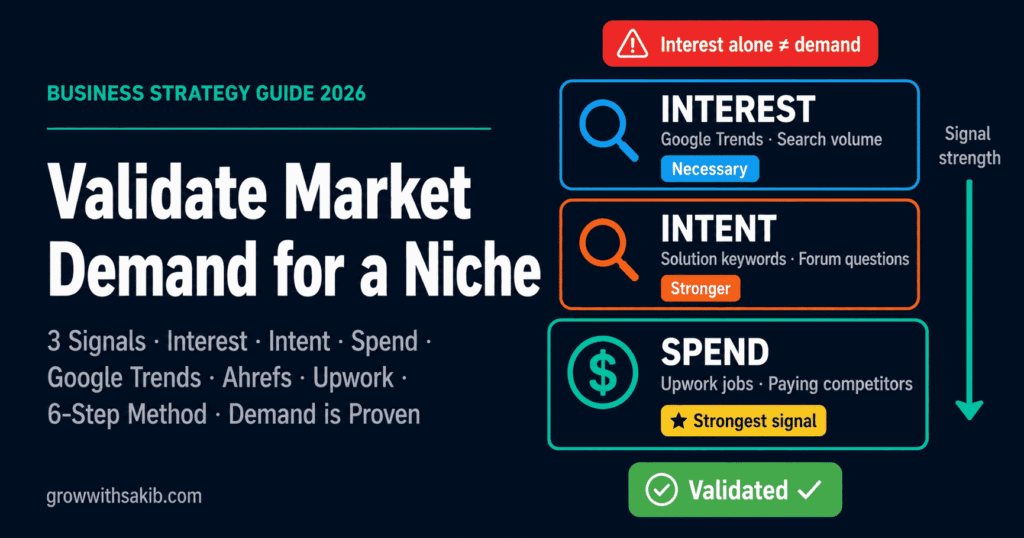
Strong demand shows three signals at once. Interest (people are searching and talking), intent (they’re looking for solutions, not just browsing), and spend (money already changes hands). One signal alone is a hint. All three together is validation — and they should align with a strongest skill you can reliably deliver before committing.
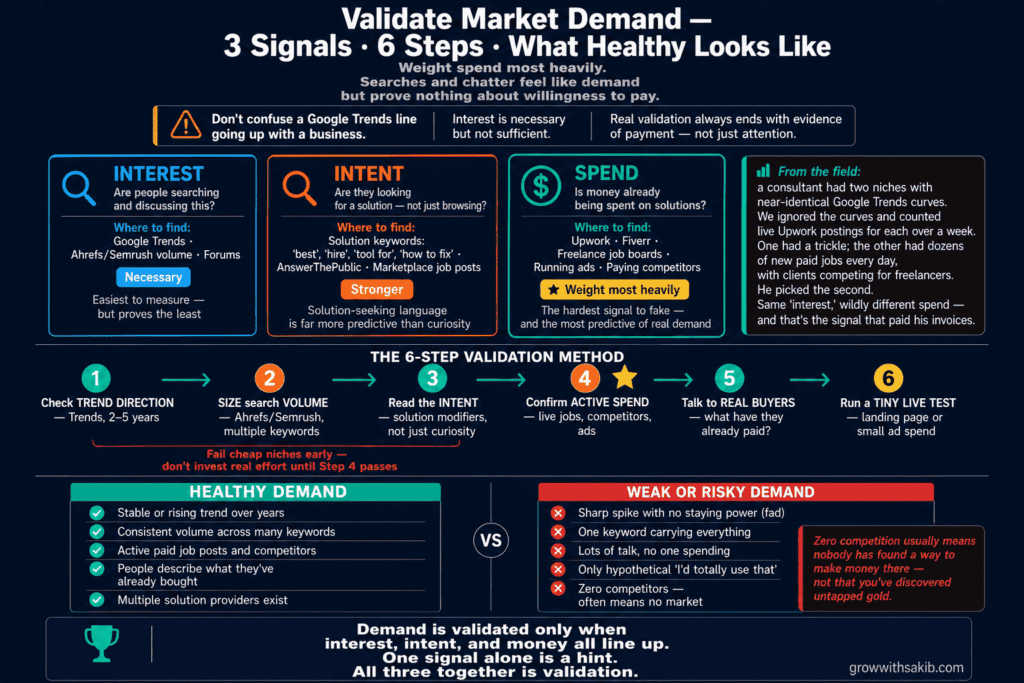
The Three Signals of Real Demand
Before touching a tool, know what you’re hunting for. Each signal answers a different question, and you want all three.
| Signal | The question it answers | Where you find it |
|---|---|---|
| Interest | Are people searching for and discussing this? | Google Trends, search volume, forums |
| Intent | Are they looking to solve it, not just curious? | Keyword modifiers, marketplace job posts |
| Spend | Is money already being spent on solutions? | Competitors, freelancers, paid tools, ads |
The biggest mistake is stopping at interest because it’s the easiest to measure. Spend is the hardest signal to fake and the most predictive — weight it most heavily.
Which Tools Validate Market Demand?
Each tool measures a different slice of demand. Use them together, not in isolation.
Google Trends — direction and seasonality
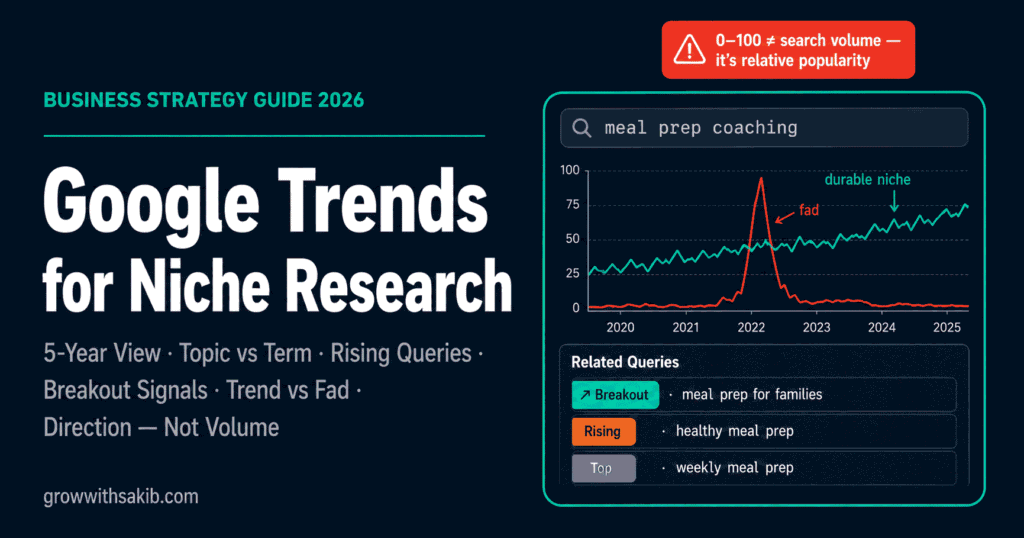
Google Trends shows whether interest in a topic is rising, flat, or fading, and whether it’s seasonal. One crucial caveat most guides skip: per Google’s own Search Central documentation, Trends provides a random sample of searches, and its numbers are relative, not absolute. A score of 100 is the peak for that query, not a volume count. So use Trends to read direction, never to estimate how many people search.
Ahrefs / Semrush — search volume and competition
For actual volume, turn to Ahrefs or Semrush. They estimate monthly search volume, keyword difficulty, and related terms — the closest you’ll get to sizing real interest and how hard it is to rank. Look for consistent volume across multiple related keywords, not one lucky term.
AnswerThePublic & autocomplete — intent language
Free tools like AnswerThePublic, plus Google autocomplete and “People also ask,” reveal the exact questions people type. Question-heavy results signal a problem people actively want solved — strong intent evidence.
Marketplaces & communities — proof of spend
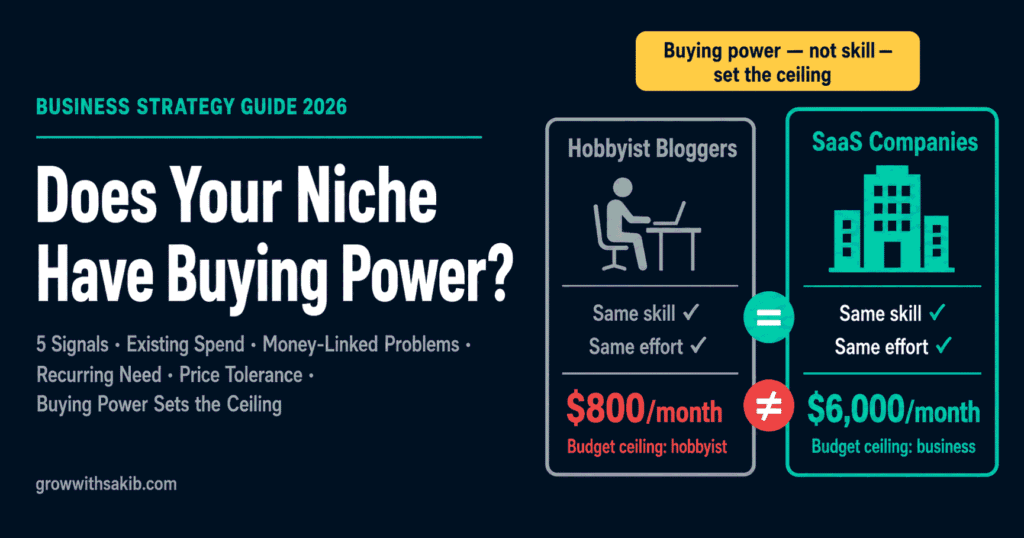
This is where validation gets real. Open Upwork, Fiverr, and freelance job boards: are people already paying for this service right now? Browse Reddit, Facebook groups, and niche forums for people asking for recommendations. Active job posts and “who can I hire for this” threads are the clearest proof that money is moving — the next check is niche buying power, which confirms whether clients in that space can afford the fees a sustainable service business needs to charge.
How to Validate Market Demand: A 6-Step Method
Run these in order. Each step adds a harder, more expensive-to-fake signal, so you fail cheap niches early and only invest real effort in survivors.
- Check trend direction. In Google Trends, confirm interest is stable or rising over 2–5 years, not collapsing.
- Size the search volume. Use Ahrefs or Semrush to confirm consistent monthly volume across several related keywords.
- Read the intent. Look for solution-seeking modifiers — “best,” “hire,” “tool for,” “how to fix” — not just informational browsing.
- Confirm active spend. Find live job posts, paying competitors, or running ads. If people pay, demand is real.
- Talk to real buyers. Speak to 5–10 people in the niche. Ask what they’ve already paid to solve, not what they’d hypothetically buy — the customer pain points guide covers how to structure those conversations to extract signal, not polite answers.
- Run a tiny live test. A simple landing page or small ad spend turns opinions into measurable clicks and sign-ups — the full version of this test is in the niche validation guide.
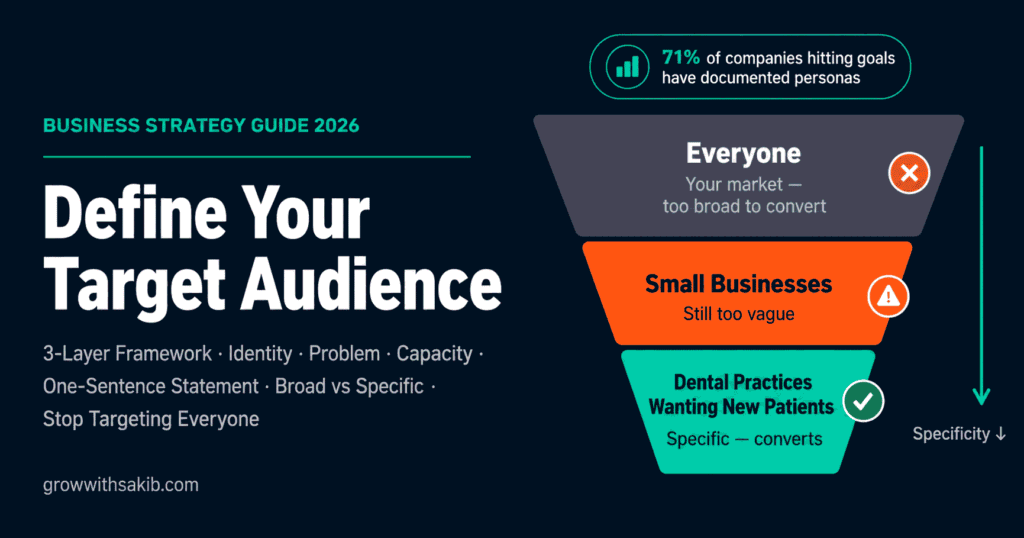
Steps 5 and 6 overlap with hands-on niche validation — if you want the deeper version of live testing, that connects to validating a niche before you build in the cluster. And the demand you find here should map back to a specific target audience and a real customer pain point.
Signs of Healthy vs. Weak Demand
| Healthy demand | Weak or risky demand |
|---|---|
| Stable or rising trend over years | Sharp spike with no staying power (a fad) |
| Consistent volume across many keywords | One keyword carrying everything |
| Active paid job posts and competitors | Lots of talk, no one spending |
| People describe what they’ve already bought | Only hypothetical “I’d totally use that” |
| Multiple solution providers exist | Zero competitors — often means no market |
That last row trips people up. No competition feels like a gold mine, but it usually means nobody has found a way to make money there. A healthy niche almost always has rivals — your job is to find the gaps competitors miss, not to find empty space.
Common Mistakes When Validating Demand
- Reading Google Trends as volume. The 0–100 scale is relative popularity, not a count of searches.
- Stopping at interest. Searches and chatter feel like demand but prove nothing about willingness to pay.
- Trusting hypothetical answers. “I’d buy that” is free to say. Past spending is the honest signal.
- Treating zero competition as opportunity. Usually it’s a warning, not a window.
- Validating once and never again. Demand shifts; re-check trend direction periodically — and if demand genuinely fades, the niche pivot guide distinguishes a data-driven pivot from an emotional switch.
When Demand Validation Has Limits
Validation reduces risk; it doesn’t eliminate it. Search tools lag, so genuinely new categories may show thin data even when demand is forming — early movers sometimes have to bet partly on judgment. Treat sparse data in an emerging space differently from sparse data in a mature one.
Local and referral-based service businesses also generate demand that barely appears in search tools at all. A bookkeeper who grows entirely through word of mouth won’t see their true market in Ahrefs. And keyword volume reflects search behaviour, not every buying channel. Match your validation methods to how your niche actually buys — online search, local networks, or industry relationships — rather than trusting one tool to tell the whole story — and build niche topical authority consistently once you commit, since that compounds the demand signal into organic visibility over time.
Frequently Asked Questions
How do I validate market demand for a niche?
Confirm three signals: interest (people search and talk about it), intent (they want a solution), and spend (money already changes hands). Check trend direction in Google Trends, size volume in Ahrefs or Semrush, scan marketplaces for active paid jobs, then talk to real buyers about what they’ve already purchased. Demand is validated only when all three align.
Is Google Trends enough to validate demand?
No. Google Trends shows direction and seasonality, but per Google’s own documentation, its numbers are a relative, sampled index — not absolute search volume. Use it to see whether interest is rising or fading, then pair it with volume tools and, most importantly, evidence that people are actually paying.
What tools are best for checking market demand?
Use Google Trends for trend direction, Ahrefs or Semrush for search volume and competition, and AnswerThePublic for intent-revealing questions. Then validate spend on Upwork, Fiverr, and niche forums. Tools measure interest and intent well, but marketplaces and real conversations are what confirm people will actually pay.
How much search volume do I need for a viable niche?
There’s no universal number — it depends on your price point and model. A high-ticket service needs far fewer searches than a low-margin one. Instead of chasing a volume threshold, look for consistent interest across several related keywords plus clear evidence of spending. Steady demand at any size beats a huge but unmonetizable audience.
Does no competition mean a great niche?
Usually the opposite. Zero competitors often means nobody has found a way to profit there, not that you’ve discovered untapped gold. Healthy niches almost always have several providers competing. A better strategy is entering a proven market and differentiating by serving a segment or solving a problem competitors handle poorly.
How do I validate demand with no budget?
Plenty is free. Use Google Trends, Google autocomplete, and “People also ask” for interest and intent. Browse Reddit, Facebook groups, and Upwork to see what people pay for. Then message 5–10 people in your target group and ask what they’ve already spent money trying to solve. Conversations cost nothing and reveal the most.
Key Takeaways
- Market demand validation proves a real, paying audience exists before you invest in a niche.
- Look for three signals — interest, intent, and spend — and weight spend most heavily.
- Google Trends shows direction, not volume; its 0–100 scale is relative and sampled.
- Use Ahrefs or Semrush for real volume, and marketplaces like Upwork for proof of spending.
- Validate in order — trend, volume, intent, spend, conversations, live test — to fail cheap niches early.
- Trust what people have already paid for over what they say they’d buy.
- Zero competition is usually a warning, not an opportunity; missing demand causes the most common startup failure.