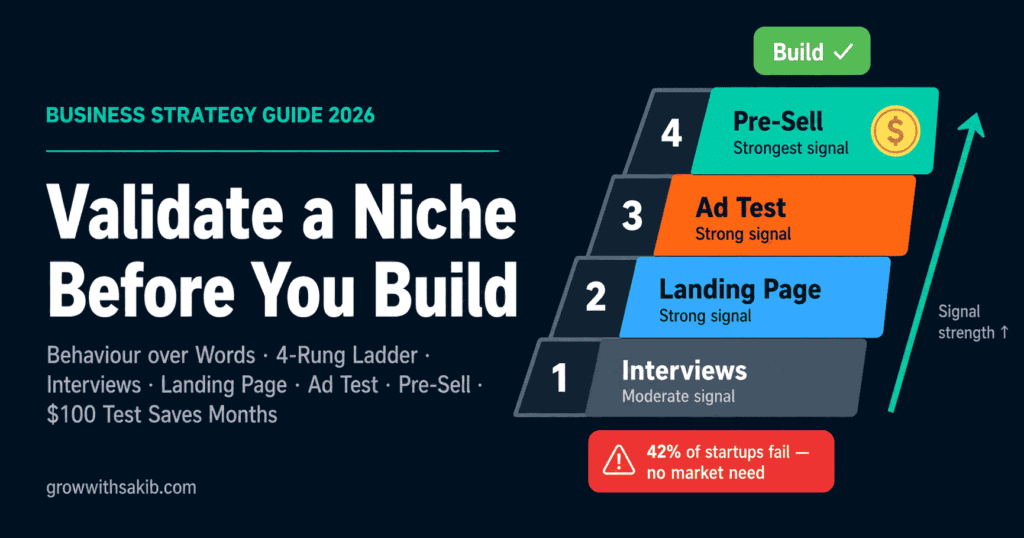
To validate a niche before you build, run small live tests that measure real behaviour, not opinions. Talk to potential clients about what they’ve already paid to solve, put up a simple landing page, run a tiny ad test, and try to pre-sell. A niche is validated only when real people take a costly action — sign up, book a call, or pay.
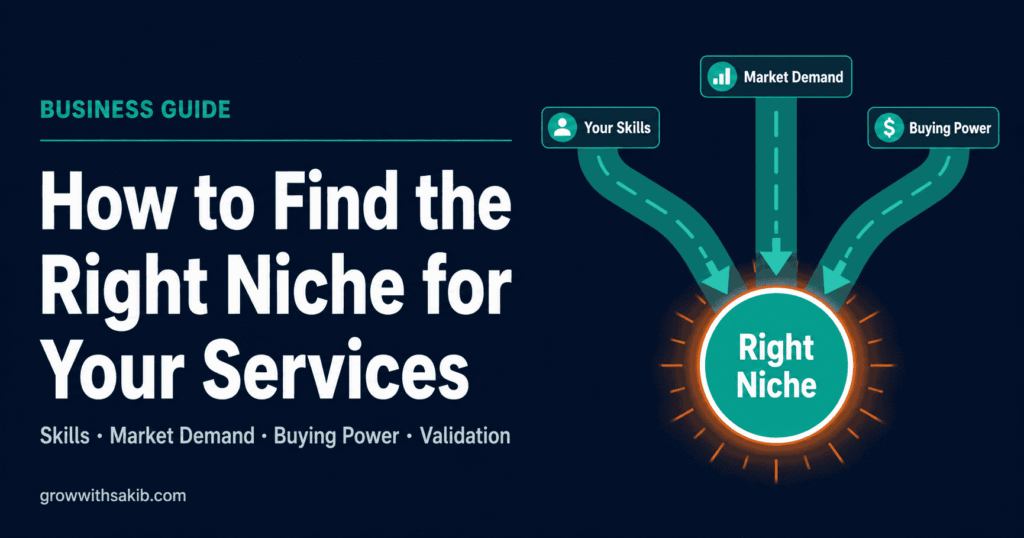
There’s a moment every service founder reaches: the research looks good, and the temptation is to start building — the site, the packages, the brand. Resist it for one more step. Research tells you a niche could work; validation tells you it does. This article covers the hands-on testing side. For the desk-research side — search data, trends, marketplaces — see how to validate market demand for a niche, part of the pillar guide on finding the right niche.
What Does It Mean to Validate a Niche?
Validating a niche means gathering real-world evidence that a specific audience will pay you to solve a specific problem — before you invest serious time or money building the business around it. It’s the bridge between “this looks promising” and “this works.”
The reason it matters is brutal and well-documented. CB Insights found that 42% of startups fail because there was no market need for what they built — the number-one reason. Validation is how you find out you’re in that 42% while it’s still cheap to change course, instead of after you’ve built everything.
One principle sits above all the tactics: validate with behaviour, not words. “Would you buy this?” is free to answer yes to. Clicking, booking, depositing, or paying costs something — and only costly actions predict real demand.
Research Validation vs. Live Validation
These are two different jobs, and you need both. Research validation reads existing signals. Live validation creates new evidence by putting a real offer in front of real people. This article is about the second.
| Research validation | Live validation | |
|---|---|---|
| Question | Does demand appear to exist? | Will these people actually act? |
| Method | Search data, trends, marketplaces | Conversations, landing pages, ads, pre-sales |
| Evidence | Indirect signals | Direct behaviour |
| Covered in | The demand-validation guide | This article |
The Validation Ladder: From Cheapest to Strongest Signal
Validation isn’t one test — it’s a ladder. Each rung costs a little more effort and returns a stronger signal. Climb only as far as you need to feel confident, and stop early if a rung fails.
| Rung | Test | Signal strength |
|---|---|---|
| 1 | Problem interviews — ask what they’ve already tried and paid for | Moderate |
| 2 | Landing page / fake-door test — measure sign-ups | Strong |
| 3 | Small paid ad test — drive cold traffic to the page | Strong |
| 4 | Pre-sell or deposit — ask for money before building | Strongest |
Notice money sits at the top. As founder lore puts it, the questions that matter most are simple: did people give you their time, and did anyone give you money? If you can’t answer the second yes, you’re still guessing — and the niche buying power guide helps you choose audiences where the money is already there to say yes with.
How to Validate a Niche: Step by Step
Step 1: Talk to potential clients (the right way)
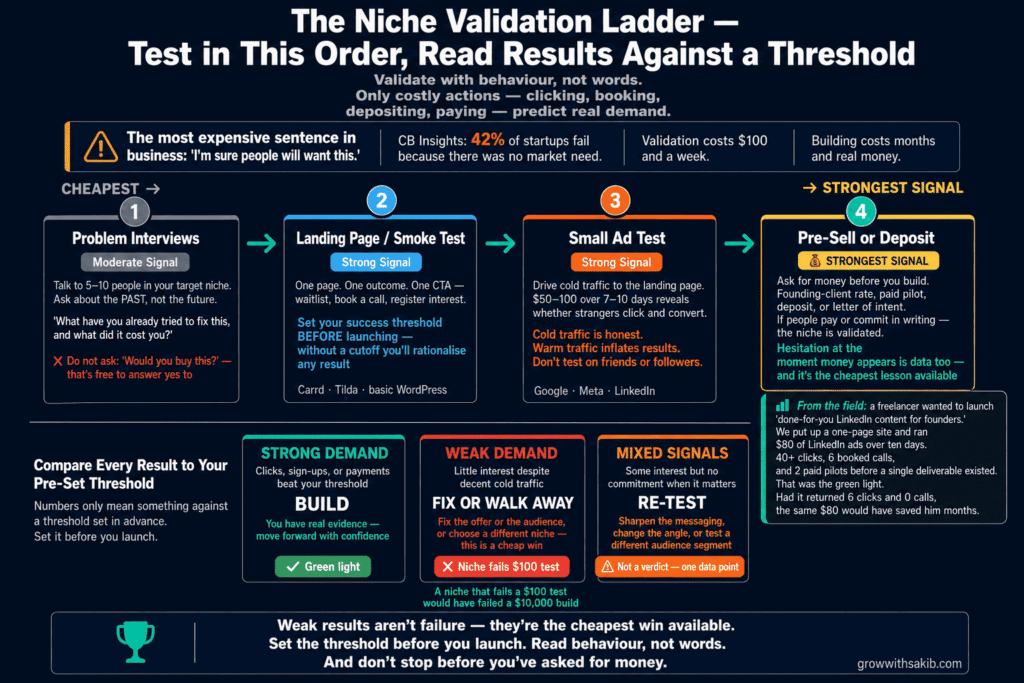
Interview 5–10 people in your target niche — but ask about the past, not the future. “What have you already tried to fix this, and what did it cost you?” beats “Would you buy my service?” every time. Past behaviour is fact; future intent is fantasy. Frame questions around the real customer pain point you identified earlier.
Step 2: Build a simple landing page
Create a one-page site describing the outcome you’d deliver, with a single clear call to action — join a waitlist, book a call, or register interest. This is a smoke test (also called a fake-door test): you’re measuring how many people want the offer before it exists. Tools like Carrd, Tilda, or a basic WordPress page make this a two-hour job.
Decide your success threshold before you launch. Skipping that is the most common smoke-test mistake — without a cutoff, you’ll rationalise whatever number you get. Aim to collect enough traffic for a real read, commonly cited as at least a few hundred visitors with a clear CTA.
Step 3: Drive real traffic with a small ad test
Opinions from your network are warm and biased. to see true demand, send cold traffic to your page with a small budget on Google, Meta, or LinkedIn — even $50–100 over a week or two reveals whether strangers click and convert. Watch click-through rate, landing-page conversion, and cost per sign-up. Don’t over-optimise the page; you want to measure demand, not your copywriting.
Step 4: Try to pre-sell
The ultimate test is asking for money before you’ve built anything. Offer a founding-client rate, a paid pilot, or a deposit to reserve a slot. In B2B, a letter of intent works similarly. If people pay or commit in writing, your niche is validated in the only currency that counts. If they hesitate the moment money appears, you’ve learned something vital — cheaply.
How to Read Your Validation Results
Numbers only mean something against a threshold you set in advance. Here’s how to interpret the three outcomes.
| Result | What it means | What to do |
|---|---|---|
| Strong demand | Clicks, sign-ups, or payments beat your threshold | Build — you have evidence |
| Weak demand | Little interest despite decent traffic | Fix the offer or audience, or walk away |
| Mixed signals | Some interest, no commitment | Re-test with sharper messaging or a new angle |
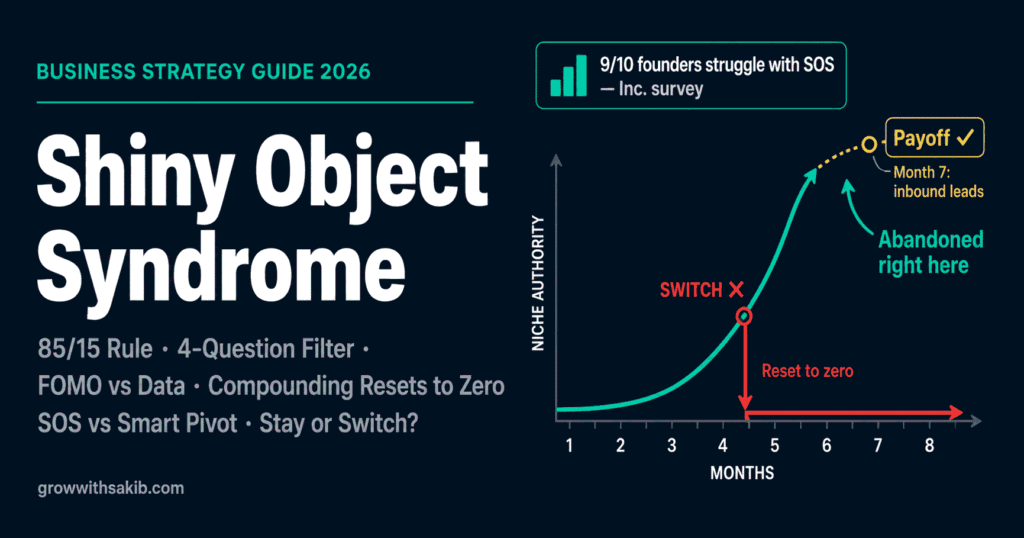
Weak results aren’t failure — they’re the cheapest win available. A niche that fails a $100 test would have failed a $10,000 build. Better to learn now. If you do walk away, that’s a strategic pivot, not shiny object syndrome — you’re moving on data, not novelty.
Common Mistakes When Validating a Niche
- Asking instead of observing. “Would you buy this?” gets polite lies. Measure actions, not answers — the same reason validating market demand requires spend signals, not just search interest.
- No success threshold set in advance. Without a cutoff, every result looks like whatever you want it to.
- Testing on warm traffic. Friends and followers inflate results; cold traffic tells the truth.
- Over-building the test. A logo and full site aren’t validation — they’re the thing you’re trying to avoid building.
- Stopping before money. Sign-ups are good; payment is proof. Climb to the top rung when you can.
When Validation Works Differently
These methods assume you can reach your audience online and that they buy in ways a landing page or ad can capture. That isn’t universal. Local service businesses — a plumber, a wedding photographer — may validate faster through a few real conversations and a test offer in local groups than through paid ads.
High-trust, relationship-driven niches also resist quick tests; a $50 ad won’t validate a $50,000 consulting engagement, where a letter of intent or paid pilot is the honest signal. And in brand-new categories, people may not yet recognise the problem, so weak early numbers don’t always mean weak demand. Match the test to how your niche buys, and treat a single failed experiment as one data point, not a verdict — the complete niche-selection guide covers what comes next once validation gives you the green light.
Frequently Asked Questions
How do I validate a niche before building anything?
Run small live tests that measure real behaviour. Interview 5–10 potential clients about what they’ve already paid to solve, Build a simple landing page and measure sign-ups, drive cold traffic with a small ad budget, and try to pre-sell. A niche is validated when real people take a costly action — not when they say they’re interested.
What is a smoke test or fake-door test?
A smoke test (or fake-door test) is a simple landing page that advertises your offer before it exists, measuring how many people click or sign up. It gauges real demand cheaply. Set a success threshold before launching, drive cold traffic to it, and judge by behaviour — clicks and opt-ins — rather than opinions.
How much should I spend to validate a niche?
You can validate for very little — often $50–100 in ads plus a free or cheap landing page. The goal isn’t a big budget; it’s enough cold traffic to read demand, commonly a few hundred visitors with a clear call to action. Spend only enough to get an honest signal, then decide.
Why shouldn’t I just ask people if they’d buy?
Because saying yes costs nothing, so it predicts nothing. People are polite and optimistic about hypothetical purchases. Only costly actions — clicking, booking, depositing, or paying — reveal genuine demand. Always validate with behaviour, not words, and frame interview questions around what people have already done and paid for.
How do I know if my validation results are good?
Compare them to a threshold you set before testing. Strong demand beats that cutoff in clicks, sign-ups, or payments and signals you should build. Weak interest despite real traffic means fix the offer or walk away. Mixed signals — interest without commitment — call for a re-test with sharper messaging or a new angle.
Is pre-selling really necessary to validate a niche?
It’s the strongest signal available, though not always required. Sign-ups and booked calls validate interest; payment validates demand in the only currency that counts. If you can ask for a deposit, founding-client rate, or letter of intent, do it — hesitation at the moment money appears teaches you more than any survey.
Key Takeaways
- Validation proves a niche works; research only suggests it could. Do the live tests before building.
- Validate with behaviour, not words — only costly actions predict real demand.
- Climb the validation ladder: interviews, landing page, ad test, pre-sell — money is the strongest signal.
- Set your success threshold before you test, or any result can be rationalised.
- Use cold traffic; warm audiences inflate results and mislead you.
- A niche that fails a $100 test would have failed a $10,000 build — weak results are a cheap win.
- Match the test to how your niche buys; local and high-trust niches validate differently.