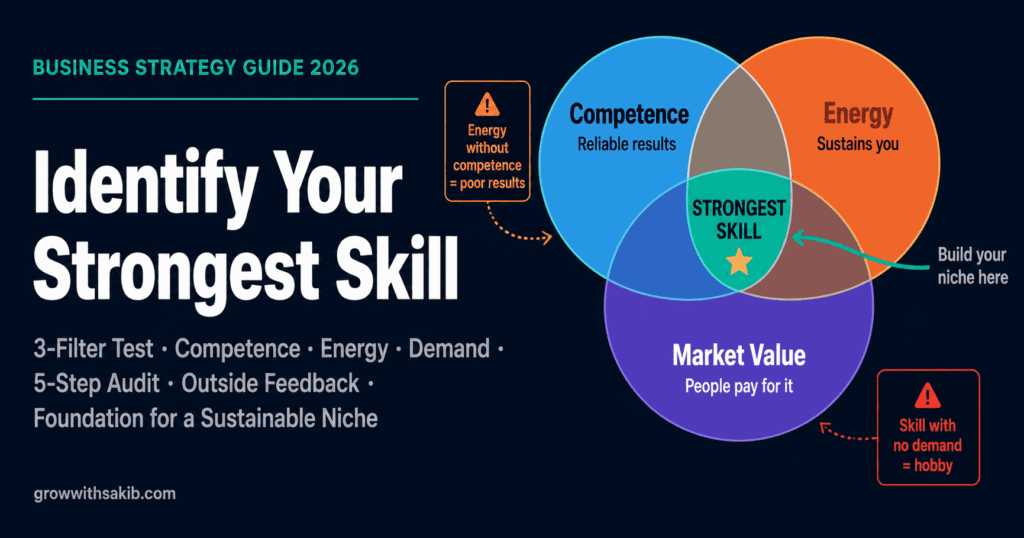
Your strongest skill is the one where proven competence, genuine energy, and market value overlap. To find it, audit the work you deliver reliable results in, cross-check what energizes rather than drains you, and confirm other people already pay for that exact outcome. The skill that survives all three filters becomes the foundation of a niche you can sustain for years.
Most people skip this step. They jump straight to picking a niche based on what looks profitable, then wonder why the work feels heavy and the results stay flat. Choosing a niche starts with an honest read of what you actually do well — not what you wish you did well. This guide expands Step 1 of the niche-selection framework into a repeatable self-audit you can finish in an afternoon.
What Does “Strongest Skill” Actually Mean?
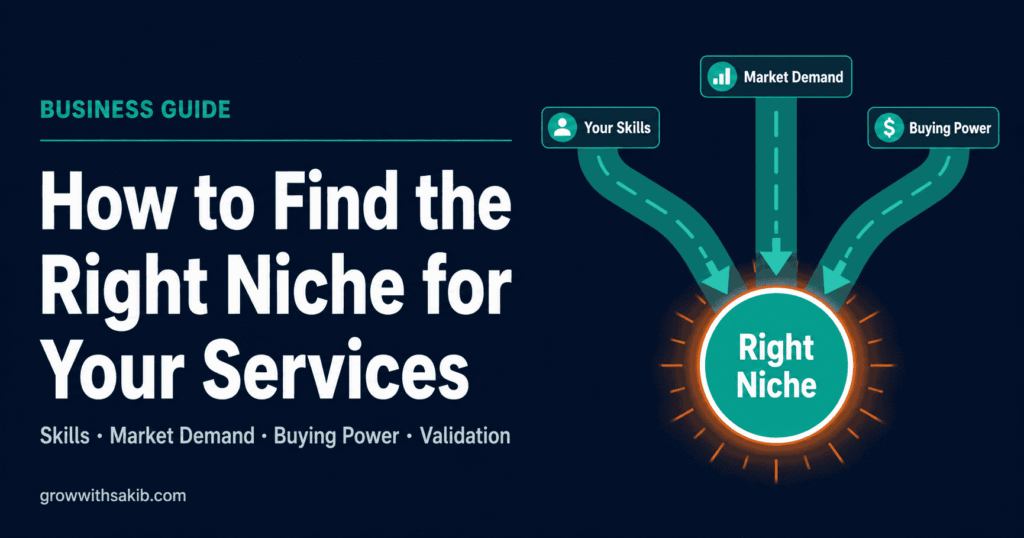
Your strongest skill is not simply the thing you’re best at on a technical scale. It’s the skill that combines three properties at once: you produce reliable outcomes, the work sustains your motivation, and the market assigns it real value. A skill can be impressive and still be the wrong foundation — if it drains you, or if nobody will pay for it.
This distinction matters because a service business runs on consistency. Gallup’s strengths research found that people who get to use their strengths every day are six times more likely to be engaged in their work and 8% more productive — and notably, Gallup also reports that people working from their strengths sustain a full week of output where others burn out far sooner. Engagement and stamina are exactly what a one-person service business cannot afford to lose.
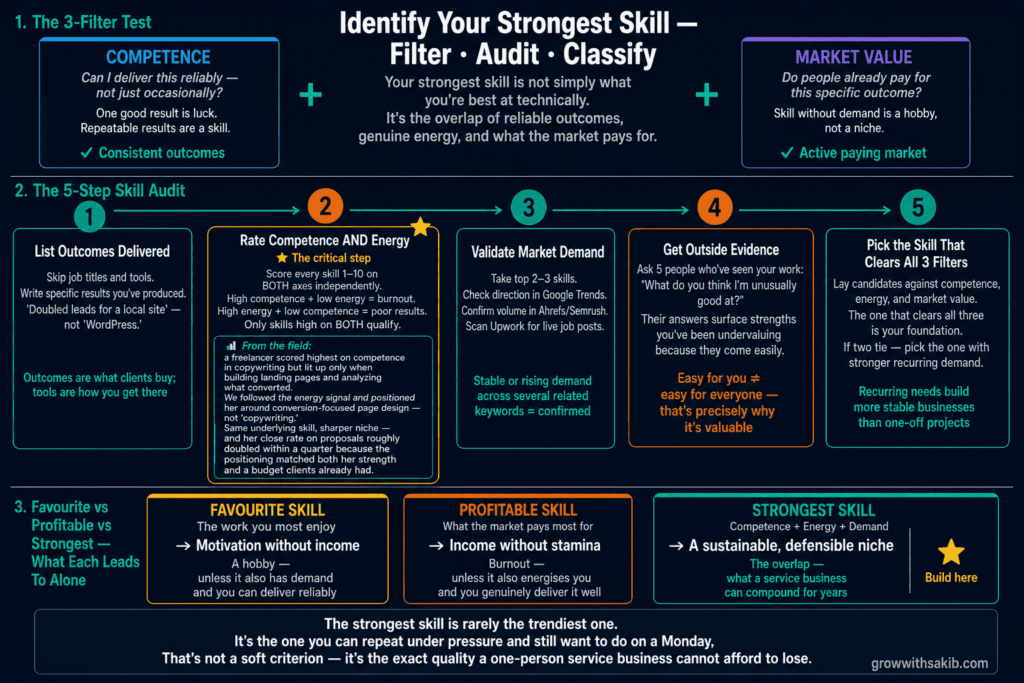
The three-filter test for a strongest skill
| Filter | The question to ask | Why it matters |
|---|---|---|
| Competence | Can I deliver this reliably, not just occasionally? | One good result is luck. Repeatable results are a skill. |
| Energy | Does this work restore or drain me over a full week? | Energy predicts whether you’ll still be doing it in two years. |
| Market value | Do people already pay for this specific outcome? | Skill without demand is a hobby, not a niche. |
Why Most People Skip the Skill Audit
The skill audit feels too obvious to bother with — and that’s exactly why it gets skipped. People assume they already know their strengths. Gallup’s data suggests otherwise: individuals routinely take their most powerful talents for granted or stay unaware of them entirely, because the things we do effortlessly rarely feel like achievements.
The cost of skipping this step shows up later. According to CB Insights’ analysis of startup post-mortems, 42% of startups fail because there’s no real market need for what they built — and a meaningful share of those founders chased an opportunity that had nothing to do with their genuine strengths. The competition-related failures (around 19%) often trace back to the same root: entering a space where you have no durable edge.
The Shiny Object trap
The most common failure mode is abandoning a strong skill to chase a niche that looks more profitable from the outside. The pillar guide calls this Shiny Object Syndrome, and it’s worth naming because it feels like ambition while behaving like self-sabotage. The fix isn’t ignoring opportunity — it’s filtering every opportunity through the three-filter test before you commit, and building the topical authority that makes your chosen skill the most visible option in your niche.
How to Identify Your Strongest Skill: A 5-Step Audit
Work through these in order. Each step narrows the field, so by the end you’re left with one or two skills that genuinely qualify as foundations for a niche.
Step 1: List the outcomes you’ve actually delivered
Skip job titles and tools. Write down results — specific outcomes you’ve produced for yourself or others. “Rebuilt a site that doubled its leads” beats “WordPress.” Outcomes are what clients buy; tools are just how you get there.
- What have I done that produced a measurable result?
- What do people come to me for without me advertising it? These organic requests often reveal the customer pain points you solve better than anyone you know.
- What could I do tomorrow with no preparation?
Step 2: Rate each skill on competence and energy
Score every skill from 1–10 on two axes: how reliably you deliver it, and how energized you feel doing it. The skills scoring high on both are your real candidates. High competence with low energy is a path to burnout; high energy with low competence is a path to poor client results.
Step 3: Check the market with real data
Take your top two or three skills and confirm people search for them and pay for them. Use Google Trends to check whether interest is stable or growing, and a keyword tool like Ahrefs or Semrush to confirm consistent search volume. Then scan freelance marketplaces — if clients are already posting jobs for that exact outcome, demand is real. The full method for confirming this is in the market demand validation guide. This connects directly to the market demand validation step in the pillar framework.
Step 4: Get outside evidence
Self-assessment has blind spots in both directions. Ask five people who’ve seen your work the same question: “What do you think I’m unusually good at?” Their answers often surface a strength you’ve been undervaluing because it comes easily to you. A structured tool like Gallup’s CliftonStrengths assessment can add a second data point, but real client and peer feedback usually matters more.
Step 5: Pick the skill that survives all three filters
Lay your candidates against competence, energy, and market value. The one skill that clears all three is your foundation. If two tie, choose the one with stronger recurring demand — recurring needs build a more stable business than one-off projects — and confirm that demand with a niche buying power check to ensure clients in that space can actually afford professional help.
Strongest Skill vs. Favourite Skill vs. Profitable Skill
These three often get confused, and the confusion is what derails niche selection. Here’s how they differ and what each one alone leads to.
| Skill type | What it means | What it leads to alone |
|---|---|---|
| Favourite skill | The work you most enjoy | Motivation without income — a hobby |
| Profitable skill | What the market pays most for | Income without stamina — burnout |
| Strongest skill | Competence + energy + demand | A sustainable, defensible niche |
Common Mistakes When Identifying Your Strongest Skill
- Confusing tools with skills. “Canva” or “WordPress” is a tool. The skill is the outcome you create with it.
- Picking the trendy skill over the proven one. Trends fade; your repeatable edge compounds — the same reason pivoting your niche should only happen when the data demands it, not when something shinier appears.
- Ignoring energy. A skill you dread won’t survive the quiet months every service business has.
- Skipping market validation. Being great at something nobody pays for is the most expensive mistake on this list.
- Relying only on self-assessment. Your blind spots are, by definition, invisible to you. Outside feedback corrects them.
When This Approach Needs Adjusting
This audit assumes you already have some track record to evaluate. If you’re early in your career with little delivered work, weight Step 3 (market data) and Step 4 (outside feedback) more heavily, and treat your first few projects as live experiments rather than proof. The framework also leans toward solo service providers and small teams. Larger businesses choosing a service line will layer in capacity, hiring, and operational factors this self-audit doesn’t cover. Treat it as the personal foundation, not the whole business case — the next step is validating a niche before you invest months building around it.
Frequently Asked Questions
How do I identify my strongest skill if I’m good at several things?
Rate each skill on three axes: how reliably you deliver it, how much energy it gives you, and whether people already pay for it. The skill that scores high on all three is your strongest. When two are close, choose the one with stronger recurring demand, since repeat work builds a more stable service business than one-off projects.
Is my strongest skill the same as my favourite skill?
Not always. Your favourite skill is the one you enjoy most; your strongest skill is where enjoyment, proven competence, and market demand overlap. A skill you love but can’t deliver reliably — or that nobody pays for — makes a poor niche foundation. The goal is the overlap, not enjoyment alone — and once you’ve found it, the specialist vs generalist decision determines how narrowly to position that skill in the market.
Can I build a niche around a skill I’m still learning?
You can, but validate demand first and treat early projects as experiments. If the market clearly wants the outcome and you’re improving fast, a developing skill can work. Just weight outside feedback and real search data more heavily than self-assessment until you have a track record to evaluate honestly.
How do I know if my skill has real market demand?
Check search interest in Google Trends, confirm consistent search volume with a tool like Ahrefs or Semrush, and scan freelance platforms for active job posts. If people are already spending money to solve the problem your skill addresses, demand is confirmed.
What if I don’t think I have any strong skills yet?
Most people undervalue skills that come easily to them. Gallup’s research notes that people often take their most powerful talents for granted. Ask five people who’ve seen your work what you’re unusually good at — their answers usually reveal a strength you’ve been overlooking.
Why does choosing the wrong skill cause business failure?
A skill you can’t sustain leads to inconsistent results and burnout, while a skill with no demand produces no clients. CB Insights found that 42% of startups fail from no market need — frequently because founders chased opportunity instead of building on a genuine, in-demand strength.
Key Takeaways
- Your strongest skill is the overlap of competence, energy, and market demand — not just what you’re technically best at.
- Run every candidate skill through the three-filter test before committing to a niche.
- Score skills on competence and energy; the ones high on both are your real candidates.
- Validate demand with Google Trends, Ahrefs or Semrush, and live job posts before deciding.
- Outside feedback corrects the blind spots self-assessment can’t see.
- Avoid the Shiny Object trap: don’t abandon a proven skill for one that merely looks profitable.
- When two skills tie, pick the one with stronger recurring demand for a more stable business.