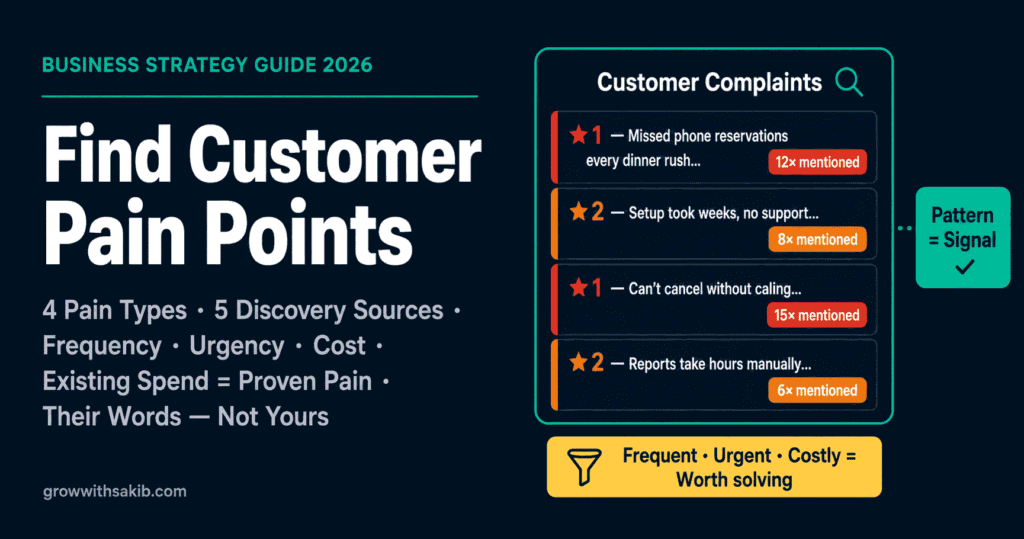
To find customer pain points worth solving, listen where people complain in their own words — reviews, support tickets, Reddit, sales calls, and search queries — then look for problems that are frequent, urgent, and expensive. A pain point people will pay to solve is one they already spend time, money, or emotion trying to fix.
Not every problem is a business. Plenty of pain points are real but mild — annoying enough to mention, never annoying enough to pay for. The skill is telling the two apart before you build an offer around them. The pillar guide on finding the right niche treats “solving a real problem” as a core step this article shows you how to find those problems and judge which ones carry real buying intent.
What Is a Customer Pain Point?
A customer pain point is a specific problem your customers or prospects experience — a recurring frustration, obstacle, or unmet need that gets in the way of something they want. In a service business, your offer is essentially a paid solution to one of these problems.
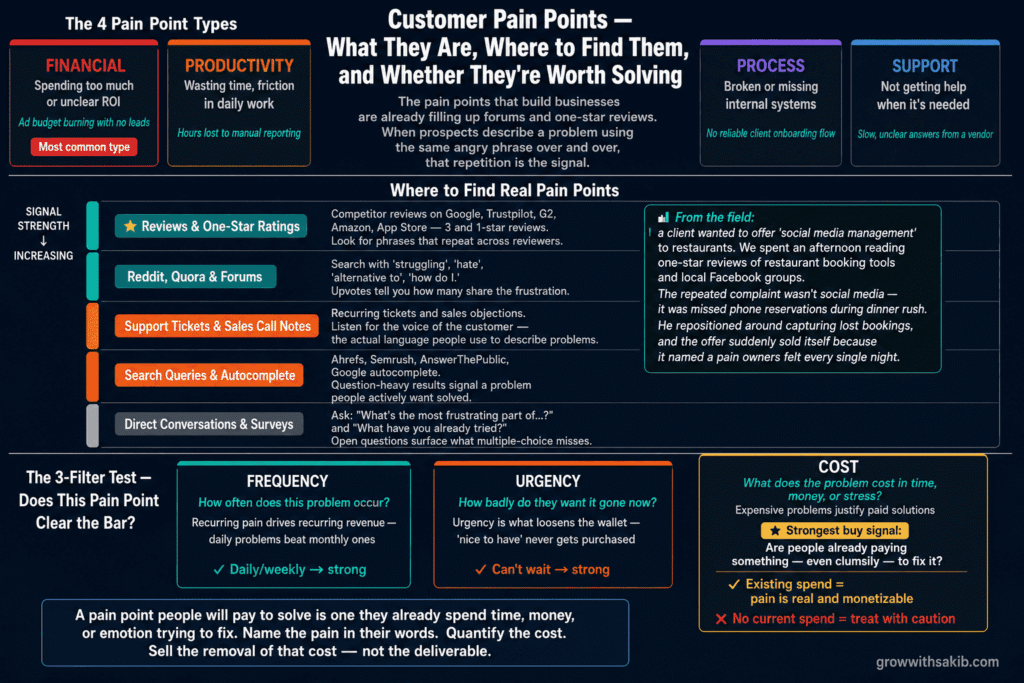
Most pain points fall into four buckets. Naming the type helps you position your service against it precisely.
| Pain point type | What it means | Service example |
|---|---|---|
| Financial | Spending too much, or unclear ROI | Ad budget burning with no leads |
| Productivity | Wasting time, friction in daily work | Hours lost to manual reporting |
| Process | Broken or missing internal systems | No reliable client onboarding flow |
| Support | Not getting help when it’s needed | Slow, unclear answers from a vendor |
Financial pain points tend to be the most common, because buyers care intensely about cost and whether they’re getting value for money. That makes them fertile ground for a service — if you can show a clear return.
Why Solving the Right Pain Point Decides Whether You Get Paid
A business survives on problems people will pay to remove. Build around a problem nobody urgently feels, and you get the most common startup failure of all: CB Insights found that 42% of startups fail because there was no real market need for what they made. That’s almost always a pain-point error — solving something that wasn’t painful enough.
The flip side is just as real. Pain points are expensive to ignore: Emplifi’s consumer research found 86% of consumers will leave a brand they were loyal to after only two or three bad experiences, and 49% said they’d walked away from a brand in the past year over poor experience. Where one business is creating pain, another can win the customer by removing it.
Where to Find Real Customer Pain Points
The best pain points are already written down somewhere, in the customer’s own words. You’re not inventing — you’re collecting. Here’s where to look, roughly in order of signal strength.
1. Reviews and one-star ratings
Read reviews of competitors and adjacent products on Google, Trustpilot, G2, Amazon, and the App Store. Three- and one-star reviews are gold: they describe exactly what’s broken and what people wish existed — the full step-by-step method is in the competitor review mining guide. Look for phrases that repeat across reviewers.
2. Reddit, Quora, and niche forums
Search your topic on Reddit and Quora with words like “struggling,” “hate,” “alternative to,” or “how do I.” Unlike polished blog comments, these threads capture unfiltered frustration — and the upvotes tell you how many people share it.
3. Support tickets and sales call notes
If you or a past client have support history, mine it. Recurring tickets and the objections that come up on sales calls are direct evidence of friction. Listening to the voice of the customer — the actual language people use to describe problems — is the single most reliable input here.
4. Search queries and autocomplete
Search behaviour is intent made visible. Tools like Ahrefs and Semrush, plus free options like AnswerThePublic and Google autocomplete, surface the exact questions people type when a problem is bugging them. High question-volume around a problem signals both pain and demand. This overlaps with the market demand validation process for a niche.
5. Direct conversations and surveys
Nothing beats asking. Talk to 5–10 people in your target group and use open-ended questions: “What’s the most frustrating part of…?” and “What have you already tried?” Open questions surface problems multiple-choice surveys never reach.
Which Pain Points Are Actually Worth Solving?
Finding pain points is easy. Filtering them is the real work. Run each candidate through three questions — a pain point worth a business clears all three.
| Filter | The question | Why it matters |
|---|---|---|
| Frequency | How often does this problem occur? | Recurring pain drives recurring revenue |
| Urgency | How badly do they want it gone now? | Urgency is what loosens the wallet |
| Cost | What does the problem cost them in time, money, or stress? | Expensive problems justify paid solutions |
The strongest signal of all: people are already paying to solve it — with a clumsy tool, a freelancer, or hours of their own time. Existing spend, however messy, proves the pain is real and monetizable. A problem nobody currently spends anything on is the one to be suspicious of — check niche buying power to confirm the audience behind the pain can actually afford professional help.
How to Turn a Pain Point Into a Service Offer
Once you’ve found a frequent, urgent, costly problem, the move is to mirror it back in your positioning.
- Name the pain in their words. Use the exact phrasing from reviews and calls, not marketing-speak.
- Quantify the cost. “Missed bookings” becomes “roughly X lost covers a week.” Numbers make pain concrete.
- Frame your service as the removal of that cost. Sell the outcome, not the deliverable.
- Validate before you commit. Confirm a handful of real people would pay before building the whole offer — the niche validation guide shows exactly how to run that test before investing months of effort.
This is also where pain points connect to who you serve. The clearer your defined target audience, the easier it is to find pain points that are specific and shared — vague audiences produce vague problems.
Common Mistakes When Researching Pain Points
- Inventing the problem. Starting from your solution and reverse-engineering a need is the classic trap.
- Confusing a mild annoyance with a paid problem. People complain about plenty they’d never pay to fix.
- Asking leading questions. “Wouldn’t you love a tool that…?” gets polite yeses, not truth.
- Trusting one source. One angry review is noise; the same complaint across many sources is signal.
- Solving surface symptoms. Dig for the root cause behind the complaint, not just the complaint itself — the same diagnostic discipline behind a good niche pivot decision when surface results disappoint but the underlying problem hasn’t changed.
When Pain-Point Research Can Mislead You
Listening to complaints has blind spots, and it’s worth naming them. People are good at describing problems but poor at prescribing solutions — so treat their suggested fixes as clues, not instructions. The job behind the complaint matters more than the fix they imagine.
Loud pain isn’t always profitable pain, either. Some of the most vocal complaints come from people who will never pay — hobbyists, free-tier users, or those simply venting. And in newer markets, customers may not yet have language for a problem they feel, so absence of complaints doesn’t always mean absence of pain. Weigh what people do and pay for more heavily than what they say — the strongest skill audit helps you cross-check that the pain you’ve found also aligns with a skill you can deliver reliably at scale.
Frequently Asked Questions
How do I find customer pain points?
Collect them where customers already complain in their own words: competitor reviews, Reddit and Quora threads, support tickets, sales call notes, and search queries. Then talk to 5–10 real people using open-ended questions. You’re not inventing problems — you’re gathering the ones that repeat across multiple sources, which is the clearest sign a pain point is real.
What are the four types of customer pain points?
The four common types are financial (spending too much or unclear value), productivity (wasted time and friction), process (broken or missing systems), and support (not getting help when needed). Financial pain points tend to be the most common, since buyers care deeply about cost and value for money, which makes them strong ground for a paid service.
How do I know if a pain point is worth solving?
Run it through three filters: frequency (how often it happens), urgency (how badly they want it gone now), and cost (what it drains in time, money, or stress). A pain point that clears all three is worth solving. The strongest signal is that people already pay something — even clumsily — to fix it today.
Where do I find pain points if I have no customers yet?
Borrow other people’s customers. Read one-star reviews of competitors and adjacent tools, search Reddit and niche forums for frustration, and analyze the questions people type into search engines. These sources reveal real, documented pain without needing your own client base, and they show you the exact language buyers use.
What’s the difference between a pain point and a mild annoyance?
A pain point worth solving is frequent, urgent, and costly enough that people already spend time, money, or emotion trying to fix it. A mild annoyance is real but tolerable — people mention it but never pay to remove it. The test is existing effort or spend: if nobody invests anything in solving it, treat it with caution.
Why do businesses fail when they misread pain points?
Because they build a solution for a problem nobody urgently feels. CB Insights found 42% of startups fail from no real market need — typically a pain-point error. Solving something mildly annoying rather than genuinely painful means customers won’t pay, no matter how good the execution is.
Key Takeaways
- A customer pain point is a specific, recurring problem your service can be paid to remove.
- Pain points fall into four types — financial, productivity, process, and support — with financial the most common.
- Collect pain points where people already complain: reviews, Reddit, support tickets, sales calls, and search queries.
- Filter every candidate by frequency, urgency, and cost; existing spend is the strongest buy signal.
- Name the pain in the customer’s own words and sell the removal of its cost, not the deliverable.
- Misreading pain points causes the most common startup failure — no real market need.
- Weigh what people do and pay for over what they say; loud pain isn’t always profitable pain.