A focused niche builds topical authority faster because it lets you cover one subject deeply and consistently — exactly what search engines and AI systems reward. When every page reinforces a single theme, Google more easily recognises your site as an expert source, so your content ranks sooner and your whole domain rises together rather than one lonely post at a time.
Choosing a niche isn’t only a business decision — it’s a search strategy. The narrower and clearer your focus, the faster you earn the trust that gets content ranked and cited. This article is the bridge between picking a niche and winning at SEO. It connects the pillar guide on finding the right niche to the deeper mechanics covered in our complete guide to generative engine optimisation.
What Is Topical Authority?
Topical authority is how thoroughly search engines trust your site to cover a subject and all its related questions. It’s earned not by one strong page, but by consistent, in-depth coverage across a whole topic — and sites with it tend to rank higher because they reliably answer what searchers ask.
This connects directly to E-E-A-T — Experience, Expertise, Authoritativeness, and Trustworthiness — the quality concepts Google’s systems are designed to reward. Per Google’s own guidance on people-first content, creators should be able to answer yes to questions like whether the content demonstrates first-hand expertise and clearly comes from someone who knows the topic well. A focused niche makes answering “yes” dramatically easier.
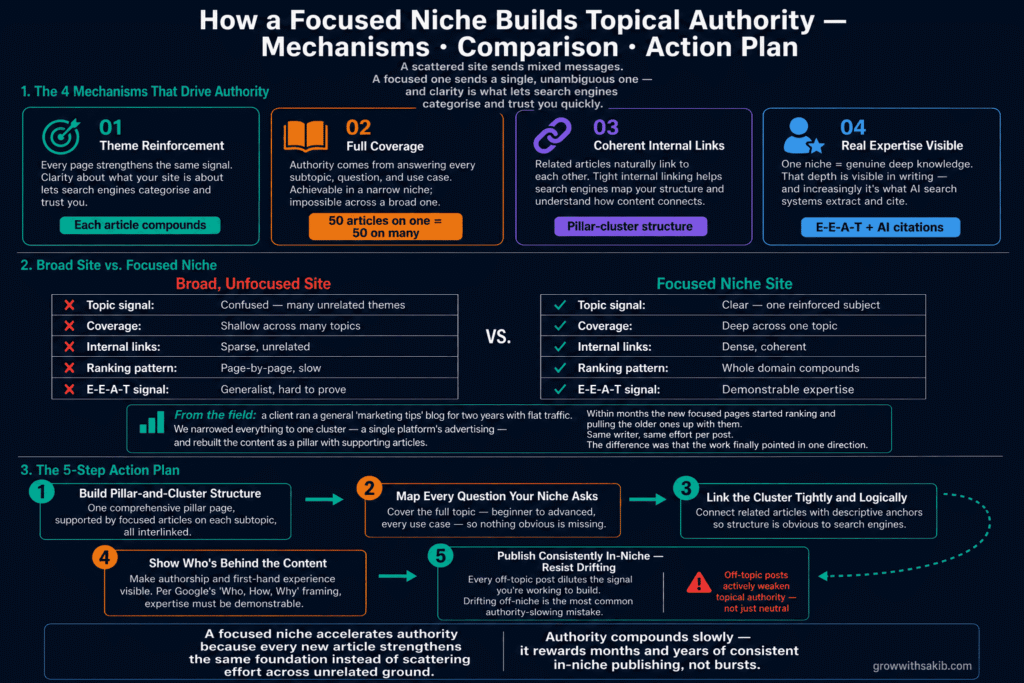
Why a Narrow Niche Accelerates Authority
Topical authority is fundamentally about depth and consistency. A niche gives you both by default. Four mechanisms drive the speed-up.
1. Every page reinforces the same theme
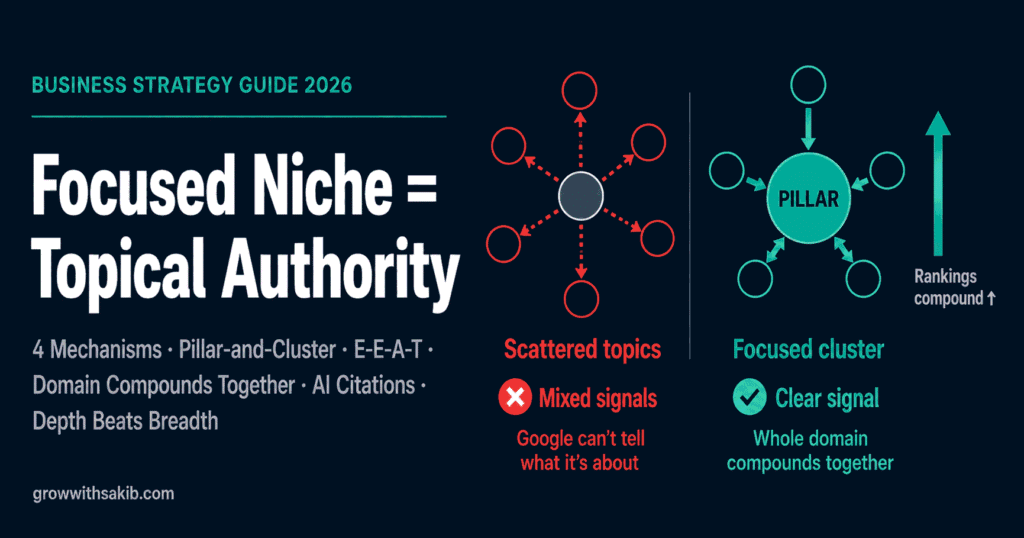
When all your content orbits one subject, each new article strengthens the signal of what your site is about. A scattered site sends mixed messages; a focused one sends a single, unambiguous one — and clarity is what lets search engines categorise and trust you quickly.
2. You can actually cover the whole topic
Authority comes from comprehensive coverage — answering every subtopic, question, and use case around a subject. That’s achievable in a narrow niche and impossible across a broad one — especially when you validate market demand first to confirm enough people are searching for those subtopics. Fifty articles about one subject build far more authority than fifty articles on unrelated topics.
3. Internal linking becomes coherent
In a focused niche, your articles naturally link to one another because they’re genuinely related. That tight internal linking helps search engines understand your structure and map how your content connects — the exact pillar-and-cluster pattern that signals organised expertise.
4. Real expertise shows on the page
Serving one niche means you actually develop deep, first-hand knowledge — the genuine Experience and Expertise in E-E-A-T. That depth is visible in writing, and increasingly, it’s what AI search systems extract and cite. Your strongest skill becomes the foundation of demonstrable authority.
Broad Site vs. Focused Niche: How Authority Builds
| Factor | Broad, unfocused site | Focused niche site |
|---|---|---|
| Topic signal | Confused — many unrelated themes | Clear — one reinforced subject |
| Coverage | Shallow across many topics | Deep across one topic |
| Internal links | Sparse, unrelated | Dense, coherent |
| Ranking pattern | Page-by-page, slow | Whole domain compounds |
| E-E-A-T signal | Generalist, hard to prove | Demonstrable expertise |
How to Turn Your Niche Into Topical Authority
Picking the niche is step one. These moves convert that focus into search authority.
- Build around a pillar-and-cluster structure. One comprehensive pillar page, supported by focused articles on each subtopic, all interlinked.
- Map every question your niche asks. Cover the full topic — beginner to advanced, every use case — so nothing obvious is missing. Start by researching the customer pain points your niche types into search engines.
- Link the cluster tightly and logically. Connect related articles with descriptive anchors so structure is obvious to search engines.
- Show who’s behind the content. Per Google’s “Who, How, Why” framing, make authorship and first-hand experience visible.
- Publish consistently in-niche, and resist drifting. Every off-topic post dilutes the signal you’re working to build.
That last point is where business discipline meets SEO. Chasing unrelated trends doesn’t just scatter your effort — it actively weakens topical authority, which is one more reason to avoid shiny object syndrome and stay committed to the niche you chose.
Common Mistakes That Slow Topical Authority
- Publishing across unrelated topics. Mixed themes confuse search engines and dilute trust.
- Going broad but shallow. Thin coverage of many topics beats nothing — but loses to deep coverage of one.
- Weak or random internal linking. Unlinked articles waste the structural signal a cluster could send.
- Hiding the author. No byline or background makes expertise impossible for Google or readers to verify.
- Drifting off-niche for quick traffic. Short-term clicks at the cost of long-term authority is a bad trade.
Where Niche Focus Has Limits
Focus is powerful, but it isn’t the only force in ranking, and it’s honest to say so. E-E-A-T concepts are not a single direct ranking factor — they describe qualities Google’s systems approximate through many signals, so topical authority works alongside content quality, links, technical health, and user experience, not instead of them.
There’s also a balance between depth and breadth over time. A niche can be too narrow to sustain ongoing content, and established sites do eventually expand into adjacent topics once their core authority is secure — which is also when a strategic niche pivot into adjacent services becomes viable from a business positioning perspective. The healthy pattern is to earn authority in one area first, then extend into related ground — not to start broad. The complete niche-selection guide explains how to choose that first area correctly so the authority you build compounds in the right direction. And authority compounds slowly; it’s a months-and-years strategy, not a quick win, so pair it with realistic expectations.
Frequently Asked Questions
How does a niche help build topical authority?
A focused niche lets you cover one subject deeply and consistently, so every page reinforces the same theme. That clarity helps search engines recognise your site as an expert source and rank your content faster. Broad, scattered sites send mixed signals and struggle to prove expertise on any single topic.
What is topical authority in SEO?
Topical authority is how thoroughly search engines trust your site to cover a subject and its related questions. It’s built through consistent, in-depth coverage across a topic rather than one strong page. Sites with it tend to rank higher because they reliably and comprehensively answer what searchers are looking for.
How is topical authority related to E-E-A-T?
E-E-A-T — Experience, Expertise, Authoritativeness, Trustworthiness — describes the quality signals Google’s systems reward, and topical authority is how you demonstrate them at scale. Per Google’s people-first content guidance, content should show genuine expertise. A focused niche makes that expertise far easier to prove.
How long does it take to build topical authority?
It’s a months-to-years strategy, not a quick win. Authority compounds as you publish comprehensive, consistent content and earn trust over time. A focused niche speeds this up considerably versus a scattered site, but realistic expectations matter — it rewards patience and steady publishing rather than bursts of unrelated content.
Can a niche be too narrow for SEO?
Yes. A niche can be too narrow to sustain ongoing content or reach enough searchers. The healthy pattern is to earn authority in one focused area first, then expand into adjacent topics once your core is established. Starting too broad is the more common mistake, but excessive narrowness has real limits too.
Does niching down help with AI search and AI Overviews?
Yes. AI search systems extract and cite content that clearly demonstrates depth and expertise on a topic. A focused niche with comprehensive, well-structured coverage gives these systems exactly what they look for. The same depth that builds traditional topical authority also makes your content more likely to be surfaced in AI-generated answers.
Key Takeaways
- A focused niche builds topical authority faster by enabling deep, consistent coverage of one subject.
- Topical authority is how thoroughly search engines trust you to cover a topic and its related questions.
- Four mechanisms drive it: theme reinforcement, full coverage, coherent internal links, and real expertise.
- It connects directly to E-E-A-T — a niche makes genuine expertise easy to demonstrate.
- Build a pillar-and-cluster structure and map every question your niche asks.
- Drifting off-niche dilutes authority — another reason to resist shiny object syndrome.
- Authority compounds over months and years and works alongside quality, links, and UX — not instead of them.