“Find a gap in the market” is the most repeated and least useful piece of business advice there is. Everyone says it. Almost nobody explains how — or warns you that most “gaps” are empty for a reason.
Knowing how to identify market gaps properly means looking in specific places for specific kinds of opening, then testing whether the gap is a real opportunity before you pour money into it. This article gives you both halves.
This expands Step 7 of our complete guide to competitor research. It’s where all your other research — reviews, keywords, SWOT — converges into a single strategic question: where’s the opening?
This expands Step 7 of our complete guide to competitor research. It’s where all your other research — reviews, keywords, SWOT — converges into a single strategic question: where’s the opening?
Why Most Market Gaps Are Traps
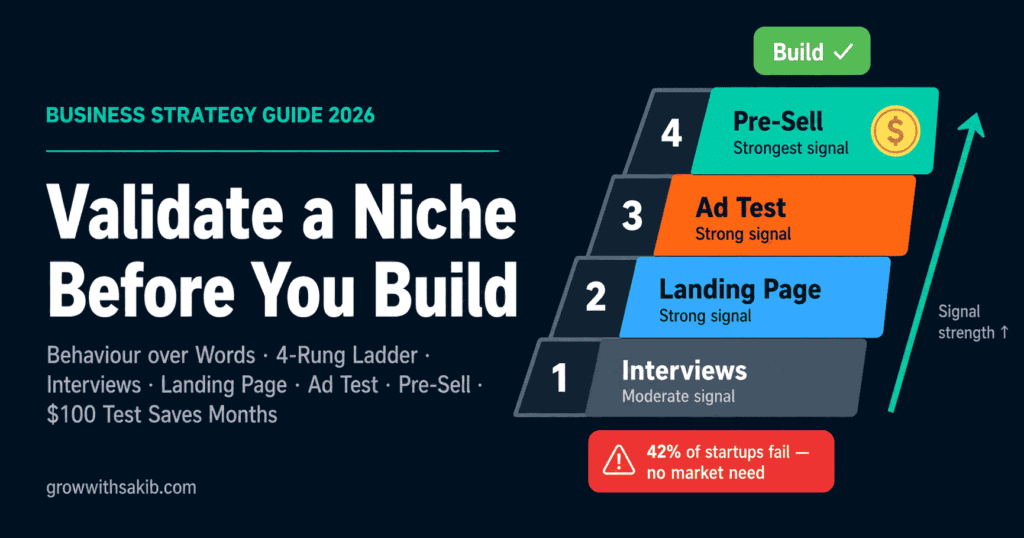
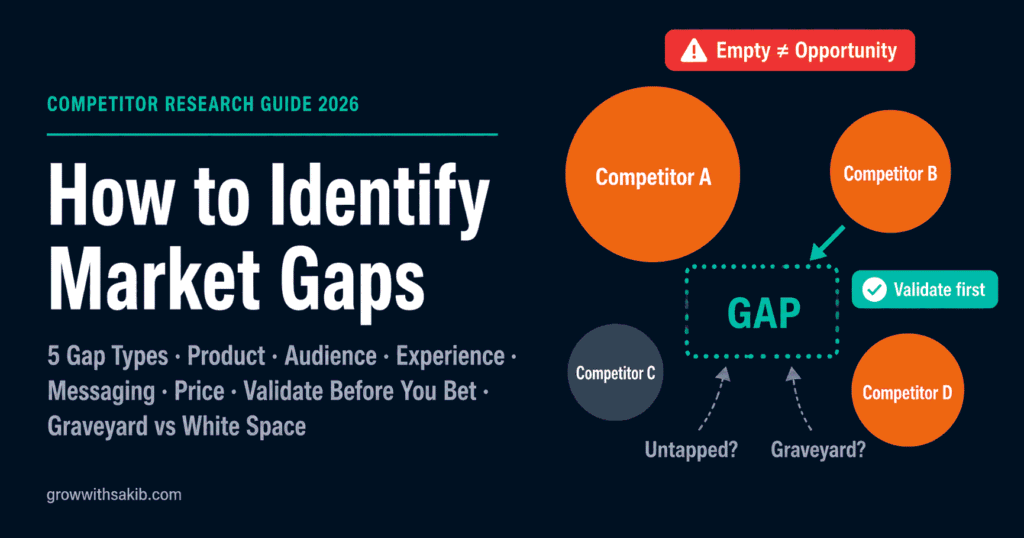
Start with a warning, because it’s the thing that saves you money. An empty space in a market is not automatically an opportunity. Sometimes nobody serves a need because nobody wants it served. CB Insights found 42% of startups fail because there’s no market need for what they built — many of them chasing a “gap” that was really just absence of demand.
So the real skill isn’t spotting empty space. It’s telling a genuine unmet need apart from a need that doesn’t exist. That’s why validation, later in this article, matters as much as discovery.
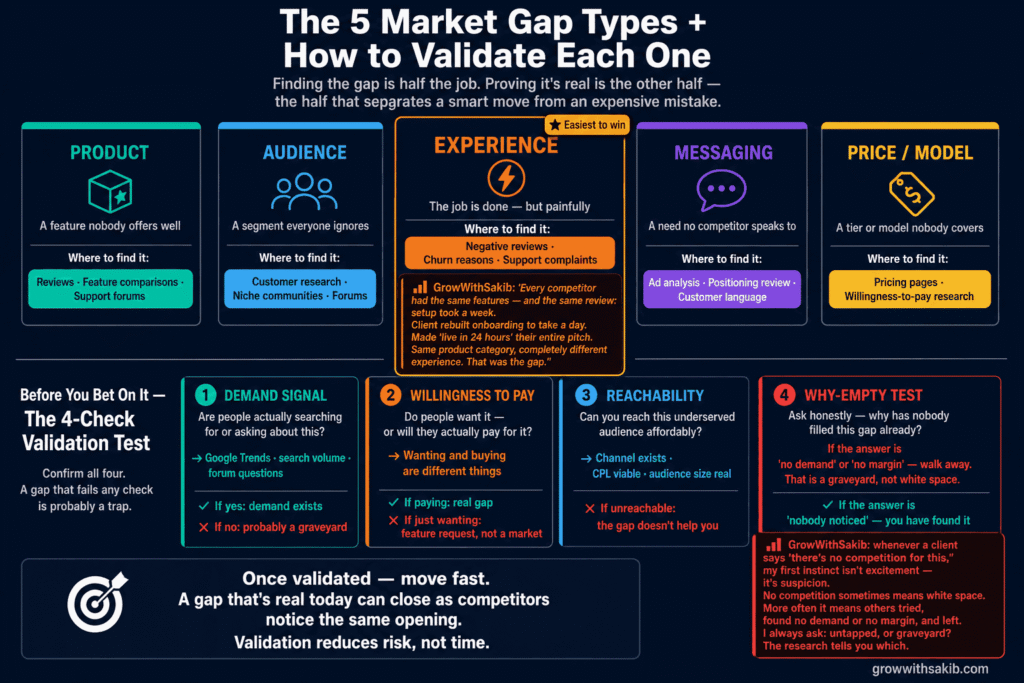
The 5 Types of Market Gap (and How to Find Each)
“Market gap” isn’t one thing. Breaking it into five types tells you where to look and what to look for.
| Gap type | What it is | Where to find it |
|---|---|---|
| Product | A feature or solution nobody offers well | Reviews, feature comparisons, support forums |
| Audience | An underserved segment everyone ignores | Customer research, demographics, niche communities; see direct vs indirect competitors to understand which segment types competitors are structurally incentivised to ignore |
| Experience | The job is done, but painfully | Negative reviews, churn reasons, support complaints |
| Messaging | A need no competitor speaks to | Ad analysis, positioning review, customer language |
| Price / Model | A price tier or model nobody covers | Pricing-page analysis, willingness-to-pay research |
1. Product gaps
A product gap is a capability customers want that no competitor delivers well. The fastest place to find it is in competitor reviews — the features customers repeatedly beg for, or the recurring “I wish it could…” complaints. When several competitors share the same missing feature, that’s a product gap — confirmed by running it through Ahrefs competitor analysis to check whether anyone ranks for terms describing the missing capability.
2. Audience gaps
An audience gap is a segment everyone overlooks — a customer type the whole category treats as an afterthought. Maybe every competitor targets enterprises and ignores solo operators, or every brand markets to one demographic and misses another. Niche communities and forums are where these underserved groups gather and complain about being ignored — the same places shadow competitors like Reddit threads and niche blogs are already capturing this overlooked demand.
3. Experience gaps
Sometimes the product exists and the audience is served, but the experience is miserable. Confusing onboarding, slow support, painful checkout. These are often the easiest gaps to win, because you don’t need a new product — just a better experience around the same job. Negative reviews and churn reasons expose them clearly.
4. Messaging gaps
A messaging gap is a need or fear no competitor addresses out loud. If every rival sells on features and nobody speaks to the customer’s real anxiety, that unspoken need is an opening — and in 2026, filling a messaging gap with well-structured content increases AI Overview citation probability, since AI engines prefer sources that answer questions competitors avoid. You find these by studying competitor ads and noticing what they all avoid saying — then saying it.
5. Price and model gaps
A price gap is a tier or business model nobody covers — no entry option, no premium tier, no usage-based pricing in a sea of subscriptions. Mapping every competitor’s pricing reveals the empty rungs. This connects closely to competitor pricing analysis, which goes deeper on reading pricing strategy.
How to Validate a Market Gap Before You Bet On It
Finding a gap is half the job. Proving it’s real is the other half — the half that separates a smart move from an expensive mistake. Run any gap through these checks:
- Demand signal: are people actually searching for or asking about this? Use Google Trends, search volume, and forum questions to confirm interest exists.
- Willingness to pay: do people just want it, or will they pay for it? Wanting and buying are different things.
- Reachability: can you actually reach this underserved audience affordably?
- Why-empty test: ask honestly why no one fills this gap. If the answer is “no margin” or “no demand,” walk away.
Demand validation is where search data earns its keep — a content gap analysis can confirm whether people are searching for the thing you think is missing. If nobody’s searching and nobody’s asking, the gap is probably a graveyard.
Turning a Validated Gap Into Positioning
A validated gap is the foundation of differentiation. Once you’ve found and tested it, build your positioning around owning it — make the gap the thing you’re known for, and reflect it in your SEO for small business keyword strategy so the gap you own in the market becomes the gap you own in search. Feed it into a competitor SWOT analysis to confirm it lines up with your strengths, and into your wider competitor analysis framework so it becomes a tracked, owned decision rather than a one-off insight.
Common Mistakes to Avoid
- Assuming empty space means opportunity. Ask why it’s empty first.
- Skipping validation. Wanting isn’t buying — confirm demand before investing.
- Only looking for product gaps. Experience, audience, and messaging gaps are often easier to win.
- Chasing a gap that doesn’t fit your strengths. A real gap you can’t serve well isn’t your gap.
- Finding the gap, then never owning it. Build your positioning around it or the insight is wasted — and track SEO results monthly to confirm your content and positioning around the gap is actually gaining organic visibility.
An Honest Note on Market Gaps
No method guarantees a winning gap. Validation reduces risk; it doesn’t remove it. Markets shift, and a gap that’s real today can close as competitors notice the same opening — so speed matters once you’ve validated one.
This also varies sharply by business type and resources. A funded startup can chase a product gap that takes a year to build; a solo operator is usually better off with an experience or messaging gap they can act on this month. Match the gap to what you can actually execute. And in genuinely new markets, expect thin data — there, customer conversations matter more than any framework, because the demand signals haven’t formed yet. Set up competitor monitoring to track when signals do emerge, so you catch the moment demand becomes measurable.
Frequently Asked Questions
How do you identify a market gap?
Look across five areas — product, audience, experience, messaging, and price — using competitor reviews, ad analysis, pricing comparison, and customer research. Each type has its own signals: product gaps show up as begged-for features, experience gaps as recurring complaints. Then validate that real demand exists before investing, because an empty space isn’t automatically an opportunity.
What is a gap in the market?
A market gap is an unmet customer need that existing competitors don’t serve well. It can be a missing product feature, an ignored audience segment, a poor experience around an existing solution, an unaddressed customer need in messaging, or a price tier nobody offers. The key word is need — a genuine one people will pay to have met.
How do you validate a market gap?
Run it through four checks: is there a real demand signal (search volume, forum questions), will people actually pay rather than just wanting it, can you reach the audience affordably, and why is the gap empty in the first place? If it’s empty due to no demand or no margin, it’s a trap. Confirm interest with search data before investing.
Why are most market gaps not real opportunities?
Because empty space often exists for a reason — others tried and found no demand or no margin. CB Insights found 42% of startups fail because there’s no market need for what they built, frequently chasing a “gap” that was really an absence of demand. The skill is telling a genuine unmet need apart from a need nobody has.
What are the different types of market gap?
There are five practical types: product gaps (a missing or poorly-built feature), audience gaps (an underserved segment), experience gaps (the job is done but painfully), messaging gaps (a need no competitor speaks to), and price or model gaps (a tier or model nobody offers). Experience and messaging gaps are often the easiest to win quickly.
Which market gap is easiest to win?
Often the experience gap. When competitors share the same features but customers complain about clunky onboarding, slow support, or painful checkout, you can win by improving the experience around the same job — no new product required. Experience and messaging gaps usually take less time and capital than building a brand-new product capability.
How do I find an underserved audience?
Look for segments the whole category treats as an afterthought — a customer type every competitor ignores while chasing the same mainstream buyer. Niche communities, forums, and review sites are where overlooked groups gather and voice frustration about being unserved. Then validate the segment is reachable and willing to pay before building around it.
Key Takeaways
- A market gap is an unmet need competitors don’t serve well — not just any empty space.
- Empty space is often a trap; always ask why no one fills the gap.
- There are five gap types: product, audience, experience, messaging, and price.
- Experience and messaging gaps are often the fastest and cheapest to win.
- Reviews, ad analysis, and pricing comparison each surface different gap types.
- Validate every gap: demand signal, willingness to pay, reachability, and why-empty.
- Match the gap to your strengths and resources — a gap you can’t serve isn’t yours.
- Once validated, build your positioning around owning the gap, then move fast.