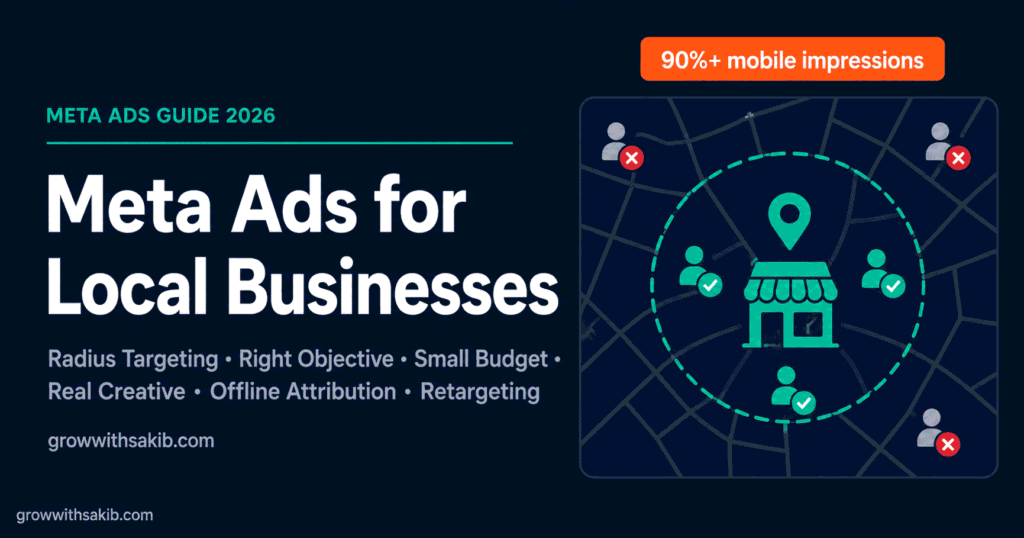
Here is how most local businesses try Facebook ads. They open the app, see the blue ‘Boost Post’ button under a photo, set a 25-mile radius, spend £50, and get a handful of likes from people three towns over who will never walk through the door. They conclude Meta ads do not work for local.
The ads work fine. The setup was wrong in three specific ways — and they are the same three ways almost every local business gets it wrong. The radius was too big and aimed at the wrong people, the objective was awareness instead of action, and there was no way to measure who actually showed up.
This guide fixes all three — and if you are also investing in organic local visibility, local SEO for small business pairs well with paid local ads to dominate both the map and the feed. You will learn the radius-targeting setting that quietly wastes most local budgets, how to pick the objective that matches your actual goal, the small-budget structure that lets a tiny spend work, the creative that gets locals through the door, and how to measure foot traffic and calls that no pixel can track.
The Radius-Targeting Trap That Wastes Local Budgets
Most local budget waste traces back to one setting that almost nobody changes. It is not the radius size — it is who Meta shows your ads to within that radius. Get this wrong and you pay to reach tourists and people passing through; get it right and you reach the locals who become repeat customers.
The hidden location-targeting default
When you set a location in Meta’s location targeting, Meta defaults to ‘People living in or recently in this location.’ That word ‘recently’ is the problem. It includes commuters passing through, tourists, and people who drove past once — none of whom can become your regulars. For most local businesses, you want to change this to ‘People who live in this location.’
The exception is genuinely foot-traffic-dependent businesses in high-traffic areas — a coffee shop by a train station, a restaurant in a tourist district — where people ‘recently in’ the area are exactly your customers. For everyone else, especially service businesses, ‘people who live here’ is the setting that stops the waste.
Right-sizing the radius
The second half of the trap is radius size. As Stackmatix’s local targeting guide puts it, you boost a post, set the radius to 25 miles, and watch your budget disappear into likes from people three towns away who will never walk through your door. Be ruthlessly precise about your actual service boundaries.
As Benly’s local guide stresses, a plumber advertising to a 50-mile radius is paying to reach people they will never serve — it is better to dominate a smaller area than spread thin across geography you cannot profitably serve. Set the radius to where your customers realistically come from, which for many businesses is far smaller than the default.
Storefront vs Service-Area: Two Different Local Strategies
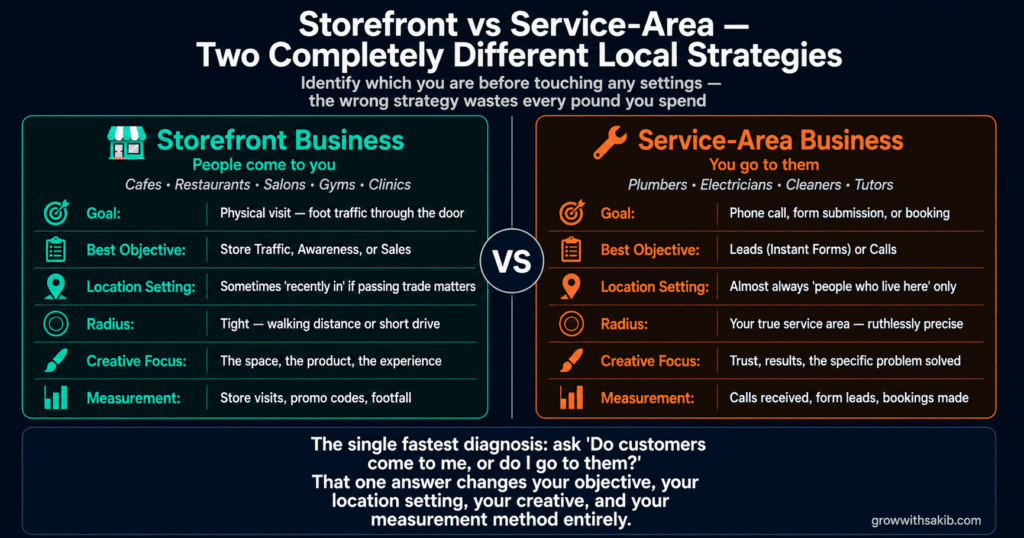
Not all local businesses are the same, and treating them the same is a common mistake. A storefront that needs people to physically visit runs a fundamentally different strategy from a service business that travels to the customer. Identify which you are before anything else.
Storefront businesses (people come to you)
Cafes, restaurants, shops, salons, gyms, clinics. The goal is to get people physically through the door. These businesses benefit from foot-traffic and store-visit objectives, can sometimes use the ‘recently in this location’ setting if they rely on passing trade, and live or die on visual creative showing the place itself.
Service-area businesses (you go to them)
Plumbers, electricians, cleaners, landscapers, mobile mechanics, tutors. The goal is a call, a form, or a booking — not a visit. These businesses should almost always target ‘people who live in this location,’ use lead or call objectives, and focus creative on trust, results, and the specific problem they solve.
| Factor | Storefront | Service-Area |
| Goal | Physical visit / foot traffic | Phone call, form, or booking |
| Best objective | Store traffic, awareness, or sales | Leads or calls |
| Location setting | Sometimes ‘recently in’ (passing trade) | Almost always ‘people who live here’ |
| Radius | Tight — walking/short drive | Your true service area |
| Creative focus | The space, the product, the experience | Trust, results, the problem solved |
| Measurement | Store visits, promo codes, footfall | Calls, form leads, bookings |
Choosing the Right Objective (Not the Boost Button)
The objective you choose tells Meta what to optimise for, and choosing wrong is one of the fastest ways to waste local budget. The first rule: stop using the boost button.
Why the boost button wastes local budgets
As JigsawKraft’s small-business guide puts it directly, if your goal is leads or sales, use Ads Manager — not the blue boost button. Boosting optimises for cheap engagement (likes, comments) because that is what makes a post look popular. Cheap engagement is not customers. The boost button is designed to be easy, not effective, and for a local business with a small budget, the difference is your entire return.
Matching objective to goal
| Your Goal | Objective to Use | Notes |
| Foot traffic to a store | Store Traffic / Awareness with reach | Best for storefronts; Meta estimates store visits |
| Phone calls | Calls objective (Click-to-Call) | Drives taps to call directly from the ad |
| Enquiries / quotes | Leads (Instant Forms) | Capture details in-app; ideal for service businesses |
| Messages / chats | Engagement (messaging) / WhatsApp | Routes to Messenger or WhatsApp conversations |
| Bookings on your site | Sales / Conversions | Requires Pixel; optimise for the booking event |
As Meta’s store traffic documentation describes, the Store Traffic objective is built for driving visits to physical locations and can estimate store visits for businesses that qualify. For service businesses, call ads and lead ads — and the full Meta Ads strategy behind them — are covered in the complete Meta Ads guide.
The Small-Budget Structure That Actually Works
Local businesses run small budgets, and small budgets demand a different structure from the multi-campaign setups built for big spenders. The guiding principle is concentration: put your limited budget where it can accumulate enough signal to optimise.
How much to budget
As Benly’s budget guidance sets out, a practical minimum is $10-20/day to give the algorithm enough data to optimise delivery. In smaller towns, $300-500/month can drive meaningful results; in competitive urban markets, expect to need $1,000-2,000/month. The right number depends on your market size and competition — but below roughly $10/day, the algorithm struggles to gather enough data to work.
The consolidation question for local
Some guides advise splitting even small local budgets across multiple ad sets to test. As AdStellar suggests, you might split $30/day into three $10/day ad sets testing different radius sizes or audiences. This works only if each ad set still clears enough conversions to learn. For most small local budgets, the opposite is safer: concentrate spend into one well-targeted campaign so it can exit the learning phase, then expand once you have a proven winner.
The starting blueprint
- One campaign, one clear objective matched to your goal (calls, leads, visits) — the full campaign structure framework is in the Meta Ads playbook.
- Tight location targeting set to ‘people who live here’ (unless you rely on passing trade), at your true service radius.
- Light demographic layering only if it clearly fits (e.g. age range for a product), but let the algorithm and creative do most of the work.
- Three to five strong local creatives to give the algorithm variation without fragmenting the budget.
- A specific offer that gives people a concrete reason to act now.
Local Creative: Why Real Beats Polished
Local businesses have a creative advantage national brands cannot buy: they are genuinely local, and they can show it. The creative that works for local is not the slick studio ad — it is the authentic, recognisable, real one.
Show the actual place, team, and results
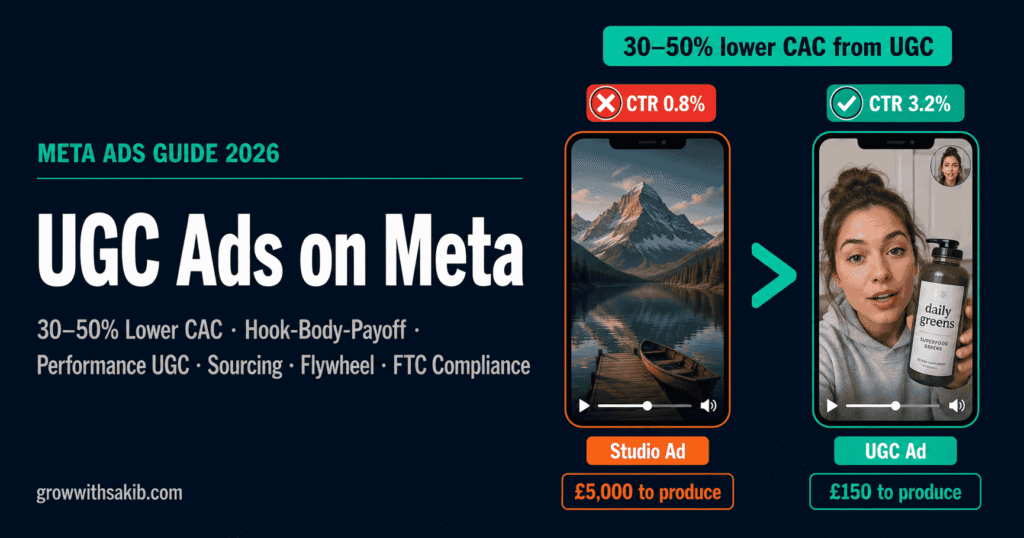
As Adligator’s local guide recommends, run real photos of your business — your food, your space, your team, your results. People scrolling locally recognise real places. A genuine photo of your actual cafe, your real staff, or a real before-and-after from your service builds trust that a stock image or polished production never will — the same trust signals that make Google reviews so powerful for local conversion. This is the same principle behind why UGC outperforms studio creative, amplified for local because recognisability matters.
Use local references
Naming the neighbourhood, the town, or a local landmark in your ad copy sharply increases relevance — and ensure your NAP consistency is correct across all platforms so your address details match when locals search for you after seeing the ad. ‘The best flat white in [neighbourhood]’ or ‘Trusted by [town] homeowners for 12 years’ signals local belonging and stops the right person scrolling. Local references are a free, powerful targeting layer that works inside the creative itself.
Lead with a specific offer
A specific, local offer converts far better than generic brand awareness. ‘20% off your first visit this week’ or ‘Free quote for [town] residents’ gives a concrete reason to act now. Pair the offer with strong ad copy and the right format — short vertical video and real photos both work well for local in 2026.
Measuring What the Pixel Can’t See: Local Attribution
Here is the hardest part of local advertising, and the part competitors gloss over. When someone sees your ad and then walks into your shop or calls you, the Meta Pixel often cannot see it. A walk-in leaves no digital trace. Solving this offline-attribution problem is what lets you know whether your ads actually work.
The methods that capture offline results
- Unique promo codes. As Adligator recommends, use a unique promo code in your ads for in-store attribution. When someone redeems ‘FB20’ at the counter, you know the ad drove that visit. The single most reliable way to connect a Facebook ad to a physical sale.
- Call tracking. Use a tracking number or simply ask every caller how they found you. For call-driven businesses, this is your primary attribution method.
- ‘How did you hear about us?’ Add this question to your booking form, intake form, or point-of-sale conversation. Low-tech, but it captures the offline journey the Pixel misses — the same self-reported approach that works for long-cycle B2B.
- Meta’s store-visit estimates. For qualifying businesses, Store Traffic campaigns provide estimated store visits — directional, not exact, but useful as a trend. A fully optimised Google Business Profile complements this by capturing the organic foot traffic your paid ads generate.
- Lead and call tracking in-platform. For
What to actually measure
As Adligator advises, monitor cost per lead and return on ad spend over 30-day windows rather than judging day to day — the same measurement principles that apply when tracking SEO results for your organic campaigns. For local, the honest metric is cost per real-world action — cost per call, per booking, per walk-in, per quote request — not cost per click or per like. A campaign producing £8 phone calls that become £400 jobs is a winner even if its click metrics look unremarkable. Connect ad spend to actual revenue the way you would for any
Local Retargeting: The Cheapest Customers You’re Ignoring
Most local businesses spend their entire budget on cold prospecting and ignore the warm audience their ads and website generate. For a local business, retargeting is often the single highest-ROI move available — and almost nobody local does it.
As JigsawKraft notes, most businesses spend 100% on cold traffic and ignore retargeting, which is often where the strongest ROI sits. Someone who visited your website, watched your video, or engaged with your page has shown local intent. Bringing them back with a retargeting campaign — a reminder, a testimonial, a time-limited offer — converts far more efficiently than reaching a stranger.
Simple local retargeting audiences
- Website visitors: anyone who hit your site, via the
- Video viewers: people who watched 25%+ of a local video ad. They know your brand; nudge them toward action.
- Page and profile engagers: people who interacted with your Facebook or Instagram. A warm, cheap audience to re-engage.
- Past customers (retention): upload your customer list as a
6 Local Meta Ads Mistakes That Waste Money
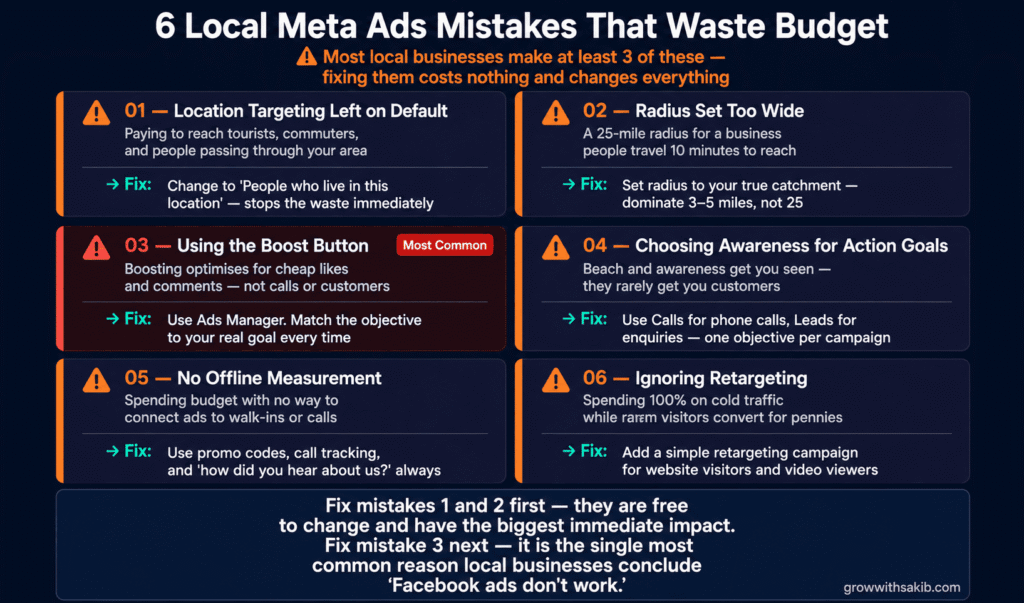
Mistake 1: Leaving location targeting on ‘recently in this location’
This default makes you pay to reach tourists, commuters, and people passing through — the same audience precision that matters in local SEO applies to paid targeting too. For most local businesses — especially service businesses — switch to ‘people who live in this location’ so your budget reaches potential regulars, not passers-by who will never return.
Mistake 2: Setting the radius too wide
A 25-mile radius for a business people travel 10 minutes to reach wastes most of your budget. Be ruthlessly precise about your real catchment. It is better to dominate a 3-5 mile radius than spread thin across an area you cannot profitably serve.
Mistake 3: Using the boost button for leads or sales
Boosting optimises for cheap engagement, not customers. For calls, leads, or sales, use Ads Manager and choose an objective that matches your goal. The boost button is the single most common reason local businesses conclude ‘Facebook ads don’t work.’
Mistake 4: Choosing awareness when you need action
Reach and awareness objectives get you seen; they rarely get you customers. If you want calls, use the calls objective. If you want enquiries, use leads. Match the objective to the real-world action you need, not to vanity reach.
Mistake 5: No offline measurement
If you cannot connect ad spend to walk-ins and calls, you are flying blind. Use promo codes, call tracking, and a ‘how did you hear about us?’ question. Measure cost per real-world action over 30-day windows, not clicks or likes.
Mistake 6: Ignoring retargeting and your customer list
Spending 100% on cold traffic while ignoring warm website visitors and your existing customers leaves the cheapest conversions on the table. Add a simple
Key Takeaways
- Fix the location-targeting default first. Change ‘people in or recently in this location’ to ‘people who live in this location’ for most local businesses — otherwise you pay to reach tourists and commuters who will never return.
- Right-size the radius ruthlessly. A tight radius covering your true catchment beats a wide one. Dominate a small area rather than spreading a small budget across geography you cannot profitably serve.
- Storefront and service-area businesses need different strategies. Storefronts optimise for visits with space-and-product creative; service businesses optimise for calls and leads with trust-and-results creative.
- Use Ads Manager, not the boost button, and match the objective to your real goal — calls, leads, or store visits — with one primary goal per campaign. Boosting optimises for cheap engagement, not customers.
- Concentrate a small budget in one campaign. Start at $10-20/day; splitting a small local budget across many ad sets stops any of them gathering enough signal to optimise.
- Show real, local creative. Authentic photos of your place, team, and results, plus local references and a specific offer, beat polished studio ads for local audiences.
- Measure what the Pixel can’t see. Use promo codes, call tracking, and ‘how did you hear about us?’ to capture walk-ins and calls. Track cost per real-world action over 30-day windows.
- Retarget and use your customer list. Warm website visitors and existing customers are the cheapest conversions a local business has — and a customer-list lookalike combined with radius targeting is your most efficient cold audience.
Frequently Asked Questions
Do Meta ads work for local businesses?
Yes — Meta ads are one of the most accessible and effective channels for local businesses, letting you reach people near your location with small budgets. As Adligator documents, you can start with $10-20/day, use radius targeting and real photos, and include a specific offer. The winners are not those with the biggest budgets but those who target precisely, create authentic local content, and measure real-world results like calls and visits.
How do I target my local area on Facebook ads?
In Ads Manager at the ad set level, set Location targeting to your business address with a radius covering your true service area. Critically, change the default from ‘people in or recently in this location’ to ‘people who live in this location’ for most local businesses — otherwise you pay to reach tourists and commuters. Keep the radius tight; a smaller, dominated area beats a wide, thinly-served one.
What budget do I need for local Meta ads?
Start at $10-20/day so the algorithm has enough data to optimise. As Benly advises, $300-500/month can drive meaningful results in smaller towns, while competitive urban markets often need $1,000-2,000/month. Below roughly $10/day, the campaign struggles to gather enough signal to learn. Concentrate a small budget in one well-targeted campaign rather than splitting it thin.
Which objective should a local business use?
Match the objective to your goal: Store Traffic for foot traffic, the Calls objective for phone calls, Leads (Instant Forms) for enquiries and quotes, or messaging for chats. Avoid the boost button and awareness objectives if you want actual customers. As JigsawKraft notes, if your goal is leads or sales, use Ads Manager — not the blue boost button — and pick one primary goal per campaign.
Why is the boost button bad for local businesses?
The boost button optimises for cheap engagement — likes and comments that make a post look popular — not for customers. For a small local budget, that difference is your entire return. Use Ads Manager instead, where you can choose a conversion-focused objective (calls, leads, store visits), set precise local targeting, and measure cost per real-world action rather than vanity engagement.
How do I measure foot traffic from Facebook ads?
Because the Pixel cannot see a walk-in, use offline methods: unique promo codes redeemed in-store, call tracking, a ‘how did you hear about us?’ question at point of sale, and Meta’s store-visit estimates for qualifying Store Traffic campaigns. Measure cost per real-world action — per call, visit, or booking — over 30-day windows, not clicks or likes.
How big should my radius be for local ads?
Match it to your true catchment, which is usually far smaller than the default. As Benly notes, a plumber advertising to a 50-mile radius pays to reach people they will never serve. A cafe might use 2-3 miles; a dental practice 4-5; a service business its real travel area. It is better to dominate a small radius than spread a small budget across geography you cannot serve.