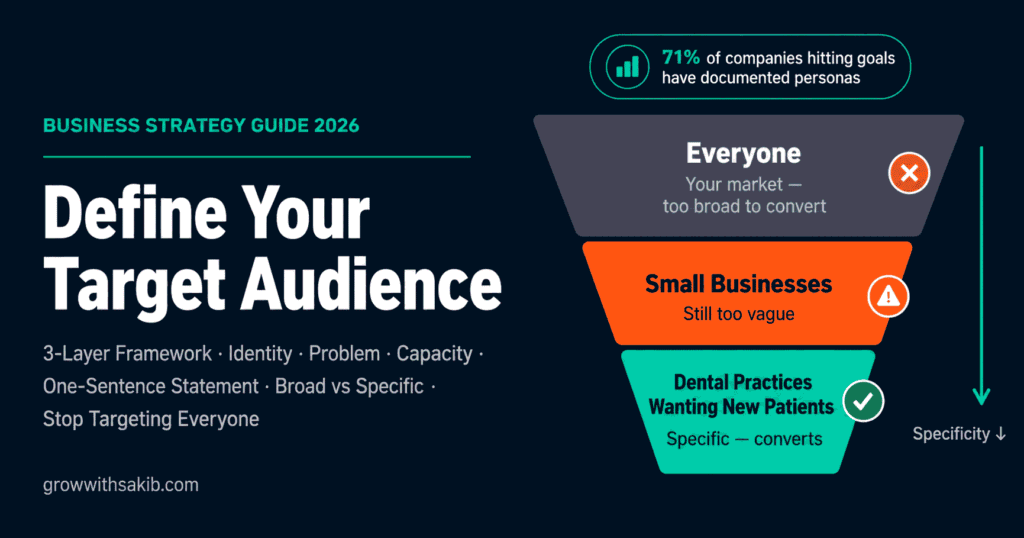
To define your target audience for a service business, name the specific group whose problem you solve best — not “everyone.” Combine three layers: who they are (firmographics or demographics), what painful problem they face, and whether they can pay. The sharper that one-sentence audience statement, the stronger your positioning, content, and conversions become.
Most service businesses describe their audience far too broadly. “Small businesses,” “anyone who needs marketing,” “B2B companies” — these feel safe but win nobody. A vague audience produces vague messaging, and vague messaging converts poorly. This guide turns the “define a specific audience” step from the pillar guide on finding the right niche into a repeatable process you can finish today — with a fill-in-the-blank statement, a layered framework, and real before/after examples.
What Is a Target Audience for a Service Business?
A target audience is the specific, definable group of people or businesses you are best positioned to serve — the ones with a problem you solve, in language you understand, and a budget that fits. For a service business, it’s narrower than a whole market. It’s the slice where your skill meets a real, paid need.
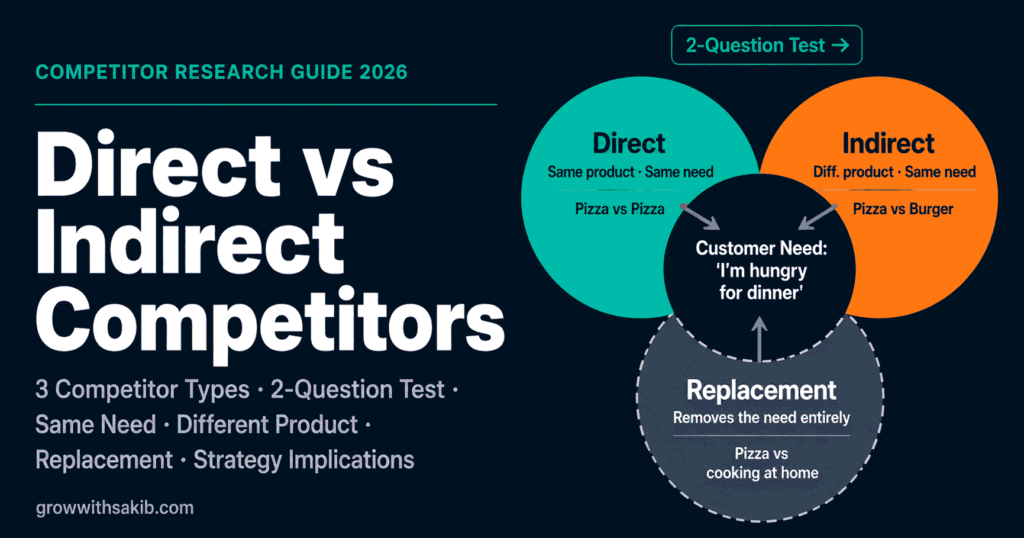
It helps to separate three terms people use interchangeably. Your market is everyone who could conceivably buy. Your target audience is the segment you actively pursue. Your buyer persona is a semi-fictional profile of one ideal client within that audience, built from real data rather than guesses.
Why bother getting specific? Because the data is blunt about it. According to Cintell’s Understanding B2B Buyers benchmark study, 71% of companies that exceed revenue and lead goals have documented personas, compared with just 26% of those that miss them. And HubSpot’s 2024 State of Marketing data shows marketers whose brands deliver a personalized experience are 215% more likely to call their strategy very effective. Specificity isn’t a nicety — it correlates with hitting targets.
Why a Specific Audience Beats “Everyone”
Targeting everyone feels like it widens your net. In practice it weakens every message, because copy written for all converts none. When you speak to one clearly-defined person, three things improve at once.
- Sharper messaging. You can name the exact problem in the prospect’s own words, so they feel understood instantly.
- Higher conversions. Specialists out-convert generalists because trust comes from relevance, and relevance comes from focus.
- Easier marketing. You know where this audience gathers, what they read, and what objections to answer — so every piece of content has a clear job.
This compounds with your wider strategy. A focused audience makes it far easier to build topical authority, because consistent coverage of one audience’s problems is exactly what search engines and AI systems reward.
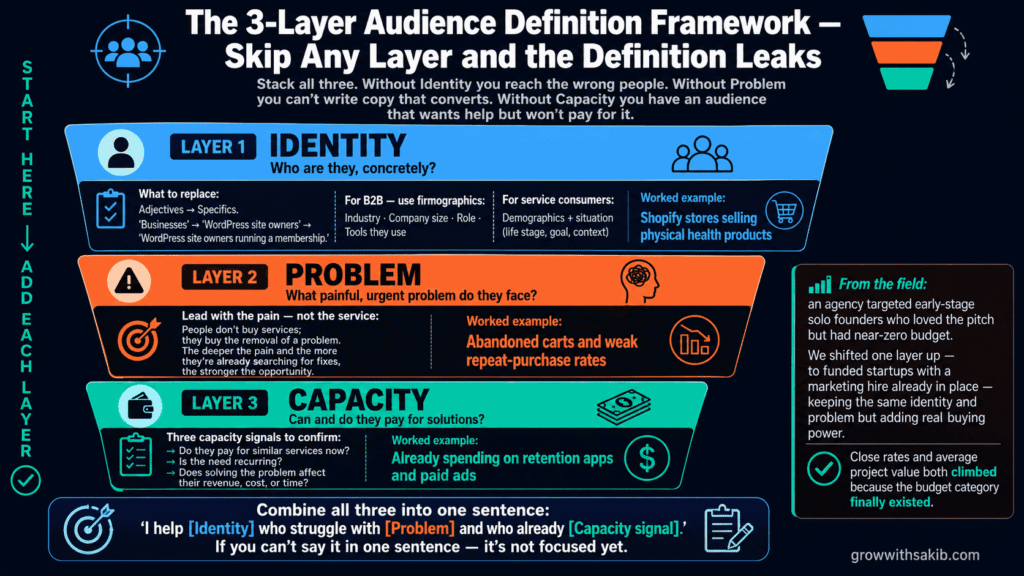
The 3-Layer Framework to Define Your Audience
A strong audience definition stacks three layers. Skip any one and the definition leaks — you’ll either attract the wrong people or attract the right people who can’t pay.
| Layer | What it answers | Example |
| 1. Identity | Who are they, concretely? | Shopify stores selling physical health products |
| 2. Problem | What painful, urgent problem do they have? | Abandoned carts and weak repeat-purchase rates |
| 3. Capacity | Can and do they pay for solutions? | Already spending on apps, ads, and agencies |
Layer 1: Identity — get concrete
Replace adjectives with specifics. “Businesses” becomes “WordPress site owners,” then “WordPress site owners running a membership business.” For B2B, lean on firmographics: industry, company size, role, and tools they use. For B2C-style services, use demographics plus situation (life stage, goal, context).
Layer 2: Problem — lead with the pain
People don’t buy services; they buy the removal of a problem. Define the specific, urgent pain your audience actively tries to solve — the customer pain points guide shows exactly how to research and validate those pains before building your service around them. The deeper the pain and the more they’re already searching for fixes, the stronger the opportunity — which ties directly into identifying real problems worth solving in the niche framework.
Layer 3: Capacity — confirm they can pay
An audience that wants your help but can’t afford it is a hobby, not a business. Confirm a budget category already exists — the niche buying power guide covers exactly how to assess whether your target audience has the financial means to hire professional help. If yes, the willingness to pay usually follows.
How to Define Your Target Audience: Step by Step
- Start from your best existing clients. List the 3–5 you most enjoyed and profited from. Patterns in industry, problem, and size are your raw material — and if you’re still early, the skill identification audit can help you determine which of your abilities these clients actually valued most.
- Write the three layers. Fill in identity, problem, and capacity for that pattern. Be uncomfortably specific.
- Draft a one-sentence audience statement. Use the template in the next section. If you can’t say it in one sentence, it’s not focused yet.
- Validate with real signals. Check search demand and talk to a handful of people who fit. Their words become your copy — the same voice-of-customer language that powers niche validation testing before you commit fully to building around this audience.
- Build one buyer persona. Turn the statement into a profile with goals, objections, and where they spend time online.
- Pressure-test and refine. Run it for a defined period, then review. Audiences evolve; revisit at least annually.
The One-Sentence Audience Statement
If you remember one tool from this article, make it this fill-in-the-blank. It forces all three layers into a single, testable line:
Worked example: “I help Shopify stores selling physical health products who struggle with low repeat-purchase rates and who already spend on retention apps and paid ads.” That single sentence tells you the copy, the channels, the offer, and the price band.
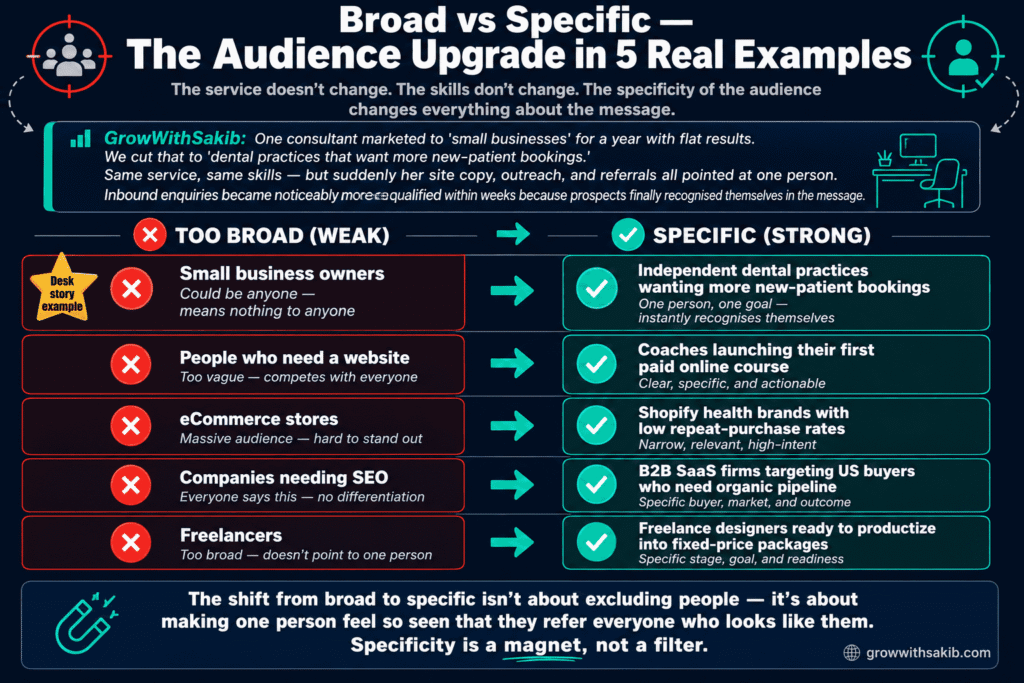
Broad vs. Specific: Before-and-After Examples
The pillar shows the principle; here’s the upgrade in action across common service niches.
| Too broad (weak) | Specific (strong) |
| Small business owners | Independent dental practices wanting more new-patient bookings |
| People who need a website | Coaches launching their first paid online course |
| eCommerce stores | Shopify health brands with low repeat-purchase rates |
| Companies needing SEO | B2B SaaS firms targeting US buyers who need organic pipeline |
| Freelancers | Freelance designers ready to productize into fixed-price packages |
Common Mistakes When Defining a Target Audience
- Targeting “everyone.” Broad reach with no resonance; you become invisible by trying to be universal.
- Confusing demographics with motivation. Age and industry don’t buy; problems and goals do. Lead with the pain.
- Building personas from assumptions. Cintell’s research links missed goals to a lack of qualitative interviews. Talk to real people.
- Ignoring buying power. A perfect-fit audience with no budget can’t sustain a business.
- Setting it and forgetting it. Markets shift. Review your audience definition at least once a year — and when the data genuinely points elsewhere, the niche pivot guide shows how to transition deliberately without losing momentum.
When to Go Narrow — and When Not To
Specificity is powerful, but it can be overdone. Slice too thin — “left-handed vegan dentists in one zip code” — and there isn’t enough volume to sustain a business. The goal is the narrowest audience that still contains enough buyers with real budget.
Context matters too. A brand-new business benefits from going very narrow to establish a beachhead and reputation fast — building the niche topical authority that makes search engines and referrals consistently send the right people. An established business with proven demand can responsibly serve two or three adjacent audiences. And a local service is naturally bounded by geography in a way a global SaaS service isn’t. Treat “specific” as relative to your market size, not as an absolute rule.
Frequently Asked Questions
How do I define my target audience for a service business?
Name the specific group whose problem you solve best, then stack three layers: identity (who they are), problem (the urgent pain they face), and capacity (whether they can pay). Compress it into one sentence — “I help [identity] who struggle with [problem] and already [buying signal]” — then validate it with real conversations.
What’s the difference between a target audience and a buyer persona?
Your target audience is the segment you actively pursue; a buyer persona is a semi-fictional profile of one ideal client within that audience. The audience is the group, the persona is the individual portrait — built from real data on goals, problems, and behaviour, not assumptions. You define the audience first, then build personas inside it.
How specific should my target audience be?
As narrow as you can go while still having enough buyers with real budget to sustain the business. New businesses benefit from going very narrow to build reputation fast; established ones can serve a few adjacent segments. If you can’t describe your audience in one specific sentence, it’s still too broad.
Why is targeting everyone bad for a service business?
Messaging written for everyone resonates with no one, so it converts poorly. A specific audience lets you name the exact problem, choose the right channels, and answer real objections. Cintell’s research found companies hitting their goals are far more likely to have documented, focused audience profiles.
How do I find data about my target audience?
Start with your best existing clients and look for patterns. Then validate with keyword research, and most importantly, talk to 5–10 people who fit the profile. Tools like HubSpot’s free persona builder help you organize findings, but qualitative interviews give you the language that makes copy convert.
Can my target audience change over time?
Yes, and it should be reviewed regularly. Markets shift, your skills deepen, and your best-fit clients evolve. Revisit your audience definition at least annually — sooner if results soften or you notice a sharper segment emerging. Just change deliberately based on data, rather than chasing every new opportunity.
Key Takeaways
- Your target audience is the specific group whose problem you solve best — never “everyone.”
- Define it in three layers: identity, problem, and capacity to pay.
- Compress the definition into one testable sentence; if you can’t, it’s too broad.
- Lead with the painful problem, not demographics — problems drive purchases.
- Build personas from real interviews, not assumptions; companies that hit goals are far likelier to document them.
- Go as narrow as you can while keeping enough budget-holding buyers to sustain the business.
- Review and refine your audience at least once a year.