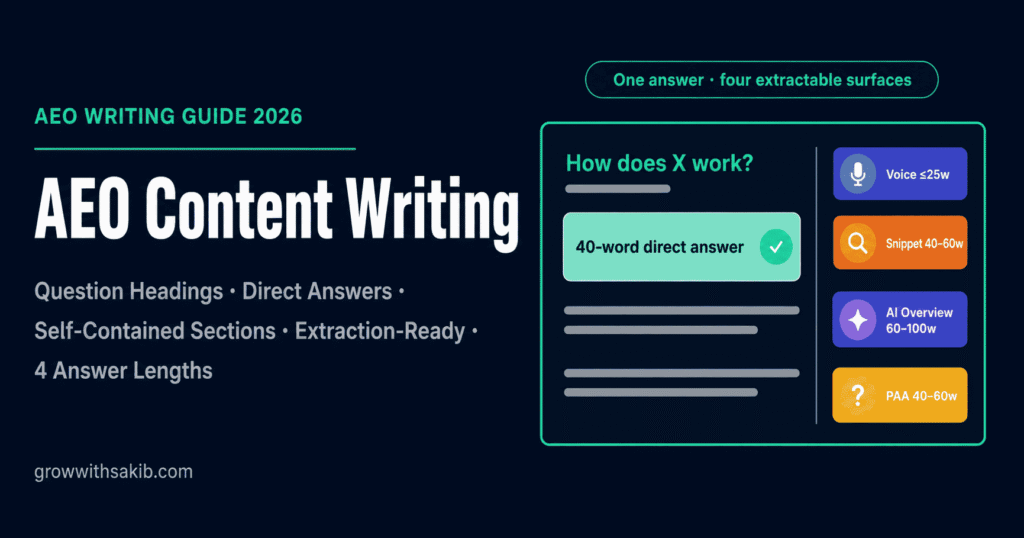
Search increasingly answers the question before anyone clicks your link. Ask your phone a question and a voice assistant reads back one answer. Type a query and an AI box summarises the answer up top. If your content isn’t written to be that answer, you’re invisible in the moment that matters – no matter how well you rank.
This is a guide to answer engine optimisation content writing – the craft of writing so voice assistants and AI answer boxes extract your words. It expands the content strategy for small business guide on GrowWithSakib. For the strategy side of AEO – the landscape, measurement, and where it sits beside GEO – see the answer engine optimisation guide on GrowWithSakib; this article is about the writing itself.
What Answer Engines Actually Extract
Answer engines – featured snippets, AI Overviews, voice assistants like Siri and Alexa, and AI tools like ChatGPT and Perplexity – don’t read your whole page. They scan for a self-contained passage near the top of a relevant section that directly answers the question, and lift it. Everything below follows from that one fact.
How long is that passage? Concise. Pew Research’s analysis of tens of thousands of AI Overview answers found a median around 67 words, and the consensus sweet spot for an extractable answer block is roughly 40-60 words. Voice answers are shorter still, because they’re read aloud. The craft below is about writing to fit that window.
Craft 1: Lead With the Direct Answer
The single most important AEO writing habit: answer the question in the first sentence, before any wind-up. Think of it as the inverted pyramid – the answer first, the context after. Here’s how to build a strong answer block:
- Sentence 1: the direct answer – state it plainly and completely, ideally echoing the question’s key words. No throat-clearing, no “it depends.”
- Sentence 2-3: the essential qualifier – the one condition or nuance that makes the answer accurate, plus a specific detail (a number, a timeframe).
- Then stop the block – keep the extractable answer to ~40-50 words. Expand with examples and depth in the paragraphs below, not inside the answer block.
What to cut from the answer block: hedging (“generally speaking,” “it really depends”), warm-up (“in today’s digital world”), and anything that needs the sentence before it to make sense. The passage-level version of this is covered in the guide to structuring content for AI summaries on GrowWithSakib.
Craft 2: Write Headings as Real Questions
Answer engines match questions to answers, so phrase your H2s and H3s as the actual questions people ask – “How long does SEO take?” not “SEO Timelines.” This does three things at once: it tells the engine exactly what the passage below answers, it matches conversational and voice queries word-for-word, and it makes your content scannable for humans too.
Draw the exact wording from how real people ask, using People Also Ask, autocomplete, and the questions in your inbox – the method in the content audience profile guide on GrowWithSakib. Then answer each heading directly beneath it. One question, one heading, one clear answer block.
Craft 3: Make Every Passage Self-Contained
This is the craft rule most writers miss, and it’s decisive. An answer engine lifts one passage out of context, so that passage has to make complete sense on its own. If it relies on the paragraph above, it’s unusable.
Concretely: replace “as we saw, this takes a while” with “SEO takes three to six months to show results.” Name the subject in each answer instead of leaning on “it” or “this.” Self-contained passages are what let a machine quote you accurately – and they read more clearly for humans, too.
Craft 4: Write for Voice Search Specifically
Voice is its own discipline, because a voice assistant reads back one answer, out loud, with no screen. That changes how you write:
- Go shorter – around 40 words or fewer. A spoken answer that runs long loses the listener. Voice rewards the tightest correct answer.
- Write the way people speak – natural, conversational sentences, not dense written prose. Read your answer aloud; if it sounds stiff, rewrite it.
- Match the spoken question – people speak full, natural questions (“how much does a website cost?”), so phrase headings and answers in that same conversational way.
- Lead with the plainest version of the answer – voice has no room for nuance stacking. Give the clear headline answer; save conditions for the on-page text.
Voice assistants typically read back the same content that wins featured snippets, so writing a tight, spoken-friendly answer block serves both. The rule of thumb: if you can’t say your answer out loud in one comfortable breath, it’s too long for voice.
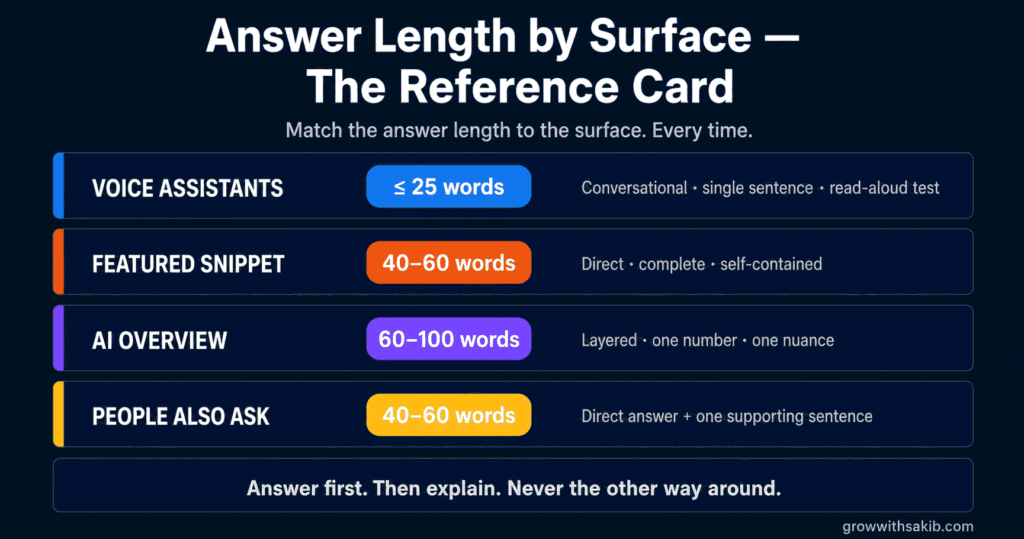
The Answer-Length Rules by Surface
“How long should the answer be?” depends on where it’s being extracted. Here’s the practical guide:
| Surface | Ideal Answer Length | Writing Style |
|---|---|---|
| Voice assistant | ~40 words or fewer | Conversational, spoken, plainest answer |
| Featured snippet | ~40-60 words (or a list/table) | Direct, self-contained, matches query |
| AI Overview / AI box | ~40-70 words (median ~67) | Answer-first, specific, well-sourced |
| People Also Ask | ~40-50 words | One clean question-and-answer pair |
Don’t overthink the exact count. The real target is: the shortest passage that answers the question completely and stands on its own. That naturally lands in the right range.
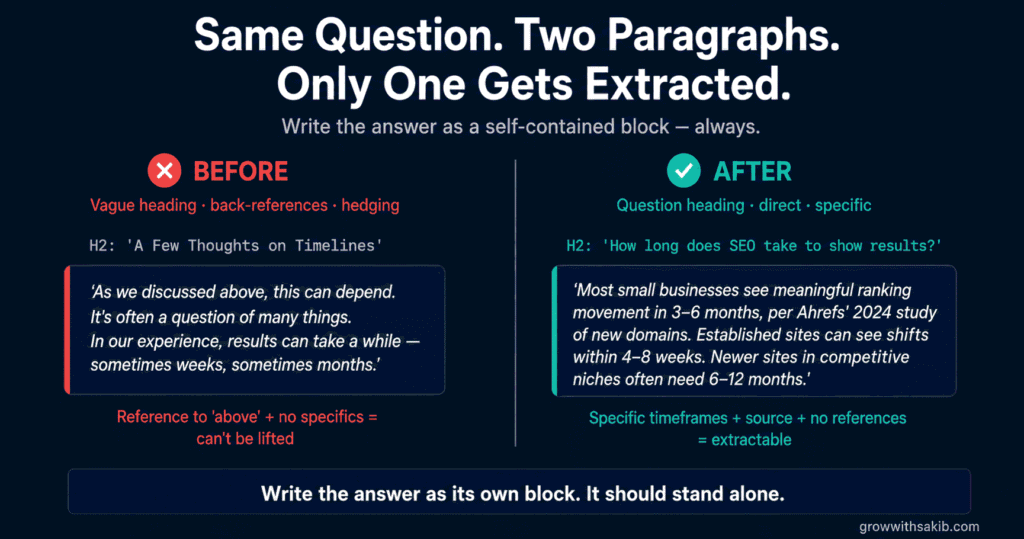
Before and After: A Real Answer Block
Here’s the craft in one example – the same answer to “how long does SEO take to work?” written first without AEO craft, then with it.
Before: Not Extractable
Why no engine can use it: the heading isn’t a question, there’s no direct answer, it leans on “as we discussed earlier” and “as mentioned above,” it’s all hedging, and nothing stands alone.
After: Built to Be Extracted
And the voice version – shorter and conversational (~32 words):
| Element | Before | After |
|---|---|---|
| Heading | “Some Notes on SEO Timelines” | “How long does SEO take to work?” |
| First sentence | Vague wind-up | The direct answer |
| Self-contained? | No – back-references everywhere | Yes – stands completely alone |
| Specifics | “varies,” “a while” | “3-6 months,” “6-12 months” |
| Extractable? | No | Yes – snippet and voice ready |
How AEO, GEO, and SEO Relate (From a Writing Lens)
These three aren’t competing writing styles – they’re layers that share the same core craft. Here’s the writer’s-eye view:
- SEO gets your page crawled, indexed, and ranked – the foundation. Without it, there’s nothing for anyone to extract.
- AEO gets a passage extracted as the direct answer in snippets and voice – the answer-first, self-contained craft in this guide.
- GEO gets your content cited inside generative AI summaries – which builds on the same answer-first writing plus depth and sourcing, covered in the complete guide to generative engine optimization on GrowWithSakib.
The good news for writers: one well-written answer-first passage serves all three. A clear, self-contained, sourced answer under a question heading helps you rank, gets you extracted, and gets you cited. You’re not writing three versions – you’re writing one, well. Answer engine optimisation was first named by Jason Barnard back in 2018 for voice and snippets; the craft has simply expanded to every answer surface since.
A Note on FAQ Content and Schema
FAQ-style Q&A content is excellent for AEO, because a question with a tight answer beneath it is exactly the format engines extract. But be accurate about schema: Google retired FAQ rich results in 2026, so FAQPage markup no longer wins those snippets, and it isn’t required for AI or voice. It’s the clean Q&A content that does the work, not the code – the full picture is in the guide to FAQ content and schema on GrowWithSakib. Write great question-and-answer content; treat the schema as an optional extra.
Honest Limits of AEO Writing
- Answer-first structure amplifies good content – it makes a genuinely useful answer extractable. It won’t get a wrong or thin answer selected; accuracy still rules.
- Ranking still underpins extraction – engines mostly pull answers from pages that already rank, so the SEO foundation matters as much as the answer craft.
- Extraction can mean fewer clicks – being the answer builds visibility and authority even when users don’t visit, so pair it with clear branding in the answer and strong on-site depth for those who do click.
- Be sceptical of precise AEO stats – many circulating numbers (traffic-shift projections, exact voice-source percentages) are vendor-stated. The craft is sound; measure your own answer visibility.
Track whether your passages actually get pulled – across voice, snippets, and AI boxes – using the guide to measuring GEO performance on GrowWithSakib, and keep the trust signals strong with the E-E-A-T content writing guide on GrowWithSakib.
Common AEO Writing Mistakes
| Mistake | Why It Hurts | Do This Instead |
|---|---|---|
| Burying the answer in a wind-up | Engines extract from the top | Lead with the direct answer |
| Vague label headings | No question to match | Write headings as real questions |
| Back-references (‘as above’) | Passage can’t stand alone | Make each passage self-contained |
| Answer blocks too long | Won’t fit the answer window | Keep it ~40-50 words, expand below |
| Same style for voice | Too dense to read aloud | Write voice answers short and spoken |
| Hedging the answer | Nothing clear to extract | State the answer plainly, qualify after |
| Trusting FAQ schema for snippets | Rich results were retired | Write great Q&A content; schema is optional |
Frequently Asked Questions
1. What is answer engine optimisation content writing?
Answer engine optimisation content writing is the craft of structuring your writing so answer engines – featured snippets, AI Overviews, and voice assistants – can extract it as the direct answer. In practice, you lead each section with a clear, self-contained answer of roughly 40-50 words under a question-formatted heading, then expand below. The goal is for your passage to be the answer a machine lifts and presents, not just a page that ranks.
2. How long should an AEO answer be?
Aim for roughly 40-60 words for a general answer block, and around 40 words or fewer for voice search, since voice answers are read aloud. Pew Research’s analysis of AI Overview answers found a median around 67 words, so concise is the rule. Don’t chase an exact count – write the shortest passage that answers the question completely and stands on its own, and it will naturally land in the right range.
3. How do I write content for voice search?
Write shorter and more conversationally than for text. Keep voice answers to around 40 words or fewer, use natural spoken sentences rather than dense prose, phrase headings as the full questions people actually say, and lead with the plainest version of the answer. A good test: read your answer aloud as if a smart speaker were saying it – if it’s a mouthful or sounds stiff, rewrite it until it flows naturally when spoken.
4. What is answer-first content?
Answer-first content states the answer to a question in the very first sentence of a section, before any background or wind-up – the inverted pyramid applied to each passage. You give the direct answer, add one or two sentences of essential qualifier and specifics, then expand with depth below. Answer engines extract from the top of sections, so leading with the answer is the single most important habit for getting your content pulled as the direct response.
5. How do I make my content self-contained for extraction?
Write each section so its heading plus first paragraph fully answer the question with no reliance on other text. Remove back-references like “as mentioned above,” and replace vague pronouns (“this,” “that”) with the actual subject. Use the isolation test: read the heading and first paragraph alone – if a stranger gets a complete, correct answer, it passes. Self-contained passages are what let a machine lift your answer accurately and present it out of context.
6. What is the difference between AEO, GEO, and SEO?
From a writing view, they’re layers sharing one craft. SEO gets your page crawled, indexed, and ranked – the foundation. AEO gets a passage extracted as the direct answer in featured snippets and voice results, using answer-first, self-contained writing. GEO gets your content cited inside generative AI summaries, building on the same answer-first craft plus depth and sourcing. The key point: one well-written answer-first passage serves all three at once, so you write one version, well.
7. Does FAQ schema help with answer engine optimisation?
FAQ-style Q&A content helps a lot, but the schema markup itself no longer wins snippets – Google retired FAQ rich results in 2026, and no special schema is required for AI or voice answers. It’s the clean question-and-answer content that answer engines extract, not the FAQPage code. So focus on writing tight, real questions with direct answers beneath them; adding the schema is an optional extra that doesn’t hurt but won’t win rich results on its own.
8. Does writing for answer engines hurt my traffic?
It can reduce clicks, since users often get their answer without visiting – but it builds visibility, brand authority, and trust in the moment they ask. The fix is to include your brand naturally in the answer, so you’re recognised even without a click, and to keep strong on-page depth for the users who do come through. Being the cited answer across voice and AI surfaces is increasingly where authority is won, click or no click.
Key Takeaways
- Answer engine optimisation writing means structuring your words so featured snippets, AI boxes, and voice assistants extract them as the direct answer.
- Lead every section with a direct answer of roughly 40-50 words under a question-formatted heading, then expand with depth below.
- Make every passage self-contained – use the isolation test: heading plus first paragraph must answer the question alone, with no back-references.
- Write headings as the real questions people ask, drawn from People Also Ask, autocomplete, and your inbox.
- For voice search, write shorter (~40 words or fewer) and conversationally – read it aloud, and if it’s a mouthful, rewrite it.
- Match answer length to the surface: ~40 words for voice, ~40-60 for snippets, ~40-70 for AI boxes (median around 67).
- AEO, GEO, and SEO share one craft: a clear, self-contained, sourced answer-first passage helps you rank, get extracted, and get cited at once.
- FAQ Q&A content aids extraction, but FAQ schema no longer wins rich results – it’s the content that does the work, not the code.