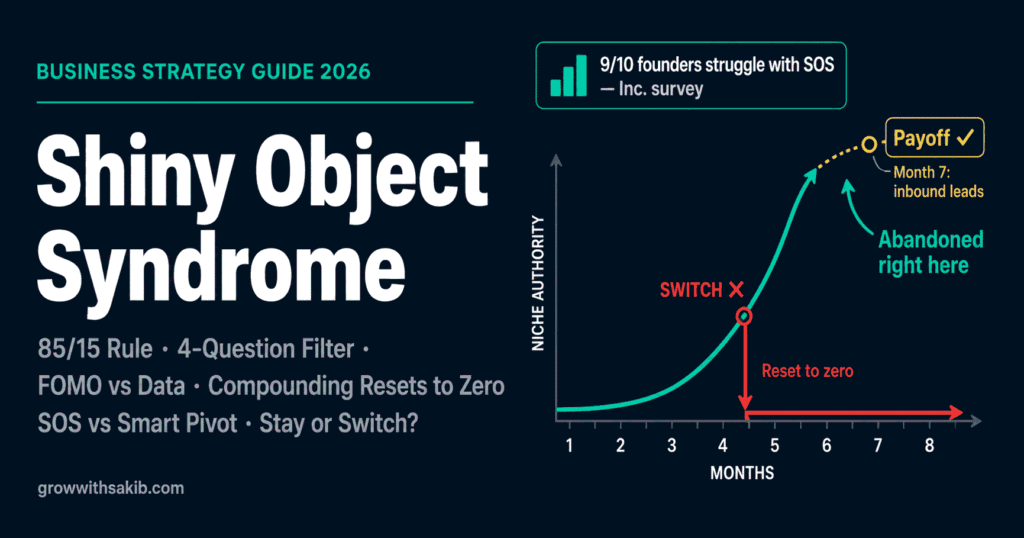
Shiny object syndrome is the entrepreneur’s habit of abandoning a working niche to chase a newer, shinier one that looks more profitable from the outside. It’s driven by novelty, FOMO, and the dopamine of starting fresh — and it quietly destroys the consistency that builds authority, revenue, and trust in any single market.
Almost every founder feels the pull. You’re three months into a niche, results are just starting to compound, and then a competitor launches something new — or a YouTube video makes another market look easier and richer. So you switch. This is the single most expensive pattern in niche selection, and it’s the reason the pillar guide on finding the right niche flags it as a core warning. This article goes deeper: why it happens, what it costs, and the exact filter that stops it.
What Is Shiny Object Syndrome in Business?
Shiny object syndrome (SOS), sometimes called magpie syndrome, is the tendency to get pulled off course by every new idea, tool, or market that looks exciting. For entrepreneurs, it usually shows up as constantly switching niches, offers, or strategies before any one of them has time to work.
It feels like ambition. It behaves like self-sabotage. As LogRocket’s breakdown of the syndrome puts it, the constant switching costs entrepreneurs their consistency and focus — which then shows up as missed timelines, weaker output, and unhappy clients. The problem isn’t having ideas. It’s that the new idea always arrives before the last one finished proving itself.
And it’s nearly universal. At one workshop, Inc. reported that nine out of ten business owners admitted they’d struggled with shiny object syndrome at least once. If you’ve felt it, you’re not broken — you’re normal. The founders who win are simply the ones who built a system to manage it.
Why Are Entrepreneurs So Prone to It?
Entrepreneurs are wired for exactly the traits that make SOS dangerous: curiosity, optimism, and a high tolerance for risk. Three forces turn those strengths into a trap.
1. The dopamine of starting beats the grind of finishing
Starting something new floods you with optimism and energy. The planning phase is pure upside — no failure yet, no tedious execution. Finishing, by contrast, is repetitive and uncertain. Your brain quietly prefers the high of the new beginning over the slog of follow-through.
2. FOMO and the competitor mirror
You see a competitor launch something, and your brain reads it as: act now or fall behind. The fear of missing out overrides the strategic question of whether that move even fits your business. Most “urgent” opportunities are only urgent because someone else is doing them.
3. The hidden tax of context switching
Every switch carries a real cognitive cost. Research from Gloria Mark at UC Irvine found it takes an average of 23 minutes and 15 seconds to fully refocus after a single interruption. Switching your entire niche is that same tax multiplied across months of lost momentum, relationships, and accumulated authority — none of which transfers cleanly to the new market.
What Does Chasing Shiny Objects Actually Cost?
The damage isn’t the time spent on the new thing. It’s the compounding you forfeit on the old one. Authority, rankings, referrals, and reputation all build slowly and then accelerate — but only if you stay put long enough to reach the acceleration.
Switching niches resets that curve to zero. And the market notices: a site that keeps changing its subject struggles to build topical authority, because search engines and AI systems reward deep, consistent coverage of one area over scattered coverage of many. Every pivot tells Google to start re-learning who you are.
| What you lose on every niche switch | Why it hurts |
|---|---|
| Compounding authority | Months of trust and rankings reset toward zero in the new market |
| Audience relationships | Your email list, referrals, and reputation don’t transfer to a different audience |
| Skill depth | You stay a beginner everywhere instead of an expert somewhere — never building the niche topical authority that makes you the obvious choice in a single market |
| Pricing power | Specialists charge more; perpetual switchers reset to commodity pricing |
Signs You’re Caught in Shiny Object Syndrome
You don’t need all of these. Two or three recurring honestly is enough to take seriously.
- You have multiple half-finished offers, funnels, or sites and no finished one.
- A competitor’s launch can change your entire plan within a week.
- You abandon a niche right as it starts showing early traction.
- You spend more time researching new opportunities — like finding customer pain points in a new market — than executing the current one.
- Every new course, tool, or trend feels like the thing that will finally work.
- You can’t clearly say what your one niche is in a single sentence.
How to Stop Chasing Shiny Objects: The 85/15 Filter
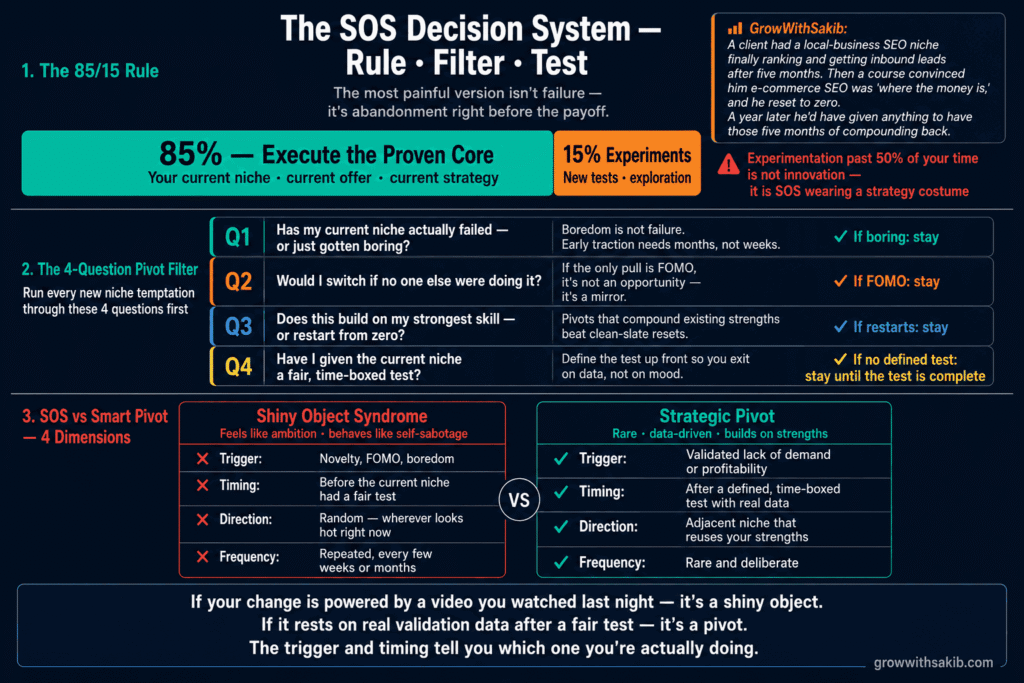
The goal isn’t to kill curiosity — it’s to budget it. A practical rule, echoed by operators who’ve studied how focused companies beat distracted ones, is to spend roughly 85% of your effort executing your proven core and cap experiments at 10–15%. If experimentation creeps past half your time, that’s not innovation — that’s shiny object syndrome wearing a strategy costume.
A 4-question filter before you pivot
Run every “new niche” temptation through these before acting:
- Has my current niche actually failed, or just gotten boring? Boredom is not failure. Early traction needs months, not weeks.
- Would I switch if no one else were doing it? If the only pull is FOMO, it’s not an opportunity — it’s a mirror.
- Does this build on my strongest skill, or restart from zero? Pivots that compound existing strengths beat clean-slate resets.
- Have I given the current niche a fair, time-boxed test? Define the test up front so you exit on data, not on mood.
Build a weekly focus habit
Distraction is managed with structure, not willpower. Block one short weekly review to check progress against your one priority — and make plan changes rare and deliberate. The point is to make switching a decision you schedule, never an impulse you indulge mid-week when a new idea lights up.
Shiny Object Syndrome vs. a Smart Pivot
Not every change is SOS. Sometimes a niche genuinely lacks demand or buying power, and leaving is the right call. The difference is in why and how you move.
| Dimension | Shiny Object Syndrome | Strategic Pivot |
|---|---|---|
| Trigger | Novelty, FOMO, boredom | Validated lack of demand or profitability — confirmed through market demand validation |
| Timing | Before the current niche had a fair test | After a defined, time-boxed test with real data |
| Direction | Random — wherever looks hot | Toward an adjacent niche that reuses your strengths |
| Frequency | Repeated, every few weeks or months | Rare and deliberate |
If your change passes the four-question filter and rests on real validation rather than excitement, it’s a pivot. If it’s powered by a video you watched last night, it’s a shiny object. Deciding when a pivot is actually warranted connects directly to the niche validation step in the pillar framework — and the niche pivot guide covers exactly how to execute that transition without losing momentum.
Common Mistakes That Feed the Cycle
- Treating boredom as a signal to quit. Boredom usually arrives right before mastery, not after failure.
- Measuring too early. Judging a niche after a few weeks guarantees it looks like it isn’t working.
- Consuming more than you execute. Endless courses and threads feel productive but are often elaborate procrastination.
- No exit criteria. Without a defined test, every mood swing feels like a strategic insight.
- Switching alone, in your own head. A coach, peer, or mastermind catches SOS before you’ve burned another quarter.
When the New Opportunity Is Actually Worth It
Focus can curdle into stubbornness. Staying in a niche with no demand, no buying power, and no path to differentiation isn’t discipline — it’s the sunk-cost fallacy. The 85/15 rule exists precisely because some experiments should graduate into your core.
The honest test: a real opportunity still looks worth it after the excitement fades and you’ve checked it against data. A shiny object only looks good while it’s new. If you’re early in your journey with no traction anywhere yet, give yourself permission to test a few directions — just time-box each one and commit fully within it using a niche validation test, rather than half-trying five at once.
Frequently Asked Questions
What is shiny object syndrome for entrepreneurs?
Shiny object syndrome is the tendency to abandon a working niche, offer, or strategy to chase a newer one that seems more exciting or profitable. Driven by novelty and fear of missing out, it scatters focus across many half-finished projects and prevents the consistency that builds authority and revenue in any single market.
Why do entrepreneurs abandon profitable niches?
Usually because of boredom, FOMO, and the dopamine of starting something new. Early success can feel slow and repetitive, while a different market looks easier from the outside. Inc. found nine in ten business owners have struggled with this, so the urge is normal — acting on it repeatedly is the problem.
How do I know if I have shiny object syndrome?
Watch for a few recurring signs: multiple half-finished projects, abandoning niches right as they gain traction, letting competitors’ launches reset your plans, and researching new opportunities more than executing your current one. If you can’t name your single niche in one sentence, that’s another strong signal.
Is switching niches always shiny object syndrome?
No. A strategic pivot is based on validated data — genuine lack of demand or buying power — after a fair, time-boxed test. Shiny object syndrome is triggered by novelty or FOMO before the current niche had a real chance. The trigger and timing tell you which one you’re doing.
How much time should I spend on new ideas?
A practical rule is to spend about 85% of your effort executing your proven core and cap experiments at 10–15%. This protects your momentum while still leaving room for genuine innovation. Once experimentation passes roughly half your time, it has become a distraction rather than a strategy.
Why is constant niche switching bad for SEO?
Search engines and AI systems reward deep, consistent coverage of one subject, which builds topical authority over time. Every niche switch resets that trust and forces Google to re-learn your focus, so perpetual switching keeps your site permanently early on the authority curve.
Key Takeaways
- Shiny object syndrome means abandoning a working niche for a newer, shinier one before it has time to pay off.
- It’s nearly universal — around nine in ten business owners have struggled with it.
- The real cost is forfeited compounding: authority, relationships, and pricing power that reset on every switch.
- Context switching is expensive; refocusing after one interruption takes over 23 minutes, and a full niche switch multiplies that across months.
- Use the 85/15 rule: execute your core 85% of the time, cap experiments at 10–15%.
- Run pivots through a 4-question filter so you exit on data, not on mood.
- A smart pivot is rare, validated, and builds on your strengths; SOS is frequent, emotional, and starts from zero.